Infant & Child Health
Probiotics for Babies and Newborns: The Questions Paediatricians Get Asked Most
Are baby probiotics safe, which babies might benefit, and what the professional bodies really say, explained calmly and in plain language.
Why so many parents search for baby probiotics
Every month, thousands of parents type "baby probiotics", "probiotics for babies" or "are probiotics safe for babies" into a search box. Many have just had a caesarean birth, or their newborn needed antibiotics, or their baby cries for hours and nobody can say why. Others have simply seen newborn probiotics on a pharmacy shelf and wondered whether they are missing something. This article answers the questions paediatricians (children's doctors) hear most often, using what the main professional bodies actually say.
Here is our one clear argument: for baby probiotics, "Which is best?" is the wrong first question. The right first question is "Best for which baby, and for what?" The answer changes completely depending on whether a baby was born early, is unwell, or is healthy and growing well.
How a baby's gut microbiome gets started
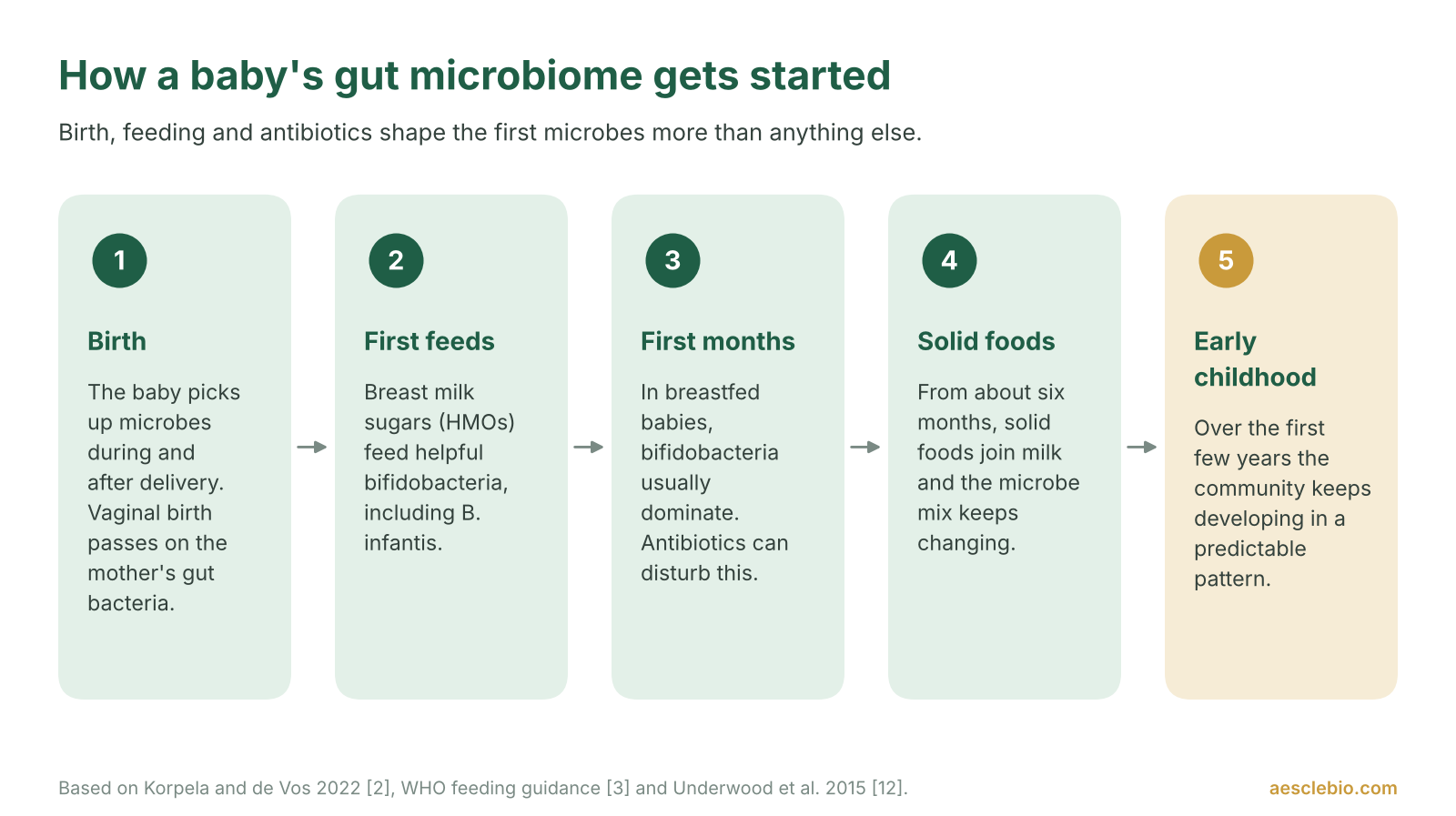
Your baby's gut microbiome is the community of trillions of tiny living things, mostly bacteria, that live in the intestines (the gut). Scientists now agree that a healthy baby picks up most of these microbes during and after birth, not in the womb [2]. Three things shape this early community more than anything else [2]:
- Type of delivery. In a vaginal birth, the baby meets the mother's own gut microbes. Babies born by caesarean section (C-section) tend to have fewer of the bacteria normally passed on from the mother, and more microbes picked up from the hospital environment [2].
- Breastfeeding. Breast milk contains more than 10 grams per litre of special sugars called human milk oligosaccharides (HMOs). A baby cannot digest them. Instead, they feed helpful bacteria, especially Bifidobacterium species (bifidobacteria) [2]. One of these, Bifidobacterium longum subspecies infantis (often shortened to B. infantis), is unusually well equipped to digest these milk sugars [12]. In other words, breast milk comes with its own built-in prebiotics: food for good microbes.
- Antibiotics. Antibiotics given to the mother during labour, or to the baby after birth, can reduce these maternal bacteria. The pattern looks similar to that seen after a C-section [2].
These differences are real, and studies link them with later health, such as a higher risk of allergies. But a link is not proof of cause, and researchers are still working out which differences matter and how much [2].
What are probiotics for babies?
Experts convened by the Food and Agriculture Organization (FAO) and the World Health Organization (WHO), two United Nations bodies, define probiotics as "live microorganisms which when administered in adequate amounts confer a health benefit on the host" [1]. Put simply: living microbes that do some good when given in a large enough amount. A baby probiotic is one of these products made for infants (babies under one year old). Most come as drops, where the bacteria are suspended in a little oil, or as powders in a sachet. Some infant formulas also have probiotics added during manufacture [9].
The key word is strain. A strain is a specific type within a species, like one individual within a family, often marked by a code after the name. Professional bodies make recommendations for named strains, for named uses, because one strain's results cannot be assumed for another [4, 9].
What do paediatric experts actually say?
Two expert groups have written the most-cited guidance. The European Society for Paediatric Gastroenterology, Hepatology and Nutrition (ESPGHAN) is the European society of children's gut and nutrition doctors. The American Academy of Pediatrics (AAP) is the professional body of US children's doctors. Their positions are summarised below in neutral terms.
Healthy, full-term babies
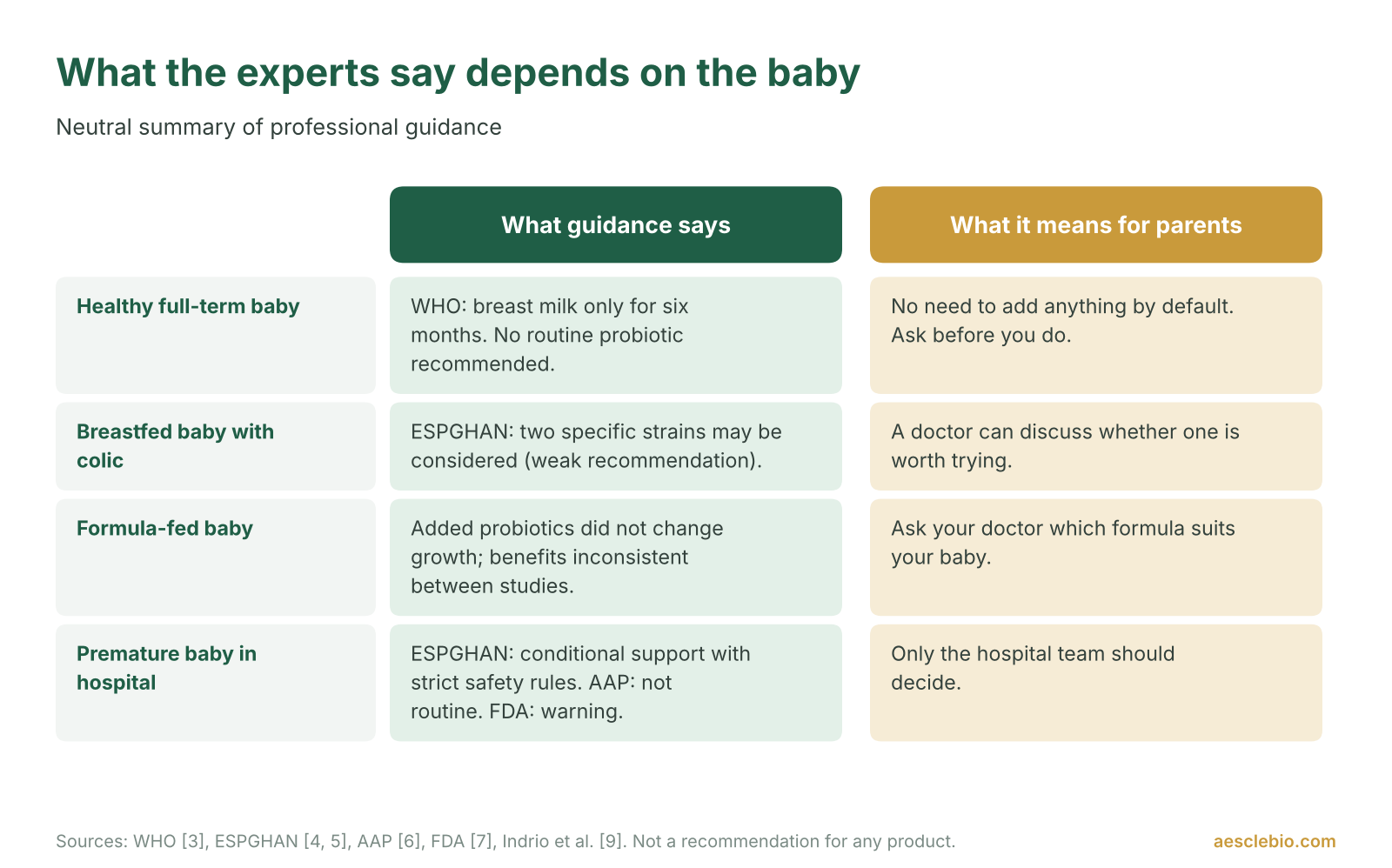
The WHO recommends that babies start breastfeeding within one hour of birth, are fed only breast milk for the first six months, and continue breastfeeding up to two years of age or beyond [3]. ESPGHAN's 2023 position paper makes recommendations only for specific conditions, and only when at least two randomised controlled trials (studies in which babies are placed in groups by chance) support the same well-defined strain [4]. It does not recommend routine probiotics for every healthy baby, and it states that "the use of probiotics with no documented health benefits should be discouraged" [4].
Babies with colic
For breastfed babies with colic (long bouts of unexplained crying), ESPGHAN says doctors may consider one of two specific strains: one of Limosilactobacillus reuteri and one of Bifidobacterium animalis subspecies lactis. This is a weak recommendation, based on moderate-quality evidence. ESPGHAN found too little evidence to make any recommendation for formula-fed babies with colic, or for any probiotic to prevent colic [4]. Our separate article on infant colic looks at these trials in detail.
Premature babies in hospital
Premature (preterm) babies are born before 37 weeks of pregnancy. The smallest of them are at risk of necrotising enterocolitis (NEC), a serious illness in which part of the bowel becomes inflamed and damaged. More than 10,000 preterm babies have taken part in randomised trials of probiotics [5, 6]. Large reviews of these trials found that multi-strain probiotics reduced NEC and deaths, while results for single strains were less certain [6].
Here the two expert groups weigh the same evidence differently:
- ESPGHAN (2020) gave a conditional recommendation, based on low-certainty evidence, for two specific probiotic options to reduce NEC in hospital, only if every safety condition is met. These conditions include proven product quality and a hospital laboratory able to detect infections caused by the probiotic itself [5].
- The AAP (2021) concluded that "current evidence does not support the routine, universal administration of probiotics to preterm infants, particularly those with a birth weight of <1000 g" [6]. It pointed out that probiotic products in the United States are sold as dietary supplements, which bypass the FDA's approval process for safety, effectiveness and manufacturing standards, and that some have been recalled for contamination [6].
- The US Food and Drug Administration (FDA) warned doctors in 2023 that preterm babies given probiotics are at risk of "invasive, potentially fatal disease". It described a baby weighing under 1,000 grams who developed sepsis (a dangerous bloodstream infection) from the probiotic bacterium and died [7]. In 2024, ESPGHAN experts and the European Foundation for the Care of Newborn Infants (EFCNI) replied, calling for a more nuanced approach to certain probiotics that balances their demonstrated benefits and risks [8].
Notice what this means. The babies with the strongest trial evidence are exactly the babies for whom a shop-bought product must never be the answer. For them, the decision belongs to the neonatal team (doctors who care for newborns in hospital).
Are probiotics safe for babies?
In trials of healthy, full-term babies, adding probiotics to formula made no difference to weight or height, and an earlier ESPGHAN review found no harm to growth or other side effects linked to such formulas [9]. The serious risks reported so far have mostly involved babies who were born very early, were very ill, or had a weakened immune system or a central line (a thin tube placed into a large vein) [5, 7]. Quality matters too: ESPGHAN cites a study in which only 1 of 16 commercial probiotic products contained the correct subspecies named on the label [5].
So the honest answer to "are probiotics safe for newborns?" is: usually well tolerated in healthy full-term babies in studies, but not risk-free, and never appropriate for a premature or sick baby without medical care. That is why every decision should start with your baby's doctor.
Formula, breastfeeding and added probiotics
Breastfeeding is the natural starting point, because breast milk carries prebiotic HMOs and protective factors from the mother [2, 3]. For probiotics for formula fed infants, a 2022 review of 26 trials with almost 3,900 babies and toddlers found that some strains added to formula reduced colic episodes, days with fever or antibiotic use. However, results varied so much between studies that the authors could not make firm recommendations, and there was no effect on weight or height [9]. Many formulas also contain added infant prebiotics, such as specific fibres, intended to make a formula-fed baby's gut bacteria more like those of a breastfed baby [9]. If you use formula, your baby's doctor can advise which type suits your baby.
What "best probiotic for infants" really depends on
Online lists of the "best baby probiotics", and searches for the "best probiotic for infant" use or the "best probiotic for newborn" babies, all expect a single winner. Science does not work that way. The "best" product, if any, depends on five things:
| Factor | Question to ask your baby's doctor |
|---|---|
| Your baby's health | Was my baby born early, or are they unwell or in hospital? If so, should anything be given at all? |
| The specific use | What exactly are we trying to help: colic, recovery after antibiotics, something else? |
| The exact strain | Has this named strain (not just the species) been tested in babies for this use? |
| Strength of evidence | Is the evidence from more than one good trial? Does a professional body support it? |
| Quality | Is it made to good manufacturing practice (GMP) standards, with the live count guaranteed until expiry? |
GMP, or good manufacturing practice, is the set of quality rules for making foods, supplements and medicines safely and consistently.
What our own research shows about infant trials
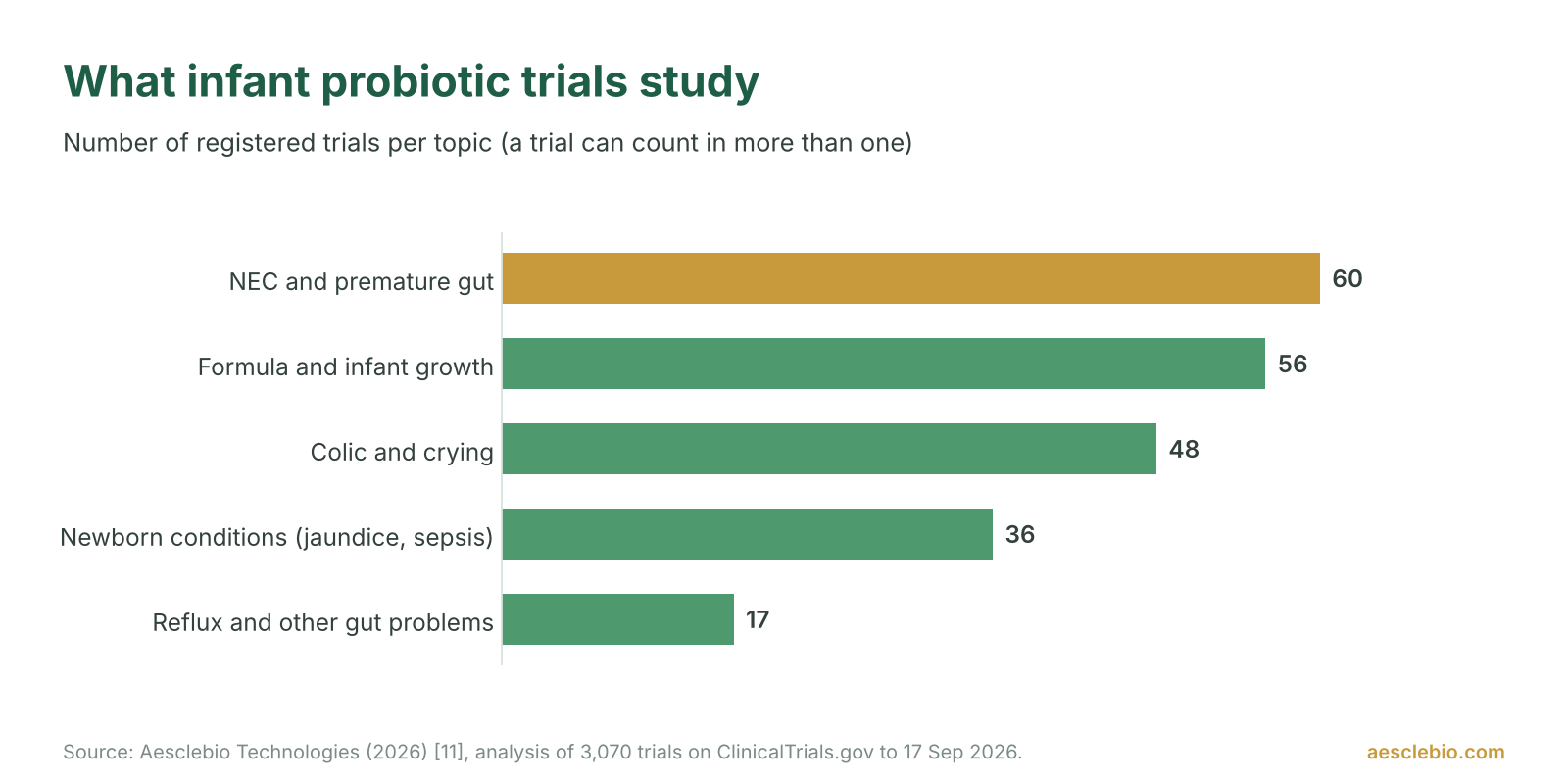
Aesclebio analysed 3,070 probiotic-type clinical trials registered on ClinicalTrials.gov, the public trial registry run by the US National Library of Medicine, up to 17 September 2026 [11]. Only about 6% of trials enrol infants (and 10% children), compared with 73% that enrol adults. Infant trials carry higher regulatory and ethical requirements [11]: babies cannot agree for themselves, so parents must give consent, and research rules allow such studies only when they are likely to benefit the participants or carry minimal risk and burden [10].
The infant evidence base is also thinner in quality. Only 43% of the 191 infant and newborn-health trials used the "gold-standard" design (randomised, double-blind and placebo-controlled, where neither families nor researchers know who receives the real product), against 58% across all trials [11]. Premature-gut conditions such as NEC were the most studied infant topic.
A simple way to think it through
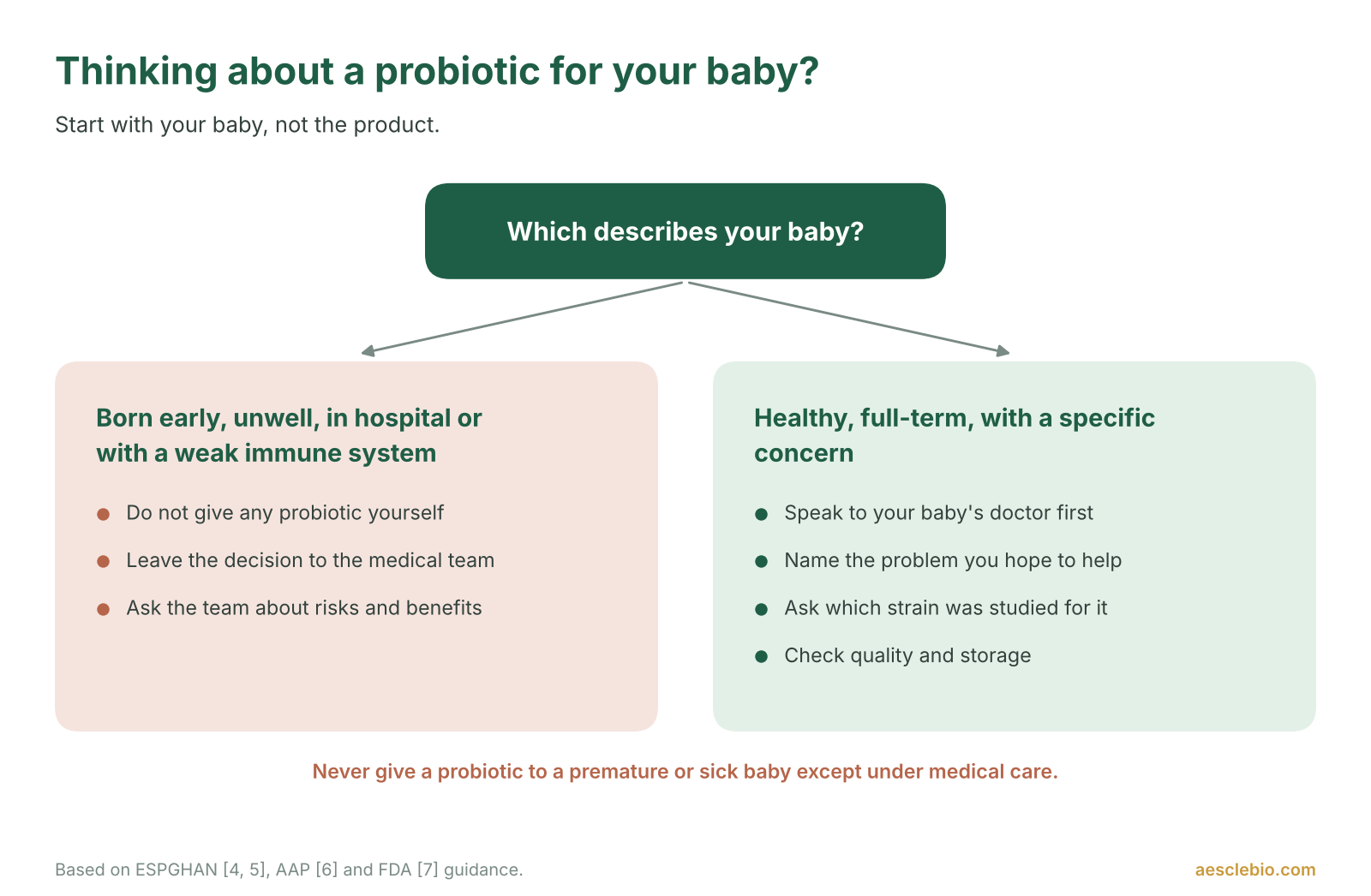
- Do not give any probiotic to a premature, unwell or hospitalised baby unless the medical team decides to.
- Do ask your baby's doctor before giving any probiotic, drops or powder to a healthy baby, and say what problem you hope to help.
- Do keep breastfeeding if you can; WHO advises only breast milk for the first six months [3].
- Do ask which strain has been studied for your baby's situation, and how good that evidence is.
- Do tell the doctor about any probiotic your baby already takes, especially before surgery or a hospital stay.
The bottom line
A baby's gut microbes are shaped mainly by birth, feeding and antibiotics, and breast milk already supplies its own prebiotics. Probiotics for babies are not a general "top-up". Some specific strains have evidence for specific situations, such as colic in breastfed babies, and premature babies in hospital have the strongest evidence of all. But that evidence comes with the greatest need for medical care. So before asking which product is best, ask your baby's doctor whether your baby needs one at all, and for what. (Older kids and toddlers have different questions, which we cover in a separate article.)
Frequently asked questions
Are probiotics safe for babies?
In studies of healthy, full-term babies, formulas with added probiotics did not affect growth, and reviews have not linked them with harm [9]. Serious infections have been reported, mainly in premature or very sick babies [5, 7]. No probiotic is risk-free, and product quality varies [5]. Speak to your baby's doctor before giving any probiotic, and never give one to a premature or unwell baby outside medical care.
Can newborns take probiotics?
Some newborn probiotics are sold for use from birth, but that does not mean every newborn needs one. ESPGHAN makes recommendations only for specific conditions and specific strains [4]. For premature babies, the AAP does not support routine use, and the FDA has warned that a probiotic infection can be fatal [6, 7]. Ask your baby's doctor whether a probiotic is right for your newborn.
What do probiotics do for infants?
In trials, certain strains have helped with specific problems: for example, some reduced crying time in breastfed babies with colic, and multi-strain products reduced NEC in premature babies in hospital [4, 6]. The benefits of probiotics for infants depend on the exact strain and the reason it is used. They are not a general health booster, and effects found for one strain do not apply to others [4].
Should my baby have probiotics after a C-section?
C-section babies start life with different gut bacteria [2]. In one large trial in babies at high risk of allergy, a probiotic and prebiotic mixture partly shifted the gut bacteria of C-section babies, and fewer developed one type of allergy by age five [2]. This needs confirming, and no professional body we reviewed recommends routine probiotics after a C-section. Breastfeeding, where possible, supports healthier gut bacteria [2]. Ask your baby's doctor.
Are probiotics good for premature babies?
Trials in more than 10,000 premature babies suggest some probiotics can reduce NEC, a serious bowel disease [5, 6]. ESPGHAN conditionally supports two specific options in hospital when strict safety conditions are met [5]. The AAP does not support routine use, and the FDA warned in 2023 of a fatal infection [6, 7]. Probiotics for premature babies are a decision for the hospital team only.
When can babies start probiotics, and when to stop?
There is no set age to start or stop. It depends on why a probiotic is being used, which strain, and how your baby responds. ESPGHAN notes that the type, dose and timing of probiotics often still need further study [4]. Your baby's doctor will advise when to begin, how long to continue and when to stop probiotics for babies.
Is there a best time of day to give baby probiotics?
We found no good evidence that the time of day matters for infant probiotics. Follow your baby's doctor's advice and the instructions on the pack, including storage. Never add probiotic drops or powder to very hot milk or food, as heat can kill live bacteria. Our article on infant probiotic drops explains formats in more detail.
Do babies need prebiotics as well?
Breast milk is naturally rich in prebiotics: HMOs that feed helpful bifidobacteria [2]. Many formulas add baby prebiotics, such as specific fibres, to copy part of this effect [9]. Prebiotics for infants given as separate supplements are a question for your baby's doctor, especially for a 6-month-old starting solid foods or younger babies.
Can I give an infant probiotic with vitamin D?
Some products combine a probiotic with vitamin D. Vitamin D advice for babies is a separate question and differs between countries and between breastfed and formula-fed babies. Do not swap or add a combined product without asking your baby's doctor, who can make sure your baby gets the right amount of each.
Is pear juice for newborn constipation a good idea?
WHO advises that babies have only breast milk for the first six months, with no other food or drink, not even water, unless medically necessary [3]. So do not give juice or any home remedy to a newborn or young baby unless a doctor advises it. Constipation in a young baby should be checked by a doctor, who can suggest safe steps for your baby's age.
Related reading
- Infant Colic and Probiotics: What the Trials Actually Show
- Infant Probiotic Drops: Strains, Oil Suspensions, Spores and What Makes a Drop Work
- The Gassy Newborn: What's Normal, What Isn't, and Where the Gut Microbiome Fits
- Prebiotic Fibres Decoded: Inulin, FOS, GOS and HMOs
- Kids, Toddlers and Probiotics: Dose, Format and the Sugar Problem
References
- Food and Agriculture Organization of the United Nations and World Health Organization. Probiotics in food: health and nutritional properties and guidelines for evaluation. FAO Food and Nutrition Paper 85. Rome: FAO; 2006. Free to read. Link
- Korpela K, de Vos WM. Infant gut microbiota restoration: state of the art. Gut Microbes. 2022;14(1):2118811. Open access / Free full text: PubMed Central PMC9467569. Link
- World Health Organization. Infant and young child feeding. Fact sheet. Geneva: WHO; updated 4 August 2026. Free to read. Link
- Szajewska H, Berni Canani R, Domellöf M, et al. Probiotics for the management of pediatric gastrointestinal disorders: position paper of the ESPGHAN Special Interest Group on Gut Microbiota and Modifications. Journal of Pediatric Gastroenterology and Nutrition. 2023;76(2):232–247. Free to read: published version in the Amsterdam UMC research repository and on the ESPGHAN website. Link
- van den Akker CHP, van Goudoever JB, Shamir R, et al. Probiotics and preterm infants: a position paper by the ESPGHAN Committee on Nutrition and the ESPGHAN Working Group for Probiotics and Prebiotics. Journal of Pediatric Gastroenterology and Nutrition. 2020;70(5):664–680. Free author manuscript: UCL Discovery. Link
- Poindexter B; Committee on Fetus and Newborn, American Academy of Pediatrics. Use of probiotics in preterm infants. Pediatrics. 2021;147(6):e2021051485. Full text requires a subscription; claims here rest only on the free abstract on PubMed (PMID 34031231) and the free AAP summary on HealthyChildren.org (24 May 2021). Link
- US Food and Drug Administration. Warning regarding use of probiotics in preterm infants. Letter to healthcare providers, 29 September 2023. Free to read. Link
- van den Akker CHP, Embleton ND, Lapillonne A, et al. Reevaluating the FDA's warning against the use of probiotics in preterm neonates: a societal statement by ESPGHAN and EFCNI. Journal of Pediatric Gastroenterology and Nutrition. 2024;78(6):1403–1408. Open access (CC BY-NC-ND). Link
- Indrio F, Gutierrez Castrellon P, Vandenplas Y, et al. Health effects of infant formula supplemented with probiotics or synbiotics in infants and toddlers: systematic review with network meta-analysis. Nutrients. 2022;14(23):5175. Open access / Free full text: PubMed Central PMC9739048. Link
- World Medical Association. WMA Declaration of Helsinki: ethical principles for medical research involving human participants. Amended by the 75th WMA General Assembly, Helsinki, October 2024. Free to read. Link
- Aesclebio Technologies. Probiotic Clinical Trials: Where the Industry Is Heading. A registry-based analysis of ClinicalTrials.gov data to 17 September 2026. Hyderabad: Aesclebio Technologies Pvt. Ltd.; 2026. Link
- Underwood MA, German JB, Lebrilla CB, et al. Bifidobacterium longum subspecies infantis: champion colonizer of the infant gut. Pediatric Research. 2015;77(1-2):229–235. Open access / Free full text: PubMed Central PMC4350908. Link
Disclaimer
This article is for general education only. It is not medical advice and is not intended to diagnose, treat, cure or prevent any disease. It does not promote any specific product or brand, and it makes no claims about any product.
Statements about research describe the findings of published studies. They do not mean that any particular food or supplement will have the same effect for you. Always speak to a qualified healthcare professional before changing your diet or starting a supplement, especially if you are pregnant, breastfeeding, giving products to a baby or child, or living with a health condition.
This topic concerns babies, pregnancy or new mothers. Nothing here is a recommendation to give any product to a baby or to use any product during pregnancy or breastfeeding. Decisions about care should always be made with a doctor, midwife or other qualified healthcare professional.
Rules on how probiotics and supplements may be described differ from country to country. Nothing in this article should be read as a health claim for any product.
All graphics are original works of Aesclebio Technologies. Figures from other studies are credited to their sources. Quotations are limited to short passages with full attribution. Any clinical-trial figures from Aesclebio's own analysis come from public registry records and do not imply that any product is effective or safe.
Prepared by the Aesclebio Research Team with the help of AI tools, under the team's direction. © 2026 Aesclebio Technologies Pvt. Ltd. All rights reserved. Short extracts may be quoted with a link to the original article.