
Why parents search for baby probiotic drops
Searches for "infant probiotic drops", "baby probiotic drops" and "newborn probiotic drops" usually start with a worried moment: a baby who cries for hours, strains to poo or has a lot of wind. A friend or a pharmacist mentions probiotic drops for baby tummy troubles. The bottle looks gentle, the dose is tiny, and the label often says "from birth".
This article makes one argument: the oil, the spores or the powder are packaging decisions. They keep bacteria alive; they do not make them work. A drop works only when three things line up: a strain with good evidence, a format that keeps enough of it alive until the last drop, and a baby like the babies in the trials. Whether a baby needs a probiotic at all is covered in our sister article on babies and newborns. Here we look inside the bottle.
What are probiotic drops?
Experts convened by two United Nations bodies, the Food and Agriculture Organization (FAO) and the World Health Organization (WHO), define probiotics as "live microorganisms which when administered in adequate amounts confer a health benefit on the host" [1]. In plain words: living microbes that do some good when you take enough of them. Drops are simply one way to deliver them to someone who cannot swallow a capsule.
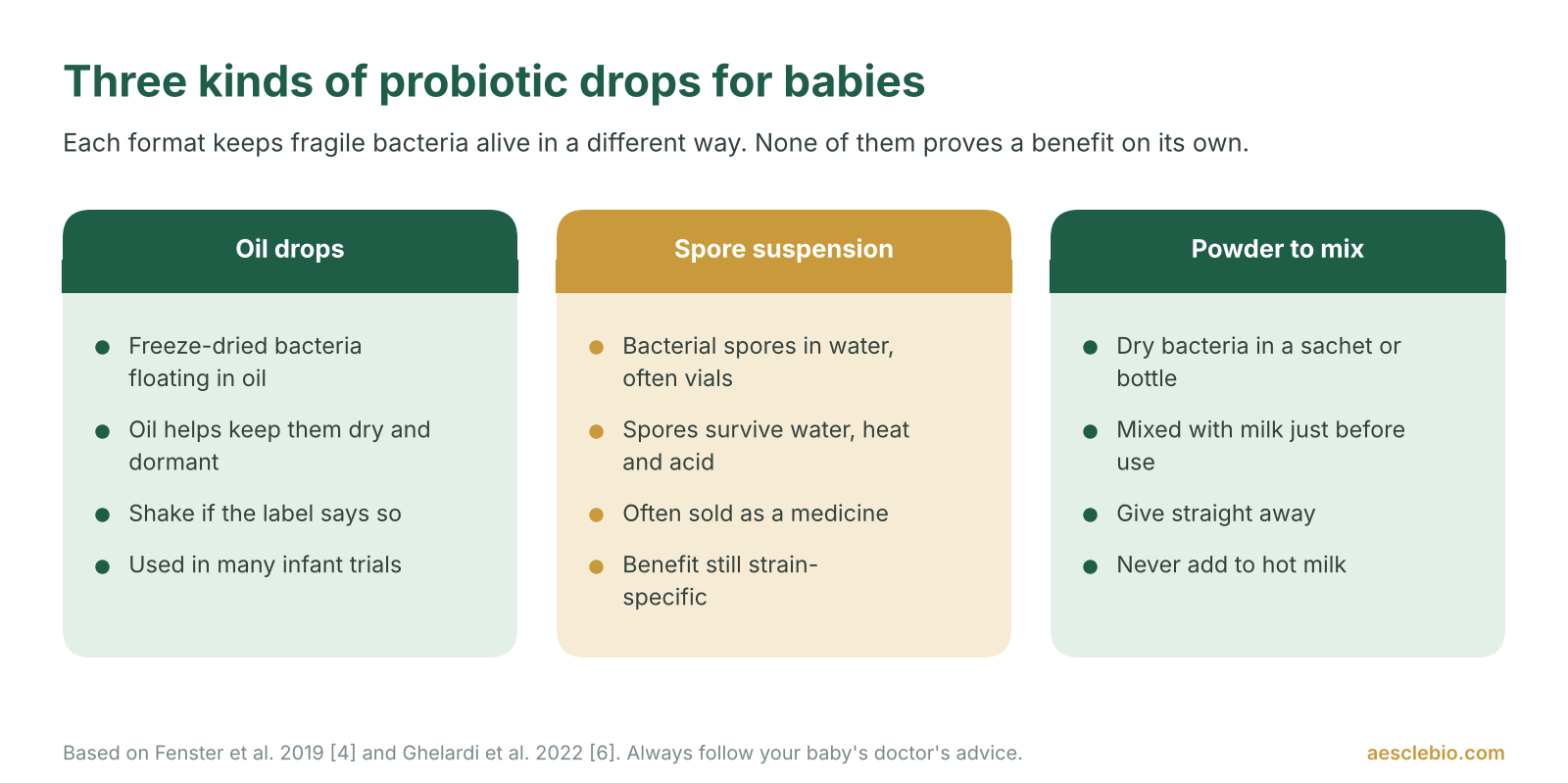
Three formats are common, and they solve the same problem in different ways. Live bacteria die quickly once they are wet and warm with nothing to eat. So each format has to keep them dry, dormant (asleep) or both, until they reach the gut.
Oil based probiotic drops: why the oil matters
Many probiotic drops for infants are made from bacteria that have been freeze-dried: frozen, then dried under a vacuum so that they go into a kind of suspended animation. The dried powder is then mixed into an oil. Oil and water do not mix, and the idea is that the dried bacteria stay dry and dormant inside the oil until they are swallowed.
Why does that matter so much? Scientists use a measure called water activity to describe how much water in a product is free to move and react, on a scale from 0 (bone dry) to 1 (pure water). A review by probiotic manufacturing scientists names water activity, followed closely by storage temperature, as the main factor that decides how long probiotics stay alive on the shelf [4]. The same review notes that in fat-based foods, such as chocolate and peanut butter, probiotics can stay stable at somewhat higher water activities than in other dry foods [4]. The review does not test oil drops, but an oil suspension appears to rely on a similar idea: fat around dry bacteria.
In practice this is how well-known infant trials gave their probiotic. In one large Australian trial, the probiotic was "in an oil suspension", and the dummy product (placebo) was maltodextrin, a plain carbohydrate, in the same oil suspension, with the same appearance, colour and taste [5].
How dose per drop and the end-of-shelf-life count are controlled
A drop is only useful if each one carries the amount promised. Makers have to do four things well:
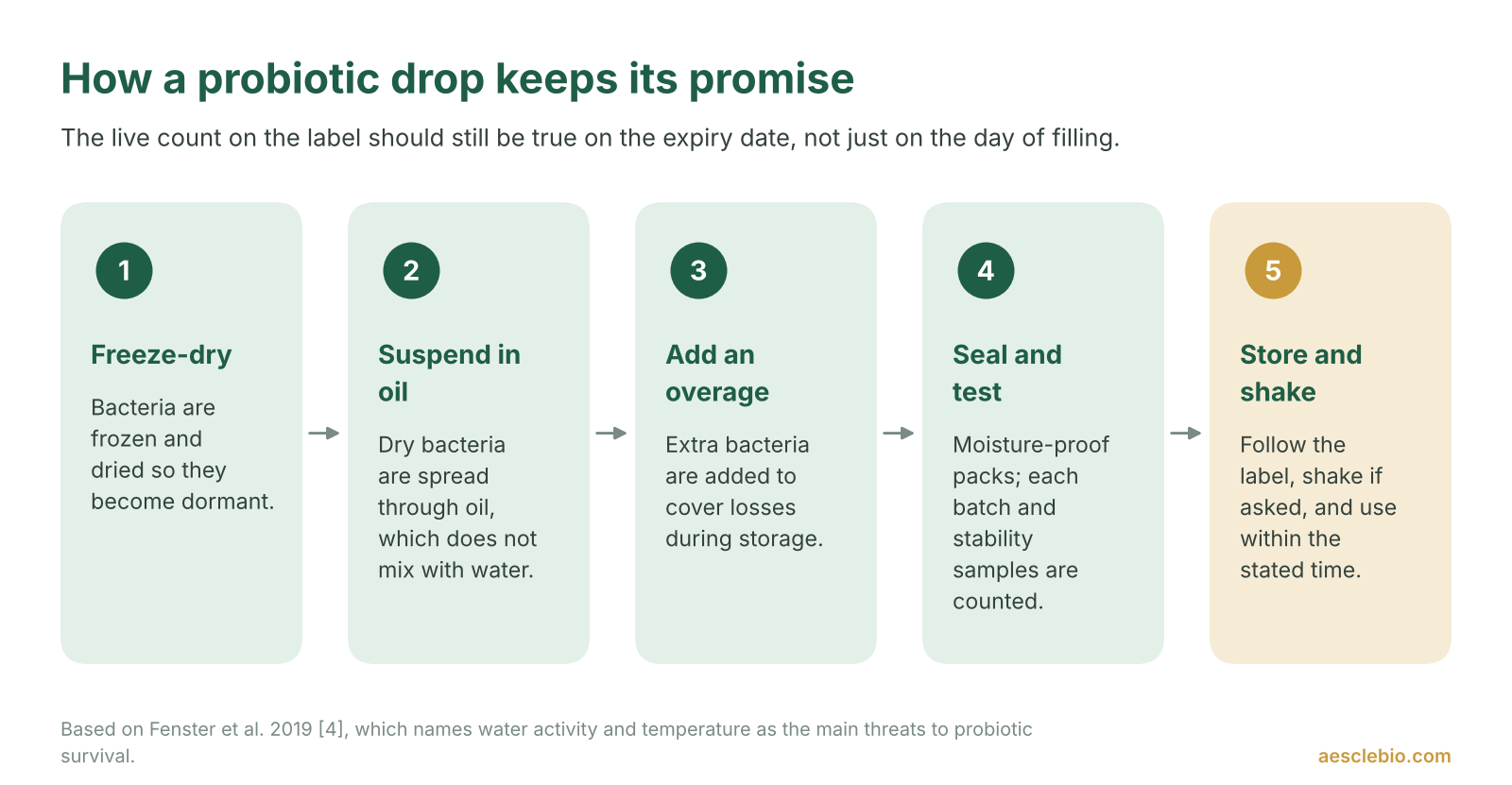
- Keep it dry from start to finish. Ingredients with low water activity, a low-humidity factory and packaging that keeps moisture out all protect the count [4].
- Add a planned overage. Some bacteria die during storage, so makers add extra at the start so that the label amount is still present on the expiry date [4].
- Test the count over time. The live count is measured in colony-forming units (CFU), the standard count of live microbes able to grow in a laboratory test. The number that matters is the count at the end of shelf life, not on filling day, so batches and stability samples should be tested over time [4].
- Keep the bacteria evenly mixed. Dried bacteria are a powder spread through the oil, not dissolved in it, so follow any label instruction to shake the bottle before use.
Spore suspensions: Bacillus clausii oral suspension and other vials
Some bacteria can make a spore: a dormant, armoured form that can survive without water or food, and tolerate heat and stomach acid, then "wake up" in the gut [6]. Spores are more stable than ordinary bacteria during processing and storage [6]. That is why a spore-former can sit in water. A Bacillus clausii oral suspension, sold in small plastic vials of liquid, is the best-known example. (Scientists have recently renamed this species Shouchella clausii [10].)
These spore products have been used for decades, and in several countries, including Italy, India, Vietnam and parts of Latin America, they are handled as medicines rather than supplements [6, 10]. A review, funded by the company that markets the best-known spore product, reports that the same spore strains given as a vial, a capsule or a powder showed similar patterns of presence in the gut of healthy adults [6]. In other words, for this spore product the format seemed to matter less than the strain and the amount.
Toughness is not the same as proof, though. ESPGHAN, the European Society for Paediatric Gastroenterology, Hepatology and Nutrition, advised doctors not to recommend the B. clausii strains it reviewed for acute gastroenteritis (stomach upset with diarrhoea) in children, a weak recommendation based on a lack of consistent, rigorous evidence of benefit [2]. A 2025 meta-analysis (a study that pools the results of several trials), which drew on the study database of the company that markets one such product, found shorter diarrhoea in children given that preparation, and called for more high-quality trials [7]. Quality also varies: the company-funded review mentioned above reports that in one study of ten spore products sold in Italy, only two matched their labels for both identity and count [6].
Powders and liquid probiotics for infants
Powders in sachets or bottles are mixed with a little breast milk, formula or water just before they are given. Water and heat are the main threats to dried probiotics [4], which is why the mix should be given straight away and never added to hot milk. Ready-mixed liquids, where ordinary (non-spore) bacteria sit in water, are harder to keep alive: the same review notes that in liquids such as juice the bacteria are not in a dried state, need refrigeration, and keep for a shorter time than dry supplements [4].
What the evidence and professional bodies say
ESPGHAN's 2023 position paper makes recommendations only when at least two randomised controlled trials (studies in which children are placed in groups by chance) support the same well-defined strain [2]. Its recommendations for specific strains cover a short set of uses: acute gastroenteritis, preventing diarrhoea linked to antibiotics or hospital stays, preventing necrotising enterocolitis (a serious bowel illness) in premature babies, a stomach infection called Helicobacter pylori, tummy pain without a clear cause, and infant colic [2]. It adds that "the use of probiotics with no documented health benefits should be discouraged" [2]. For constipation, ESPGHAN advises doctors not to recommend probiotics as a treatment, and wind is not on the list [2], so be cautious about any drop marketed for them.
For breastfed babies with colic, ESPGHAN says doctors may consider one of two specific strains, one of which is a Limosilactobacillus reuteri strain; it made no recommendation for formula-fed babies [2]. In the earlier colic trials and in the Australian trial described above, that strain was given as oil drops [5]. Yet even here, results depend on the baby. In the Australian trial of 167 breastfed and formula-fed babies, the same strain, oil drops and amount that had helped in earlier, smaller trials did not reduce crying or fussing [5]. The researchers wrote that their results contrast with earlier trials "despite using the same probiotic strain, formulation, and dosing" [5]. It is a clear reminder that a well-made drop is necessary, but not enough. Our article on infant colic looks at these trials in detail.
The American Academy of Pediatrics (AAP), the professional body of US children's doctors, points out that probiotics in the United States are sold as dietary supplements, "bypassing the rigor" of the drug approval process for safety, effectiveness and manufacturing, and that some have been recalled for contamination [3]. It does not support routine, universal use of probiotics in premature babies, particularly the smallest ones [3]. In 2014, a premature baby in the United States died of a rare fungal infection after receiving a probiotic powder that was later found to be contaminated [8]. No other cases were found in the investigation that followed [8]. Such events are rare, but they show why quality matters most for the smallest babies.
What our own research shows about drops
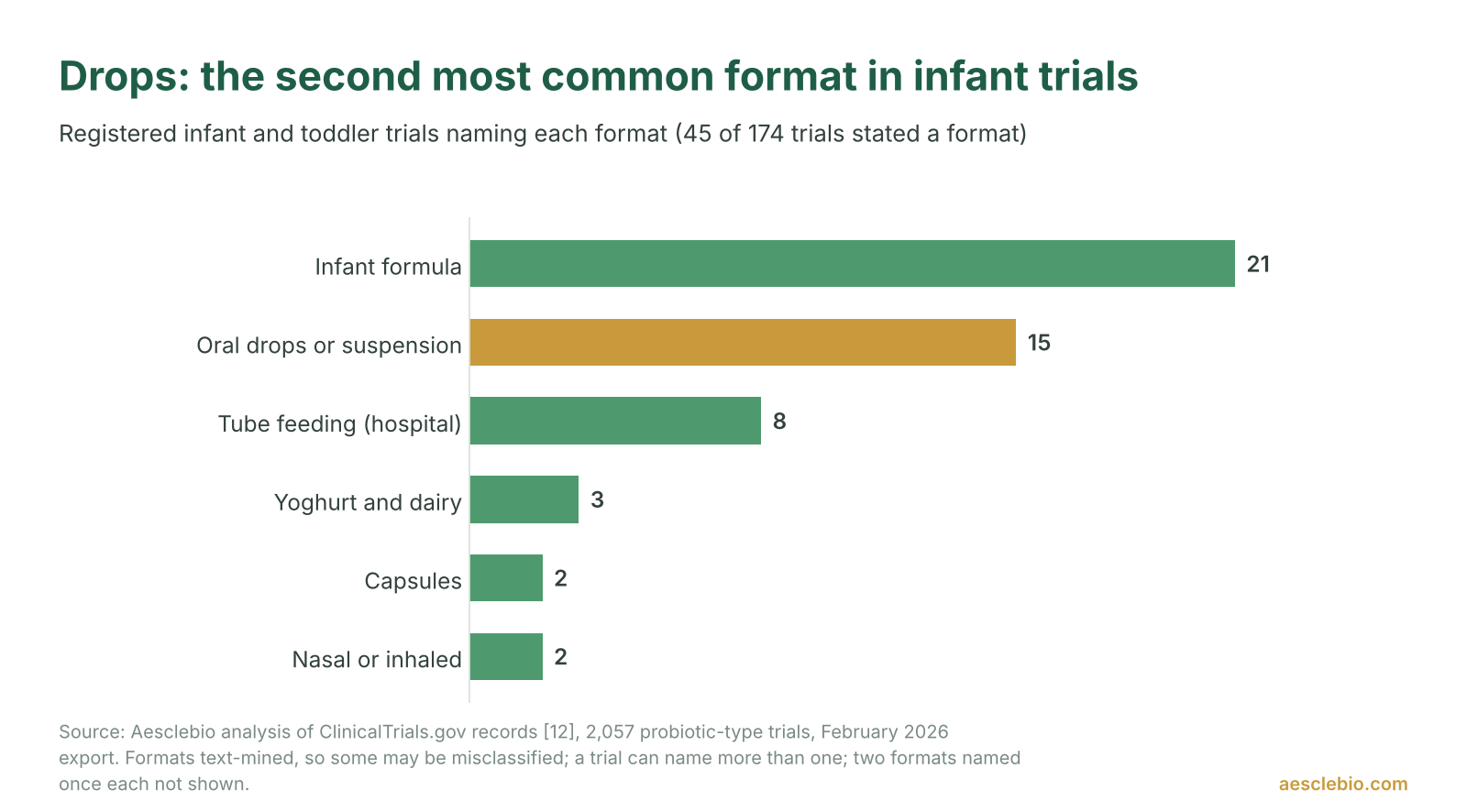
Drops are the classic baby format in research too. In Aesclebio's analysis of ClinicalTrials.gov records (2,057 probiotic-type trials in a February 2026 export of the public registry run by the US National Library of Medicine), 174 trials enrolled infants and toddlers. Of the 45 that stated a format, 15 used oral drops or suspensions, second only to infant formula (21) [12]. Across all ages, only 33 trials were classed as using oral drops or a suspension, and 16 of those 33 named the same species, L. reuteri [12]. Formats were picked out automatically from the trial descriptions, so a few trials may be misclassified (one vaginal spray, for example, was counted as a suspension) [12]. Even so, the picture is clear: much of the evidence for drops rests on a single species.
Spore-formers tell a similar story. Our separate report counted 29 registered trials naming B. clausii, but only 31% used the "gold-standard" design: randomised, compared against a placebo, and double-blind, meaning neither families nor researchers know who gets what [10].
Supplement or medicine? It depends on the country
The same bottle can be a food supplement in one country and a medicine in another. In our analysis of 3,070 registered trials, 63% listed the product as a dietary supplement and 18% as a drug, but the drug share was 46% in South Asia against 8% in Europe [9].
| Market | How probiotic drops are usually classed | What that means for parents |
|---|---|---|
| India | Health supplements are meant for people aged 5 and over; foods for infants fall under separate infant nutrition rules. Spore suspensions are sold as medicines. | Ask your baby's doctor which route a product uses and why. |
| United States | Dietary supplements, with no pre-market approval of safety or effectiveness. | Quality depends on the maker; look for strong quality signals. |
| Italy, Vietnam, parts of Latin America | Spore products are often handled as medicines. | A medicine licence covers quality and approved uses, not every problem. |
| Everywhere | Status is a legal label, not proof for your baby's problem. | The strain's evidence still matters most. |
Myth or fact?
| Myth | What the evidence says |
|---|---|
| Oil drops contain more live bacteria than powders. | Oil is a carrier that keeps dried bacteria dry. The live count depends on how many the maker put in, the overage and how the product is stored [4]. |
| If a strain worked in one trial, any drop with that species will work. | Benefits are strain-specific, and even the same strain in the same drops gave different results in different groups of babies [2, 5]. |
| Spore drops are stronger because spores are tough. | Toughness helps spores survive the shelf and the stomach. Benefit still has to be shown strain by strain, and ESPGHAN advised doctors not to recommend the spore strains it reviewed for acute gastroenteritis in children [2, 6]. |
| Natural or organic infant probiotic drops are automatically safe. | "Organic" describes ingredients, not purity of the bacteria. A contaminated probiotic powder was linked to the death of a premature baby, and some products have been recalled for contamination, so quality systems matter more than marketing words [3, 8]. |
How to choose: the best infant probiotic drops are the best-documented ones
Lists of the "best probiotic drops for newborns" rarely ask the questions that matter. If your baby's doctor suggests drops, these quality signals help:
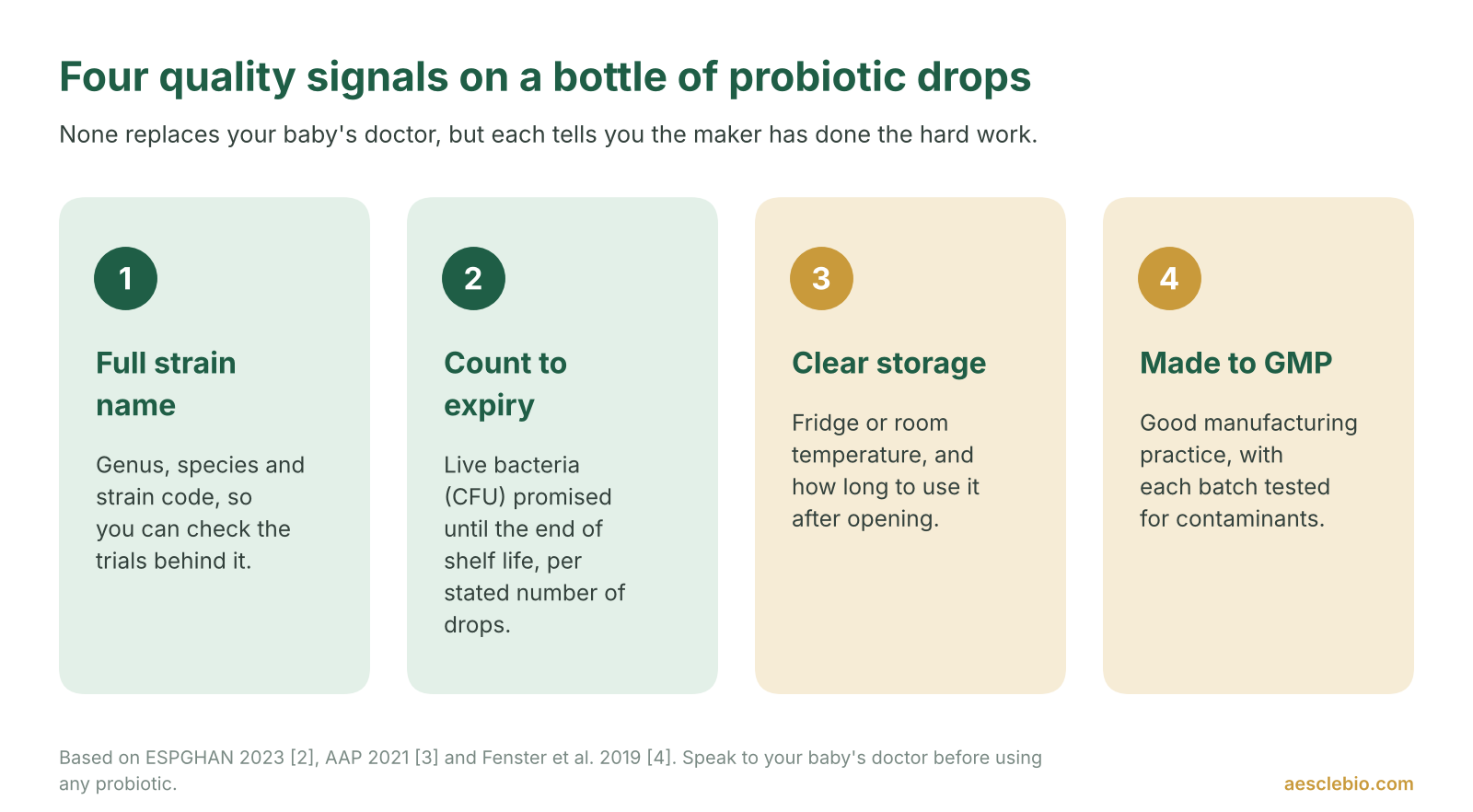
- Store as the label says. Some oil drops need the fridge, others do not. Keep the cap closed, keep the bottle out of heat and sunlight, and use it within the period stated after opening.
- Premature, sick or immune-weakened babies should only be given probiotics under the care of a medical team. The AAP does not support routine use in premature babies [3].
- Toddler probiotic drops follow the same rules; a bigger child does not make a weak product better.
For brands: white label infant probiotic drops
Brands looking for a contract manufacturer for liquid probiotic supplements should ask for stability data in the final oil and pack until the end of shelf life, water-activity control, a justified overage, contaminant testing of every batch, and the evidence behind the strain in infants [4]. Then confirm the regulatory route in each market, because the same drops may need to be a food, an infant food or a medicine [9, 11].
The bottom line
Oil, spores and powders are clever ways to keep fragile bacteria alive. A good oil drop keeps freeze-dried bacteria dry; a spore suspension relies on bacteria that are built to survive; a powder waits until the last moment to add water. But the bottle does not make the drop work. Only a well-studied strain, delivered in the amount used in trials, to a baby like those in the trials, can do that. Probiotic drops for babies are not a routine extra. Speak to your baby's doctor first.
Frequently asked questions
Are probiotic drops safe for newborns?
In the large Australian trial of full-term babies with colic, no side effects linked to the oil drops occurred [5]. They are not risk-free: a contaminated probiotic powder was linked to the death of a premature baby in the United States, and some products have been recalled for contamination [3, 8]. Never give probiotic drops to a newborn who was born early or is unwell without medical care, and speak to your baby's doctor first.
What do probiotic drops do for babies?
It depends entirely on the strain. In some trials, specific strains in drops reduced crying time in breastfed babies with colic, but a large trial of the same drops in a broader group of babies found no benefit [2, 5]. Drops are not a general health booster for babies. Ask your baby's doctor whether there is a reason to use one.
Do infant probiotic drops help with constipation or gas?
The evidence is thin. ESPGHAN's 2023 paper advises doctors not to recommend probiotics as a treatment for constipation in children, and it made no recommendation for wind [2]. Constipation and gas in a young baby are often normal, but they should be checked by a doctor, who can suggest safe steps for your baby's age.
Are oil based probiotic drops better than powders?
Not automatically. Oil keeps freeze-dried bacteria dry, which helps them survive on the shelf [4]. A powder mixed just before use can do the same job. What matters is the strain, the live count guaranteed until the end of shelf life, and how you store the product [4].
What is a Bacillus clausii oral suspension?
It is a liquid containing spores of Bacillus clausii, usually in small vials. Spores are dormant and tough, so they survive in water and on the shelf [6]. In several countries these products are sold as medicines [10, 11]. ESPGHAN advised doctors not to recommend the strains it reviewed for acute gastroenteritis in children, because consistent evidence of benefit was lacking [2]. Use them only on a doctor's advice.
Do probiotic drops need to be refrigerated?
Some do and some do not. It depends on the strain, the oil and the packaging. Moisture and heat are the main enemies of live bacteria [4], so follow the storage instructions on the label, keep the cap tightly closed, and use the bottle within the stated time after opening.
Can I use vitamin D and probiotic drops together?
Some products combine vitamin D and probiotic drops, and one registered trial compared drops with lactobacilli and vitamin D against vitamin D drops alone [12]. A combined product fixes the amount of both in each drop, so it may not match the vitamin D your baby needs. Ask your baby's doctor before switching or adding.
How do I choose the best baby probiotic drops?
Look for a full strain name, a live count promised until the end of shelf life, clear storage advice, and a maker that follows good manufacturing practice [4]. Most importantly, check that the strain was studied in babies for the problem you are worried about [2]. Your baby's doctor can help you judge this.
Related reading
- Probiotics for Babies and Newborns: The Questions Paediatricians Get Asked Most
- Infant Colic and Probiotics: What the Trials Actually Show
- Gummies vs Capsules vs Sachets vs Drops (Aesclebio blog)
- Billions of CFU, Little Meaning: Why the Biggest Number on the Label Rarely Wins
- Your Probiotic Is a Strain, Not a Species: Reading the Code After the Name
References
- Food and Agriculture Organization of the United Nations and World Health Organization. Probiotics in food: health and nutritional properties and guidelines for evaluation. FAO Food and Nutrition Paper 85. Rome: FAO; 2006. Free to read. Link
- Szajewska H, Berni Canani R, Domellöf M, et al. Probiotics for the management of pediatric gastrointestinal disorders: position paper of the ESPGHAN Special Interest Group on Gut Microbiota and Modifications. Journal of Pediatric Gastroenterology and Nutrition. 2023;76(2):232–247. doi:10.1097/MPG.0000000000003633. Free full text on the ESPGHAN website. Link
- Poindexter B; Committee on Fetus and Newborn, American Academy of Pediatrics. Use of probiotics in preterm infants. Pediatrics. 2021;147(6):e2021051485. doi:10.1542/peds.2021-051485. Abstract free on PubMed (PMID 34031231); claims here are limited to the free abstract. Link
- Fenster K, Freeburg B, Hollard C, et al. The production and delivery of probiotics: a review of a practical approach. Microorganisms. 2019;7(3):83. Open access / Free full text: PubMed Central PMC6463069. Link
- Sung V, Hiscock H, Tang MLK, et al. Treating infant colic with the probiotic Lactobacillus reuteri: double blind, placebo controlled randomised trial. BMJ. 2014;348:g2107. Open access / Free full text: PubMed Central PMC3972414. Link
- Ghelardi E, Abreu y Abreu AT, Marzet CB, et al. Current progress and future perspectives on the use of Bacillus clausii. Microorganisms. 2022;10(6):1246. Industry note: the review was funded by the company that markets one Bacillus clausii product, and one author is employed by that company. Open access / Free full text: PubMed Central PMC9230978. Link
- Michel MC, Pellegrino P. A comprehensive review and meta-analysis on the treatment of acute gastroenteritis in children with a Bacillus clausii preparation. Advances in Therapy. 2025;42(7):3076–3088. Open access / Free full text: PubMed Central PMC12182463. Link
- Vallabhaneni S, Walker TA, Lockhart SR, et al. Notes from the field: fatal gastrointestinal mucormycosis in a premature infant associated with a contaminated dietary supplement: Connecticut, 2014. MMWR Morbidity and Mortality Weekly Report. 2015;64(6):155–156. Free full text: PubMed Central PMC4584706. Link
- Aesclebio Technologies. Probiotic Clinical Trials: Where the Industry Is Heading. A registry-based analysis of ClinicalTrials.gov data to 17 September 2026. Hyderabad: Aesclebio Technologies Pvt. Ltd.; 2026. Link
- Aesclebio Technologies. The Bacillus Surge: clinical-trial trends for spore-forming probiotics and what they mean for formulation. A registry-based analysis of ClinicalTrials.gov data to 17 September 2026. Hyderabad: Aesclebio Technologies Pvt. Ltd.; 2026. Link
- Aesclebio Technologies. How India Regulates Probiotic Products: a plain-language guide to the food route and the medicine route. Status as of 21 September 2026. Hyderabad: Aesclebio Technologies Pvt. Ltd.; 2026. Link
- Aesclebio Technologies. Aesclebio analysis of ClinicalTrials.gov records: 2,057 interventional probiotic-type trials, registry export February 2026 (delivery formats and age groups text-mined from registry descriptions). Hyderabad: Aesclebio Technologies Pvt. Ltd.; 2026. Link
Disclaimer
This article is for general education only. It is not medical advice and is not intended to diagnose, treat, cure or prevent any disease. It does not promote any specific product or brand, and it makes no claims about any product.
Statements about research describe the findings of published studies. They do not mean that any particular food or supplement will have the same effect for you. Always speak to a qualified healthcare professional before changing your diet or starting a supplement, especially if you are pregnant, breastfeeding, giving products to a baby or child, or living with a health condition.
This topic concerns babies, pregnancy or new mothers. Nothing here is a recommendation to give any product to a baby or to use any product during pregnancy or breastfeeding. Decisions about care should always be made with a doctor, midwife or other qualified healthcare professional.
Rules on how probiotics and supplements may be described differ from country to country. Nothing in this article should be read as a health claim for any product.
All graphics are original works of Aesclebio Technologies. Figures from other studies are credited to their sources. Quotations are limited to short passages with full attribution. Any clinical-trial figures from Aesclebio's own analysis come from public registry records and do not imply that any product is effective or safe.
Prepared by the Aesclebio Research Team with the help of AI tools, under the team's direction. © 2026 Aesclebio Technologies Pvt. Ltd. All rights reserved. Short extracts may be quoted with a link to the original article.