
Infant & Child Health
Infant Colic and Probiotics: What the Trials Actually Show
Probiotics for colic do not work for "colicky babies" in general. The evidence is narrower: one species, mostly one strain, and mainly breastfed babies. Here is what that means for parents.
Why so many parents search for probiotics for colic
Few things wear parents down like a baby who cries for hours and will not settle. So it is no surprise that searches such as "probiotics for colic", "colic drops for babies" and "colic vs gas" are so common.
This article makes one argument. The trials do not show that "probiotics help colic". What they show is much narrower: a single species of bacterium, mostly one particular strain of it, reduced crying in one group of babies, those who were breastfed and already had colic [3, 6]. Outside that group, the picture is unclear. Knowing this helps you have a better conversation with your baby's doctor.
What is colic? From the "rule of threes" to Rome IV
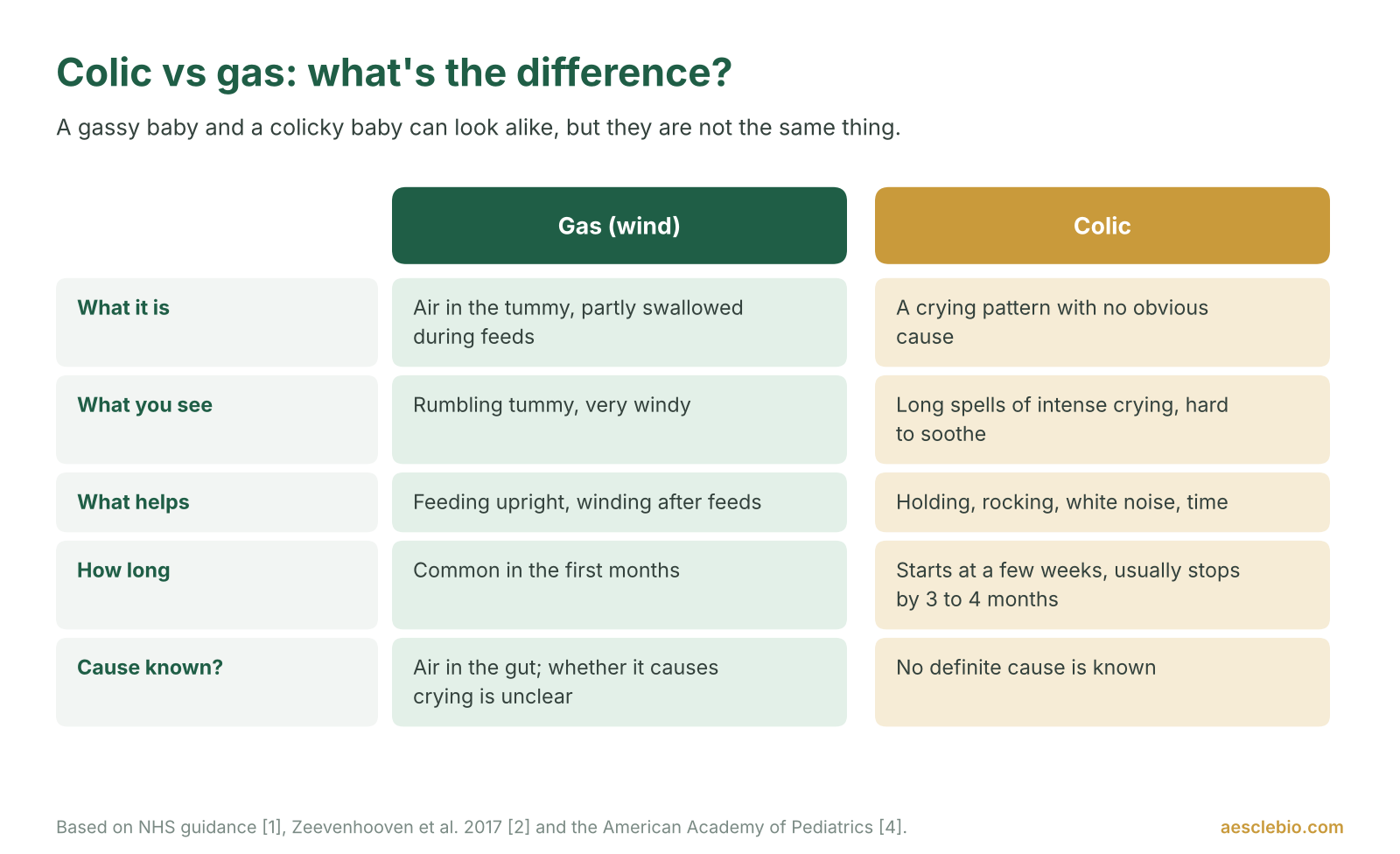
The NHS puts it simply: colic is when a baby cries a lot but there is no obvious cause [1]. It usually starts when a baby is a few weeks old and stops by 3 to 4 months [1].
For decades, doctors and researchers used Wessel's "rule of threes": crying or fussing for at least 3 hours a day, on at least 3 days a week, for more than 3 weeks, in an otherwise healthy baby [3]. In 2016 an international expert group, the Rome committee, which writes the standard definitions for gut problems that have no visible cause, replaced it with the Rome IV criteria. Rome IV describes colic as repeated, long spells of crying with no obvious cause, in a baby under 5 months old who is growing well and is not ill [2, 3].
Why the change? A baby who cries for 2 hours and 50 minutes is no different from one who cries for 3 hours, babies in some cultures cry more than others, and what really distresses parents is crying that cannot be soothed [2]. For research studies, Rome IV still asks for 3 or more hours of crying or fussing a day, confirmed with a diary [2].
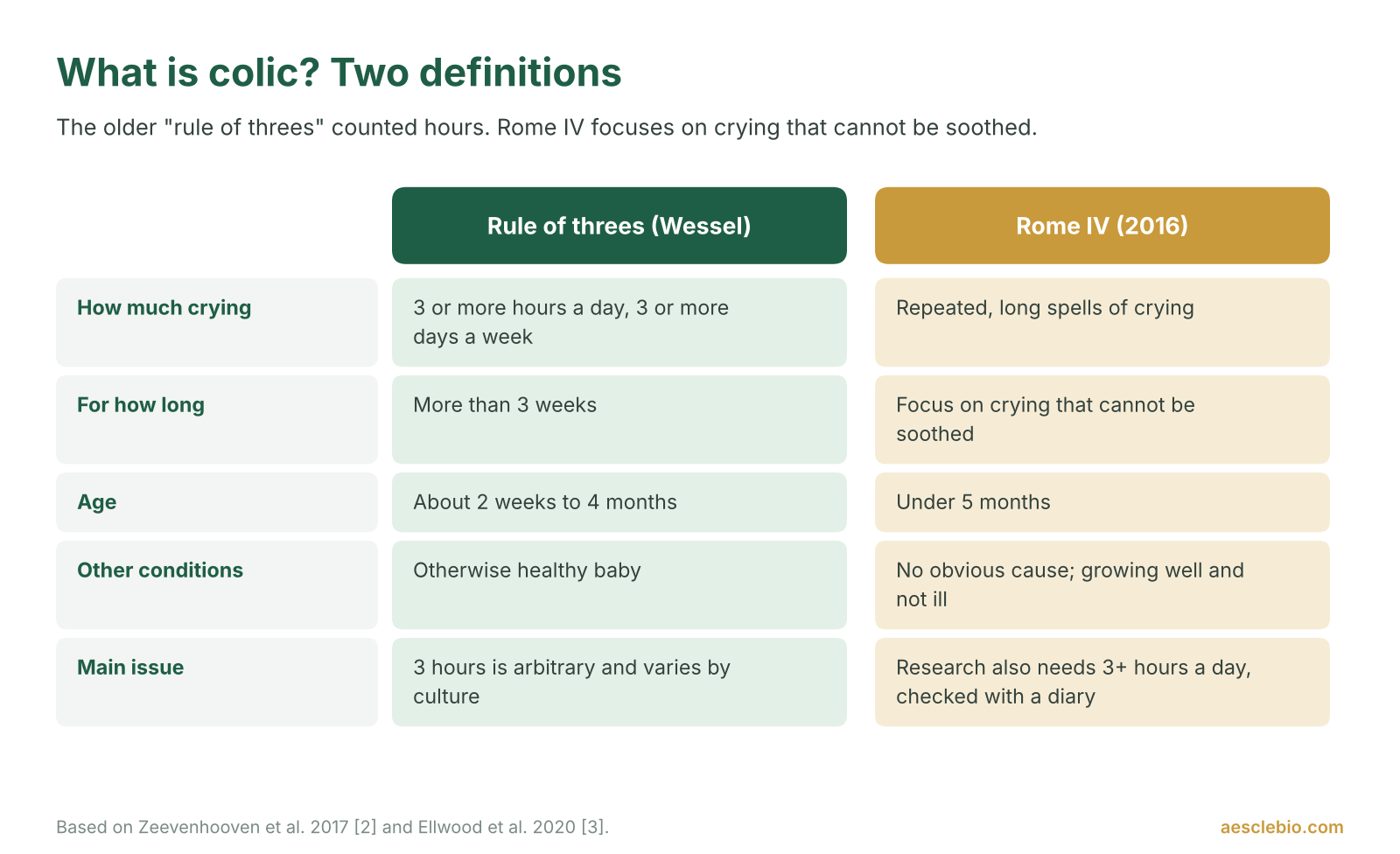
It also helps to know what normal looks like. A review of 28 diary studies with 8,690 babies found that babies fuss and cry for about 2 hours a day on average in their first 6 weeks, falling to about 68 minutes a day by 10 to 12 weeks [3]. Colic sits at the top end of that normal curve. Fewer than 5 in 100 babies brought to a doctor for inconsolable crying turn out to have an underlying illness [2, 3].
Colic vs gas: is colic gas?
Colic and gas are easy to confuse, because colicky babies often bring their knees up to their tummy, and their tummy may rumble or they may be very windy [1]. But in babies the word "colic" describes a crying pattern with no obvious cause, not a cause in itself [2]. Nobody has shown that gas is what makes colicky babies cry; the cause of colic is still unknown [1, 4]. Reflux is a third, different thing: a baby bringing up milk or being sick during or shortly after a feed, usually starting before 8 weeks and getting better by age 1 [5]. Our article on the gassy newborn covers wind and reflux in more detail.
Infant colic causes: what researchers think
Nobody knows exactly what causes colic [1, 4]. Researchers have several theories, and more than one may be true for different babies [2]:
- Normal development. Most excessive crying is probably the upper end of the normal crying curve of healthy babies, which peaks at around 5 to 6 weeks and declines by 3 months [2].
- A sensitive, still-developing nervous system. The American Academy of Pediatrics (AAP), the professional body for US children's doctors, says colic most often means a baby is unusually sensitive to stimulation [4].
- The gut. Possible gut-related causes include cow's milk allergy, reflux and differences in how the gut moves [2]. In breastfed babies, colic can sometimes signal sensitivity to a food in the mother's diet [4].
- The gut microbiome, the community of microbes living in the gut. Some studies found that babies with colic have a less varied mix of gut bacteria than babies without colic [2]. This is the idea behind probiotic trials. But a difference does not prove the bacteria cause the crying.
Probiotics for infant colic: what the trials actually show
Probiotics are live microbes that give a health benefit when taken in a large enough amount. Most of the evidence comes from meta-analyses: studies that pool the results of many trials to get a clearer answer. The answer depends on which babies were studied.
Breastfed babies who already have colic
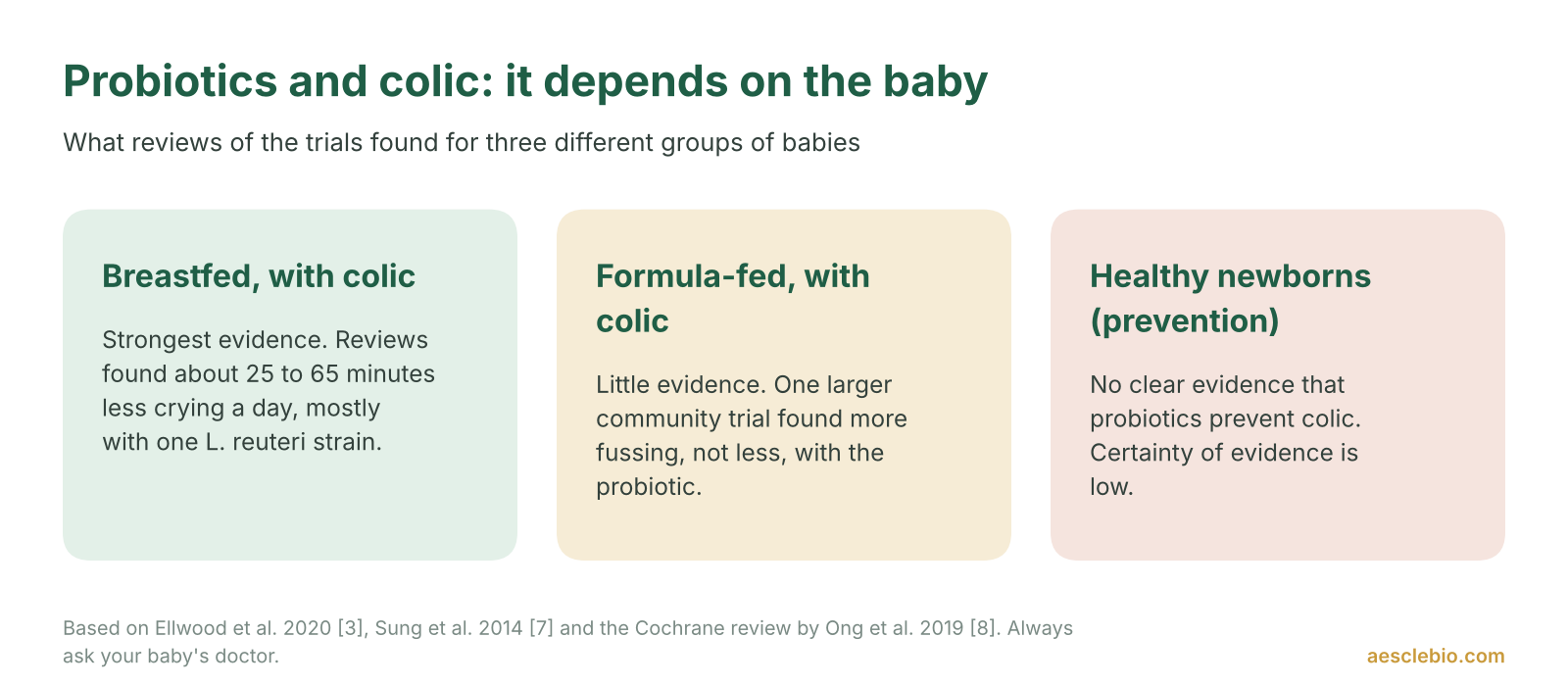
This is where the evidence is strongest. A 2020 review of reviews and guidelines in BMJ Open compared four common colic treatments. It found that the strongest evidence was for probiotics in breastfed babies, with crying cut by about 25 to 65 minutes a day across the meta-analyses it examined [3]. One of those analyses combined four trials of one particular strain of L. reuteri, 345 babies in all. After 21 days, babies given the probiotic cried about 25 minutes a day less than babies in the comparison groups, who mostly received a placebo, a dummy product that looks the same [3].
A 2020 meta-analysis of 16 trials with 1,319 babies also found shorter crying with probiotics, and in 10 of those trials the probiotic was that same strain [6]. Most of the babies in these trials were wholly or mainly breastfed, and within that range the share of breastfed babies did not change the result [6]. The authors also found signs that smaller positive studies may have been published more readily than negative ones [6].
Formula-fed babies
Here the evidence is much weaker. The BMJ Open review noted that the probiotic evidence centred on breastfed rather than formula-fed babies [3]. And one of the larger single trials, run in the community in Australia with 167 breastfed and formula-fed babies, found no benefit. It was double-blind, meaning neither the parents nor the researchers knew who got the probiotic and who got the placebo [7]. After one month, babies given the probiotic actually cried or fussed 49 minutes a day more than those on placebo, mostly extra fussing, especially in formula-fed babies; in exclusively breastfed babies it made no clear difference either way [7]. The authors concluded that their results did not support a general recommendation of probiotics for colic [7].
Preventing colic in healthy newborns
Can giving probiotics from birth stop colic from starting? A 2019 review by Cochrane, an independent network known for careful evidence summaries, looked at six trials with 1,886 babies. It found no clear evidence that probiotics prevent colic. In the three trials that measured it, daily crying time did seem shorter, by about 33 minutes, but the certainty of the evidence was low, meaning new studies could easily change the picture [8].
Why the strain matters more than the word "probiotic"
Most of the treatment trials tested one particular strain of Limosilactobacillus reuteri (until 2020 called Lactobacillus reuteri) [6]. The prevention trials used a wider mix of species and strains [8]. A strain is a specific type within a species, a bit like one individual within a family. A result for one strain cannot be assumed for another strain, even of the same species, and certainly not for a different species or a mixture. So "probiotic colic drops" on a shelf are not automatically backed by these trials.
What our own research shows
In Aesclebio's analysis of 3,070 probiotic-type clinical trials (research studies in people) registered on ClinicalTrials.gov, the public trial registry run by the US National Library of Medicine, 48 trials focused on infant colic and crying [11]. That is a small number for such a common problem.
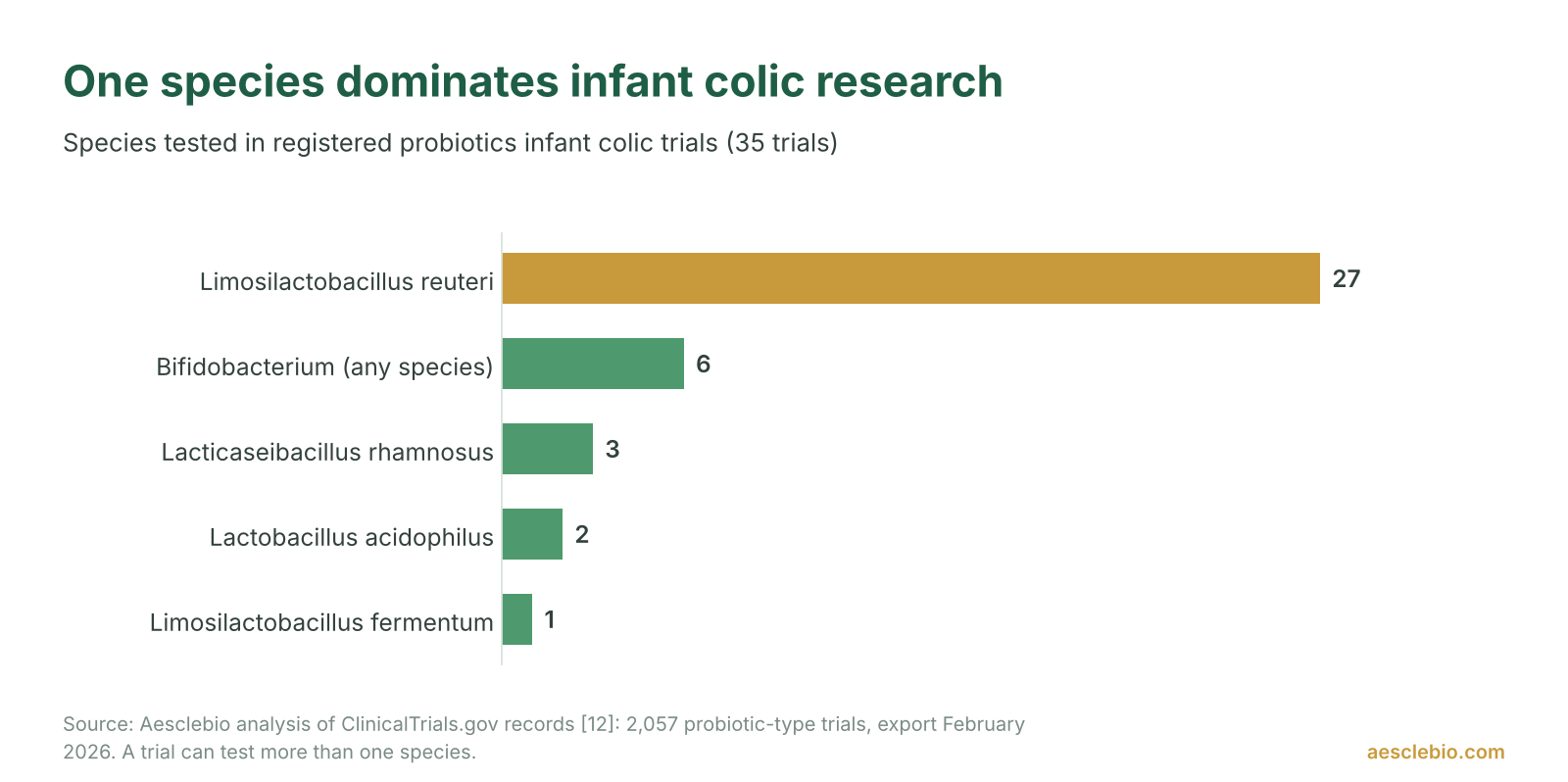
We looked more closely at a separate, earlier set of 2,057 registered trials, of which 35 studied infant colic and crying [12]. *27 of the 35 (77%) tested L. reuteri**; only 6 tested any type of Bifidobacterium_, and 3 tested_ Lacticaseibacillus rhamnosus* [12]. Most aimed to treat colic (23 trials) rather than prevent it (6) [12]. And only 2 of the 35 had posted their results on the registry itself [12]. The field is narrow, leans on one species, and is often hard for the public to check.
What do guidelines say about probiotics for newborn colic?
| Body | What it says about probiotics for colic |
|---|---|
| NHS (UK) | Anti-colic drops, probiotics and herbal remedies are not recommended; there is no evidence they help colic [1]. |
| American Academy of Family Physicians (USA, 2015) | Probiotics may be considered, for breastfed babies only [3]. |
| Irish College of General Practitioners (2014) | Probiotic supplements listed among options to consider [3]. |
| European Society for Paediatric Gastroenterology, Hepatology and Nutrition (ESPGHAN, 2023) | Recommends specific, named strains for managing colic in breastfed babies, according to the published summary and a 2025 update by members of the same group [9, 10]. |
| UK, US and Irish guidelines | All agree: check mother and baby, and give parents information, support and reassurance [3]. |
Expert bodies disagree, a sign the question is not settled. Where the advice is positive, it is about treating colic, not preventing it, and the US and European advice is limited to breastfed babies [3, 9, 10]. None of these bodies gives formula-fed babies the same footing.
Myth or fact?
| Myth | What the evidence says |
|---|---|
| Probiotics cure colic. | No product cures colic. Colic usually stops by itself by 3 to 4 months [1]. Some trials found less crying with one strain in breastfed babies [3]. |
| Any probiotic will do. | Most treatment trials tested one particular strain of L. reuteri [6]. Results cannot simply be transferred to other strains. |
| Probiotics given from birth prevent colic. | A Cochrane review found no clear evidence that probiotics prevent colic, and the certainty was low [8]. |
| Colic is caused by gas, so gas drops fix it. | No definite cause of colic is known [4]. Simethicone, the ingredient in many anti-gas drops, showed no benefit in reviews [3]. |
| If a baby cries a lot, it must be colic. | Most crying is normal, but a weak, high-pitched or unusual cry needs urgent help [1]. |
Colic drops, probiotic drops and other colic remedies: what parents can do
Because colic passes on its own, the main goals are to comfort the baby, look after yourself, and spot anything that is not colic. Health services suggest [1, 4]:
- Hold and comfort. Cuddling, gentle rocking, steady rhythmic motion and calming background sound such as white noise can help [1, 4].
- Feed as usual. Keep breastfeeding or formula feeding as normal, feed your baby upright and wind (burp) them after feeds [1].
- A warm bath can soothe some babies [1].
- Do not change your diet or formula on your own. If you are breastfeeding, the AAP suggests discussing any diet changes with your baby's doctor first; for formula-fed babies, ask the doctor before switching to a special formula [4].
- Be wary of quick fixes. The NHS does not recommend spinal manipulation or cranial osteopathy for colic [1]. Reviews found no benefit from simethicone gas drops [3].
- Take a break. If you feel overwhelmed, put your baby down safely in the cot and step away for a few minutes, or ask someone to take over. Never shake a baby; it can cause brain damage or death [4].
What about probiotic drops for colic? If you are thinking about them, take the question to your baby's doctor. Bring the label. The doctor can check whether the product names a specific, studied strain, whether your baby's situation matches the babies in the trials, and whether something else, such as reflux or a milk allergy, might explain the crying.
When to see a doctor
See your doctor or health visitor if your baby still has colic symptoms after 4 months, is not growing or gaining weight as expected, if nothing seems to help, or if you are finding it hard to cope [1]. Get urgent medical help if your baby has a weak, high-pitched or unusual cry [1], or if they have green, yellow or bloody vomit, blood in their poo, a very high temperature, refuse to feed, or will not stop crying and seem very distressed [5].
The bottom line
Colic is exhausting, common and almost always harmless, and it fades by 3 to 4 months [1]. The trials do not support probiotics for every colicky baby. They show something narrower: one particular strain of L. reuteri reduced crying in breastfed babies who already had colic, while evidence for formula-fed babies and for prevention is weak [3, 7, 8]. Health bodies disagree about what that means in practice [1, 3, 10]. So treat any probiotic as a question for your baby's doctor, not as a shelf-bought fix, and give yourself credit for getting through one of the hardest phases of early parenthood.
Frequently asked questions
Do probiotics for colic work?
For some babies, possibly. Several reviews found that one particular strain of Limosilactobacillus reuteri reduced daily crying in breastfed babies who already had colic [3, 6]. The evidence is weak for formula-fed babies, and a large community trial found no benefit [7]. There is no clear evidence that probiotics prevent colic [8]. Always speak to your baby's doctor before giving any probiotic.
What is the difference between colic and gas?
Gas (wind) is air in the tummy. The NHS suggests holding your baby upright during feeds to stop them swallowing air, and winding them afterwards [1]. Colic is a pattern of long, hard-to-soothe crying with no obvious cause in a healthy baby under 5 months [2, 3]. Colicky babies may pass wind while crying, but no definite cause of colic is known [4].
Is colic gas?
Not exactly. "Colic" describes a crying pattern, not a cause [2]. Colicky babies can be very windy [1], but nobody has shown that gas causes the crying. Experts think colic may reflect normal development, a sensitive nervous system or gut factors, and the exact cause is still unknown [2, 4].
What is colic gas in women?
The word "colic" itself means sudden tummy pain with no obvious cause [2]. In adults, severe tummy pain can come from many problems. One is biliary colic, the name for tummy pain caused by gallstones, and being a woman is one of the risk factors for gallstones [13]. Tummy pain lasting longer than 30 minutes needs medical advice, and sudden, severe pain needs urgent help [13]. Adult colic has nothing to do with infant colic.
Are probiotic colic drops safe for babies?
In trials of probiotics for colic, serious side effects were rare, and no more common than with placebo [3, 8]. But safety depends on the baby and the product. Babies born early, or with weak immune systems or other health problems, need special medical care. That is why the decision, and any dose, belongs with your baby's doctor.
Do colic drops for babies help?
It depends what is in them. Reviews found no benefit from simethicone, the ingredient in many anti-gas drops [3], and the NHS does not recommend anti-colic drops, probiotics or herbal remedies [1]. Some guidelines say probiotics, or specific strains, may be considered for breastfed babies [3, 10]. Ask your baby's doctor before using any drops.
What helps with colic and gas relief?
Holding and cuddling, gentle rocking, white noise, a warm bath, feeding upright and winding after feeds are suggested by the NHS [1]. Keep feeding as usual. If you are struggling to cope, put your baby down safely and take a break, and never shake a baby [4]. If nothing helps, speak to your doctor or health visitor [1].
Are there probiotics for newborn colic in formula-fed babies?
The evidence for formula-fed babies is limited. Most positive trials were in breastfed babies [3], and one larger community trial that included formula-fed babies found more fussing, not less, with the probiotic [7]. Where guidelines do support probiotics, the US and European advice is limited to breastfed babies [3, 10]. Your baby's doctor can advise on feeding options.
When does colic stop?
Colic usually starts at a few weeks old and stops by 3 to 4 months [1]. The AAP says it can sometimes last until 6 months [4]. See a doctor if symptoms continue after 4 months, or if your baby is not gaining weight as expected [1].
Related reading
- The Gassy Newborn: What's Normal, What Isn't, and Where the Gut Microbiome Fits
- Probiotics for Babies and Newborns: The Questions Paediatricians Get Asked Most
- Infant Probiotic Drops: Strains, Oil Suspensions, Spores and What Makes a Drop Work
- Your Probiotic Is a Strain, Not a Species: Reading the Code After the Name
- L. reuteri: The Most Searched Probiotic Species (Aesclebio blog)
References
- National Health Service (NHS). Colic. NHS website; accessed October 2026. Free to read. Link
- Zeevenhooven J, Koppen IJN, Benninga MA. The new Rome IV criteria for functional gastrointestinal disorders in infants and toddlers. Pediatric Gastroenterology, Hepatology & Nutrition. 2017;20(1):1–13. Open access / Free full text: PubMed Central PMC5385301. Link
- Ellwood J, Draper-Rodi J, Carnes D. Comparison of common interventions for the treatment of infantile colic: a systematic review of reviews and guidelines. BMJ Open. 2020;10(2):e035405. Open access / Free full text: PubMed Central PMC7202698. Link
- American Academy of Pediatrics. Colic. HealthyChildren.org; accessed October 2026. Free to read. Link
- National Health Service (NHS). Reflux in babies. NHS website; accessed October 2026. Free to read. Link
- Skonieczna-Żydecka K, Janda K, Kaczmarczyk M, et al. The effect of probiotics on symptoms, gut microbiota and inflammatory markers in infantile colic: a systematic review, meta-analysis and meta-regression of randomized controlled trials. Journal of Clinical Medicine. 2020;9(4):999. Open access / Free full text: PubMed Central PMC7231167. Link
- Sung V, Hiscock H, Tang MLK, et al. Treating infant colic with the probiotic Lactobacillus reuteri: double blind, placebo controlled randomised trial. BMJ. 2014;348:g2107. Open access / Free full text: PubMed Central PMC3972414. Link
- Ong TG, Gordon M, Banks SS, et al. Probiotics to prevent infantile colic. Cochrane Database of Systematic Reviews. 2019;3(3):CD012473. Free full text: PubMed Central PMC6415699. Link
- Szajewska H, Berni Canani R, Domellöf M, et al. Probiotics for the management of pediatric gastrointestinal disorders: position paper of the ESPGHAN Special Interest Group on Gut Microbiota and Modifications. Journal of Pediatric Gastroenterology and Nutrition. 2023;76(2):232–247. Abstract free on PubMed (PMID 36219218); the full text may need a subscription, so this article relies only on the free abstract. Link
- Zemła M, Kotowska-Bąbol M, Szajewska H. An update on probiotics in paediatrics. Current Opinion in Clinical Nutrition and Metabolic Care. 2026;29(3):320–326. Published online December 2025. Abstract free on PubMed (PMID 41334956); the full text may need a subscription, so this article relies only on the free abstract. Link
- Aesclebio Technologies. Probiotic Clinical Trials: Where the Industry Is Heading. A registry-based analysis of ClinicalTrials.gov data to 17 September 2026. Hyderabad: Aesclebio Technologies Pvt. Ltd.; 2026. Link
- Aesclebio Technologies. Aesclebio analysis of ClinicalTrials.gov records: enriched dataset of 2,057 interventional probiotic-type trials (registry export February 2026). Hyderabad: Aesclebio Technologies Pvt. Ltd.; 2026. Link
- National Health Service (NHS). Gallstones. NHS website; accessed October 2026. Free to read. Link
Disclaimer
This article is for general education only. It is not medical advice and is not intended to diagnose, treat, cure or prevent any disease. It does not promote any specific product or brand, and it makes no claims about any product.
Statements about research describe the findings of published studies. They do not mean that any particular food or supplement will have the same effect for you. Always speak to a qualified healthcare professional before changing your diet or starting a supplement, especially if you are pregnant, breastfeeding, giving products to a baby or child, or living with a health condition.
This topic concerns babies, pregnancy or new mothers. Nothing here is a recommendation to give any product to a baby or to use any product during pregnancy or breastfeeding. Decisions about care should always be made with a doctor, midwife or other qualified healthcare professional.
Rules on how probiotics and supplements may be described differ from country to country. Nothing in this article should be read as a health claim for any product.
All graphics are original works of Aesclebio Technologies. Figures from other studies are credited to their sources. Quotations are limited to short passages with full attribution. Any clinical-trial figures from Aesclebio's own analysis come from public registry records and do not imply that any product is effective or safe.
Prepared by the Aesclebio Research Team with the help of AI tools, under the team's direction. © 2026 Aesclebio Technologies Pvt. Ltd. All rights reserved. Short extracts may be quoted with a link to the original article.