
Infant & Child Health
Kids, Toddlers and Probiotics: Dose, Format and the Sugar Problem
What the research in children really shows, why the strain matters more than the shape, and what to check before you buy a kids probiotic.
Why so many parents search for a kids probiotic
Every month, thousands of parents type "kids probiotic", "probiotic for kids" or "probiotics for toddlers" into a search engine. Usually there is a reason: antibiotics, a stomach bug or a run of winter colds. The shelves answer with bright gummies, chewables, powders and drops. Very few tell you what the research found in children.
This article makes one argument. When choosing a probiotic for children, the strain and the evidence come first. Format, flavour and the cartoon on the box come last. Then we weigh the trade-offs of each format, especially sugar in gummies.
First, what counts as a probiotic?
Probiotics are "live microorganisms that, when administered in adequate amounts, confer a health benefit on the host" [9]. In plain words: living microbes that do some good when you take enough of them. A microbe is a living thing too small to see, such as a bacterium or a yeast.
Every probiotic has three parts to its name: a genus (family name), a species (first name) and a strain code (an identity number). The European Society for Paediatric Gastroenterology, Hepatology and Nutrition (ESPGHAN), the main European group of children's gut doctors, states plainly that the effects of probiotics are considered to be strain specific [1]. Two products with the same species on the label can behave very differently.
What the research in children actually shows
In 2023, an ESPGHAN working group reviewed the trials and only made a recommendation when at least two randomised controlled trials (studies where children are put into groups by chance) had tested a similar, well-defined strain [1].
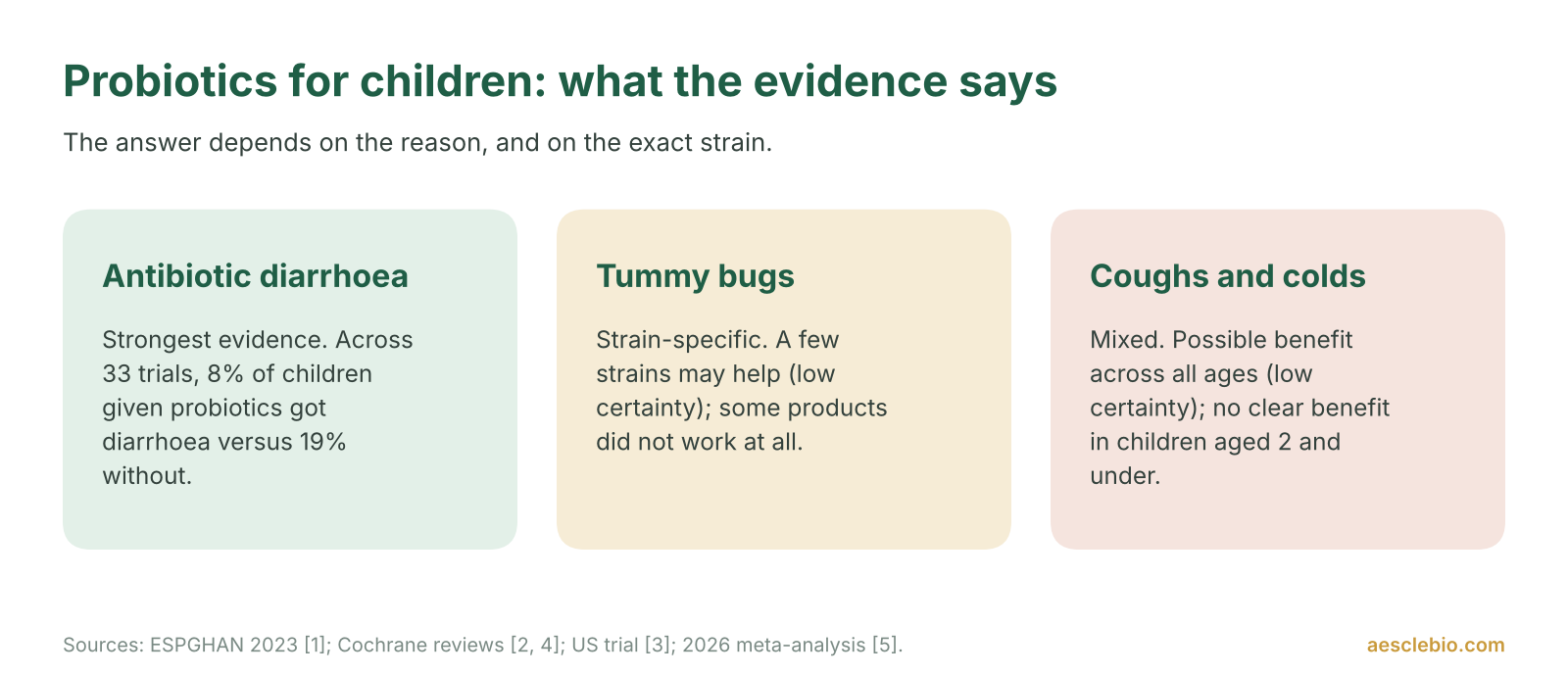
Acute diarrhoea (tummy bugs)
Acute gastroenteritis is a sudden stomach and bowel infection. ESPGHAN said doctors may consider four specific probiotics: one strain of Lacticaseibacillus rhamnosus, the yeast Saccharomyces boulardii, one strain of Limosilactobacillus reuteri, and one two-strain combination. All four were weak recommendations based on low or very low certainty evidence [1].
The same group advised against two others because the trials showed no benefit: a combination of L. rhamnosus and L. helveticus (a strong recommendation, based on moderate-certainty evidence) and several strains of Bacillus clausii (a weak recommendation, based on very low certainty evidence) [1]. And in a large US trial of 971 children aged 3 months to 4 years seen in emergency departments, a 5-day course of the best-known L. rhamnosus strain did no better than a placebo (a dummy product): diarrhoea lasted about 50 hours in both groups [3].
Diarrhoea linked to antibiotics
Antibiotics also upset helpful gut bacteria, and some children get diarrhoea as a result. A Cochrane review (a careful, independent summary of all the trials) pooled 33 studies with 6,352 children. Diarrhoea occurred in 8% of children given probiotics, compared with 19% of children in the comparison groups, with moderate-certainty evidence [2]. None of the 24 trials that reported on side effects found a serious side effect caused by the probiotics [2]. ESPGHAN's advice here is a strong recommendation, based on moderate-certainty evidence: when a child has risk factors, doctors may recommend S. boulardii or one strain of L. rhamnosus, at the high amounts used in the trials and started at the same time as the antibiotic [1].
Coughs and colds
Here the picture is mixed. A Cochrane review covering children, adults and older people found that probiotics may reduce how many people catch upper respiratory infections (colds, sore throats, ear and sinus infections), but the certainty of that evidence was low [4]. A 2026 analysis of nine trials of probiotics or synbiotics (probiotics combined with a prebiotic) in children aged 2 and under found no clear reduction in these infections and concluded that routine use for that purpose is not supported, while noting possible effects for particular strains [5].
Why the strain matters more than the gummy
One L. rhamnosus strain earned a cautious "may consider", while a different product that also contained L. rhamnosus earned a firm "do not recommend" [1]. The species name alone told you nothing. That is why ESPGHAN concluded that probiotics with no documented health benefits should be discouraged [1].
Children are also under-studied. In Aesclebio's analysis of 3,070 probiotic-type clinical trials registered on ClinicalTrials.gov (the public trial registry run by the US National Library of Medicine), trials in children made up about 10% and trials in infants about 6%, against 73% in adults [10].
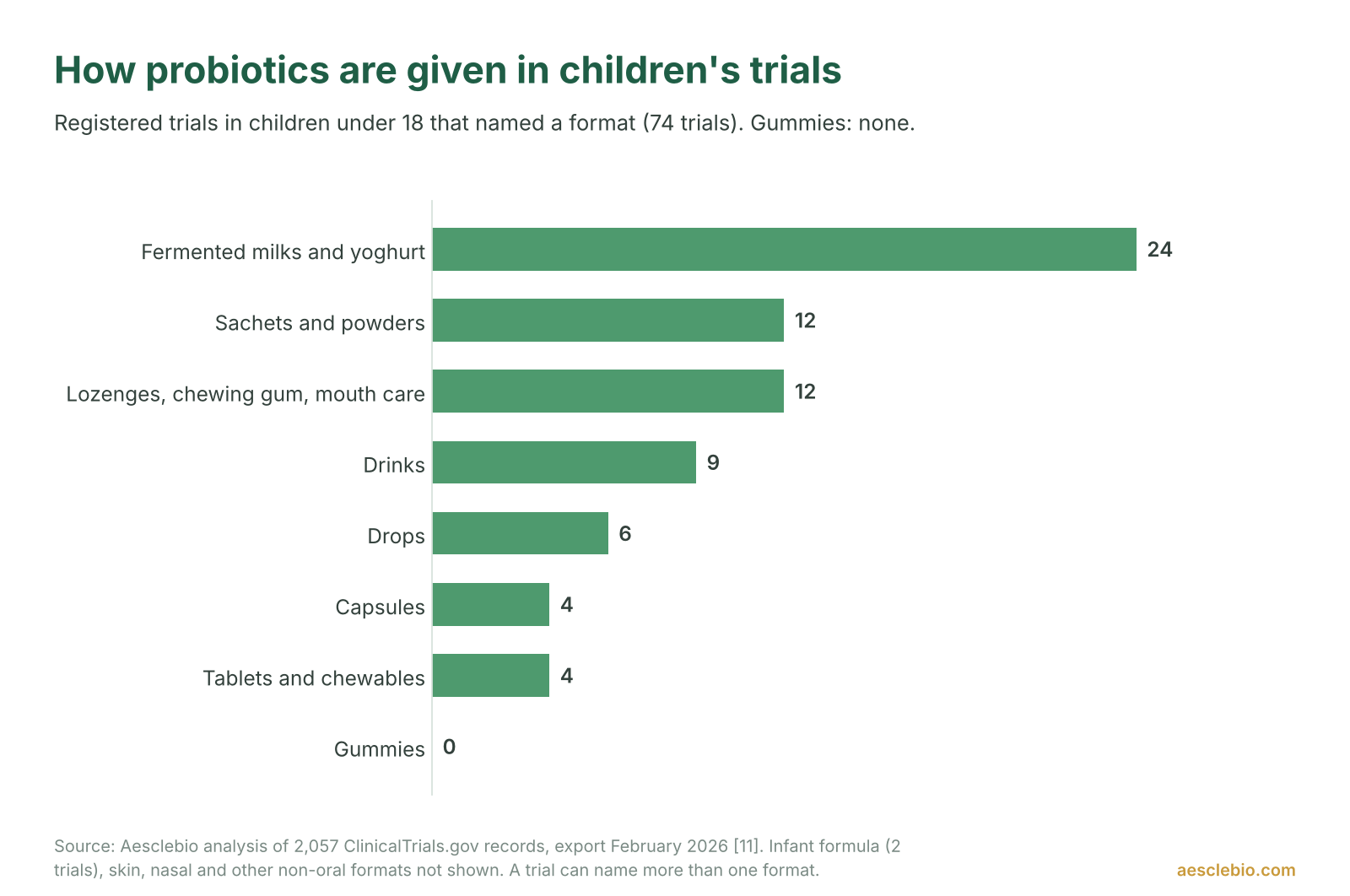
The format gap is even sharper. In a separate Aesclebio analysis of 2,057 trial records, 232 trials studied children and teenagers under 18. Of the 74 that described how the probiotic was given, the most common vehicles were fermented milks and yoghurts, followed by sachets and powders and by lozenges, chewing gum and other mouth-care products. Not one described a gummy [11]. The first children's gummy trial we found, listed in Aesclebio's report on spore-forming probiotics, has a start date of 2024 [12]. The format that dominates children's shelves has the least trial evidence.
Chewables, powders, drops and gummies: the trade-offs
Each format solves one problem and creates another. The right one is the format in which your chosen, studied strain is sold, at the age your child can manage it safely.
| Format | Good for | Watch out for |
|---|---|---|
| Drops (oil or liquid) | Babies and young toddlers; easy to measure | Must be stored as directed; check the count is promised to the end of shelf life |
| Powders and powder sticks (single-serve sachets) | Toddlers; mixed into cool food or drink; no sugar needed | Hot food or drink can kill live bacteria; check the filler |
| Chewable tablets | Children who can chew well; usually less sugar than gummies | Sweeteners and flavours; only for children old enough to chew well |
| Gummies | Fussy eaters; children who refuse other formats | Sugar or sugar alcohols; look like sweets; heat in manufacturing |
| Capsules | Older children and teenagers who can swallow them | Hard for young children to swallow |
The sugar problem (and the sugar-free problem)
A gummy is, at heart, a sweet. The probiotic gummies used in one published study were made from a cooked syrup and contained noticeable amounts of sugars such as sucrose, glucose and maltose [6]. The World Health Organization (WHO) recommends that children and adults keep "free sugars" (sugars added to food, plus those in honey, syrups and fruit juice) below 10% of their daily energy, and ideally below 5%, partly because more sugar means more tooth decay [7].
"Sugar-free" gummies swap sugar for sugar alcohols, also called polyols (for example sorbitol, maltitol or xylitol). They avoid the sugar, but a systematic review found that polyols can cause wind, tummy discomfort and a laxative effect, and that these effects grow with the amount eaten [8].
Gummies look like sweets: store them like medicine
Young children cannot tell a supplement from a sweet. Supplements are not harmless just because they are sold without a prescription: in the United States, iron-containing supplements must carry a legal warning that accidental overdose of iron-containing products is a leading cause of fatal poisoning in children under 6, together with the instruction to keep the product out of reach of children [13]. A probiotic gummy is not an iron tablet, but the habit is the same: keep any gummy supplement in a closed, child-resistant container, high up and out of sight, and never call it "sweets" or "candy".
Heat, gummies and live bacteria counts
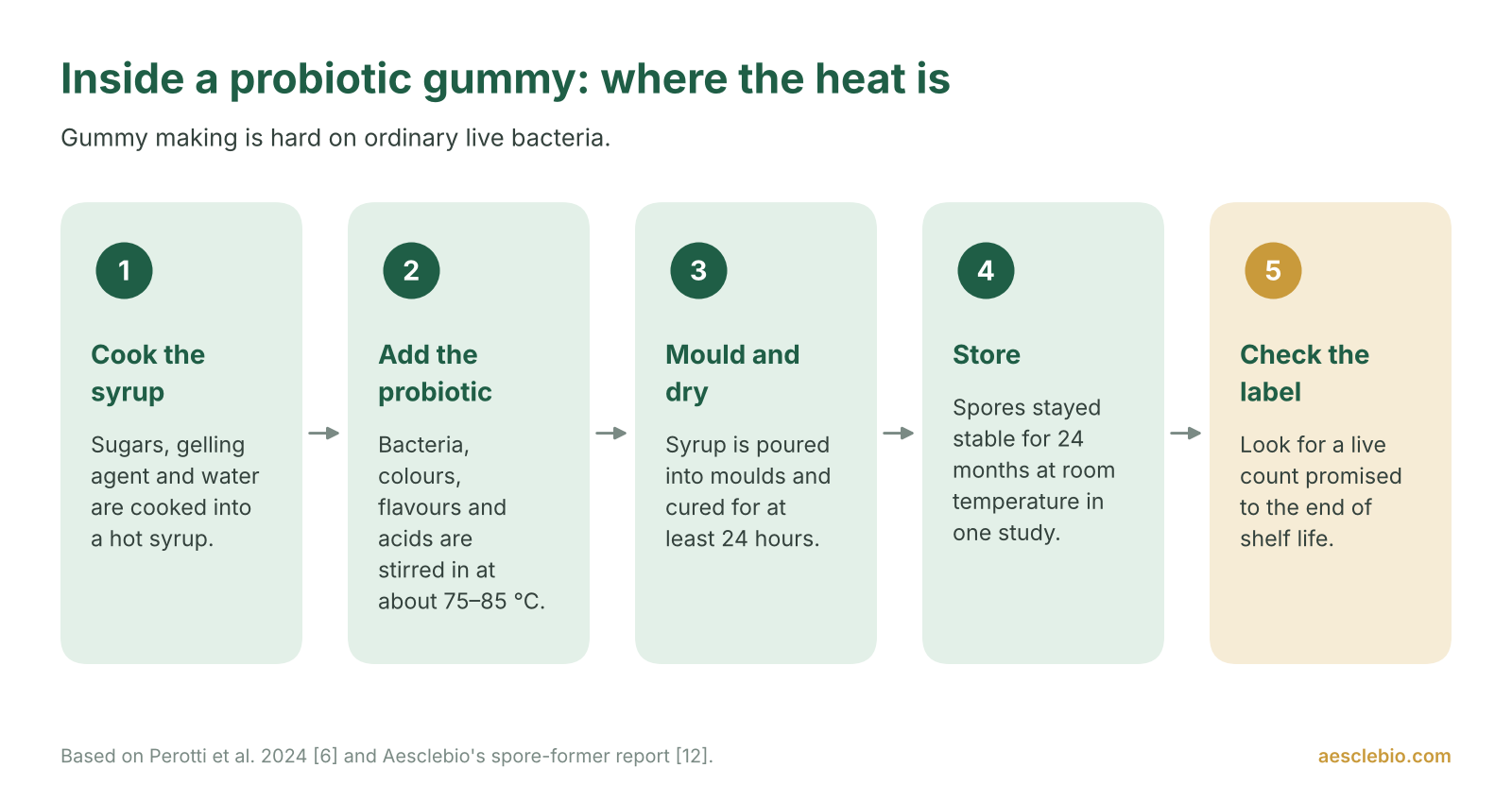
In the published gummy study above, the probiotic was stirred into the syrup when it was still at about 75–85 °C [6]. Heat like this is hard on ordinary live bacteria such as lactobacilli [12]. So the makers used a spore-forming bacterium, Heyndrickxia coagulans (formerly Bacillus coagulans; the study uses another recent name, Weizmannia coagulans). A spore is a dormant, tough form of a bacterium with a protective coat, a bit like a seed. Packed as spores, the count stayed stable for 24 months at room temperature [6].
Aesclebio's own review of spore-forming probiotics makes the same point: spores tolerate heat, acid and long storage in formats such as chewables and heat-treated foods, where ordinary lactobacilli lose their viability (their ability to stay alive) [12]. But spore-forming alone does not prove a benefit [12]. If a gummy lists a non-spore species, ask how many survive to the end of shelf life.
So what dose of probiotic should a child take?
We deliberately do not give a dose: none suits every child, strain and reason. In the Cochrane review on antibiotic-linked diarrhoea, the amount mattered: trials using higher amounts showed a clearer effect than trials using lower ones [2]. The safe, sensible rule is simple: the dose should match the dose used in the studies behind that exact strain, for that exact use, and your child's doctor should agree it. That applies equally to probiotics for 1-year-olds, 2-year-olds, 3-year-olds and 4-year-olds.
Prebiotics, multivitamins and "2-in-1" kids products
Many products combine a probiotic with a prebiotic (a fibre that feeds helpful gut bacteria) or with vitamins. A kids prebiotic and probiotic product, or kids vitamins with probiotics, can be convenient, but adding ingredients does not add evidence. Each probiotic strain in the mix still needs a name, a count and studies behind it, exactly as it would on its own [1]. If a multivitamin with probiotic gives only a vague "probiotic blend", treat the probiotic part as decoration.
Myth or fact?
| Myth | What the evidence says |
|---|---|
| Any probiotic will help a child's tummy bug. | Only specific strains have supporting evidence, and some products were found not to work at all [1, 3]. |
| Gummies are just as good as other formats. | A gummy can work if its strain survives manufacturing, but gummies bring sugar or sugar alcohols and heat stress, and have the least trial evidence in children [6, 8, 11]. |
| More billions on the label is always better. | The right amount is the amount studied for that strain and that use. A bigger number on an unstudied strain proves nothing [1, 2]. |
| Probiotics will stop my child catching colds. | Evidence for coughs and colds is mixed, and a 2026 review found no clear benefit in children aged 2 and under [4, 5]. |
How to choose: a parent's label checklist
Whether you are reading a "top 10" list or a pharmacy shelf, ask these questions.
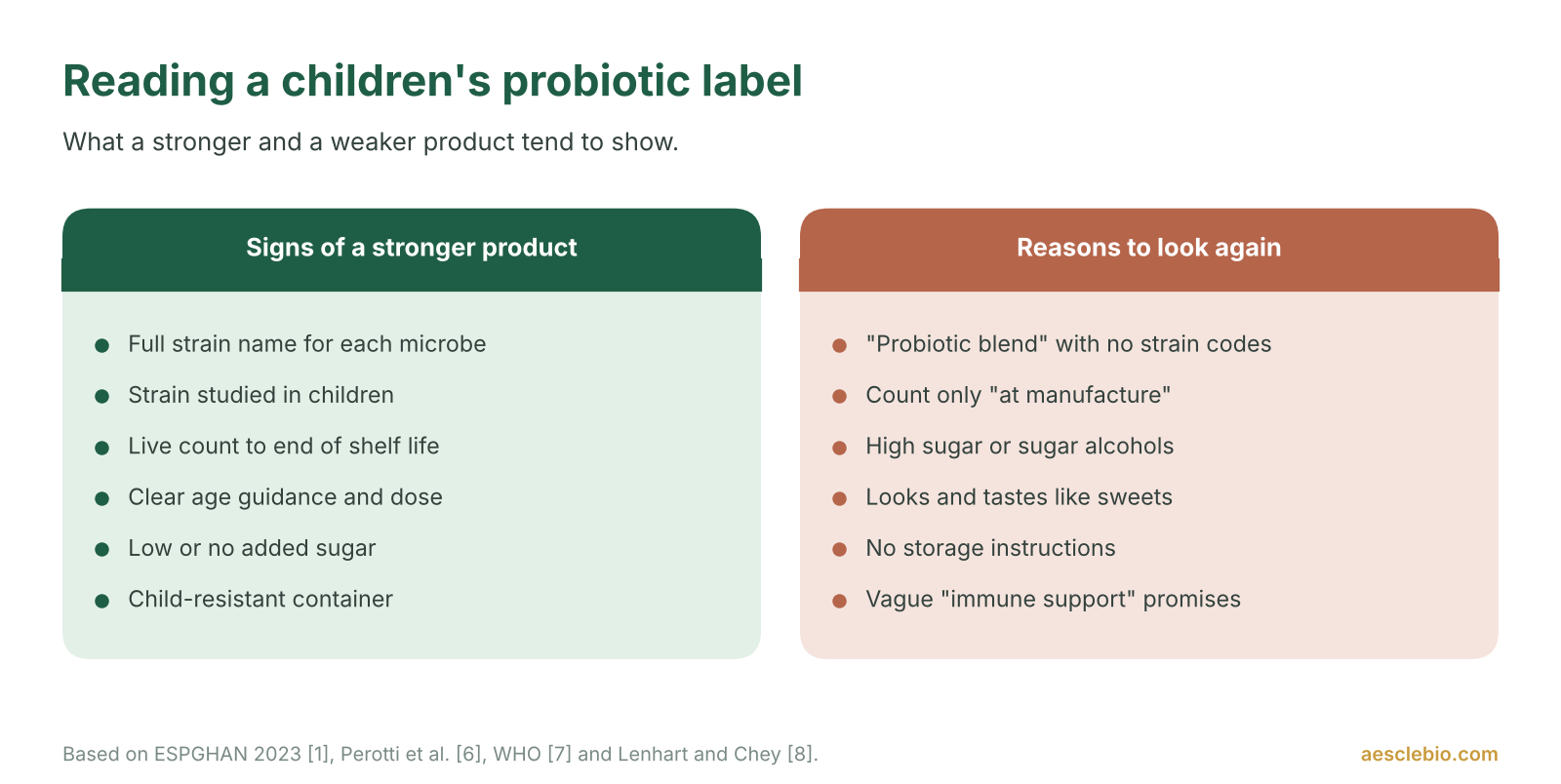
- Full strain name. Genus, species and strain code for every microbe, not just "probiotic blend".
- Evidence in children. Has that exact strain been studied in children, for the reason you want it?
- Live count to the end of shelf life. The number of colony-forming units (CFU), the standard count of live microbes, promised until the expiry date, not just "at manufacture".
- Dose that matches the studies. Agreed with your child's doctor.
- Age guidance. Suitable for your child's age, in a format they can manage safely.
- Sugar and sweeteners. Grams of sugar per serving, and any sugar alcohols such as sorbitol or maltitol.
- Storage instructions. Fridge or room temperature, and a child-resistant container.
- Maker's quality. Produced under good manufacturing practice (GMP), the quality rules for making foods and supplements safely and consistently.
The bottom line
The best kids probiotic is not the one with the brightest pack or the sweetest taste. It is the one whose exact strain has been studied in children for the reason you want it, with a live count promised to the end of shelf life, at the dose used in those studies, and in a format your child can take safely. Gummies are a convenience with real costs: sugar or sugar alcohols, heat stress on live bacteria, and the risk of being mistaken for sweets. Choose on evidence first, format second, and agree the plan with your child's doctor.
Frequently asked questions
What is the best probiotic for toddlers?
There is no single best probiotic for toddlers. The best choice is a product whose exact strain has been studied in young children for the reason you want it, such as diarrhoea linked to antibiotics, where the evidence is strongest [1, 2]. For toddler probiotics, powders and drops are often easier than gummies and need no added sugar. Ask your child's doctor before starting.
Are probiotics safe for a 1-year-old?
In trials, probiotics were generally well tolerated by children, and no serious side effects were linked to them [2]. Rare serious side effects have been reported in very ill or immune-weakened children [2]. For a 1-year-old, use only a product made for that age, and speak to your doctor first, especially if your child was born early or has a health condition.
Can a 2-year-old take probiotics?
Yes, many probiotics for 2-year-olds are sold as powders, drops or chewables, but whether your child needs one depends on the reason. Evidence is strongest around antibiotics, mixed for colds, and strain-specific for tummy bugs [1, 2, 4]. The dose should follow the studies behind that product and your doctor's advice, not a general rule.
Are children's chewable probiotics better than gummies?
Neither format is better in itself; the strain inside matters more [1]. Chewables usually contain less sugar than gummies but may contain sweeteners. Gummies often contain sugar or sugar alcohols and are made with heat, which ordinary live bacteria survive poorly [6, 8]. Neither suits children too young to chew well.
Do probiotic gummies for kids contain sugar?
Most do. Gummies are made from a cooked syrup, often with sucrose and glucose [6]. "Sugar-free" versions usually use sugar alcohols, which can cause wind or loose stools in larger amounts [8]. WHO advises keeping free sugars below 10% of daily energy, ideally below 5% [7]. Check grams of sugar per serving on the label.
What are the benefits of probiotics for kids?
The clearest benefit in children is fewer cases of diarrhoea during antibiotic treatment: 8% versus 19% across 33 trials [2]. Some specific strains may shorten tummy bugs, though evidence is low certainty [1]. Results for colds and respiratory infections are mixed [4, 5]. Benefits belong to particular strains, not to probiotics as a group.
Should a child take a prebiotic and probiotic together?
A prebiotic is a fibre that feeds helpful gut bacteria. Combined kids pre and probiotic products can be convenient, but the combination still needs evidence for the strain and use you care about [1]. A varied diet with fruit, vegetables, pulses and whole grains naturally provides prebiotic fibres. Ask your doctor before adding supplements.
What is the best probiotic for a 15-year-old?
Teenagers can usually swallow capsules, which avoids sugary formats. The same rule applies as for younger children: choose a named strain studied for the reason you want it, with a live count promised to the end of shelf life [1]. Teens on antibiotics, for example for acne, should ask their doctor whether a probiotic is worthwhile.
Do kids need a probiotic every day?
Most healthy children do not need a daily probiotic. In trials, probiotics were usually given for a defined period, such as during a course of antibiotics or for a few days during a tummy bug [1, 2]. A balanced diet, including yoghurt or curd if your child enjoys it, supports a healthy gut. Talk to your doctor before long-term use.
Related reading
- Probiotics for Babies and Newborns: The Questions Paediatricians Get Asked Most
- Your Probiotic Is a Strain, Not a Species: Reading the Code After the Name
- Billions of CFU, Little Meaning: Why the Biggest Number on the Label Rarely Wins
- Gummies vs Capsules vs Sachets vs Drops (Aesclebio blog)
- Infant Probiotic Drops: Strains, Oil Suspensions, Spores and What Makes a Drop Work
References
- Szajewska H, Berni Canani R, Domellöf M, et al. Probiotics for the management of pediatric gastrointestinal disorders: position paper of the ESPGHAN Special Interest Group on Gut Microbiota and Modifications. Journal of Pediatric Gastroenterology and Nutrition. 2023;76(2):232–247. doi:10.1097/MPG.0000000000003633. Free full text: ESPGHAN website. Link
- Guo Q, Goldenberg JZ, Humphrey C, et al. Probiotics for the prevention of pediatric antibiotic-associated diarrhea. Cochrane Database of Systematic Reviews. 2019;4(4):CD004827. Free full text: PubMed Central PMC6490796. Link
- Schnadower D, Tarr PI, Casper TC, et al. Lactobacillus rhamnosus GG versus placebo for acute gastroenteritis in children. New England Journal of Medicine. 2018;379(21):2002–2014. Free full text: PubMed Central PMC6358014. Link
- Zhao Y, Dong BR, Hao Q. Probiotics for preventing acute upper respiratory tract infections. Cochrane Database of Systematic Reviews. 2022;8(8):CD006895. Free full text: PubMed Central PMC9400717. Link
- Carnazzo SM, Sinagra E, Raimondo D, et al. Strain-specific effects of early-life probiotic supplementation on respiratory infections in infants: a systematic review and meta-analysis. Nutrients. 2026;18(13):2067. Open access: PubMed Central PMC13363551. Link
- Perotti S, Mantegazza G, Pierallini E, et al. Human assessment of the survival and germination of Weizmannia coagulans SNZ1969 spores delivered via gummy candies. Current Research in Food Science. 2024;9:100793. Open access: PubMed Central PMC11278553. Link
- World Health Organization. Guideline: sugars intake for adults and children. Geneva: WHO; 2015. Link
- Lenhart A, Chey WD. A systematic review of the effects of polyols on gastrointestinal health and irritable bowel syndrome. Advances in Nutrition. 2017;8(4):587–596. Free full text: PubMed Central PMC5508768. Link
- Hill C, Guarner F, Reid G, et al. Expert consensus document: the International Scientific Association for Probiotics and Prebiotics consensus statement on the scope and appropriate use of the term probiotic. Nature Reviews Gastroenterology & Hepatology. 2014;11:506–514. Open access. Link
- Aesclebio Technologies. Probiotic Clinical Trials: Where the Industry Is Heading. A registry-based analysis of ClinicalTrials.gov data to 17 September 2026. Hyderabad: Aesclebio Technologies Pvt. Ltd.; 2026. Link
- Aesclebio Technologies. Aesclebio analysis of ClinicalTrials.gov records: 2,057 interventional probiotic-type trials, registry export February 2026 (population and delivery-format coding). Hyderabad: Aesclebio Technologies Pvt. Ltd.; 2026. Link
- Aesclebio Technologies. The Bacillus Surge: clinical-trial trends for spore-forming probiotics and what they mean for formulation. A registry-based analysis of ClinicalTrials.gov data to 17 September 2026. Hyderabad: Aesclebio Technologies Pvt. Ltd.; 2026. Link
- US Food and Drug Administration. Code of Federal Regulations, Title 21, Section 101.17(e): Dietary supplements containing iron or iron salts: warning statement. Free full text: Electronic Code of Federal Regulations (eCFR). Link
Disclaimer
This article is for general education only. It is not medical advice and is not intended to diagnose, treat, cure or prevent any disease. It does not promote any specific product or brand, and it makes no claims about any product.
Statements about research describe the findings of published studies. They do not mean that any particular food or supplement will have the same effect for you. Always speak to a qualified healthcare professional before changing your diet or starting a supplement, especially if you are pregnant, breastfeeding, giving products to a baby or child, or living with a health condition.
This topic concerns babies, pregnancy or new mothers. Nothing here is a recommendation to give any product to a baby or to use any product during pregnancy or breastfeeding. Decisions about care should always be made with a doctor, midwife or other qualified healthcare professional.
Rules on how probiotics and supplements may be described differ from country to country. Nothing in this article should be read as a health claim for any product.
All graphics are original works of Aesclebio Technologies. Figures from other studies are credited to their sources. Quotations are limited to short passages with full attribution. Any clinical-trial figures from Aesclebio's own analysis come from public registry records and do not imply that any product is effective or safe.
Prepared by the Aesclebio Research Team with the help of AI tools, under the team's direction. © 2026 Aesclebio Technologies Pvt. Ltd. All rights reserved. Short extracts may be quoted with a link to the original article.