
Probiotic Basics
Probiotic Foods vs Probiotic Supplements: Why a Probiotic Foods List Is Not a Dose
Which foods have probiotics, which do not, and when a supplement makes more sense, explained in plain language.
Why so many people search for probiotic foods
Every month, many people type "foods with probiotics", "probiotic rich foods" or "what foods have probiotics" into search engines. The lists they find usually look alike: yoghurt, kefir, sauerkraut, kimchi, kombucha, pickles. These lists are a fair start. But they mix up two different ideas: foods that were made by microbes, and foods that deliver a known amount of helpful live microbes. This article separates the two, so you can read any probiotic foods list with a sharper eye.
First, what exactly is a probiotic?
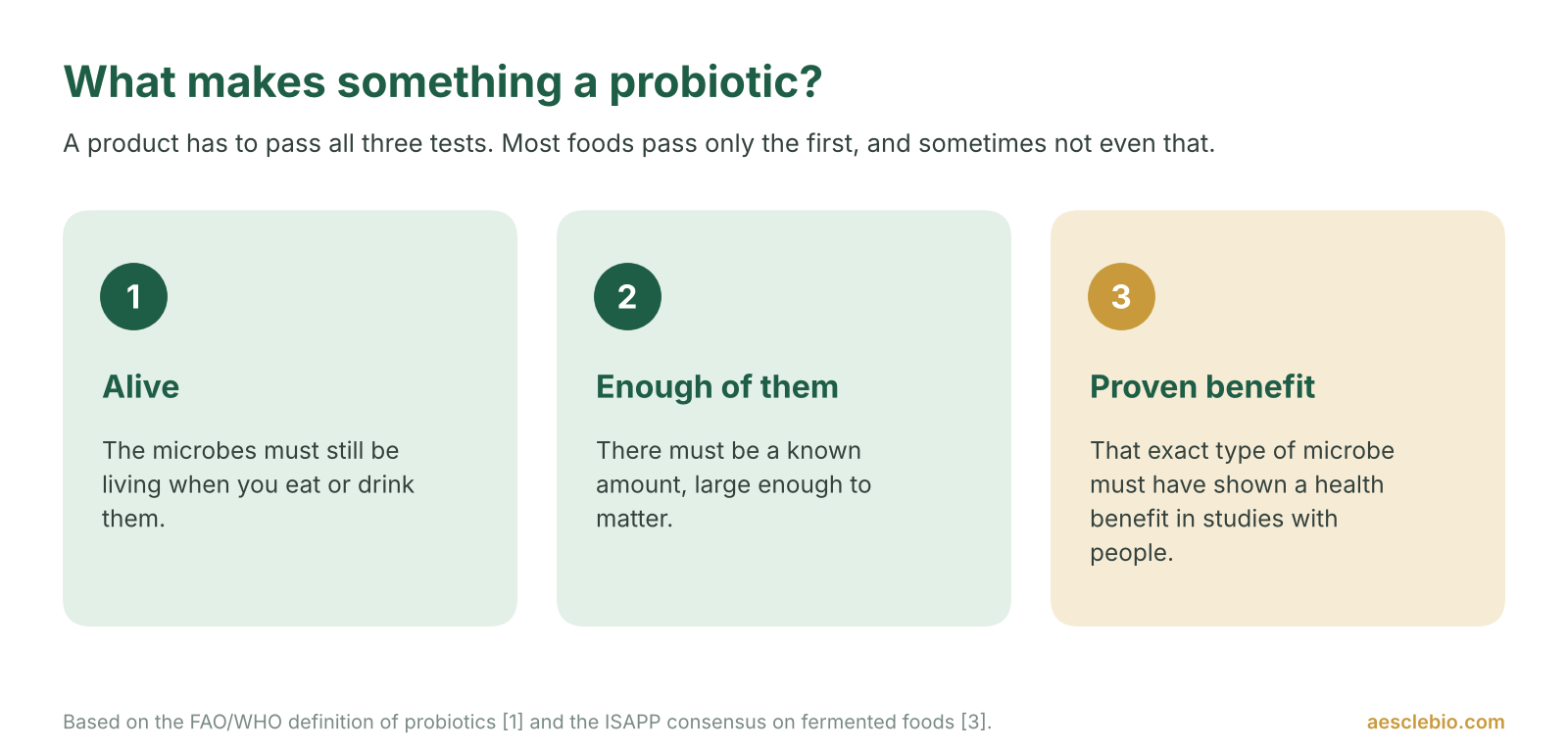
Experts brought together by two United Nations bodies, the Food and Agriculture Organization (FAO) and the World Health Organization (WHO), define probiotics as "live microorganisms which when administered in adequate amounts confer a health benefit on the host" [1]. An international panel of scientists confirmed this definition, with a small wording correction, in 2014 [2]. In everyday words: living microbes that do you some good when you take enough of them. A "microorganism", or "microbe", is simply a living thing too small to see, such as a bacterium or a yeast.
That one sentence sets three tests. A true probiotic must pass all three.
Fermented food is not the same as probiotic food
Fermentation is the natural process in which microbes such as bacteria or yeasts change a food: milk becomes yoghurt, cabbage becomes sauerkraut, soybeans become miso. In 2021 a panel of the International Scientific Association for Probiotics and Prebiotics (ISAPP), a non-profit scientific group, defined fermented foods as "foods made through desired microbial growth and enzymatic conversions of food components" [3]. (Enzymes are natural helpers that break food down.)
The same panel made one point very clearly: a fermented food is not automatically a probiotic. It should only be labelled as "containing probiotics" when there is evidence that its live microbes give a health benefit and its microbial content is clearly defined [3]. Many fermented foods fall short for one of three reasons:
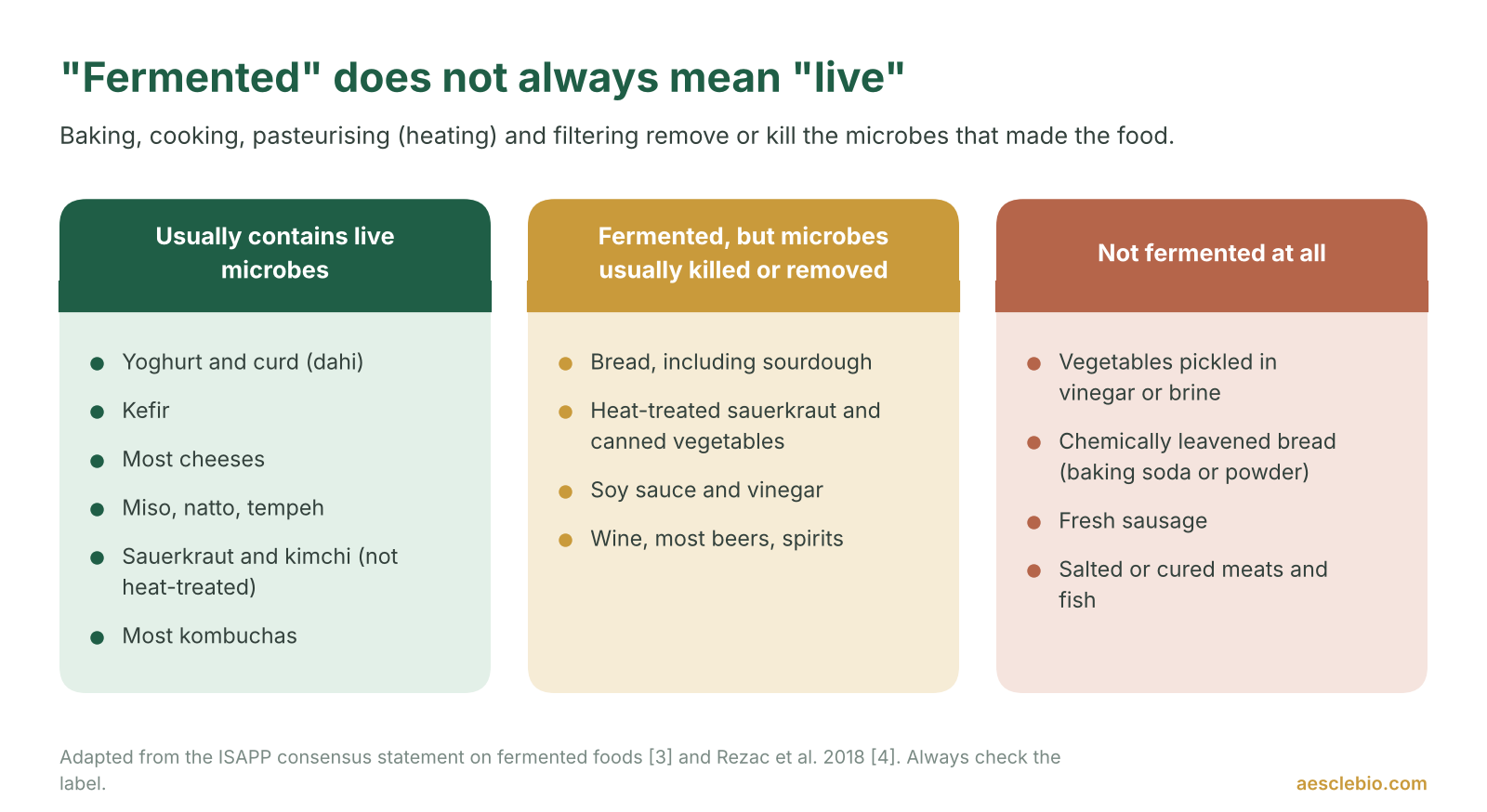
- The microbes are killed. Bread is baked. Many sauerkrauts, soy sauces and fermented sausages are heated after fermentation so that they keep longer on the shelf [3, 4]. Cooking heat also kills microbes, so foods steamed or cooked from a fermented batter will not contain live microbes either.
- The microbes are removed. Most wines and beers are filtered or otherwise treated to remove the microbes before bottling [3, 4].
- The food was never fermented. Many shop-bought pickles and olives are simply placed in salt water (brine) or vinegar, with no microbes involved [4].
The best probiotic foods? A list of what is really inside
Here is a practical probiotic foods list. It shows which foods are usually sources of live microbes and what to check on the pack. In yoghurt, cheese and fermented vegetables, most of the bacteria are lactic acid bacteria, the family that includes Lactobacillus and its close relatives, so these are the main "Lactobacillus foods" people search for. Natto, kombucha, miso and tempeh rely on other bacteria, yeasts or moulds [3, 5].
| Food | Live microbes? | What to check |
|---|---|---|
| Yoghurt and curd (dahi) | Yes, usually | Words such as "live" or "active cultures"; kept chilled |
| Kefir (fermented milk drink) | Yes, usually | Kept chilled; eaten before the use-by date |
| Most cheeses | Often | Varies with the type and age of the cheese |
| Miso, natto, tempeh | Usually, until cooked | Cooking at home kills the microbes, as it does for any food |
| Sauerkraut, kimchi and other fermented vegetables | Only if not heat-treated | Sold chilled and labelled "raw" or "unpasteurised" |
| Kombucha (fermented tea) | Most | Some brands are pasteurised (heat-treated) |
| Sourdough and other bread | No | Baking kills the microbes |
| Soy sauce, vinegar | Usually no | Usually heat-treated (pasteurised) |
| Pickles in vinegar or brine | Usually no | Most shop-bought pickles are not fermented; only those labelled "fermented" and sold chilled and unpasteurised may contain live microbes |
How many live microbes do these foods contain?
This is where any list of "foods high in probiotics" runs into trouble. A review of laboratory counts in shop-bought and factory-made fermented foods, covering about 50 years of studies, found that many contain large numbers of live microbes, but that counts can differ a great deal within the same type of food, depending on things such as the age of the product and where it was made [4]. Cultured dairy foods such as yoghurt and kefir regularly showed high counts, as did some fermented vegetables such as kimchi; long-aged hard cheeses tended to have the lowest [4].
Yoghurt is one of the few foods with an international minimum. The Codex Alimentarius Commission, the international food-standards body set up by the FAO and WHO, sets a minimum of 10 million live starter microbes in every gram of yoghurt, written as 10⁷ colony-forming units per gram [6]. Starter microbes are the ones added to turn milk into yoghurt. A "colony-forming unit", or CFU, is the standard way of counting live microbes.
There is a catch. Starter microbes are chosen because they turn milk into yoghurt. Apart from helping people who have difficulty digesting lactose (milk sugar) [3, 4], they have not generally been shown to give a particular health benefit. So a good yoghurt clearly passes the first test (alive), but not automatically the third (proven benefit). Apart from yoghurt and a few other fermented milks [6], most fermented foods have no minimum count at all, and their labels rarely say which microbes are inside or how many.
Myth or fact?
| Myth | What the evidence says |
|---|---|
| Every fermented food is a probiotic. | Only some fermented foods still contain live microbes, and very few have the defined content and proof that a probiotic needs [3]. |
| Microbes from yoghurt move into your gut and stay for good. | Microbes from fermented foods can survive the stomach and reach the large intestine, but they are unlikely to settle there for the long term. They pass through [3]. |
| Kombucha, kimchi and miso are proven to improve gut health. | A 2019 review found no randomised controlled trials (the strongest kind of study, where people are placed in groups by chance) testing kombucha, miso, kimchi or tempeh for gut health. Kefir, sauerkraut, natto and sourdough bread had each been tested in at least one [5]. |
| Fermented foods do nothing for you. | In a small 17-week study at Stanford University, 36 healthy adults were split into two diet groups of 18. Over the study, the group that ate more fermented foods developed a wider variety of gut bacteria, and several blood markers of inflammation (signs that the body's defence system is switched on) went down [7]. Encouraging, but small, and it needs repeating. |
Where probiotic supplements are different
A well-made probiotic supplement is designed to pass all three tests. It names the microbe in full: genus, species and strain code. Think of it as a family name, a first name and an identity number. It states how many live microbes it contains, ideally until the end of its shelf life and not only on the day it was made. And that exact strain should have been studied in people.
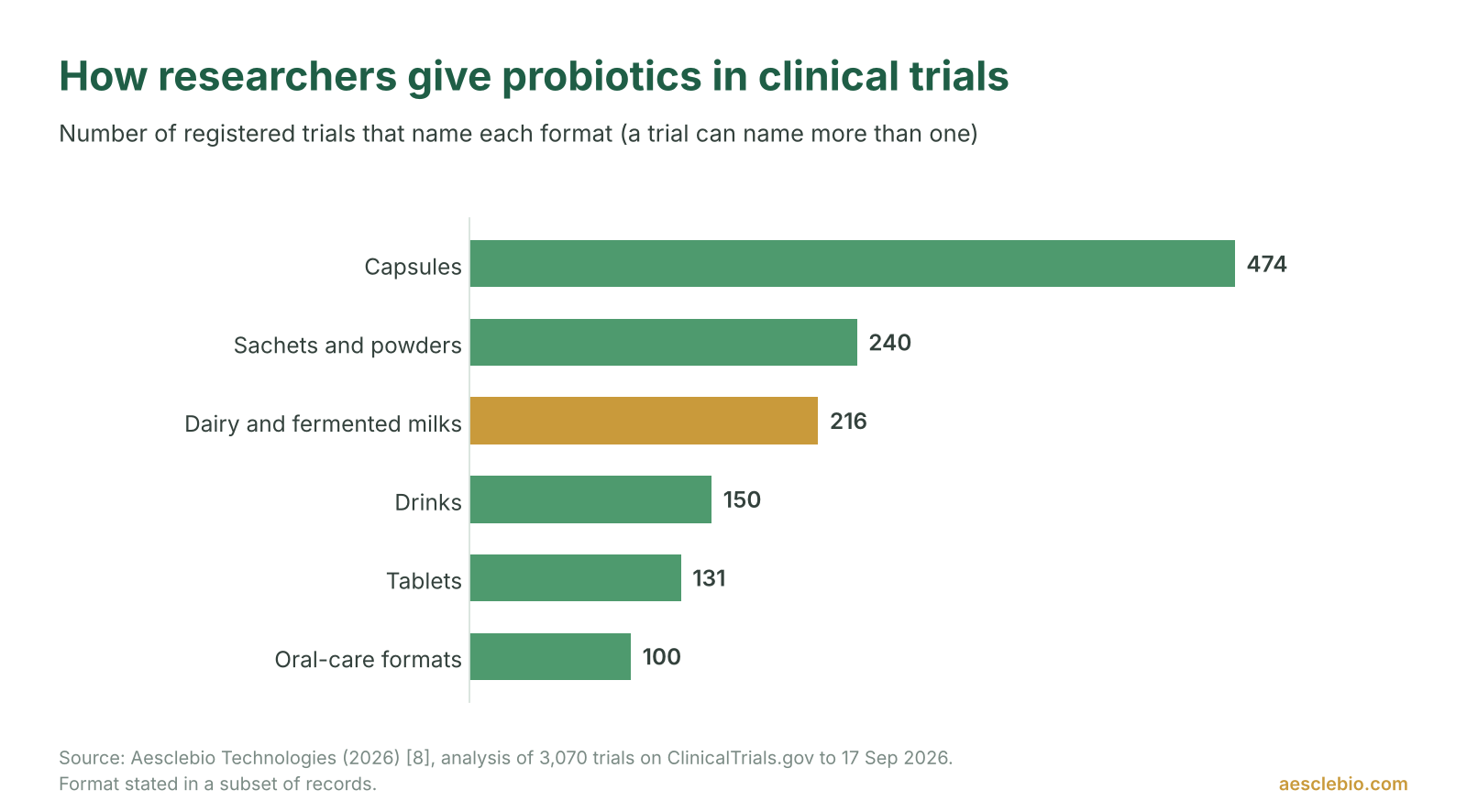
Our own research shows how differently science treats the two. In Aesclebio's analysis of 3,070 probiotic-type clinical trials (research studies in people) registered on ClinicalTrials.gov, the public trial registry run by the US National Library of Medicine, 2,461 (about 80%) tested live probiotics, while only 193 (about 6%) tested fermented foods [8]. Fermented-food trials were also much less likely to use the strongest study design: randomised, compared against a placebo (a dummy product), and "double-blind", meaning neither the volunteers nor the researchers know who is getting what [8].
None of this means supplements are always "better". It means they are built to answer a different question: does this particular microbe, at this amount, help with this particular thing? A bowl of yoghurt or a spoon of sauerkraut cannot answer that question, because nobody knows exactly what, or how much, is inside.
What about probiotic foods for bloating?
Many people look for probiotic foods for bloating. There is no single food proven to fix it, and evidence for specific fermented foods in gut symptoms is still limited [5]. Some people can notice more wind at first when they add fermented foods or extra fibre, so it can help to start with small portions. If bloating is frequent, painful or comes with other symptoms, see a doctor rather than treating it yourself.
How to choose: food, supplement, or both
When you buy fermented foods
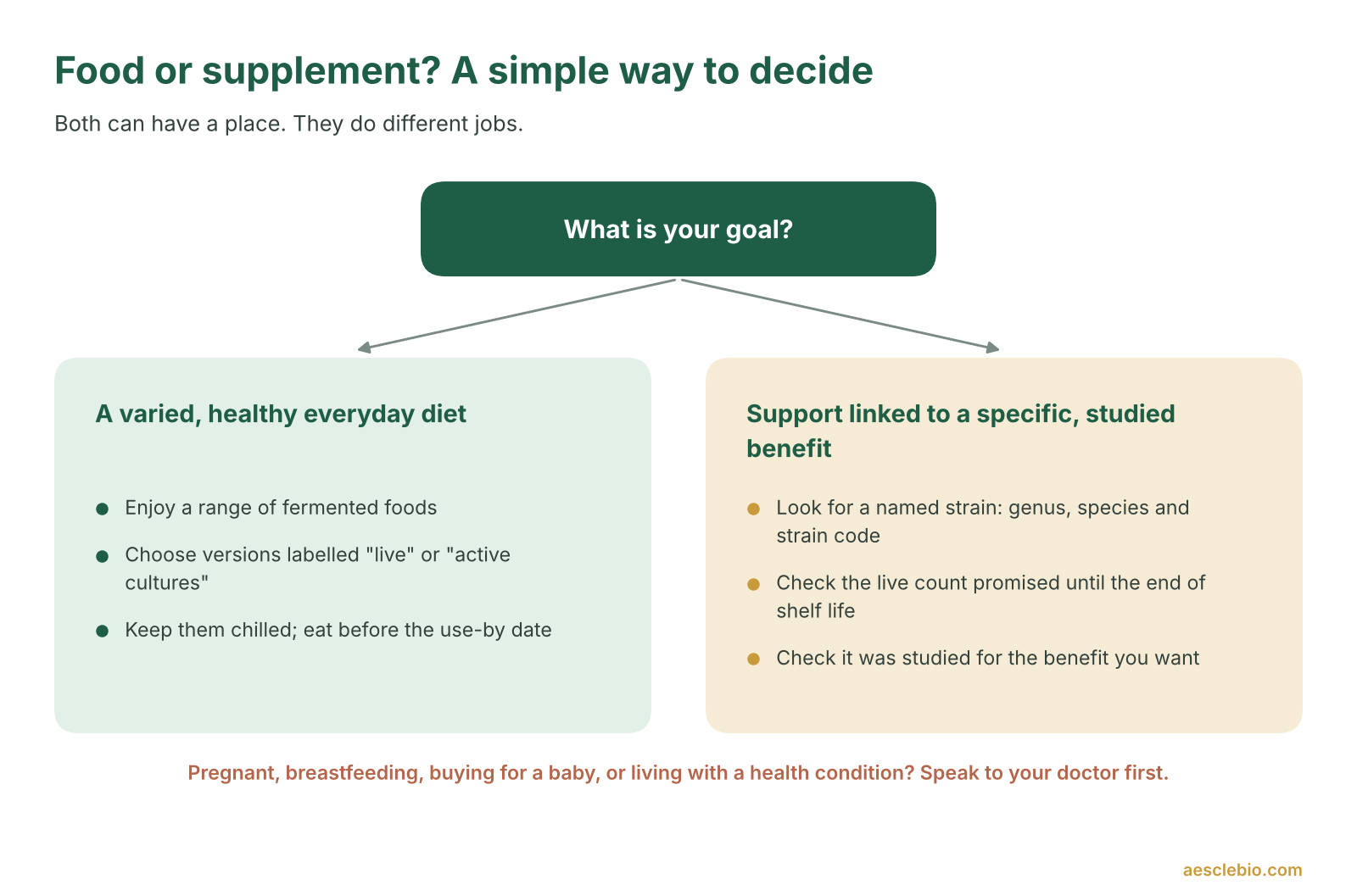
- Look for "live" or "active cultures" on the label.
- Choose chilled products and eat them before the use-by date.
- Check that the food was not "pasteurised" or "heat-treated" after fermentation.
- Eat a variety. Different foods carry different microbes.
When you buy a probiotic supplement
- Look for the full strain name: genus, species and strain code.
- Check the live count (in CFU) promised until the end of shelf life.
- Follow the storage instructions. Some products need the fridge; others do not.
- Check that the strain has been studied for the benefit you want.
- Choose a maker that follows good manufacturing practice (GMP), the quality rules for making foods and supplements safely and consistently.
The bottom line
Fermented foods are tasty and traditional, and they can be part of a healthy, varied diet. Some contain plenty of live microbes; many contain none at all. But a probiotic foods list is not a dose. It cannot tell you which microbes you are getting, how many, or whether they have been shown to help. When a specific, studied benefit is the goal, a well-made supplement with a named strain and a guaranteed live count is the more precise tool. Whichever you choose, read the label.
Frequently asked questions
What foods have probiotics besides yoghurt?
Besides yoghurt and curd, the foods most likely to contain live microbes are kefir, most cheeses, miso, natto, tempeh, sauerkraut and kimchi that have not been heat-treated, and most kombuchas [3]. Whether they truly count as "probiotic" depends on knowing which microbes are present, how many, and whether those microbes have a proven benefit.
Is yoghurt a probiotic?
Yoghurt contains live starter microbes: at least 10 million per gram under the international Codex standard [6]. These are chosen to make yoghurt; apart from helping people who struggle to digest lactose, they are not generally linked to a particular benefit [3, 4]. A yoghurt is a probiotic food only when it also contains named microbes at an amount shown in studies to help [3].
Does kombucha have probiotics?
Most kombuchas contain live bacteria and yeasts, but some are pasteurised, which kills them [3]. A 2019 review found no randomised controlled trials of kombucha for gut health [5].
Do sauerkraut and kimchi have probiotics?
Only if they have not been heated. Fermented vegetables sold chilled and labelled "raw" or "unpasteurised" usually contain live microbes; shelf-stable jars usually do not [3, 4]. The microbes inside are usually not identified, so they are live, but not proven probiotics [3].
Are there probiotic fruits and vegetables?
Fresh fruits and vegetables naturally carry some microbes, but these are not defined or studied, so they are not probiotic foods. Vegetables become a rich source of live fermentation microbes when they are fermented, as in sauerkraut and kimchi, and only if they are not heated afterwards [3, 4]. Fruits and vegetables are still valuable for other reasons, such as the fibre they provide.
Does tofu have probiotics?
Plain tofu is made by setting soy milk, not by fermentation, so it is not a probiotic food [5]. The fermented soy foods are miso, natto and tempeh, which usually contain live microbes until they are cooked [3].
Which foods are highest in probiotics?
Cultured dairy foods such as yoghurt and kefir regularly show high counts of live microbes, and so do some fermented vegetables such as kimchi [4]. Counts vary a great deal from product to product, so the label matters more than the type of food.
Are natural probiotics in foods better than supplements?
Neither is simply "better"; they do different jobs. Fermented foods add variety and flavour to a balanced diet. A supplement is designed to deliver a specific, studied strain in a known amount. If you are pregnant, breastfeeding, buying for a baby or living with a health condition, speak to your doctor first.
Related reading
- What Probiotics Are, and the Five Myths That Survive Every Explainer
- Microbiome vs Microbiota: The Words Everyone Uses and Almost Nobody Defines
- Billions of CFU, Little Meaning: Why the Biggest Number on the Label Rarely Wins
- Prebiotic Fibres Decoded: Inulin, FOS, GOS and HMOs
References
- Food and Agriculture Organization of the United Nations and World Health Organization. Probiotics in food: health and nutritional properties and guidelines for evaluation. FAO Food and Nutrition Paper 85. Rome: FAO; 2006. Link
- Hill C, Guarner F, Reid G, et al. Expert consensus document: the International Scientific Association for Probiotics and Prebiotics consensus statement on the scope and appropriate use of the term probiotic. Nature Reviews Gastroenterology & Hepatology. 2014;11:506–514. Open access. Link
- Marco ML, Sanders ME, Gänzle M, et al. The International Scientific Association for Probiotics and Prebiotics (ISAPP) consensus statement on fermented foods. Nature Reviews Gastroenterology & Hepatology. 2021;18:196–208. Free full text: PubMed Central PMC7925329. Link
- Rezac S, Kok CR, Heermann M, Hutkins R. Fermented foods as a dietary source of live organisms. Frontiers in Microbiology. 2018;9:1785. Open access. Link
- Dimidi E, Cox SR, Rossi M, Whelan K. Fermented foods: definitions and characteristics, impact on the gut microbiota and effects on gastrointestinal health and disease. Nutrients. 2019;11(8):1806. Open access. Link
- Codex Alimentarius Commission. Standard for Fermented Milks (CXS 243-2003). Rome: FAO and WHO. Link
- Wastyk HC, Fragiadakis GK, Perelman D, et al. Gut-microbiota-targeted diets modulate human immune status. Cell. 2021;184(16):4137–4153. Free full text: PubMed Central PMC9020749. Link
- Aesclebio Technologies. Probiotic Clinical Trials: Where the Industry Is Heading. A registry-based analysis of ClinicalTrials.gov data to 17 September 2026. Hyderabad: Aesclebio Technologies Pvt. Ltd.; 2026. Link
Disclaimer
This article is for general education only. It is not medical advice and is not intended to diagnose, treat, cure or prevent any disease. It does not promote any specific product or brand, and it makes no claims about any product.
Statements about research describe the findings of published studies. They do not mean that any particular food or supplement will have the same effect for you. Always speak to a qualified healthcare professional before changing your diet or starting a supplement, especially if you are pregnant, breastfeeding, giving products to a baby or child, or living with a health condition.
Rules on how probiotics and supplements may be described differ from country to country. Nothing in this article should be read as a health claim for any product.
All graphics are original works of Aesclebio Technologies. Figures from other studies are credited to their sources. Quotations are limited to short passages with full attribution. Any clinical-trial figures from Aesclebio's own analysis come from public registry records and do not imply that any product is effective or safe.
Prepared by the Aesclebio Research Team with the help of AI tools, under the team's direction. © 2026 Aesclebio Technologies Pvt. Ltd. All rights reserved. Short extracts may be quoted with a link to the original article.