
Probiotic Basics
Prebiotics, Probiotics, Postbiotics, Synbiotics: A Field Guide Beyond the Buzzwords
What each of the four "biotics" really is, where the evidence stands, and how to tell which one you need, explained in plain language.
Why "pre and post probiotics" confuse so many people
Every month, thousands of people type searches such as "pre and post probiotics", "pre and post biotics", "prebiotic vs probiotic vs postbiotics" or simply "prebiotics probiotics and postbiotics" into search engines. Add synbiotics to the mix and you have four words that sound almost the same, often printed on the same shelf, sometimes on the same pack. No wonder people ask which one they need.
Here is the argument of this article: the four "biotics" are not rival products fighting for a place in your cupboard. They are four roles in one system: the microbes, their food, the two together, and the useful remains of microbes that are no longer alive. Each word now has an agreed scientific meaning, and each one sets a test that a product has to pass. Once you know those tests, the buzzwords become much easier to read, and the label word starts to matter less than the evidence behind the specific product.
Prebiotic vs probiotic vs postbiotic vs synbiotic: the official definitions
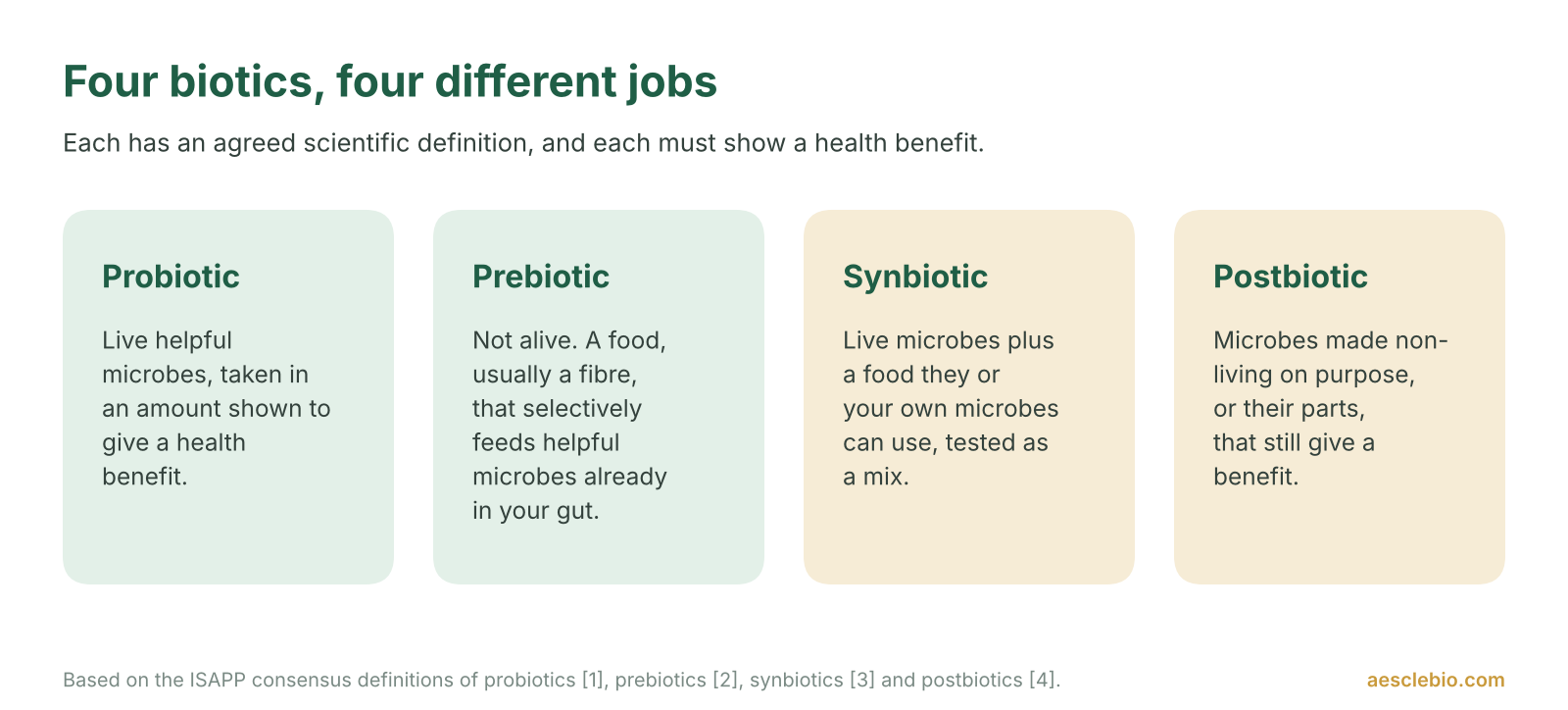
Between 2014 and 2021, the International Scientific Association for Probiotics and Prebiotics (ISAPP), a non-profit group of scientists, brought together expert panels to define each term. Their four consensus statements are free to read and are now a widely used reference point for scientists [1, 2, 3, 4]. A "microorganism", or microbe, is a living thing too small to see, such as a bacterium or a yeast. "The host" simply means the person (or animal) taking the product.
| Term | Agreed definition (short quote) | In plain words |
|---|---|---|
| Probiotic (2014) | "Live microorganisms that, when administered in adequate amounts, confer a health benefit on the host" [1] | Helpful live microbes, taken in a big enough amount |
| Prebiotic (2017) | "A substrate that is selectively utilized by host microorganisms conferring a health benefit" [2] | Food that only certain helpful gut microbes can use |
| Synbiotic (2020) | "A mixture comprising live microorganisms and substrate(s) selectively utilized by host microorganisms that confers a health benefit on the host" [3] | Live microbes plus their food, shown to help as a mix |
| Postbiotic (2021) | "Preparation of inanimate microorganisms and/or their components that confers a health benefit on the host" [4] | Microbes made non-living on purpose, or their parts, that still help |
Look at the last few words of every definition: "confer a health benefit". That phrase is the real dividing line. A product is not a probiotic just because it contains bacteria, and a fibre is not a prebiotic just because it reaches the gut. Each needs evidence of a benefit in the host [1, 2].
Probiotics: the live microbes
Probiotics must be alive when you take them, and present in an amount shown to help. The 2014 panel said some gut benefits are shared by many well-studied probiotic species, while other effects, such as those on the body's defence (immune) system, are probably more strain-specific, meaning they belong to one particular type within a species [1]. The same panel said fermented foods with live cultures that have not been studied should be described as "containing live and active cultures", not called probiotic [1].
Prebiotics: food for your own helpful microbes
A prebiotic is not alive. It is a food ingredient, usually a type of fibre, that selectively feeds helpful microbes already living in you [2]. "Selectively" is the key word: most fibres feed a wide range of gut microbes, so not every fibre is a prebiotic [2]. The best-documented prebiotics in people are fructans (fibres built from the sugar fructose), such as inulin and fructo-oligosaccharides (FOS), and galactans (fibres built from the sugar galactose), such as galacto-oligosaccharides (GOS) [2]. The dose must be large enough to have an effect, but not so large that it causes discomfort such as excess gas [2].
Synbiotics: live microbes and their food, together
Many people assume the "syn" in synbiotic means synergy, that is, one plus one making three. The panel was clear that it simply means "together" [3]. A synbiotic is live microbes plus a food that helpful microbes can use, and the mixture as a whole must have shown a health benefit [3]. There are two kinds, explained below.
Postbiotics: dead does not mean useless
A postbiotic contains microbes that have been made non-living on purpose (inactivated), for example by heat, or their cell parts, with or without the substances they produced while growing [4]. The panel set firm limits. Purified substances on their own, such as a single short-chain fatty acid (an acid that gut bacteria make from fibre), are not postbiotics, and neither are vaccines [4]. The microbes used must be identified before they are inactivated, so a mix of unknown microbes does not qualify [4].
Complementary vs synergistic synbiotics, in plain words
Think of a garden. A complementary synbiotic is like planting new seeds and, separately, adding fertiliser for the plants already growing there. The live microbe is an established probiotic and the food is an established prebiotic; each must meet its own minimum standard, and they work side by side [3]. A synergistic synbiotic is like a seed sold with its own special fertiliser: the food is chosen so that the added microbe itself can use it [3]. To prove that, the same study must show both a health benefit and that the added microbe really used the food [3].
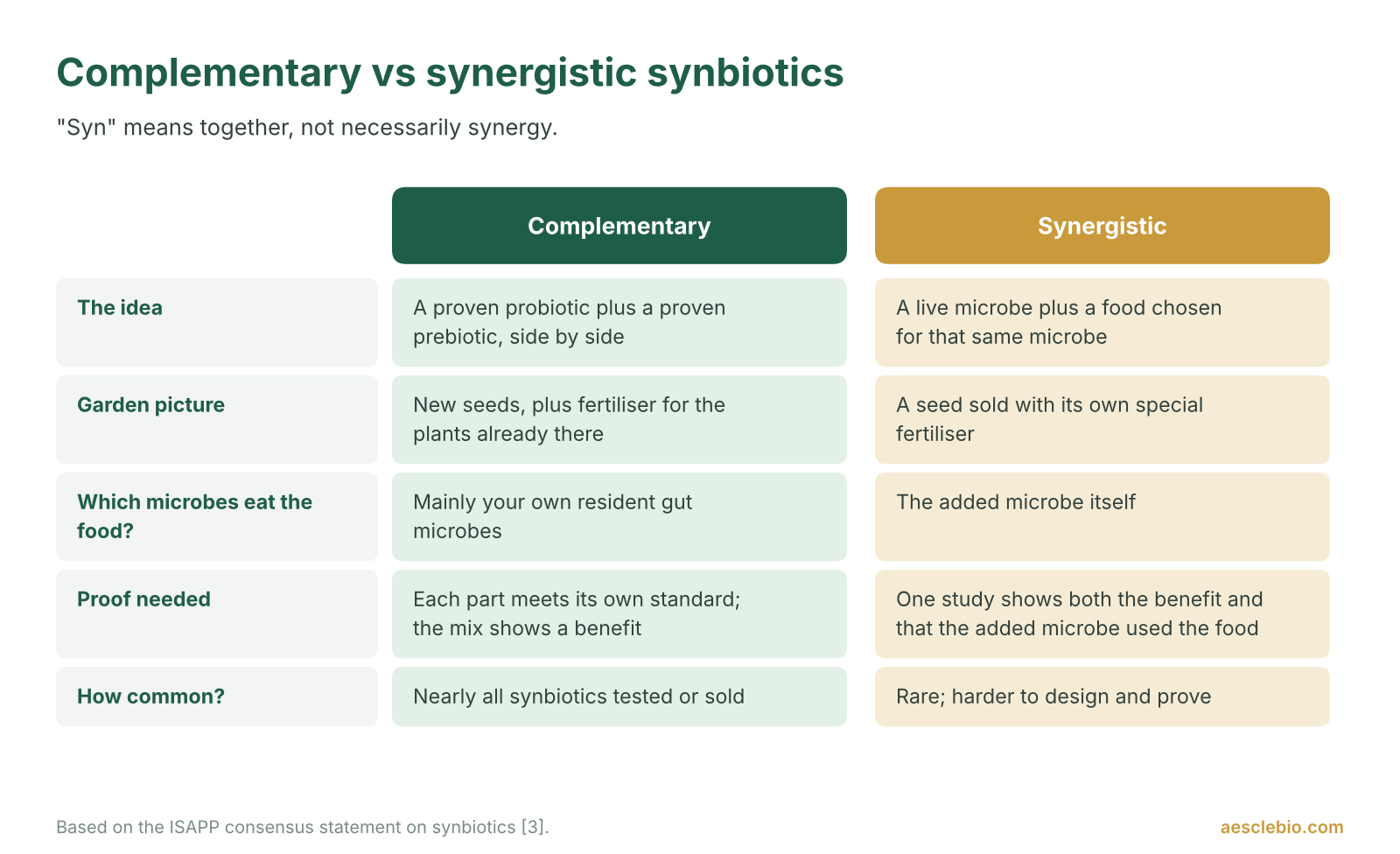
One honest detail: the panel noted that nearly all synbiotics tested in published trials or sold in shops are the complementary kind [3]. It also said that a product with evidence for each part separately, but not for the mix, should not be called a synbiotic; it should simply say it "contains probiotics and prebiotics" [3].
Where each biotic has real evidence
The four categories are not equally mature. The table below gives one example of the evidence for each, and how strong it is. Remember that results belong to the specific product studied, not to every product carrying the same label word.
| Category | Example of evidence | How strong? |
|---|---|---|
| Probiotics | In 42 trials with 11,305 adults taking antibiotics, those also given probiotics were about 37% less likely to develop antibiotic-associated diarrhoea; only certain species, mainly from two well-known groups of helpful bacteria (lactobacilli and bifidobacteria), made a difference [5] | Moderate quality overall; the largest evidence base |
| Prebiotics | A review of 47 studies pooled 29 placebo-controlled trials: short-chain fructans (shorter fibre chains, such as FOS) increased how often people opened their bowels, by about one extra bowel movement every three days; long-chain fructans (such as long-chain inulin) showed no clear effect [6] | Clear for bowel frequency with short-chain fructans, though results varied a lot between trials; other benefits still being studied [2, 6] |
| Synbiotics | Many trials and meta-analyses exist, but almost all test complementary mixtures; the combination itself must be tested [3] | Varies by product; few true synergistic synbiotics proven |
| Postbiotics | Inactivated (heat-killed) bacteria have shown benefits in some trials, including one with 443 people with irritable bowel syndrome (IBS), a common long-term gut condition [4] | Early: human data limited and of variable quality [4] |
Notice the pattern. Even in the strongest category, the antibiotic study found that only certain species worked, and that people at low risk of diarrhoea saw no clear difference [5]. In the prebiotic study, short-chain and long-chain fructans behaved differently [6]. The type matters more than the category. That is the real answer to "which biotic is best": the one whose exact form has been tested for the goal you care about.
Postbiotics and synbiotics are where research is growing fastest
Our own research shows how quickly the field is changing. Aesclebio analysed 3,070 clinical trials (research studies in people) of probiotic-type products registered on ClinicalTrials.gov, the public trial registry run by the US National Library of Medicine, up to 17 September 2026 [7]. Using statistical trend models for registrations between 2014 and 2025, we found that postbiotics grew by about 34% a year, synbiotics by 14% and live probiotics by 9%, while fermented foods have stalled at +4%, a change too small to rule out chance (not statistically significant) [7].
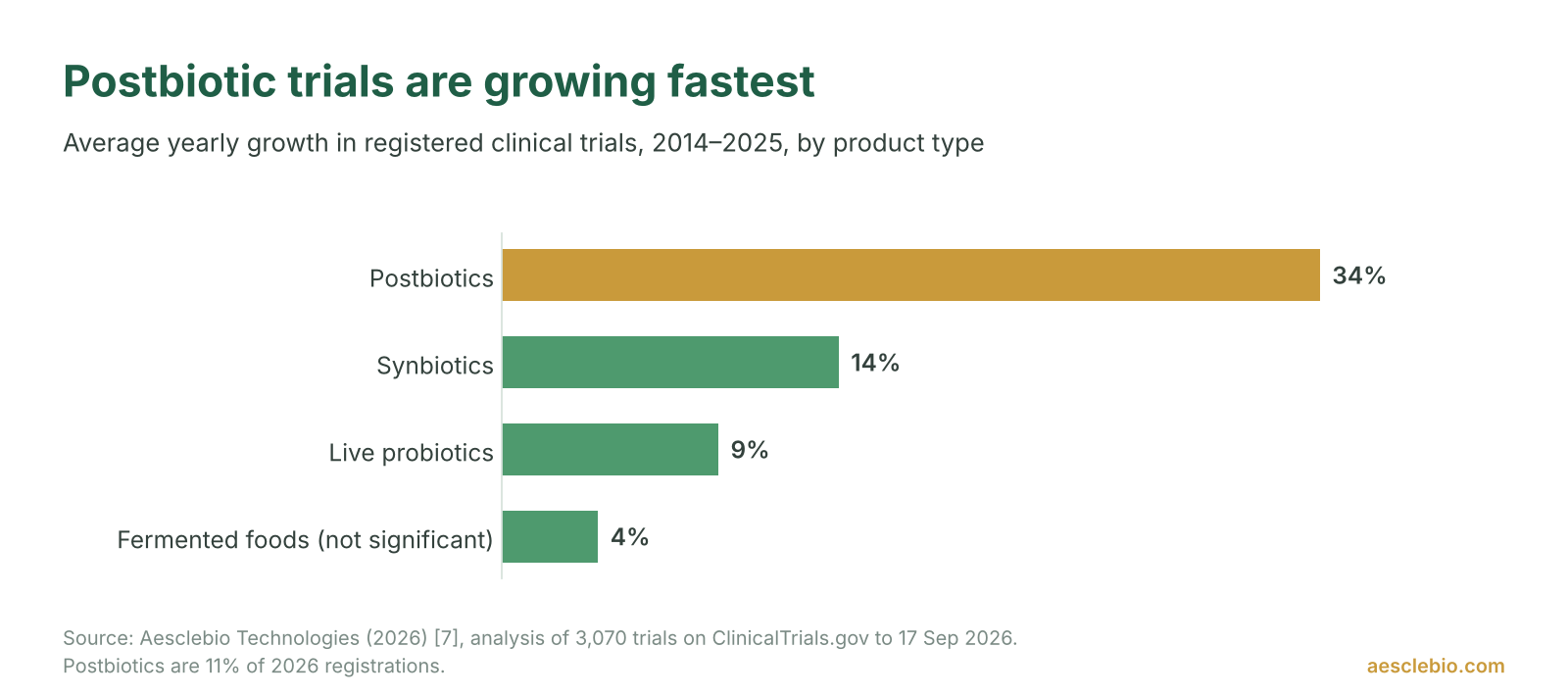
Postbiotics already make up 11% of 2026 registrations, against 4% of all trials to date [7]. Live probiotics still dominate, at about 80% of all trials [7]. Part of the reason for the postbiotic rise is practical: inactivated microbes do not have to be kept alive, so long shelf life is easier to achieve [4, 7]. One more point blurs the lines: the postbiotic panel noted that most probiotic products, especially near the end of their shelf life, already contain large numbers of dead microbes alongside the live ones [4]. A growing number of trials is a sign of interest, not proof that any product works.
Why the biotics work together rather than compete
Seen side by side, the four categories fit together. A prebiotic can feed the microbes you already have, or the probiotic you add. A synbiotic packages both. A postbiotic can carry some of the useful parts of a microbe without needing it to stay alive. Even the definitions overlap on purpose: the synbiotic definition counts both your own resident microbes and added probiotics as "host microorganisms" that the food can feed [3]. That is why "pre pro and postbiotics in one" products exist, and why choosing one does not mean rejecting the others.
| Myth | What the evidence says |
|---|---|
| You must choose between prebiotics, probiotics and postbiotics. | They do different jobs and can be combined. What matters is whether the specific product has evidence [1, 2, 3, 4]. |
| "Synbiotic" means the ingredients boost each other. | "Syn" means "together". Most synbiotics are complementary: two proven parts working side by side [3]. |
| All fibre is prebiotic. | Most fibres feed many gut microbes at once. A prebiotic must be used selectively by helpful microbes and show a benefit [2]. |
| Dead bacteria cannot do anything. | Some inactivated microbes have shown benefits in trials, though the evidence is still early [4]. |
| Any fermented food is a probiotic. | Fermented foods are a separate category. Only those with live, defined microbes and evidence of benefit can claim to contain probiotics [1, 8]. |
How to read the label: pre post and probiotics benefits start with the details
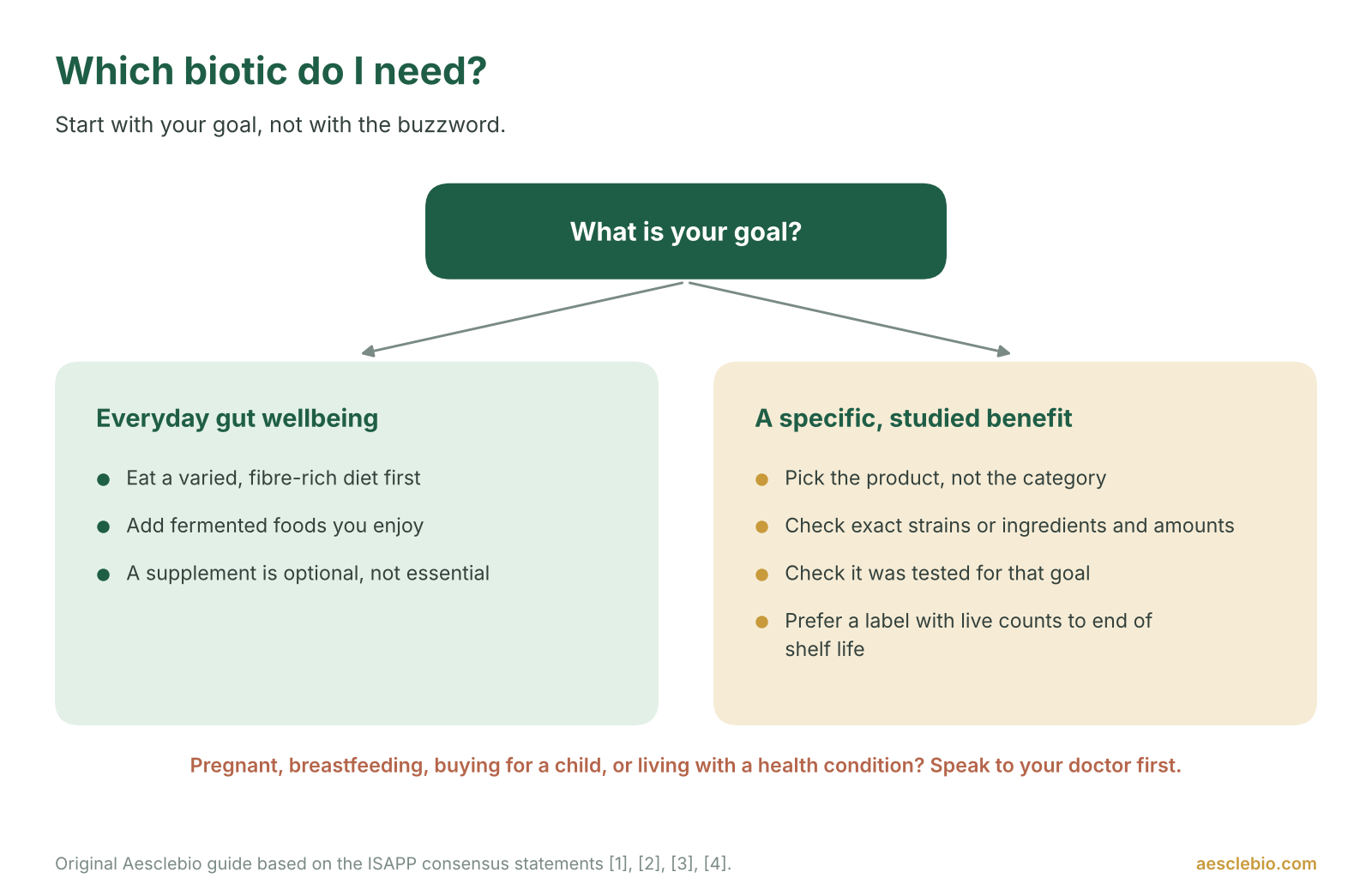
Whichever biotic you are looking at, a trustworthy label tells you what exactly is inside, how much, and what it was studied for. Use this checklist.
- Probiotic: the full name of each microbe (genus, species and strain code, like a family name, first name and identity number) and the live count in colony-forming units (CFU), the standard count of live microbes, promised until the end of shelf life [1].
- Prebiotic: the named ingredient (for example inulin, FOS or GOS) and the amount per serving, at a dose that has been studied [2].
- Synbiotic: both parts named with amounts. If the mix itself has not been tested, the honest wording is "contains probiotics and prebiotics" [3].
- Postbiotic: the microbe it was made from, how it was inactivated (for example by heat) and the amount. Inactivation methods can change what the final product contains [4].
- For every product: a maker that follows good manufacturing practice (GMP), the quality rules for making foods and supplements safely and consistently.
The bottom line
Probiotics, prebiotics, synbiotics and postbiotics are not four competing fashions. They are four tools: live microbes, their food, the two combined, and useful microbes that are no longer alive. Each has an agreed definition, and each definition ends with the same test: a proven health benefit. So the smartest question is not "which biotic?" but "which exact product, studied for what, at what amount?" Start with a fibre-rich, varied diet, read labels for names and numbers, and if you are pregnant, breastfeeding, buying for a child or living with a health condition, ask your doctor first.
Frequently asked questions
What's the difference between prebiotic, probiotic and postbiotic?
A probiotic is a live microbe that gives a health benefit in a big enough amount. A prebiotic is a food, usually a fibre, that selectively feeds helpful microbes already in your gut. A postbiotic is a preparation of microbes made non-living on purpose, or their parts, that still gives a benefit [1, 2, 4]. All three must show a proven health benefit to earn the name.
What are synbiotics?
A synbiotic is a mixture of live microbes and a food that helpful microbes can use, which has been shown to give a health benefit as a mix [3]. Complementary synbiotics combine a proven probiotic with a proven prebiotic. Synergistic synbiotics pair a microbe with a food chosen specifically for that microbe [3]. Most synbiotics on sale are the complementary kind.
Prebiotics vs probiotics: what is the difference between prebiotics and probiotics?
Probiotics are living microbes that you add. Prebiotics are not alive; they are food for the helpful microbes you already have [1, 2]. A simple way to remember it: probiotics are the seeds, prebiotics are the fertiliser. They can be taken separately or together, and each should have evidence for the specific ingredient and dose.
What do pre and post biotics do?
Prebiotics feed selected helpful gut microbes, and the best-studied ones, such as short-chain fructans, made bowel movements more frequent when trials were pooled [2, 6]. Postbiotics deliver inactivated microbes or their parts; some have shown benefits in early trials, including in people with irritable bowel syndrome, but human evidence is still limited [4].
Probiotics vs postbiotics: which is better?
Neither is simply better. Probiotics have far more research behind them [5, 7]. Postbiotics do not need to be kept alive, so they are easier to store and add to different formats, and research on them is growing fast [4, 7]. The best choice is a specific product with evidence for the benefit you want.
Do I need prebiotics and probiotics?
Many people get prebiotic-type fibres from a varied, plant-rich diet. Whether you also need a supplement depends on your goal. For general wellbeing, diet comes first. For a specific goal, look for a product whose exact strain or ingredient was studied for it [1, 2]. If you are pregnant, breastfeeding, buying for a child or have a health condition, speak to your doctor first.
What are the best pre and post probiotics?
There is no single best product. The best pre and post probiotics for you are those whose exact strain, ingredient and amount have been tested in people for the benefit you want [1, 2, 4]. A clear label with full strain names, amounts and live counts until the end of shelf life is a better guide than a long list of buzzwords.
Can you take pre, pro and postbiotics in one product?
Yes. Products combining all three exist, and the categories are designed to work together rather than compete [3, 4]. But each part should be named with its amount, and ideally the combination itself should have been tested. If a mix of probiotic and prebiotic has not been tested together, the honest label wording is "contains probiotics and prebiotics" [3].
Is fermented food (like yogurt) a probiotic, prebiotic or postbiotic?
Fermented foods such as yoghurt (yogurt) are a separate category. They may contain live microbes, but they count as probiotic only when the microbes are defined and shown to give a benefit [1, 8]. Heat-treated fermented foods contain no live microbes; they are not automatically postbiotics either, because the microbes must be identified and a benefit shown [4].
Related reading
- Prebiotic Fibres Decoded: Inulin, FOS, GOS and HMOs
- What Probiotics Are, and the Five Myths That Survive Every Explainer
- Your Probiotic Is a Strain, Not a Species: Reading the Code After the Name
- Probiotic Foods vs Probiotic Supplements: Why a Probiotic Foods List Is Not a Dose
- Billions of CFU, Little Meaning: Why the Biggest Number on the Label Rarely Wins
References
- Hill C, Guarner F, Reid G, et al. Expert consensus document: the International Scientific Association for Probiotics and Prebiotics consensus statement on the scope and appropriate use of the term probiotic. Nature Reviews Gastroenterology & Hepatology. 2014;11(8):506–514. Open access. Link
- Gibson GR, Hutkins R, Sanders ME, et al. Expert consensus document: the International Scientific Association for Probiotics and Prebiotics (ISAPP) consensus statement on the definition and scope of prebiotics. Nature Reviews Gastroenterology & Hepatology. 2017;14(8):491–502. Open access. Link
- Swanson KS, Gibson GR, Hutkins R, et al. The International Scientific Association for Probiotics and Prebiotics (ISAPP) consensus statement on the definition and scope of synbiotics. Nature Reviews Gastroenterology & Hepatology. 2020;17(11):687–701. Free full text: PubMed Central PMC7581511. Link
- Salminen S, Collado MC, Endo A, et al. The International Scientific Association of Probiotics and Prebiotics (ISAPP) consensus statement on the definition and scope of postbiotics. Nature Reviews Gastroenterology & Hepatology. 2021;18(9):649–667. Free full text: PubMed Central PMC8387231. Link
- Goodman C, Keating G, Georgousopoulou E, et al. Probiotics for the prevention of antibiotic-associated diarrhoea: a systematic review and meta-analysis. BMJ Open. 2021;11(8):e043054. Free full text: PubMed Central PMC8362734. Link
- de Vries J, Le Bourgot C, Calame W, et al. Effects of β-fructans fiber on bowel function: a systematic review and meta-analysis. Nutrients. 2019;11(1):91. Free full text: PubMed Central PMC6356805. Link
- Aesclebio Technologies. Probiotic Clinical Trials: Where the Industry Is Heading. A registry-based analysis of ClinicalTrials.gov data to 17 September 2026. Hyderabad: Aesclebio Technologies Pvt. Ltd.; 2026. Link
- Marco ML, Sanders ME, Gänzle M, et al. The International Scientific Association for Probiotics and Prebiotics (ISAPP) consensus statement on fermented foods. Nature Reviews Gastroenterology & Hepatology. 2021;18:196–208. Free full text: PubMed Central PMC7925329. Link
Disclaimer
This article is for general education only. It is not medical advice and is not intended to diagnose, treat, cure or prevent any disease. It does not promote any specific product or brand, and it makes no claims about any product.
Statements about research describe the findings of published studies. They do not mean that any particular food or supplement will have the same effect for you. Always speak to a qualified healthcare professional before changing your diet or starting a supplement, especially if you are pregnant, breastfeeding, giving products to a baby or child, or living with a health condition.
Rules on how probiotics and supplements may be described differ from country to country. Nothing in this article should be read as a health claim for any product.
All graphics are original works of Aesclebio Technologies. Figures from other studies are credited to their sources. Quotations are limited to short passages with full attribution. Any clinical-trial figures from Aesclebio's own analysis come from public registry records and do not imply that any product is effective or safe.
Prepared by the Aesclebio Research Team with the help of AI tools, under the team's direction. © 2026 Aesclebio Technologies Pvt. Ltd. All rights reserved. Short extracts may be quoted with a link to the original article.