
Infant & Child Health
The Gassy Newborn: What's Normal, What Isn't, and Where the Gut Microbiome Fits
Why newborns are so gassy, how to tell gas from colic and reflux, gentle ways to help, the warning signs that need a doctor, and what probiotic research really shows.
Why so many parents search for a gassy baby
In the small hours of the night, worried parents type "gassy baby", "gas baby", "crying gas" or "gas on newborn" into their phones. Their baby is squirming, red in the face and pulling up its legs, and it seems obvious that trapped wind is to blame. Our argument is simple: gas in newborns is real and normal, but it is usually a sign of being new, not a sign that something is wrong. Knowing the difference helps you soothe your baby, and helps you spot the rare times when you need a doctor.
Why is my newborn so gassy?
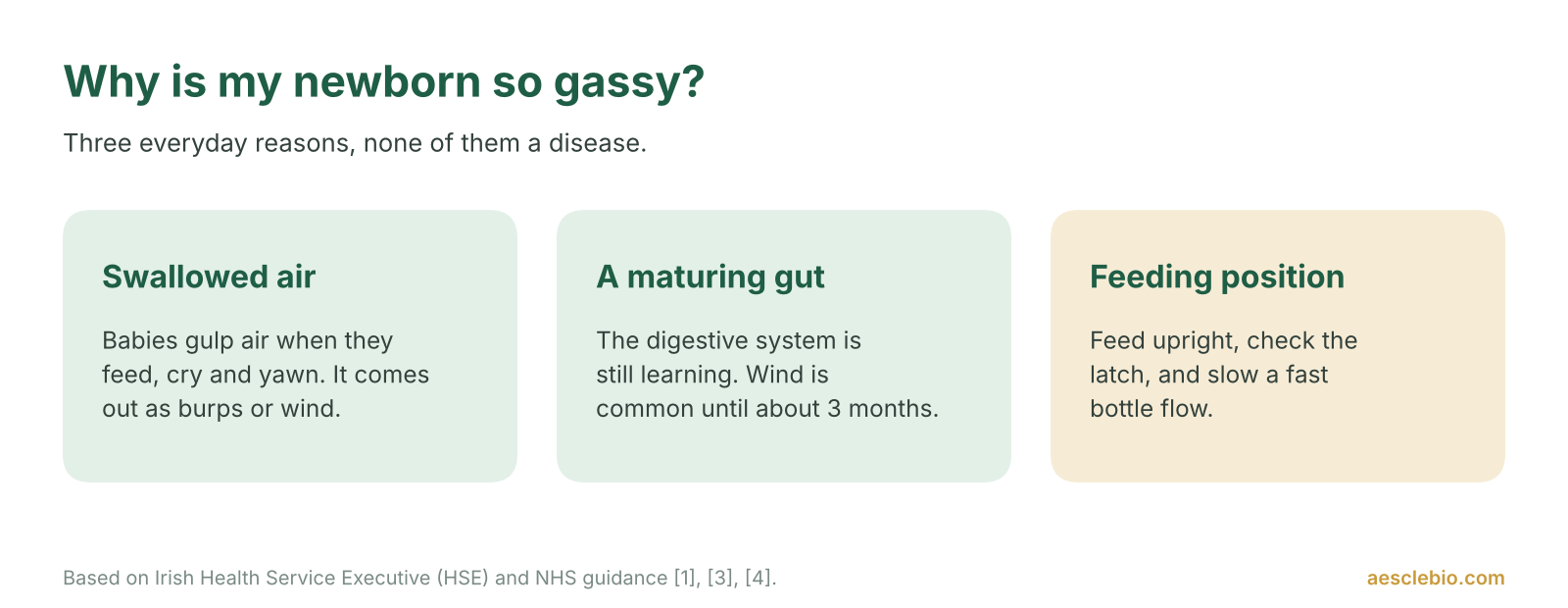
There are three everyday causes of gas in babies. None of them is a disease.
- Swallowed air. Babies gulp air while feeding, crying and even yawning. The air can get trapped in the tummy and cause discomfort until it comes up as a burp or out the other end as wind [3, 4].
- A gut that is still maturing. Wind is common from the newborn stage until about 3 months, while the digestive system matures [3]. Young babies may simply find food harder to digest [1].
- Feeding position and flow. How a baby feeds matters too. Health services suggest holding your baby upright during feeds, checking that a breastfed baby is well attached, and, for bottle feeds, slowing the flow or trying a different teat size [1, 3].
So a newborn farting a lot, or passing lots of gas after feeds, is usually just a normal part of a gut that is still maturing [3].
Signs of gas in a newborn: how to tell if your baby is gassy
Parents often ask how to tell if a newborn is gassy. The signs that a baby needs to bring up wind include seeming uncomfortable during a feed, crying, an arched back, drawing the legs up towards the tummy and clenched fists [4]. A gassy baby may also squirm or cry during a feed, or look uncomfortable when laid down after feeds [3]. Many babies relax once they burp or pass wind.
These symptoms of a gassy newborn overlap heavily with colic and reflux, which is why so many parents feel unsure. The table below sets out the differences.
Colic vs gas vs reflux: what's the difference?
Colic is the name for a baby who cries a lot without an obvious cause. The NHS says a baby may have colic if they cry "more than 3 hours a day, 3 days a week for at least 1 week" while otherwise healthy [1]. Reflux is when a baby brings up milk, or is sick, during or shortly after a feed [5]. Wind can be part of both.
| Normal gas (wind) | Colic | Reflux | |
|---|---|---|---|
| What it looks like | Squirming, legs drawn up, settles after a burp or passing wind | Long bouts of intense crying, hard to soothe, red face, clenched fists, windy tummy | Bringing up milk or being sick during or after feeds; coughing or hiccupping while feeding |
| When it happens | Around feeds | Often worse in the afternoon and evening | During or soon after feeds |
| Usual age | Newborn to about 3 months | Starts at a few weeks; usually stops by 3 to 4 months | Starts before about 8 weeks; usually better by 1 year |
| Is it a worry? | No, if your baby feeds and grows well | Hard on parents; see a doctor if nothing helps or weight gain is poor | Usually not, unless the baby feeds poorly or does not gain weight |
Here is the twist. Colicky babies often pass gas while they cry, but the American Academy of Pediatrics (AAP), the professional body for US children's doctors, says there is no definite explanation for colic [2]. And crying makes babies swallow more air [3]. So the gas you hear during a long crying spell may partly be the result of the crying, not its cause.
How to relieve newborn gas: gentle techniques health services suggest
No single trick works for every baby, but these simple steps are widely advised by health services and are safe when done gently.
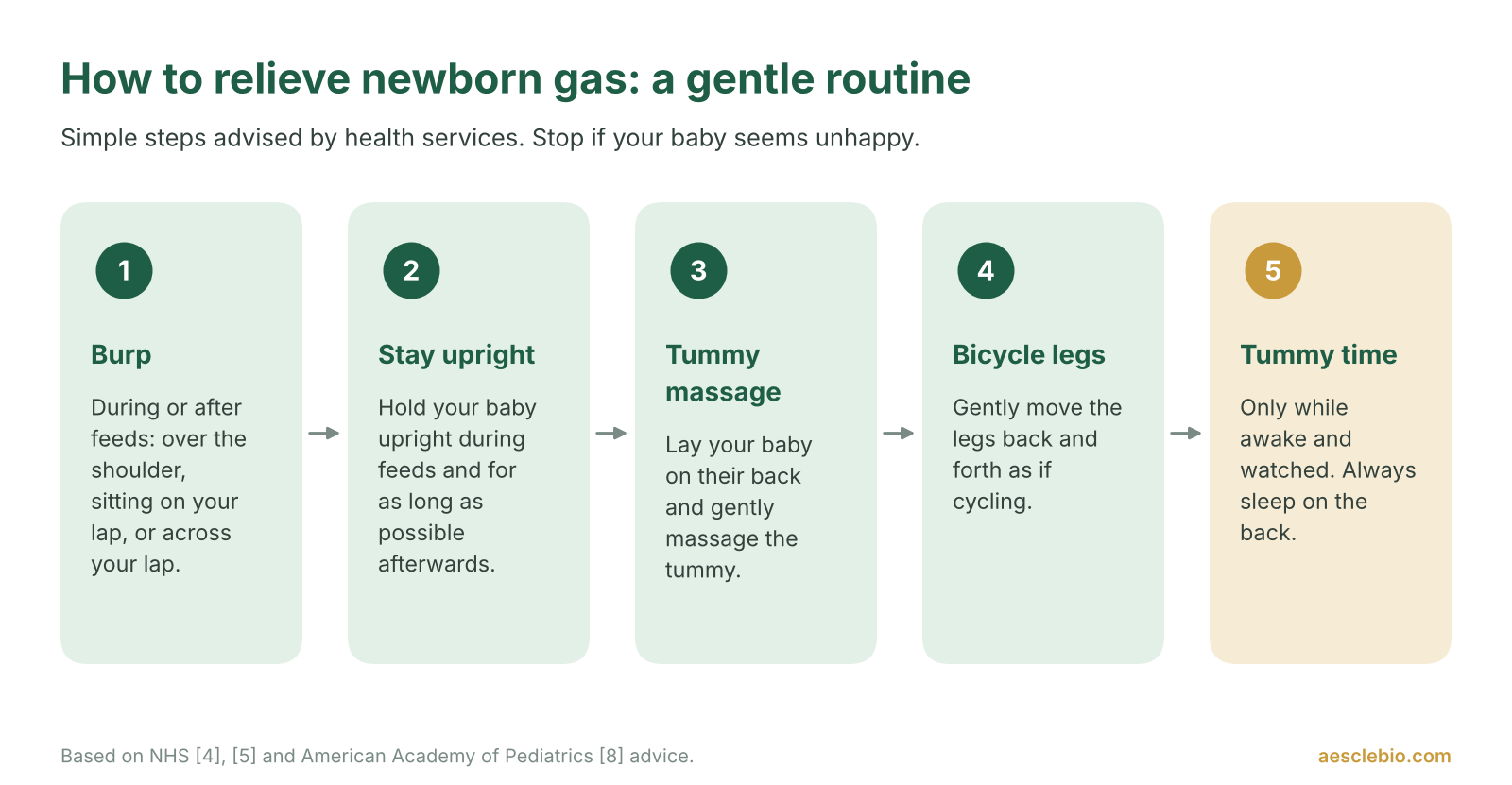
1. Burp your baby
Some babies need burping during a feed and others after; if your baby seems unsettled while feeding, take a short break [4]. Three positions are commonly suggested: over your shoulder, sitting on your lap leaning slightly forward with their chin supported, or lying face down across your lap. Keep their back straight, avoid pressing on the throat, and gently rub or pat their back. A couple of minutes is usually enough [4].
2. Keep your baby upright after feeds
Health services advise holding your baby upright during feeds and for as long as possible afterwards, for both wind and reflux [3, 5]. Responding quickly to crying also helps, because leaving a baby to cry makes them swallow more air [3].
3. Tummy massage and bicycle legs
If your baby still won't burp, the NHS suggests lying them on their back, gently massaging their tummy and moving their legs back and forth as if cycling [4]. For an infant massage for gas, keep your touch light and gentle on the tummy (the stomach or belly area), and stop if your baby seems unhappy. If this does not help, speak to your health visitor or doctor [4]. Massaging the back while holding your baby upright can also help bring up wind [3].
4. Tummy time, only when awake and watched
The AAP says you can start tummy time the day your baby comes home from hospital, but only while your baby is awake and closely supervised; it helps build strong muscles [8]. For sleep, always lay your baby on their back [5, 8].
5. Comfort for the crying
Holding and cuddling, gentle rocking, a warm bath and soft background noise are all suggested for colicky crying [1]. If you feel overwhelmed, ask someone you trust to take over, or lay your baby on their back in their cot or another safe place and take a few minutes' break [2]. Never shake a baby [2, 6].
When gas is not just gas: warning signs that need a doctor
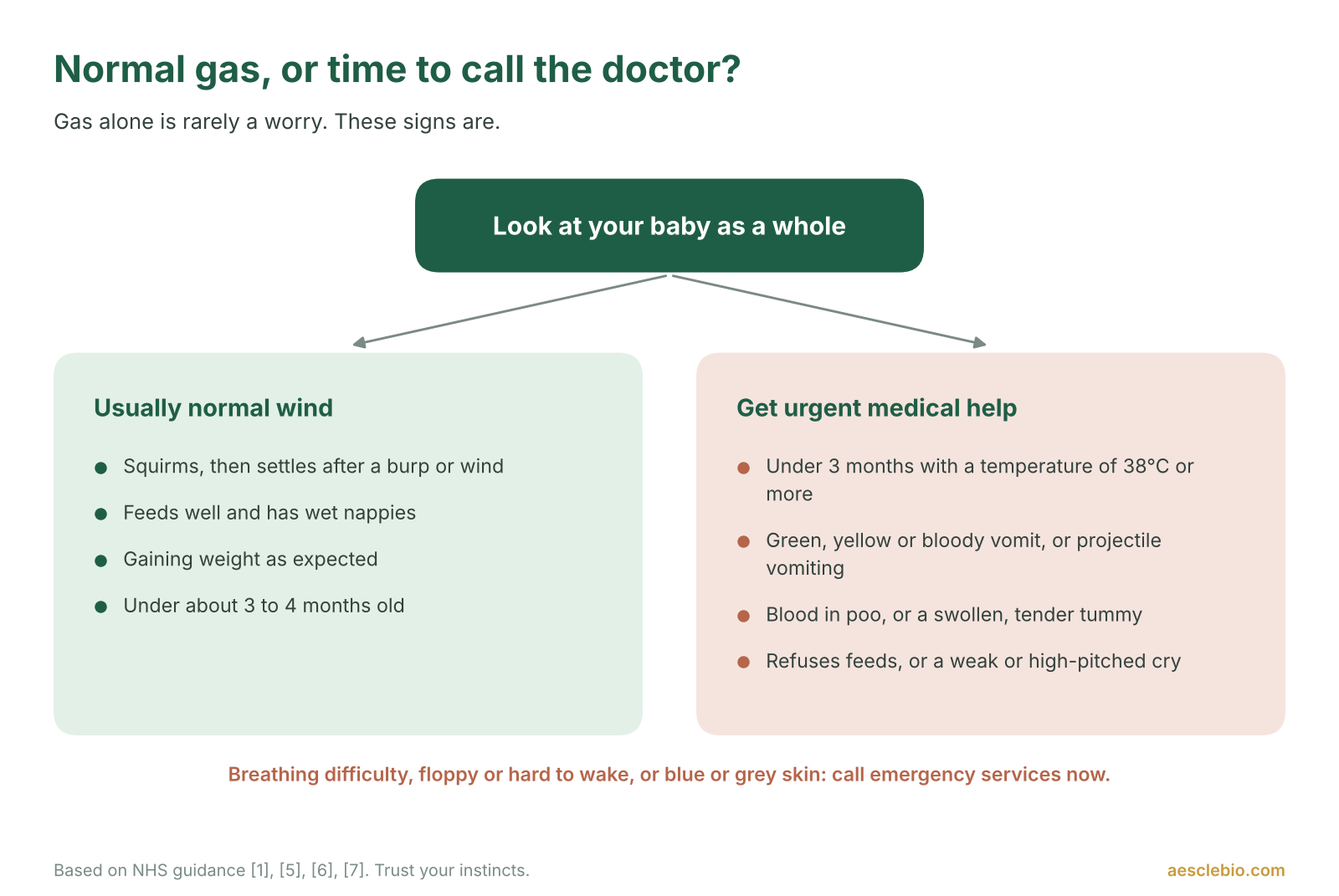
Most gassiness is harmless. But some symptoms point to illness and need prompt medical help. Do not wait to see if they pass.
Also see a doctor, without the same urgency, if your baby is not gaining weight as expected, if nothing seems to help, if colic symptoms carry on after 4 months, or if you are finding it hard to cope [1].
When do babies outgrow gas pains?
The good news: most babies get less gassy with time. Wind is most common from birth to about 3 months [3]. The AAP says everyday fussing usually peaks at about 6 weeks, and colicky crying generally stops by 3 to 4 months, though it can last until 6 months [2]. So a gassy 2 week old, a fussy 1 month old and a gassy two month old are all well inside the normal window, even if the baby seems constantly gassy or has bad gas for a while. If gassiness peaks and then gets worse rather than better after 4 months, talk to your doctor [1].
Where the infant gut microbiome fits
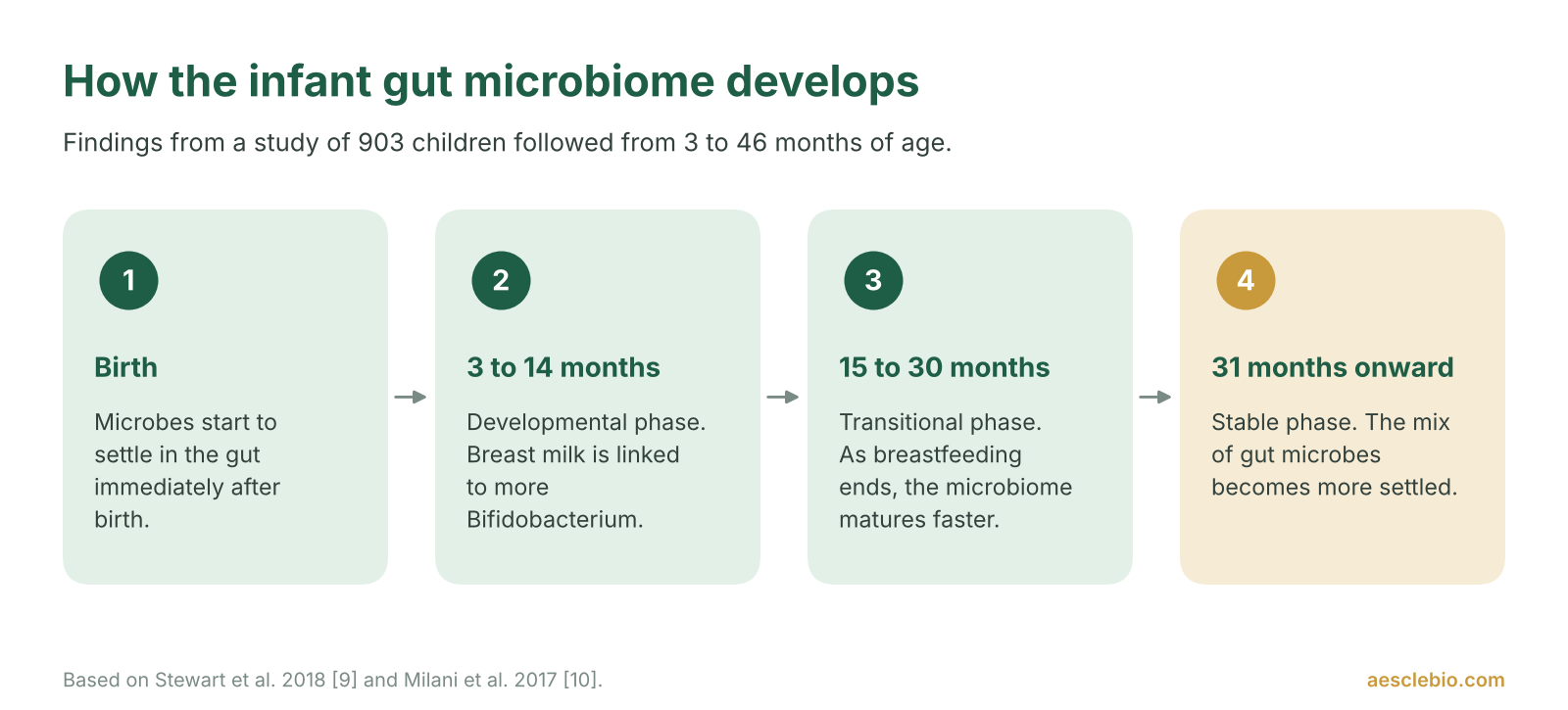
The gut microbiome is the community of microbes (bacteria and other tiny living things) that live in the gut, together with their genes. A newborn's microbiome starts almost from scratch: microbes settle in the gut immediately after birth [10]. Certain friendly bacteria, especially Bifidobacterium species, are specially adapted to feed on sugars found in breast milk [10].
A large study that followed 903 children in Europe and the US, using stool samples taken from 3 to 46 months of age, found that the gut microbiome develops in three phases: a developmental phase (3 to 14 months), a transitional phase (15 to 30 months) and a stable phase (from about 31 months) [9]. Breast milk was the strongest influence, linked to higher levels of Bifidobacterium; the way a baby was born (vaginal or caesarean birth), siblings and even furry pets also played a part [9].
There is growing evidence that the gut bacteria of colicky babies differ from those of babies without colic [12]. That has led to many trials of probiotics, which are live microbes that give a health benefit when taken in a large enough amount. But a difference in gut bacteria does not prove that the bacteria cause the crying, and it does not prove that adding bacteria will stop it.
Probiotics for infant gas and colic: what the research says
Most probiotic research in babies is about colic, not gas on its own. Here is what the stronger reviews say.
- For babies who already have colic: a 2020 review of reviews and guidelines found that the strongest evidence was for probiotics reducing crying time in breastfed babies with colic, by roughly 25 to 65 minutes a day in the studies it looked at [11]. The same review found that simethicone, the ingredient in many anti-gas drops, showed no benefit in the evidence it reviewed [11].
- For preventing colic in healthy newborns: a 2019 Cochrane review (an independent, highly regarded type of evidence summary) of six trials with 1,886 babies found no clear evidence that probiotics prevent colic. Daily crying time did seem shorter with probiotics, but the certainty of the evidence was low, meaning future studies could change the picture [12].
- Results depend on the strain. The most studied probiotic in these trials is one particular strain of Limosilactobacillus reuteri (until 2020 called Lactobacillus reuteri) [12]. A result for one strain cannot be assumed for another, even of the same species.
- Health services are cautious. The NHS says it does not recommend anti-colic drops, herbal remedies or probiotic supplements, as there is no evidence they help colic [1]. Experts and health services do not fully agree, a sign that the evidence is not settled.
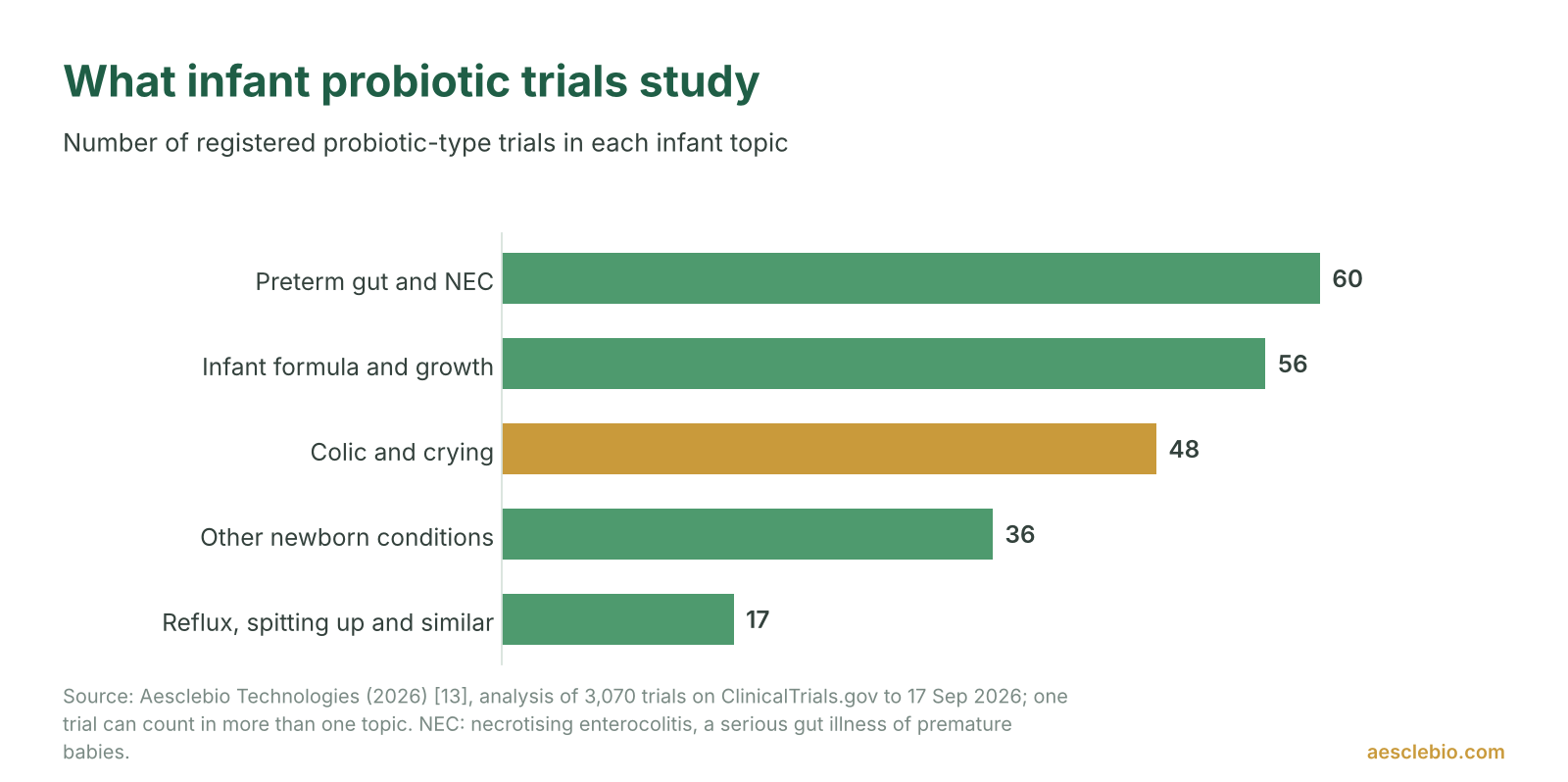
What about probiotics for acid reflux in infants? Here the research is thinner still. In Aesclebio's own analysis of 3,070 probiotic-type clinical trials (research studies in people) registered on ClinicalTrials.gov, the public trial registry run by the US National Library of Medicine, 191 fell in the infant and newborn health area. Within the infant topics, 48 trials were about colic and crying, but just 17 were about infant reflux, spitting up and similar digestive problems (one trial can count in more than one topic) [13].
Myth or fact?
| Myth | What the evidence says |
|---|---|
| A very gassy baby means something is wrong with their tummy. | Wind is common from birth to about 3 months while the digestive system matures [3]. Watch for warning signs, not for gas itself [5]. |
| All crying in newborns is caused by gas. | Babies cry for many reasons, including hunger, tiredness, a dirty nappy and wanting a cuddle [6]. There is no definite explanation for colic [2]. |
| Gas drops are proven to stop colic. | A review of reviews found simethicone showed no benefit for colic, and the NHS does not recommend anti-colic drops [1, 11]. |
| Probiotics work for every fussy baby. | Trials suggest benefit mainly for crying in breastfed babies with colic, for specific strains, and the evidence for preventing colic is low-certainty [11, 12]. |
The bottom line
A gassy newborn is usually a healthy newborn with a gut that is still learning. Burp often, keep your baby upright after feeds, try gentle tummy massage and bicycle legs, and give it time: most babies are far less gassy by 3 to 4 months. Learn the warning signs, and act fast if you see them. Some probiotic strains show promise for colicky crying in breastfed babies, but they are not a gas cure, and the decision belongs with your baby's doctor.
Frequently asked questions
Is it normal for newborns to be gassy?
Yes. Babies swallow air when they feed, cry and yawn, and their digestive system is still maturing, so wind is common from the newborn stage to about 3 months [3]. Look at your baby as a whole: feeding well, regular wet nappies and steady weight gain matter more than the amount of wind [5, 6]. See a doctor if gas comes with fever, vomiting, blood in the poo or poor feeding [5, 7].
What are the signs of gas in a newborn?
Common signs that a baby needs to bring up wind include seeming uncomfortable during a feed, crying, an arched back, drawing the legs up towards the tummy and clenched fists [4]. A gassy baby may also squirm during feeds or look uncomfortable when laid down afterwards [3]. These signs often ease after a burp or passing wind.
How do you get rid of gas in infants?
Try burping during or after feeds, holding your baby upright, and responding quickly to crying so they swallow less air [3, 4]. If a baby still won't burp, the NHS suggests laying them on their back, gently massaging the tummy and moving the legs as if cycling [4]. There is no instant cure, and most babies outgrow it.
How do I do infant massage for gas?
The NHS suggests laying your baby on their back, gently massaging their tummy, and moving their legs back and forth as if they were riding a bicycle [4]. Keep your touch light and stop if your baby seems unhappy. If it does not help, or you are unsure how to do it, ask your health visitor or your baby's doctor to show you [4].
Colic vs gas: how can I tell the difference?
Gas tends to happen around feeds and settles after a burp or passing wind [3]. Colic means crying more than 3 hours a day, 3 days a week, for at least 1 week in an otherwise healthy baby, often worse in the evening [1]. Colicky babies pass gas while crying, but gas is not a proven cause of colic [2].
My baby won't stop crying because of gas. What should I do?
Try burping, holding your baby upright, a gentle tummy massage, rocking or a warm bath [1, 4]. If you cannot cope, ask someone to take over, or lay your baby on their back in a safe place and take a short break; never shake a baby [2, 6]. Get urgent help if the cry is weak, high-pitched or not like their normal cry, or if your baby has a fever, vomiting or refuses feeds [1, 5].
When do babies stop being gassy?
Most babies become less gassy by about 3 months, as the digestive system matures [3]. Everyday fussing usually peaks at around 6 weeks, and colicky crying generally stops by 3 to 4 months, though it can last until 6 months [2]. If symptoms carry on after 4 months, see your doctor [1].
Do probiotics help newborn gas or infant reflux?
Trials mainly studied colic. Reviews found that certain strains reduced crying time in breastfed babies with colic, but there is no clear evidence that probiotics prevent colic, and the certainty is low [11, 12]. Research on probiotics for infant reflux is much thinner [13]. The NHS does not recommend probiotics for colic [1]. Always ask your baby's doctor first.
My newborn is extremely gassy and screaming in pain. Is it a problem?
Severe gas trouble, with crying and squirming that look painful, is often still normal wind or colic [1, 3]. For a newborn having gas that seems painful, or who struggles to pass gas, try burping and gentle tummy massage [4]. Excessive gassiness on its own is not usually a sign of a gastric problem when your baby feeds and grows well [3, 5]. But see a doctor urgently if the screaming comes with fever, vomiting, blood in the poo, a swollen tummy or refusing feeds [5, 7].
What is the difference between gas bubbles and baby moving in pregnancy?
This question comes from pregnancy, not the newborn stage. The NHS says you should start to feel your baby move between 16 and 24 weeks, and early movements can feel like a gentle swirling or fluttering [14]. If you are not sure whether you are feeling movements or wind, ask your midwife. If your baby's movements slow down or change, contact your midwife or maternity unit straight away [14].
Related reading
- Infant Colic and Probiotics: What the Trials Actually Show
- Probiotics for Babies and Newborns: The Questions Paediatricians Get Asked Most
- Infant Probiotic Drops: Strains, Oil Suspensions, Spores and What Makes a Drop Work
- Microbiome vs Microbiota: The Words Everyone Uses and Almost Nobody Defines
- L. reuteri: The Most Searched Probiotic Species (Aesclebio blog)
References
- National Health Service (NHS). Colic. NHS website; page reviewed and accessed October 2026. Free to read. Link
- American Academy of Pediatrics. Colic. HealthyChildren.org; accessed October 2026. Free to read. Link
- Health Service Executive (HSE), Ireland. Winding and burping your baby. HSE website; accessed October 2026. Free to read. Link
- National Health Service (NHS) Start for Life. Burping your baby. NHS website; accessed October 2026. Free to read. Link
- National Health Service (NHS). Reflux in babies. NHS website; accessed October 2026. Free to read. Link
- National Health Service (NHS). Soothing a crying baby. NHS website; accessed October 2026. Free to read. Link
- National Health Service (NHS). Fever in children. NHS website; accessed October 2026. Free to read. Link
- American Academy of Pediatrics. Back to Sleep, Tummy to Play. HealthyChildren.org; accessed October 2026. Free to read. Link
- Stewart CJ, Ajami NJ, O'Brien JL, et al. Temporal development of the gut microbiome in early childhood from the TEDDY study. Nature. 2018;562(7728):583–588. Free full text: PubMed Central PMC6415775. Link
- Milani C, Duranti S, Bottacini F, et al. The first microbial colonizers of the human gut: composition, activities, and health implications of the infant gut microbiota. Microbiology and Molecular Biology Reviews. 2017;81(4):e00036-17. Free full text: PubMed Central PMC5706746. Link
- Ellwood J, Draper-Rodi J, Carnes D. Comparison of common interventions for the treatment of infantile colic: a systematic review of reviews and guidelines. BMJ Open. 2020;10(2):e035405. Open access; PubMed Central PMC7202698. Link
- Ong TG, Gordon M, Banks SS, et al. Probiotics to prevent infantile colic. Cochrane Database of Systematic Reviews. 2019;3(3):CD012473. Free full text: PubMed Central PMC6415699. Link
- Aesclebio Technologies. Probiotic Clinical Trials: Where the Industry Is Heading. A registry-based analysis of ClinicalTrials.gov data to 17 September 2026. Hyderabad: Aesclebio Technologies Pvt. Ltd.; 2026. Link
- National Health Service (NHS). Your baby's movements. NHS website; accessed October 2026. Free to read. Link
Disclaimer
This article is for general education only. It is not medical advice and is not intended to diagnose, treat, cure or prevent any disease. It does not promote any specific product or brand, and it makes no claims about any product.
Statements about research describe the findings of published studies. They do not mean that any particular food or supplement will have the same effect for you. Always speak to a qualified healthcare professional before changing your diet or starting a supplement, especially if you are pregnant, breastfeeding, giving products to a baby or child, or living with a health condition.
This topic concerns babies, pregnancy or new mothers. Nothing here is a recommendation to give any product to a baby or to use any product during pregnancy or breastfeeding. Decisions about care should always be made with a doctor, midwife or other qualified healthcare professional.
Rules on how probiotics and supplements may be described differ from country to country. Nothing in this article should be read as a health claim for any product.
All graphics are original works of Aesclebio Technologies. Figures from other studies are credited to their sources. Quotations are limited to short passages with full attribution. Any clinical-trial figures from Aesclebio's own analysis come from public registry records and do not imply that any product is effective or safe.
Prepared by the Aesclebio Research Team with the help of AI tools, under the team's direction. © 2026 Aesclebio Technologies Pvt. Ltd. All rights reserved. Short extracts may be quoted with a link to the original article.