
Probiotic Basics
Microbiome vs Microbiota: The Words Everyone Uses and Almost Nobody Defines
What the microbiome really is, how it differs from the microbiota, why the gut microbiome matters, and what diet and probiotics can and cannot change.
Why everyone searches for the microbiome
"Microbiome" is one of the most searched science words online. Every month, people type "microbiome definition", "what is the gut microbiome" and "microbiome microbiota" into search engines, often after seeing the word on a yoghurt pot, a supplement label or a news headline. Most pages skip the part that matters: microbiome and microbiota are not the same thing, and the difference changes how you should read health claims. This article gives precise, plain-language definitions, then uses them to separate what microbiome science knows from what marketing hopes.
First, what is a microbe?
A microbe, or microorganism, is a living thing too small to see without a microscope. Bacteria are the best known. The word also covers archaea (single-celled organisms that look like bacteria but form a separate branch of life), fungi such as yeasts, tiny algae and small single-celled organisms called protists [1]. So what does a microbe do? Almost everything: microbes help make yoghurt, cheese and bread [11], and in your gut they digest fibre that your own body cannot [7]. Only a tiny fraction of microbes cause disease [1].
How experts define microbiome and microbiota
In biology, the word microbiome joins two parts: "micro" (small) and "biome" (a living community together with its home). It was first defined in 1988 by scientists studying microbes around plant roots, as a "characteristic microbial community" living in a "reasonably well-defined habitat" [1]. In 2020, about 40 leading researchers met, more than a hundred others answered an online survey, and the group published a re-visited microbiome definition in the open-access journal Microbiome [1].
Their answer draws a clear line between the two words [1]:
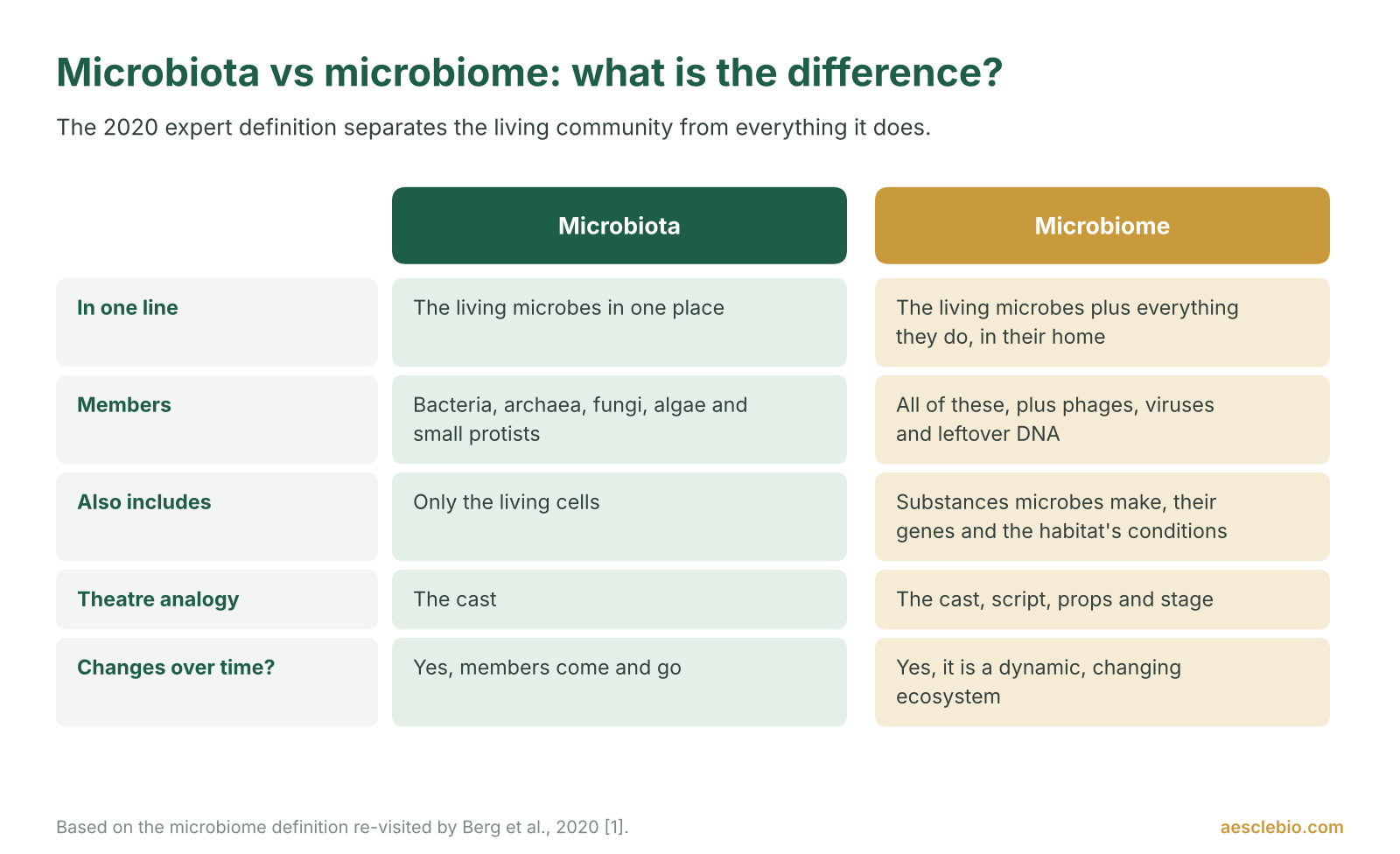
- Microbiota means the living microbes themselves: the bacteria, archaea, fungi, algae and small protists that share one place. Viruses, phages (viruses that infect bacteria) and loose DNA (genetic material floating outside living cells) are usually not counted, because they are not considered living microorganisms.
- Microbiome means the microbiota plus its "theatre of activity": the microbes' structures, the substances they produce, mobile genetic material such as phages and viruses, leftover DNA from dead cells, and the conditions of the habitat. The panel also stressed that a microbiome is dynamic: it changes over time and from place to place.
An easy way to remember it: the microbiota is the cast; the microbiome is the cast plus the script, the props and the stage. Even this expert group did not agree on everything. Whether viruses belong in the microbiome was one of the most argued points, with survey answers ranging from "in any case" to "definitely no" [1].
Why even scientists used the words differently
If the words confuse you, you are in good company. Respected sources have given the same word different meanings:
| Source | What "microbiome" means | What it changes |
|---|---|---|
| Marchesi and Ravel, 2015 [2] | The whole habitat: the microbes (viruses included), their genes and the surrounding conditions | Close to today's reference definition |
| Valdes and colleagues, 2018 [7] | The collective genomes (complete sets of genes) of the microbes in one place | Treats the microbiome as genetic data |
| Expert panel led by Berg, 2020 [1] | The microbiota plus its theatre of activity, in a defined habitat, changing over time | Current reference definition |
Why should you care? Because a label or headline that promises to "balance your microbiome" rarely says which meaning it uses, or what was actually measured. Many studies measure the microbiota by reading microbial DNA in a stool sample, a method called DNA sequencing, the main technology of modern microbiome research [1, 7]. That mainly tells you who is there, and at best what they could do. On its own, it does not show what they are actually doing, which is the part the full microbiome definition cares about [1, 2].
What lives where: many microbiomes, not one
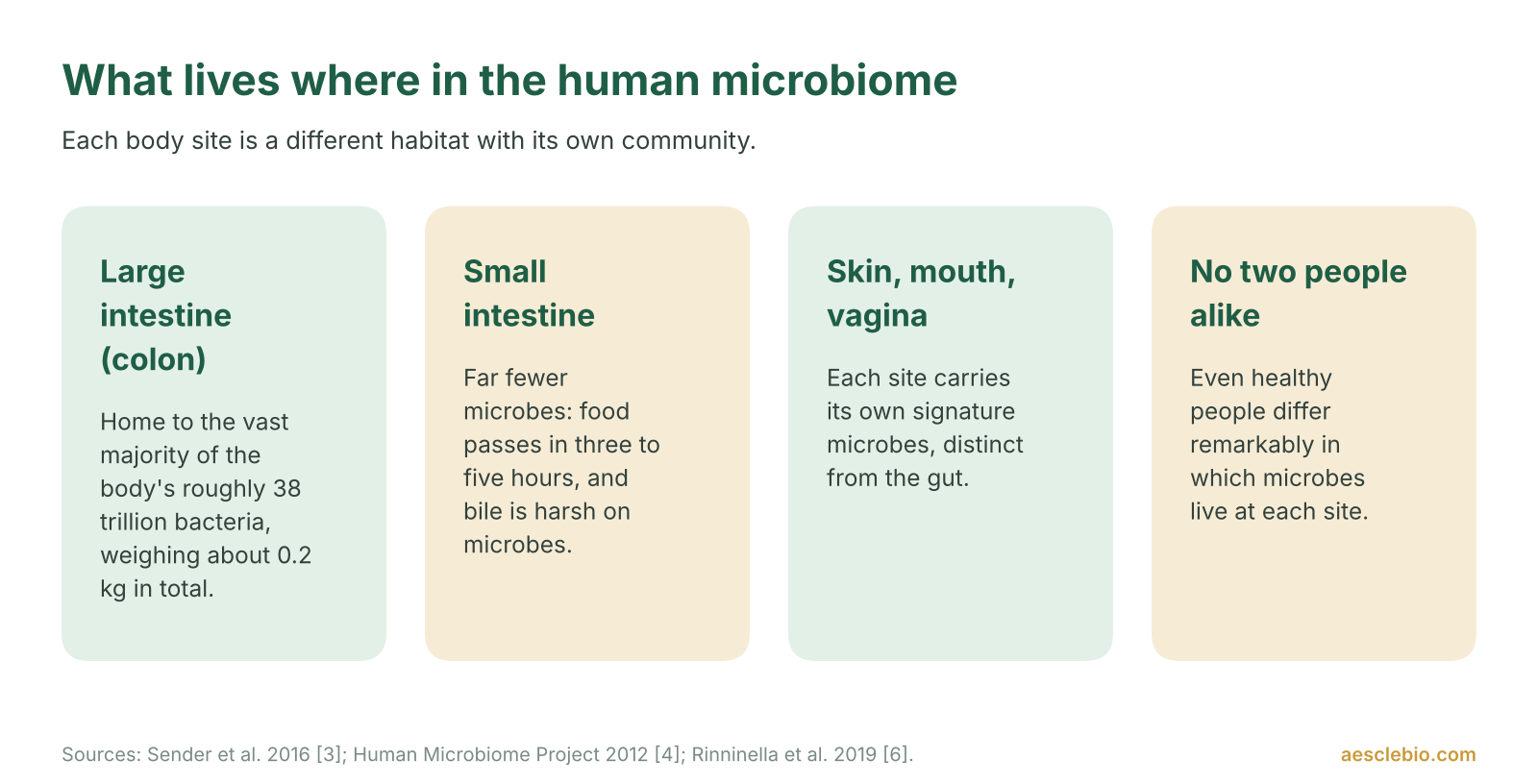
You do not have one microbiome; you have many. Each part of the body is a different habitat with its own community. The Human Microbiome Project, a large study that sampled 242 healthy adults in the United States, found that the gut, skin, vagina and other body sites each carry their own signature microbes, and that these differ remarkably even between healthy people [4].
By far the largest community lives in the large intestine (colon). An adult body carries roughly 38 trillion bacteria, weighing only about 0.2 kilograms in total, and the vast majority live in the colon [3]. You may have read that bacteria outnumber your own cells ten to one. A careful recount in 2016 found the ratio is closer to one to one, because the body has about 30 trillion human cells too [3]. The small intestine holds far fewer microbes, partly because food passes through it in three to five hours and bile (a digestive juice made by the liver) is harsh on microbes [6].
Which bacteria are most likely found in the gut microbiome? Two large groups, called Firmicutes and Bacteroidetes, make up about 90% of gut bacteria [6]. The exact species within them vary greatly between people [4, 6].
Why the gut microbiome matters
So what is the gut microbiome actually doing? Research points to several jobs:
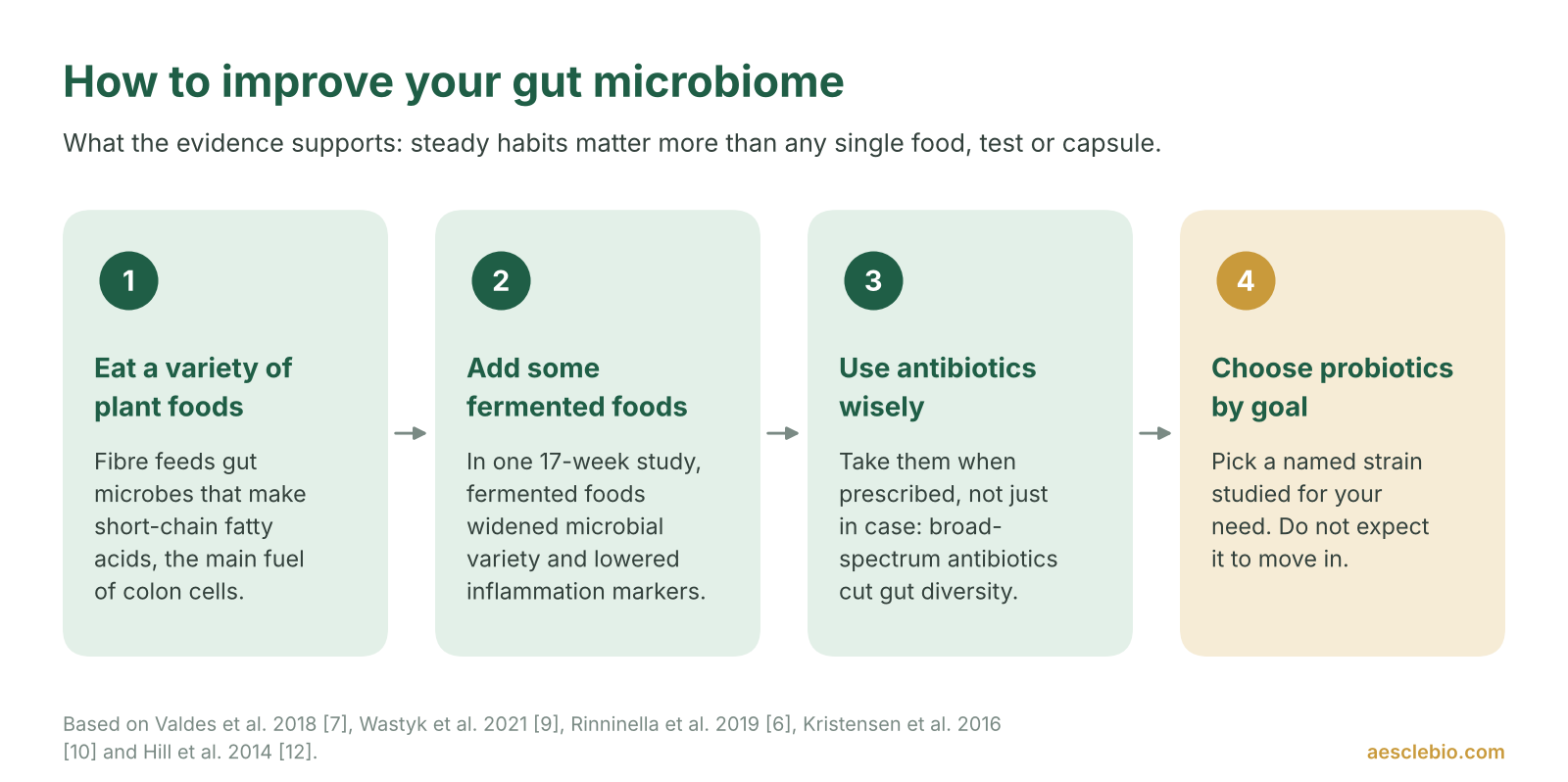
- Digesting fibre. Your own digestive juices cannot break down most dietary fibre. Gut microbes ferment it and make short-chain fatty acids, small compounds such as butyrate. Butyrate is the main fuel for the cells lining your colon [7].
- Handling nutrients. Gut microbes take part in processing bile acids, fats, amino acids (the building blocks of protein) and vitamins [6].
- Guarding the gut. Resident microbes compete with harmful bacteria for food and space, and help keep the gut lining intact [6].
- Working with the body's defences. Gut microbes are linked to the immune system, to metabolism (how the body uses energy) and even to behaviour. Much of this evidence comes from animal studies and is still being tested in people [7].
That is why the human microbiome is important. But notice the careful wording. Many links between the microbiome and illness are associations: scientists often cannot yet tell whether a changed microbiome causes a problem or is a result of it [6].
There is no single "healthy microbiome"
Here is the point most explainers skip: there is no one perfect microbiome to aim for. A major review of gut microbiota composition concluded that "there is not a unique optimal gut microbiota composition since it is different for each individual" [6]. Only about a third of the genes in the human microbiome are found in most healthy people [5].
What seems more consistent is function. The Human Microbiome Project found that the metabolic jobs the microbiome can carry out were stable between people, even when the species doing them were different [4]. In other words, two healthy people can have very different casts performing much the same play.
Scientists use the word dysbiosis for an unfavourable change in the microbial community. Lower diversity (fewer kinds of microbes) is often treated as one marker of it, and has been seen in people with obesity, autoimmune conditions and heart and metabolic conditions, and in older adults [7]. Yet the 2020 expert panel noted that drawing the border between a healthy and an unhealthy microbiota remains a major challenge [1]. So be cautious of any test or product that claims to tell you whether your microbiome is "good" or "bad".
How diet shapes your microbiome
If you want to improve your gut microbiome, start with your plate. Studies of twins show that the environment, including diet and medicines, shapes the gut microbiota more than genes do [7].
Diet acts fast. In one study, 10 volunteers each ate an all-plant diet and, at a separate time, an all-animal diet, for five days each. On the animal-based diet, their gut microbiota changed a single day after the new food reached the large intestine, and returned to its usual make-up about two days after that diet ended [8].
Longer changes show more. In a 17-week study at Stanford University, 36 healthy adults were split into two diet groups. The group that ate more fermented foods, such as yoghurt, kefir and kimchi, steadily gained a wider variety of gut microbes and showed lower blood markers of inflammation (signs that the body's defence system is switched on). The high-fibre group kept the same variety over the study, but their microbes made more of the enzymes that break down fibre [9]. Both diets changed the microbiome; they simply changed different parts of it.
Medicines matter too. Broad-spectrum antibiotics, which kill many kinds of bacteria at once, reduce the variety of gut bacteria during treatment [6]. So take them when prescribed, not "just in case".
What probiotics can and cannot do
Probiotics are "live microorganisms that, when administered in adequate amounts, confer a health benefit on the host" [12]. Many people imagine that a capsule or a powder of Lactobacillus acidophilus bacteria will "reseed" the gut. The evidence says something different.
A systematic review (a study that collects and grades all the trials on one question) found seven randomised controlled trials in healthy adults. In these trials, people were placed by chance into a probiotic group or a placebo (dummy product) group. None found a change in the variety, richness or evenness of the stool microbiota compared with placebo, and only one found any change in the overall community structure [10]. Microbes from fermented foods behave similarly: they can survive the journey, but they are unlikely to settle in the gut for the long term [11]. Most simply pass through.
That does not make probiotics useless. Probiotics can act on the body directly while they pass through, for example by interacting with the immune system or producing useful compounds [7]. Many benefits are linked to specific strains studied for specific purposes [12]. So the right question is not "Will this rebuild my microbiome?" but "Has this exact strain been shown to help with this exact thing?"
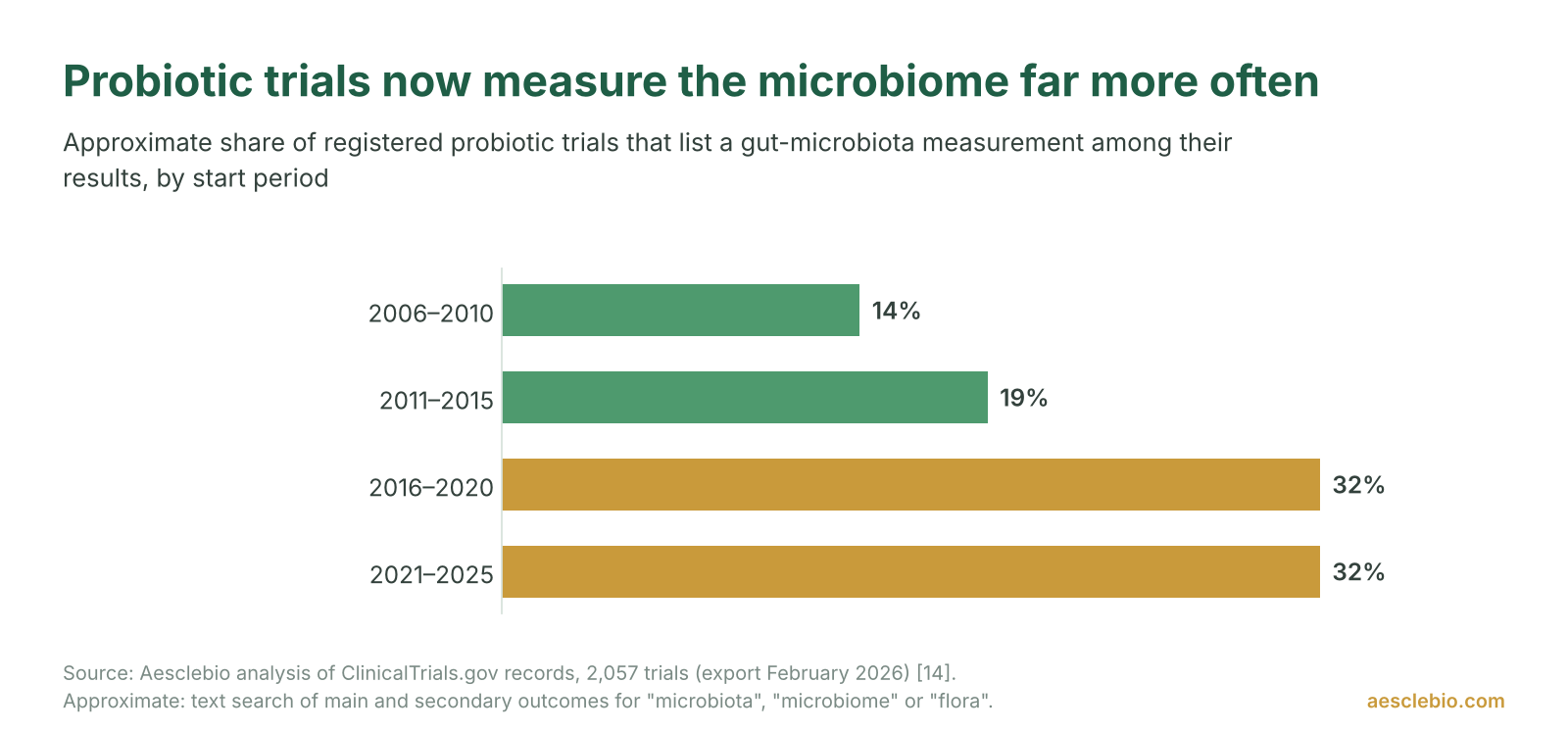
Our own research shows how microbiome science is changing the way probiotics are tested. In Aesclebio's analysis of 2,057 probiotic clinical trials (research studies in people) registered on ClinicalTrials.gov, the public trial registry run by the US National Library of Medicine, roughly 570, or about 28%, listed a gut-microbiota measurement among their main or secondary results [14]. This is an approximate count: we found these trials by searching the outcome descriptions for words such as "microbiota", "microbiome" and "flora", and slightly different search words give totals between about 570 and 590. The trend is clear either way. The share rose from about 14% of trials started in 2006–2010 to about one in three of trials started from 2016 onwards [14]. Our wider industry report also counted 91 trials whose stated goal was to change the microbiota of people with no named disease [13]. Measuring a change, though, is not the same as showing a benefit.
Myth or fact?
| Myth | What the evidence says |
|---|---|
| Microbiome and microbiota mean the same thing. | The microbiota is the living microbes; the microbiome is the microbiota plus everything it does and produces, in its habitat [1]. |
| Bacteria outnumber your cells ten to one. | The best recount puts the ratio at about one to one: roughly 38 trillion bacteria and 30 trillion human cells [3]. |
| Everyone should aim for the same "healthy microbiome". | Healthy people differ remarkably in their microbes; there is no single optimal composition [4, 6]. |
| Probiotics move in and repopulate your gut. | In seven trials in healthy adults, probiotics did not change the variety of stool microbes compared with placebo; most pass through [10, 11]. |
| A stool test can tell you if your microbiome is healthy. | Experts still cannot draw a clear line between a healthy and an unhealthy microbiota [1, 5]. |
How to look after your gut microbiome
There are no shortcuts or instant microbiome solutions, but the evidence points to a few steady habits. None of them requires a test or a special product.
The bottom line
Microbiota is the living community; microbiome is that community plus everything it does, in its home [1]. There is no single healthy microbiome to copy, diet shapes yours every day, and most probiotics are visitors, not new residents. The best evidence supports a varied, fibre-rich diet with some fermented foods, sensible use of antibiotics and, when you have a specific goal, a probiotic strain that has been studied for that goal.
Frequently asked questions
What is the microbiome, in simple words?
The microbiome is a community of microbes living in one place, such as your gut, together with everything they do: the substances they make, their genes, the viruses around them and the conditions of their home [1]. Scientists also speak of microbiomes in soil, water and plants. The human microbiome is really many microbiomes, one for each body site, from the gut to the skin [4].
What is the difference between microbiome and microbiota?
The microbiota is the living microbes themselves: bacteria, archaea, fungi, algae and protists. The microbiome is broader: the microbiota plus its "theatre of activity", meaning the substances microbes produce, mobile genetic material such as phages and viruses, and the habitat's conditions [1]. Think of the microbiota as the cast and the microbiome as the cast plus the stage and script.
What is the gut microbiome?
The gut microbiome is the community of microbes in your digestive tract, together with what they do. Most of them live in the large intestine (colon), which holds the vast majority of the body's roughly 38 trillion bacteria [3]. They ferment fibre into short-chain fatty acids, help process nutrients and help guard the gut lining [6, 7].
Why is the microbiome important?
The gut microbiome digests fibre your body cannot, makes compounds that fuel the cells of the colon, helps protect against harmful bacteria and works closely with the immune system [6, 7]. Many links to illness are still associations, so scientists cannot always say whether a changed microbiome is a cause or a result [6].
Which bacteria are most likely found in the gut microbiome?
Two large groups of bacteria, Firmicutes and Bacteroidetes, together make up about 90% of the gut microbiota [6]. The exact species within those groups vary greatly from person to person, even among healthy people [4]. That is one reason there is no single "correct" list of gut bacteria to aim for.
Can you name two foods that bacteria help make?
Yoghurt and cheese are two classic examples: bacteria turn milk into both [11]. Other foods made with the help of microbes include kefir, sauerkraut, kimchi, miso and sourdough bread [11]. Foods with good bacteria that are still alive, such as yoghurt with live cultures, can be part of a varied diet, but most of their microbes pass through rather than settle [11].
Does yogurt change your gut microbiome?
Yoghurt (yogurt) is one of several fermented foods that can contribute to a varied diet. In a 17-week study, adults who ate more fermented foods, yoghurt included, developed a wider variety of gut microbes [9]. The microbes in yoghurt itself are unlikely to settle in the gut for the long term [11].
What are gut dysbiosis symptoms?
Dysbiosis describes an unfavourable change in the gut's microbial community [1, 7]. It is hard even to define [5], there is no agreed list of dysbiosis symptoms, and experts still cannot draw a clear line between a healthy and an unhealthy microbiota [1]. Ongoing bloating, pain or changes in bowel habits should be checked by a doctor.
How can I improve my gut microbiome and support healthy gut bacteria?
Eat a wide variety of fibre-rich plant foods, which feed microbes that make short-chain fatty acids [7], and include some fermented foods [9]. Use antibiotics only when they are prescribed [6]. If you choose a probiotic, pick a named strain studied for your specific goal [12], and speak to a doctor first if you are pregnant, breastfeeding or buying for a child.
Related reading
- Prebiotics, Probiotics, Postbiotics, Synbiotics: A Field Guide Beyond the Buzzwords
- What Probiotics Are, and the Five Myths That Survive Every Explainer
- Probiotic Foods vs Probiotic Supplements: Why a Probiotic Foods List Is Not a Dose
- Your Probiotic Is a Strain, Not a Species: Reading the Code After the Name
- Prebiotic Fibres Decoded: Inulin, FOS, GOS and HMOs
References
- Berg G, Rybakova D, Fischer D, et al. Microbiome definition re-visited: old concepts and new challenges. Microbiome. 2020;8(1):103. Open access. Free full text: PubMed Central PMC7329523. Link
- Marchesi JR, Ravel J. The vocabulary of microbiome research: a proposal. Microbiome. 2015;3:31. Open access. Free full text: PubMed Central PMC4520061. Link
- Sender R, Fuchs S, Milo R. Revised estimates for the number of human and bacteria cells in the body. PLoS Biology. 2016;14(8):e1002533. Open access. Free full text: PubMed Central PMC4991899. Link
- Human Microbiome Project Consortium. Structure, function and diversity of the healthy human microbiome. Nature. 2012;486(7402):207–214. Free full text: PubMed Central PMC3564958. Link
- Lloyd-Price J, Abu-Ali G, Huttenhower C. The healthy human microbiome. Genome Medicine. 2016;8(1):51. Open access. Free full text: PubMed Central PMC4848870. Link
- Rinninella E, Raoul P, Cintoni M, et al. What is the healthy gut microbiota composition? A changing ecosystem across age, environment, diet, and diseases. Microorganisms. 2019;7(1):14. Open access. Free full text: PubMed Central PMC6351938. Link
- Valdes AM, Walter J, Segal E, et al. Role of the gut microbiota in nutrition and health. BMJ. 2018;361:k2179. Free full text: PubMed Central PMC6000740. Link
- David LA, Maurice CF, Carmody RN, et al. Diet rapidly and reproducibly alters the human gut microbiome. Nature. 2014;505(7484):559–563. Free full text: PubMed Central PMC3957428. Link
- Wastyk HC, Fragiadakis GK, Perelman D, et al. Gut-microbiota-targeted diets modulate human immune status. Cell. 2021;184(16):4137–4153. Free full text: PubMed Central PMC9020749. Link
- Kristensen NB, Bryrup T, Allin KH, et al. Alterations in fecal microbiota composition by probiotic supplementation in healthy adults: a systematic review of randomized controlled trials. Genome Medicine. 2016;8(1):52. Open access. Free full text: PubMed Central PMC4862129. Link
- Marco ML, Sanders ME, Gänzle M, et al. The International Scientific Association for Probiotics and Prebiotics (ISAPP) consensus statement on fermented foods. Nature Reviews Gastroenterology & Hepatology. 2021;18:196–208. Free full text: PubMed Central PMC7925329. Link
- Hill C, Guarner F, Reid G, et al. Expert consensus document: the International Scientific Association for Probiotics and Prebiotics consensus statement on the scope and appropriate use of the term probiotic. Nature Reviews Gastroenterology & Hepatology. 2014;11:506–514. Open access. Link
- Aesclebio Technologies. Probiotic Clinical Trials: Where the Industry Is Heading. A registry-based analysis of ClinicalTrials.gov data to 17 September 2026. Hyderabad: Aesclebio Technologies Pvt. Ltd.; 2026. Link
- Aesclebio Technologies. Aesclebio analysis of ClinicalTrials.gov records: 2,057 interventional probiotic-type trials in the analytic set (ClinicalTrials.gov export, February 2026); trials measuring the microbiota identified by a text search of outcome descriptions, so counts are approximate. Hyderabad: Aesclebio Technologies Pvt. Ltd.; October 2026. Link
Disclaimer
This article is for general education only. It is not medical advice and is not intended to diagnose, treat, cure or prevent any disease. It does not promote any specific product or brand, and it makes no claims about any product.
Statements about research describe the findings of published studies. They do not mean that any particular food or supplement will have the same effect for you. Always speak to a qualified healthcare professional before changing your diet or starting a supplement, especially if you are pregnant, breastfeeding, giving products to a baby or child, or living with a health condition.
Rules on how probiotics and supplements may be described differ from country to country. Nothing in this article should be read as a health claim for any product.
All graphics are original works of Aesclebio Technologies. Figures from other studies are credited to their sources. Quotations are limited to short passages with full attribution. Any clinical-trial figures from Aesclebio's own analysis come from public registry records and do not imply that any product is effective or safe.
Prepared by the Aesclebio Research Team with the help of AI tools, under the team's direction. © 2026 Aesclebio Technologies Pvt. Ltd. All rights reserved. Short extracts may be quoted with a link to the original article.