Women's Health
Breastfeeding, Mastitis and the Breast-Milk Microbiome: What Probiotics Can and Cannot Do
Can you take probiotics while breastfeeding, do they pass into breast milk, and do they help mastitis? The evidence, explained in plain language.
Why so many nursing mothers search for probiotics
Every month, thousands of people type phrases such as "probiotics breastfeeding", "probiotics nursing", "probiotic for nursing mothers" and "probiotics for breastfeeding mothers" into search engines. Behind them are three very reasonable worries. Is it safe to keep taking a probiotic I took in pregnancy? Will it pass into my milk and reach my baby? And, for many mothers, can it help with mastitis, the painful breast inflammation that makes many women stop breastfeeding early [8]?
Online answers tend to be either "great for you and baby" or "avoid everything". The research is more interesting, and it starts with breast milk itself.
Breast milk is not sterile: meet the breast-milk microbiome
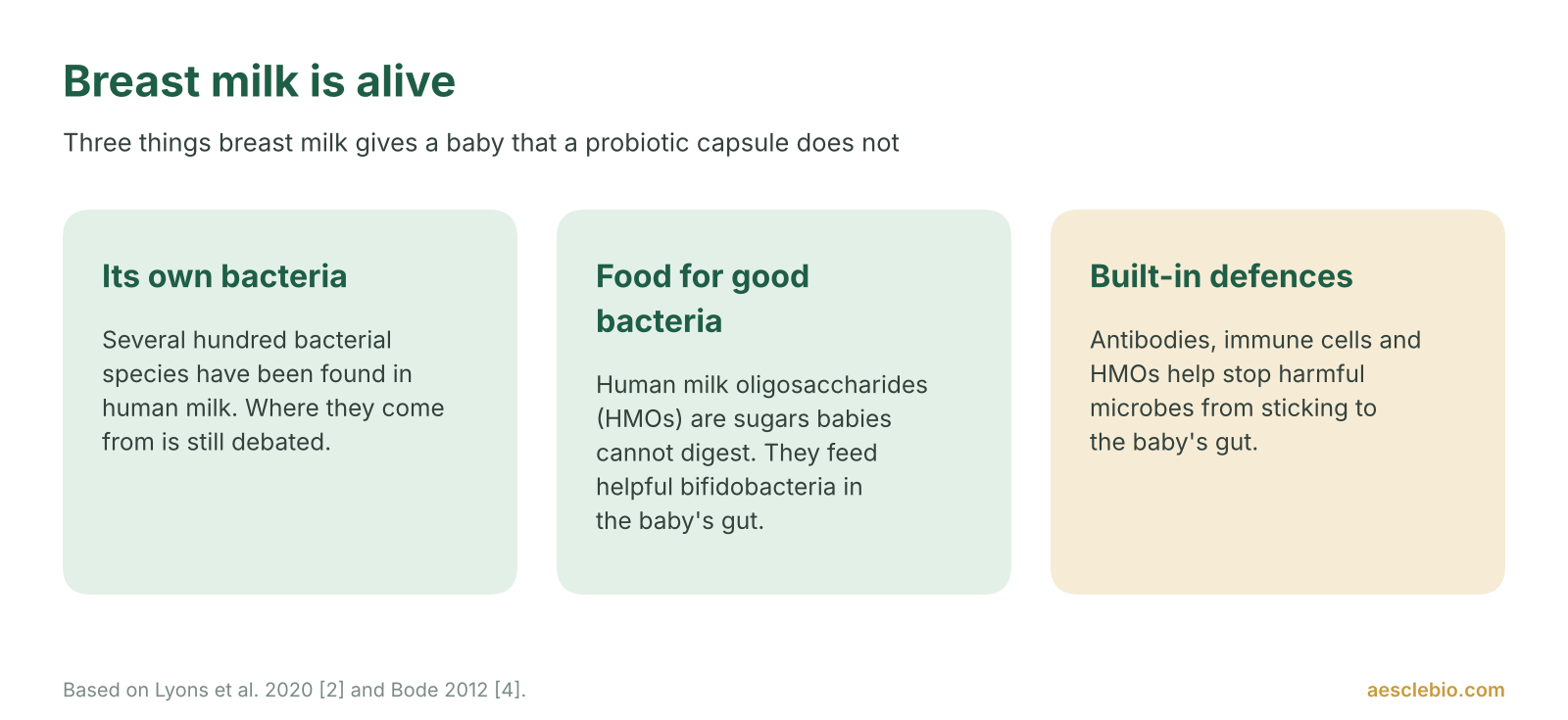
For a long time, scientists thought healthy breast milk was sterile, meaning free of microbes, and that any bacteria found in it were contamination from skin. It is now widely accepted that breast milk has its own microbiome: a community of living microbes (bacteria too small to see) [2]. Modern DNA testing has identified several hundred bacterial species in human milk, and milk is thought to be one of the main sources of microbes for a baby's gut after birth [2].
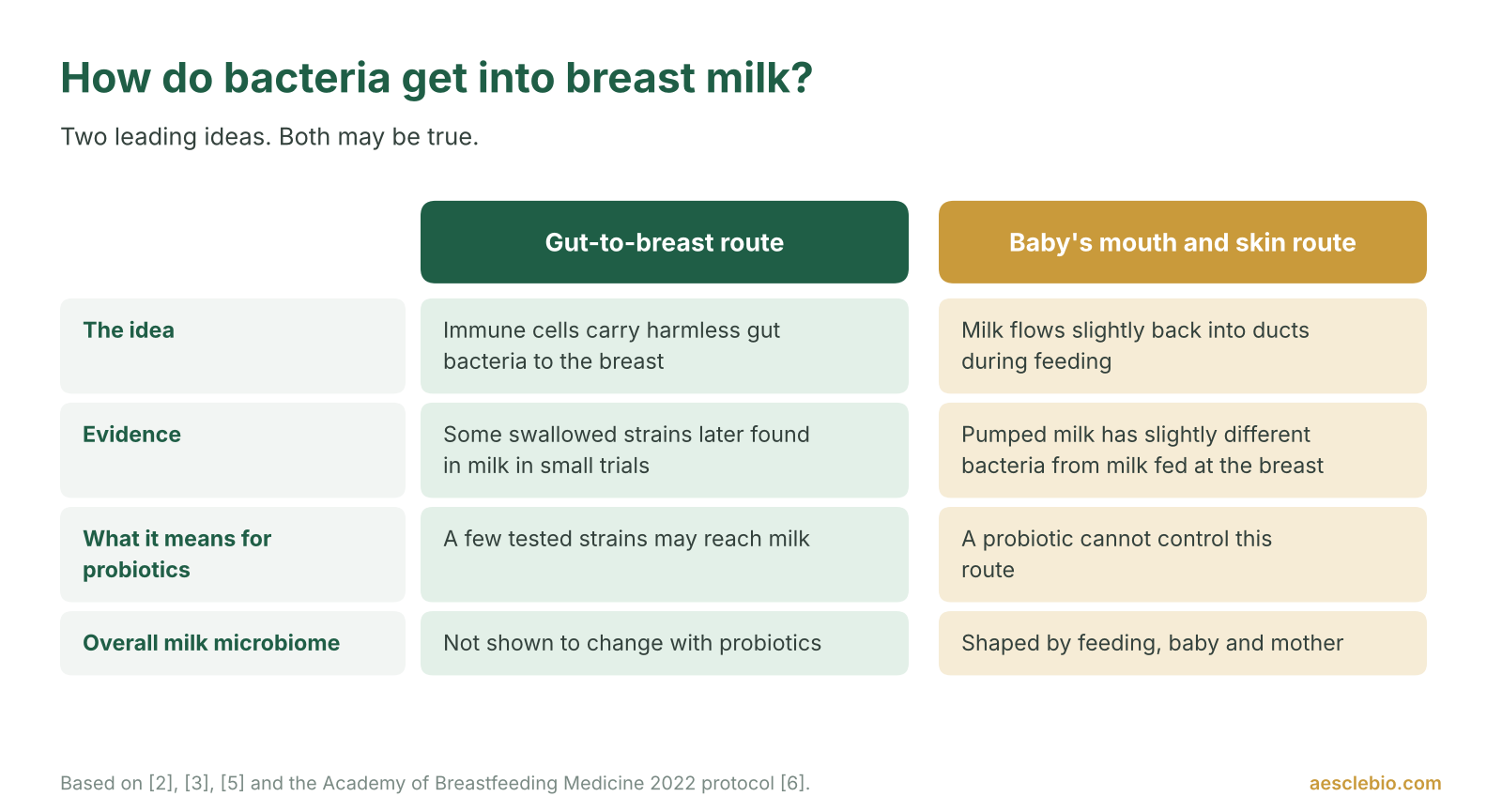
Where these bacteria come from is still debated. One idea is a gut-to-breast route (scientists call it the entero-mammary pathway): immune cells may carry harmless bacteria from the mother's gut to the breast in late pregnancy and while breastfeeding [2, 3]. Another is that bacteria come from the baby's mouth and the mother's skin, as milk can flow slightly backwards into the ducts during feeding [2, 3]. A Canadian study of 393 mothers found that milk from mothers who sometimes pumped had a slightly different bacterial make-up from that of mothers who fed only at the breast, which supports this second route [3].
Milk also contains something a probiotic capsule does not: human milk oligosaccharides (HMOs). These are complex sugars that babies cannot digest themselves [2, 4]. Instead, they act as food for helpful gut bacteria, especially Bifidobacterium species (bifidobacteria), and they may also act as decoys that stop harmful microbes from sticking to a baby's gut [4]. More than 200 different HMOs have been identified [2]. In other words, breast milk delivers both microbes and the food to grow the right ones.
Do probiotics pass into breast milk?
This is one of the most common questions, and the honest answer is: sometimes, for some strains, in small studies. A strain is a specific type within a species, like an individual within a family. In a small trial of 20 women with mastitis, two strains originally taken from breast milk were later found in the milk of 6 of the 10 women who swallowed them [5]. A 2020 review describes a further mastitis study in which two swallowed strains were later detected in milk [2].
But finding a swallowed strain in milk is not the same as changing the milk microbiome. The Academy of Breastfeeding Medicine (ABM), an international doctors' organisation, notes in its 2022 mastitis guideline that probiotics have been shown not to alter the overall make-up of the human milk microbiome [6]. So do probiotics go into breast milk? A few tested strains appear to. For a typical supermarket probiotic, nobody knows.
Can you take probiotics while breastfeeding? What the safety research shows
The best overview of safety is a 2021 systematic review, a study that gathers and judges all the research on a question. It looked at 100 studies in which pregnant or breastfeeding women took probiotics or prebiotics (fibres that feed gut bacteria) [9]. It found no deaths and no serious side effects linked to these products in mothers or babies. The side effects that were reported were mostly in the gut, such as nausea, diarrhoea, constipation or bloating, and none were serious [9]. The authors concluded that probiotics and prebiotics appear safe to use during pregnancy and breastfeeding [9].
There is a catch worth knowing. Almost half of those 100 studies (49) did not report any safety information at all. Only 28 reported on side effects or other problems, and just 11 described side effects possibly linked to the product [9]. So "no serious problems found" partly reflects how little was measured. That is why probiotics safe for breastfeeding is a fair summary for healthy mothers using well-studied products, but not a promise about every product on the shelf. If you or your baby have a health condition, or your baby was born early, ask your doctor before starting.
Probiotics for mastitis: promising, but less settled than the marketing suggests
Mastitis simply means inflammation of the breast [6]. The ABM now describes it as a spectrum: from swollen, narrowed milk ducts, through inflammation and bacterial infection, and sometimes an abscess (a pocket of pus) [6, 8]. One theory behind it is dysbiosis, an unhealthy shift in the balance of bacteria in the breast, where helpful bacteria decline and bacteria such as some Staphylococcus species multiply [6, 8]. That theory is exactly why researchers tested probiotics.
Here is what the trials found:
- Prevention. A 2022 meta-analysis (a study that pools the results of several trials) found six randomised controlled trials with 1,197 women. In the three that measured new cases of mastitis, women given probiotics (started during pregnancy) had about half as many cases as women taking a placebo (a dummy product) [8].
- Treatment. One trial of 352 women with mastitis compared three weeks of L. fermentum or L. salivarius strains with routine antibiotics [8]. As reported in later reviews, the probiotic groups had lower bacterial counts in their milk, better pain relief and fewer repeat bouts than the antibiotic group [2, 12]. In a 2022 Chinese trial of 101 women with a breast abscess drained by needle, more women in the L. fermentum group than in the placebo group had healed by day 5 (43% versus 18%) [12].
- Milk bacteria. Across the trials, women taking probiotics had lower bacterial counts in their milk, which is a sign researchers watch in mastitis, not a cure in itself [8].
Now the caution. The Cochrane review, an independent, highly respected type of systematic review, rated the evidence that probiotics reduce mastitis as low-certainty [7]. It also noted that the results of the largest probiotic trial, with 639 women, had not been made public because of a contract between the probiotic supplier and the researchers [7]. Cochrane added that industry funding may also have affected how certain the evidence is [7]. And, as our own registry check below shows, the registered mastitis trials all come from one country.
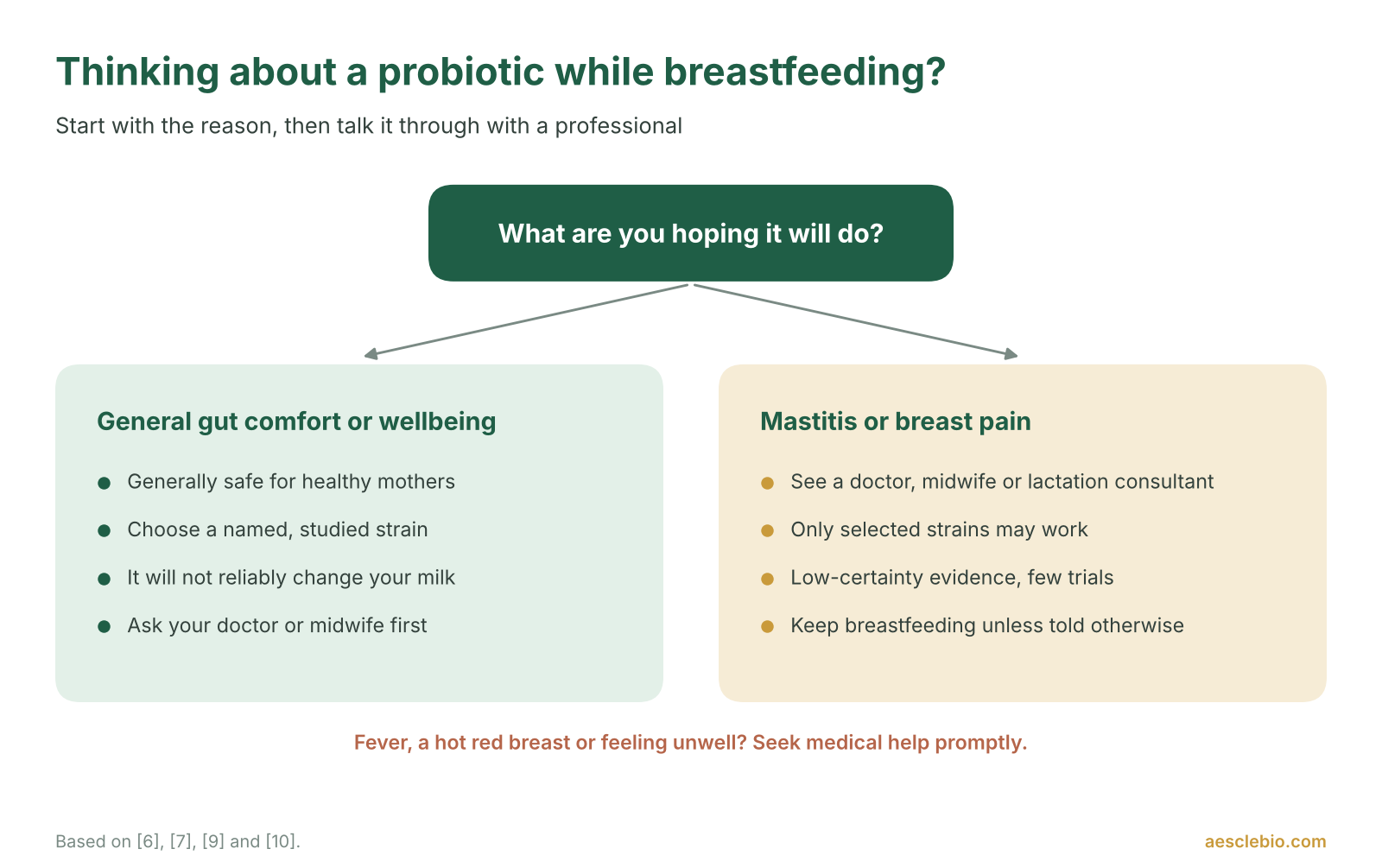
The ABM's guideline reflects this balance. It says the data on probiotics are "mixed", that a probiotic, if used, should contain Limosilactobacillus fermentum or, preferably, Ligilactobacillus salivarius, and, importantly, that "only selected strains of these bacterial species may be effective against mastitis pathogens" [6]. So the best probiotic for breastfeeding moms with mastitis is not "any lactobacillus". It is a specific, tested strain, used alongside proper medical care. The ABM also stresses that mothers with mastitis should be supported to keep breastfeeding; milk from a breast with bacterial mastitis is safe for the baby [6].
How little research there is: what our own data show
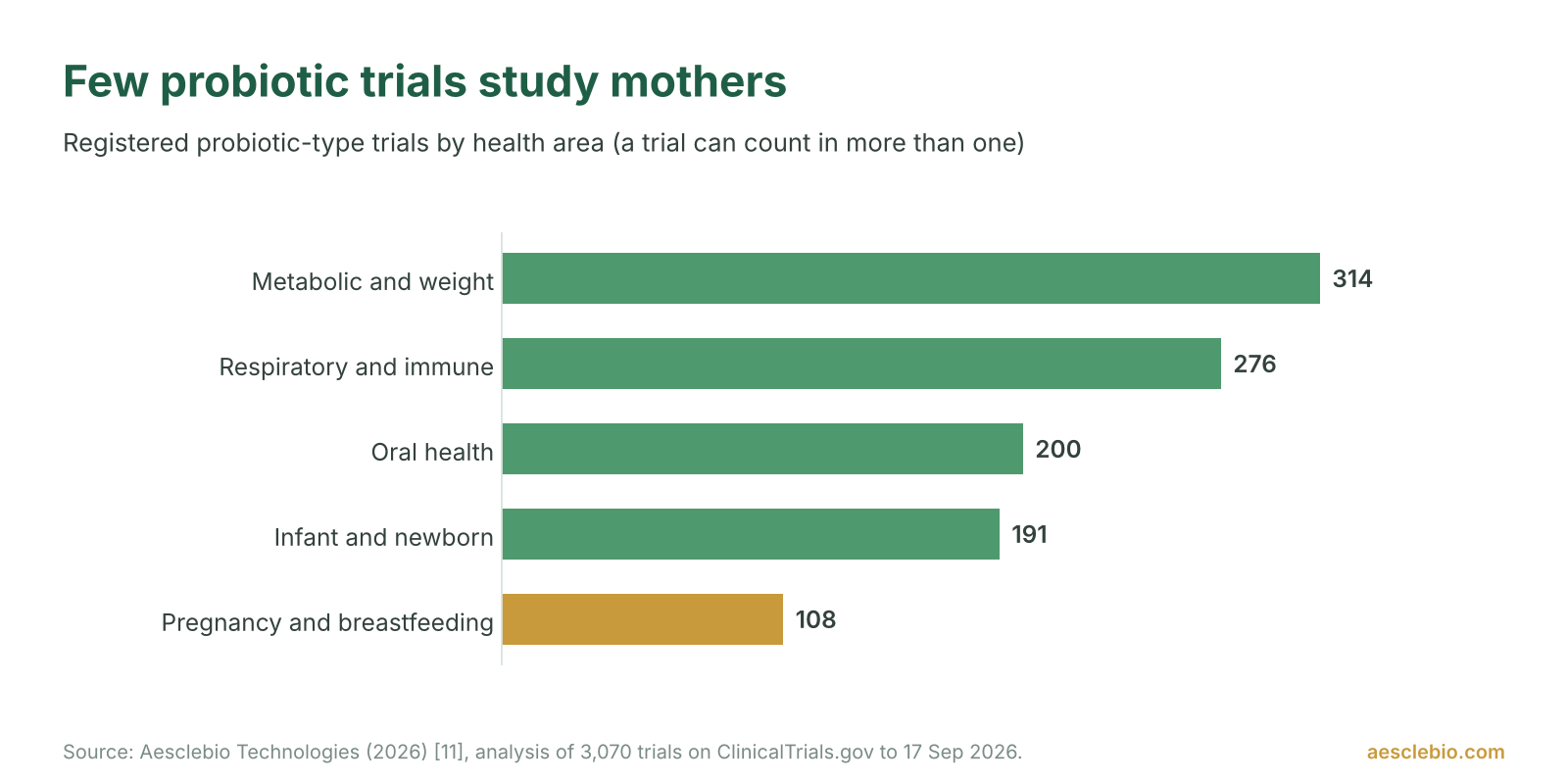
Aesclebio's analysis of 3,070 probiotic-type clinical trials (research studies in people) registered on ClinicalTrials.gov, the public trial registry run by the US National Library of Medicine, found just 108 trials in maternal health, covering pregnancy and breastfeeding together. That is about 3.5% of all trials, and fewer than for metabolic health, respiratory and immune health, oral health or infant health [11].
When we looked closer at an earlier export of the same registry (2,057 trials), 62 trials enrolled pregnant or breastfeeding women, and only five trials listed mastitis as a condition. All five were run in Spain, and four of the five had no results posted on the registry (Aesclebio analysis of ClinicalTrials.gov records). The evidence rests on very few trials, strains and countries.
Myth or fact?
| Myth | What the evidence says |
|---|---|
| Breast milk is sterile, so a probiotic adds the first "good bacteria". | Breast milk has its own microbiome, with several hundred bacterial species identified [2]. |
| Any probiotic you take goes straight into your milk. | A few tested strains have been found in milk in small studies [5], but probiotics have not been shown to change the overall milk microbiome [6]. |
| All lactobacilli help mastitis. | Doctors' guidance says only selected strains of L. fermentum and L. salivarius may be effective, and the prevention evidence is low-certainty [6, 7]. |
| If you have mastitis, you should stop breastfeeding. | The ABM advises supporting mothers to continue; milk from a breast with bacterial mastitis is safe for the baby [6]. |
| Lactation gummies are proven to boost milk supply. | Doctors' guidance finds little or no scientific evidence for herbal milk boosters, and cannot recommend any specific one [10]. |
Lactation gummies and breastmilk gummies: what are they?
Searches for "lactation gummies", "breastmilk gummies" and "breastfeeding gummies" are common. These are chewable supplements sold to breastfeeding mothers, often with milk supply in mind. Ingredients vary from product to product; labels may list vitamins, minerals or plant extracts, and some add probiotics. Substances taken to try to start, keep up or increase milk supply are called galactagogues [10].
The ABM's guideline on galactagogues says high-quality evidence is lacking for the medicines used this way, that there is little or no scientific evidence for the effectiveness or safety of herbal galactagogues, and that it cannot recommend any specific galactagogue at this time [10]. It also warns that herbal preparations are poorly regulated [10]. Most importantly, it says a lactation expert should first look at the whole feeding process, and that how often and how well milk is removed should be checked and improved before any galactagogue is tried [10]. Aesclebio's own search of PubMed, the main database of medical research, in October 2026 found no published trials of lactation gummies as a product. If a gummy contains lactation probiotics, the same rule applies as for any probiotic: look for a named strain with studies behind it, and check the sugar content.
Choosing the best probiotic while breastfeeding: what to ask
The table below sums up the evidence, question by question. It is not a substitute for advice from someone who knows you and your baby.
| Question | What the evidence says | How sure are we? |
|---|---|---|
| Is it safe to take probiotics while breastfeeding? | No serious harms found in 100 studies; gut symptoms most commonly reported [9] | Fairly sure for healthy mothers; many studies did not report safety |
| Do probiotics pass through breast milk? | Some tested strains found in milk; overall milk microbiome not changed [5, 6] | Uncertain; few small studies |
| Do probiotics help prevent mastitis? | About half as many cases in three pooled trials [8] | Low certainty; key data unpublished [7] |
| Do probiotics help treat mastitis? | Encouraging results for selected L. fermentum and L. salivarius strains [6, 8] | Low certainty; few trials |
| Do lactation gummies boost milk supply? | No specific galactagogue recommended [10] | Little or no good evidence |
If you are thinking about a probiotic
- Talk to your doctor, midwife or lactation consultant first, and mention any other medicines.
- Ask what you are hoping it will do. General wellbeing and mastitis are very different goals.
- Look for the full strain name: genus, species and a strain code, not just "lactobacillus blend".
- Check that the live count (in colony-forming units, CFU, the standard count of live microbes) is guaranteed until the end of shelf life.
- Choose a maker that follows good manufacturing practice (GMP), the quality rules for making supplements safely and consistently.
- Stop and seek advice if you or your baby develop new symptoms.
The bottom line
Breast milk is already a living system: it carries its own microbes and its own sugars to feed a baby's helpful bacteria [2, 4]. Taking probiotics while nursing appears generally safe for healthy mothers [9], but it is not a reliable way to "add good bacteria" to your milk [6]. The real promise is narrower and more specific: selected strains of L. fermentum and L. salivarius for mastitis, with encouraging but low-certainty evidence [6, 7, 8]. The strain matters more than the label, and the person who knows you matters more than either. Speak to your doctor, midwife or lactation consultant before you start.
Frequently asked questions
Can you take probiotics while breastfeeding?
For most healthy mothers, yes, research so far suggests probiotics are generally safe while breastfeeding. A review of 100 studies in pregnant and breastfeeding women found no serious side effects; gut symptoms such as bloating or nausea were the most commonly reported [9]. Many studies did not measure safety carefully, so check with your doctor, midwife or lactation consultant first, especially if you or your baby have a health condition.
Is it OK to take probiotics while nursing if my baby was born early?
Ask your baby's doctor first. The main safety review mostly covered healthy mothers [9]. Babies born early, or who are unwell, need individual advice, so do not start a supplement without speaking to the team caring for your baby.
Do probiotics pass into breast milk?
Some do, in small studies. In one trial of 20 women, two swallowed strains were later found in the milk of 6 of the 10 women who took them [5]. But the Academy of Breastfeeding Medicine notes that probiotics have not been shown to change the overall make-up of the milk microbiome [6]. For most shop-bought probiotics, nobody has tested whether they reach milk.
Will probiotics pass through breast milk to my baby?
Even when a strain is found in milk, the amount a baby receives is unknown, and most products have never been tested this way [5, 6]. What is certain is that breast milk already gives your baby its own bacteria and the sugars (HMOs) that feed helpful bifidobacteria [2, 4]. A probiotic is not needed to make breast milk "work".
What is the best probiotic for breastfeeding mothers?
There is no single best probiotic for breastfeeding mothers in general. For mastitis, most of the trial evidence is for selected strains of Limosilactobacillus fermentum and Ligilactobacillus salivarius, and the Academy of Breastfeeding Medicine stresses that only selected strains may work [6]. Look for a named strain with studies behind it, and decide with your doctor, midwife or lactation consultant.
Do probiotics help with mastitis prevention?
Possibly. Pooled results from three trials found about half as many mastitis cases in women given probiotics, started during pregnancy, compared with a placebo [8]. However, the Cochrane review rated this evidence low-certainty, and results from the largest trial have not been published [7]. Probiotics for mastitis prevention are promising, not proven.
Is Lactobacillus fermentum good for mastitis?
Some strains of Lactobacillus fermentum (now called Limosilactobacillus fermentum) have shown encouraging results in mastitis trials, including fewer repeat bouts and faster healing of drained abscesses [2, 8, 12]. The evidence is low-certainty and strain-specific [6, 7]. It is not a replacement for medical care: see a doctor if you have fever or a hot, painful breast.
Do lactation gummies work?
There is little good evidence. The Academy of Breastfeeding Medicine says there is little or no scientific evidence for herbal milk boosters and cannot recommend any specific one [10]. If you are worried about supply, the first step is for a lactation consultant to check how feeding is going [10]. Gummies can also contain added sugar, so check the label.
Should I stop breastfeeding if I have mastitis?
Usually not. The Academy of Breastfeeding Medicine advises supporting mothers to continue breastfeeding, and says milk from a breast with bacterial mastitis is safe for the baby [6]. Your doctor, midwife or lactation consultant can help with comfort, feeding position and whether you need treatment.
Related reading
- Probiotics in Pregnancy (Aesclebio blog)
- Postpartum Gut Health: The First Bowel Movement and Beyond
- Prebiotic Fibres Decoded: Inulin, FOS, GOS and HMOs
- Probiotics for Babies and Newborns: The Questions Paediatricians Get Asked Most
- Your Probiotic Is a Strain, Not a Species: Reading the Code After the Name
References
- Hill C, Guarner F, Reid G, et al. Expert consensus document: the International Scientific Association for Probiotics and Prebiotics consensus statement on the scope and appropriate use of the term probiotic. Nature Reviews Gastroenterology & Hepatology. 2014;11:506–514. Open access. Link
- Lyons KE, Ryan CA, Dempsey EM, et al. Breast milk, a source of beneficial microbes and associated benefits for infant health. Nutrients. 2020;12(4):1039. Open access / Free full text: PubMed Central PMC7231147. Link
- Moossavi S, Azad MB. Origins of human milk microbiota: new evidence and arising questions. Gut Microbes. 2020;12(1):1667722. Free full text: PubMed Central PMC7524145. Link
- Bode L. Human milk oligosaccharides: every baby needs a sugar mama. Glycobiology. 2012;22(9):1147–1162. Free full text: PubMed Central PMC3406618. Link
- Jiménez E, Fernández L, Maldonado A, et al. Oral administration of Lactobacillus strains isolated from breast milk as an alternative for the treatment of infectious mastitis during lactation. Applied and Environmental Microbiology. 2008;74(15):4650–4655. Free full text: PubMed Central PMC2519365. Link
- Mitchell KB, Johnson HM, Rodríguez JM, et al. Academy of Breastfeeding Medicine Clinical Protocol #36: The Mastitis Spectrum, Revised 2022. Breastfeeding Medicine. 2022;17(5):360–376. Free to read from the Academy of Breastfeeding Medicine. Link
- Crepinsek MA, Taylor EA, Michener K, Stewart F. Interventions for preventing mastitis after childbirth. Cochrane Database of Systematic Reviews. 2020;9(9):CD007239. Free full text: PubMed Central PMC8094918. Link
- Yu Q, Xu C, Wang M, et al. The preventive and therapeutic effects of probiotics on mastitis: a systematic review and meta-analysis. PLoS One. 2022;17(9):e0274467. Open access / Free full text: PubMed Central PMC9462749. Link
- Sheyholislami H, Connor KL. Are probiotics and prebiotics safe for use during pregnancy and lactation? A systematic review and meta-analysis. Nutrients. 2021;13(7):2382. Open access / Free full text: PubMed Central PMC8308823. Link
- Brodribb W, Academy of Breastfeeding Medicine. ABM Clinical Protocol #9: Use of galactogogues in initiating or augmenting maternal milk production, second revision 2018. Breastfeeding Medicine. 2018;13(5):307–314. Free to read from the Academy of Breastfeeding Medicine. Link
- Aesclebio Technologies. Probiotic Clinical Trials: Where the Industry Is Heading. A registry-based analysis of ClinicalTrials.gov data to 17 September 2026. Hyderabad: Aesclebio Technologies Pvt. Ltd.; 2026. Link
- Zhang Y, Gao Y, Qin J, et al. Breast microecology improvement using probiotics following needle aspiration in patients with lactational breast abscess: a multi-center randomized double-blind controlled trial. Scientific Reports. 2022;12(1):16692. Open access / Free full text: PubMed Central PMC9537526. Link
Disclaimer
This article is for general education only. It is not medical advice and is not intended to diagnose, treat, cure or prevent any disease. It does not promote any specific product or brand, and it makes no claims about any product.
Statements about research describe the findings of published studies. They do not mean that any particular food or supplement will have the same effect for you. Always speak to a qualified healthcare professional before changing your diet or starting a supplement, especially if you are pregnant, breastfeeding, giving products to a baby or child, or living with a health condition.
This topic concerns babies, pregnancy or new mothers. Nothing here is a recommendation to give any product to a baby or to use any product during pregnancy or breastfeeding. Decisions about care should always be made with a doctor, midwife or other qualified healthcare professional.
Rules on how probiotics and supplements may be described differ from country to country. Nothing in this article should be read as a health claim for any product.
All graphics are original works of Aesclebio Technologies. Figures from other studies are credited to their sources. Quotations are limited to short passages with full attribution. Any clinical-trial figures from Aesclebio's own analysis come from public registry records and do not imply that any product is effective or safe.
Prepared by the Aesclebio Research Team with the help of AI tools, under the team's direction. © 2026 Aesclebio Technologies Pvt. Ltd. All rights reserved. Short extracts may be quoted with a link to the original article.