
Strain Science
Your Probiotic Is a Strain, Not a Species: Reading the Code After the Name
What a probiotic strain is, why the letters and numbers after the name matter, and why Lactobacillus got new names in 2020, explained in plain language.
Why so many people search for strain codes
Every month, people type strings such as “bifidobacterium lactis HN019”, “b lactis HN019”, “lactobacillus acidophilus NCFM”, “B420 probiotic” or “DSM 17938” into search engines. They have usually seen these letters and numbers on a label and want to know what they mean. Most pages answer with a list of claimed benefits. This article does something more useful: it explains how to read the code, because the code after the name is the most important part of a probiotic label. Without it, you cannot tell which microbe you are buying, or whether anyone has ever studied it.
What is a probiotic strain? Genus, species and strain explained
Scientists name every microbe in layers. Think of a person’s family name, first name and identity number. The genus is the family name (Lactobacillus, Bifidobacterium). The species is the first name (acidophilus, rhamnosus). The strain is the identity number: one particular, traceable line of that species, grown from one original microbe. A 2020 expert paper by scientists linked to the International Scientific Association for Probiotics and Prebiotics (ISAPP), a non-profit scientific body, explains that a proper strain name has two parts: the official genus and species (and subspecies, where one exists), followed by a strain designation. That designation can be a catalogue number from a recognised culture collection or a company’s own code [2].
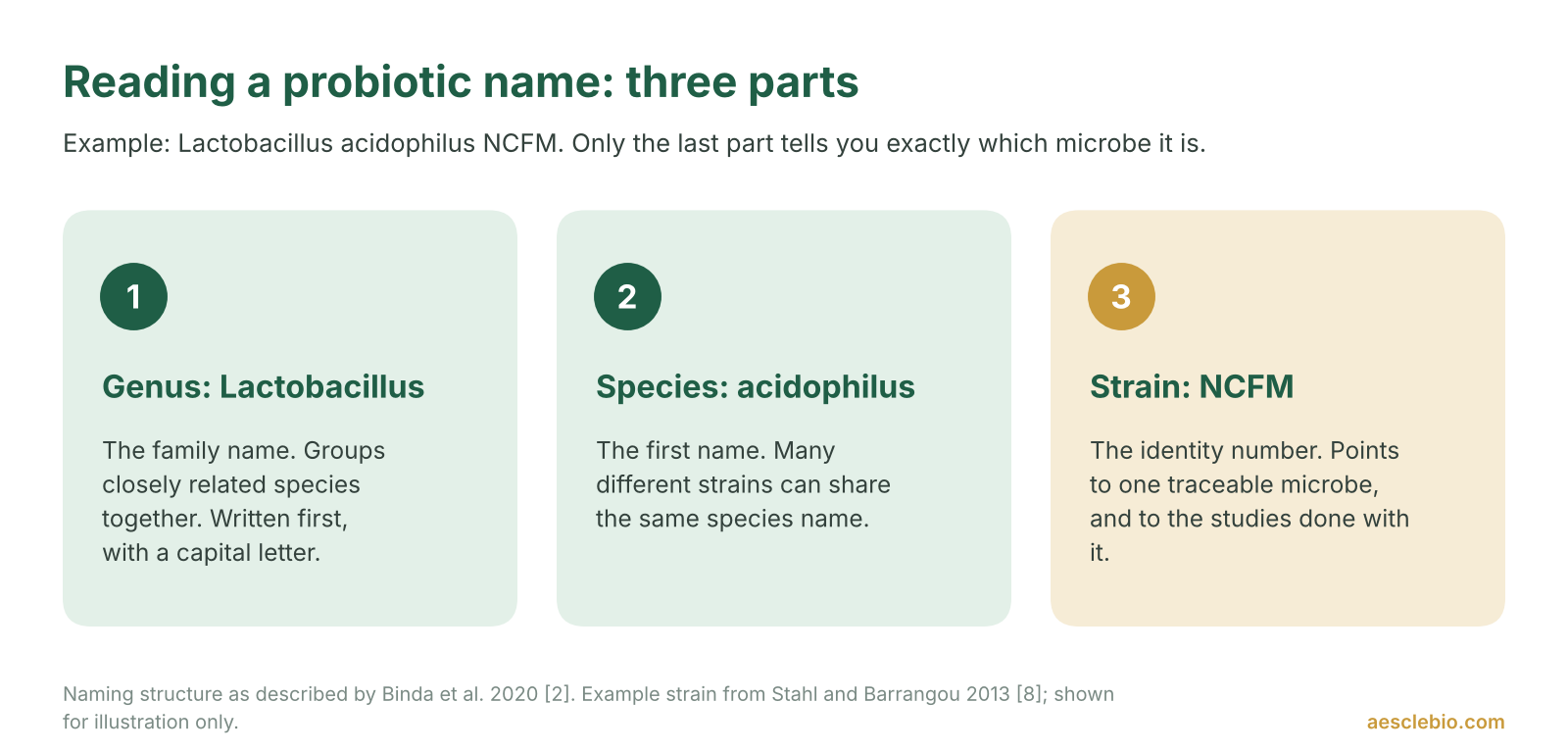
Some species are split once more into subspecies. The best-known case is Bifidobacterium animalis subsp. lactis (“subsp.” means subspecies), which almost everyone shortens to B. lactis. So “Bifidobacterium animalis subsp. lactis B420” and “Bifidobacterium lactis B420” are the same strain written two ways [12]. The same logic applies to a supplement: a Bifidobacterium lactis HN019 probiotic cannot borrow evidence from a different B. lactis strain, and a label that reads only “B. lactis” tells you far less than one that reads Bifidobacterium lactis HN019. The table shows how a few published strain names break down. These are examples of what codes look like, not recommendations.
| Full name as published | Genus and species | Strain code |
|---|---|---|
| Bifidobacterium animalis subsp. lactis HN019 [11] | Bifidobacterium animalis, subspecies lactis | HN019 |
| Bifidobacterium animalis subsp. lactis B420 [12] | Bifidobacterium animalis, subspecies lactis | B420 |
| Lactobacillus acidophilus NCFM [8] | Lactobacillus acidophilus | NCFM |
| Lactobacillus acidophilus La-14 [8] | Lactobacillus acidophilus | La-14 |
| Lacticaseibacillus rhamnosus HN001 [13] | Lacticaseibacillus rhamnosus (formerly Lactobacillus rhamnosus) | HN001 |
| Limosilactobacillus reuteri DSM 17938 [7] | Limosilactobacillus reuteri (formerly Lactobacillus reuteri) | DSM 17938 |
| Limosilactobacillus reuteri ATCC PTA 6475 [10] | Limosilactobacillus reuteri (formerly Lactobacillus reuteri) | ATCC PTA 6475 |
Why benefits are strain-specific, and when they are not
Here is the core argument. Two strains of the same species can behave very differently, so a result found with one strain does not automatically carry over to another. A systematic review (a study that gathers and weighs all the trials on a question) looked at 228 randomised trials and found strong evidence that probiotic effects are both strain-specific and condition-specific: among strains of the same or closely related species, some showed a benefit for a given problem while others did not [3]. The authors warned that reviews which pool different strains together can reach misleading conclusions [3].
Animal work shows the same pattern. In one mouse study described in a 2018 review, three strains of L. reuteri were given to mice on a high-fat diet: only one reduced weight gain, while mice given another strain gained some weight [10]. Mouse results prove nothing in people, but they show how far strains of one species can differ [10].
How a strain gets its code: culture collections and genome sequencing
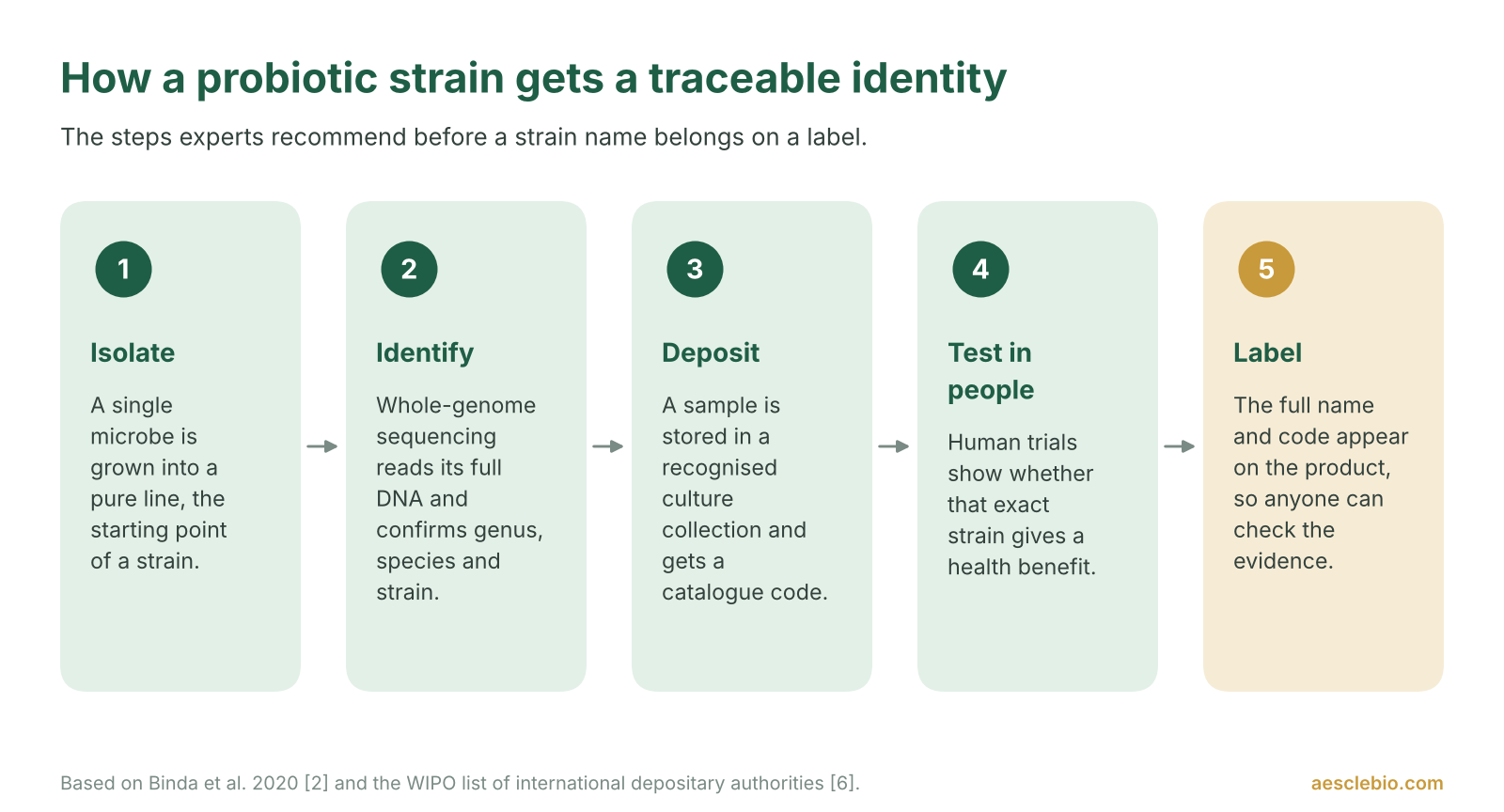
Experts recommend that every probiotic strain be deposited (placed for safe-keeping) in a recognised culture collection, a kind of library that stores living microbes so that other scientists can obtain and check them [2]. Under the Budapest Treaty of 1977, the World Intellectual Property Organization (WIPO), the United Nations agency for patents and inventions, recognises 53 international depositary authorities as of March 2026 [6]. They include the American Type Culture Collection (ATCC) in the United States, the German Collection of Microorganisms and Cell Cultures (DSMZ), and three in India: the Microbial Type Culture Collection (MTCC), the Microbial Culture Collection (MCC) and the National Agriculturally Important Microbial Culture Collection (NAIMCC) [6]. That is why a code beginning “DSM” points to the German collection, and “ATCC PTA 6475” points to the American one. Other codes, such as HN019, NCFM or La-14, are a company’s or laboratory’s own designation for a strain [2]. Experts recommend that each strain keep a single designation, because several names for one strain cause confusion [2].
How do scientists prove a strain is what the label says? The “gold standard” for probiotic strain identity testing is whole-genome sequencing (WGS): reading the strain’s complete DNA, its full instruction book, letter by letter [2]. This genomic sequencing for strain validation can tell apart strains that older laboratory tests could not. Two examples show why it is needed:
- The genomes of L. acidophilus La-14 and L. acidophilus NCFM are 99.98% the same, differing at about 111 single spots, plus one larger deletion, in roughly two million DNA letters [8]. Two separate strains, almost twins.
- Two B. lactis strains, Bl-04 and DSM 10140, differ by only 47 single DNA letters and four small insertions or deletions. Older typing methods had failed to tell B. lactis strains apart; a test built on these tiny differences sorted 24 strains into 14 groups [9].
- A strain can even be changed on purpose. Scientists removed two plasmids (small extra rings of DNA that carried antibiotic-resistance genes) from L. reuteri ATCC 55730, using methods that do not genetically modify the microbe. The result was a new “daughter” strain, which received its own code: DSM 17938 [7].
The Lactobacillus reclassification of 2020: why the names changed
For decades, Lactobacillus was a giant catch-all genus. By March 2020 it held 261 species that were extremely different from one another in their genes, habits and homes [4]. In April 2020, an international team of 15 scientists published a study in the International Journal of Systematic and Evolutionary Microbiology that compared the whole genomes of all these species [4]. They split the old genus into 25 genera: a smaller, amended Lactobacillus, the existing genus Paralactobacillus, and 23 new genera [4]. The new groups bring together species that are truly related and share similar ecology and metabolism (how they live and feed) [4].
The informal word “lactobacilli” is still useful for all the species that were classed as Lactobacillaceae until 2020 [4]. Helpfully, every new genus name begins with “L”, so the short form L. rhamnosus still works [5]. The research team also built a free online tool for looking up the new names for any former Lactobacillus species [5]. Here are the new names for Lactobacillus species most often seen on probiotic labels:
| Old name | Name since 2020 | Changed? |
|---|---|---|
| Lactobacillus casei | Lacticaseibacillus casei | Yes |
| Lactobacillus paracasei | Lacticaseibacillus paracasei | Yes |
| Lactobacillus rhamnosus | Lacticaseibacillus rhamnosus | Yes |
| Lactobacillus plantarum | Lactiplantibacillus plantarum | Yes |
| Lactobacillus reuteri | Limosilactobacillus reuteri | Yes |
| Lactobacillus fermentum | Limosilactobacillus fermentum | Yes |
| Lactobacillus salivarius | Ligilactobacillus salivarius | Yes |
| Lactobacillus brevis | Levilactobacillus brevis | Yes |
| Lactobacillus acidophilus | Lactobacillus acidophilus | No |
| Lactobacillus gasseri | Lactobacillus gasseri | No |
| Lactobacillus crispatus | Lactobacillus crispatus | No |
| Lactobacillus johnsonii | Lactobacillus johnsonii | No |
| Lactobacillus helveticus | Lactobacillus helveticus | No |
| Lactobacillus delbrueckii subsp. bulgaricus | Lactobacillus delbrueckii subsp. bulgaricus | No |
What did not change? The species part of each name stayed the same [5]. The strain code is a catalogue or company number, not part of the scientific name [2], so it stays too: Lactobacillus rhamnosus HN001 is simply written Lacticaseibacillus rhamnosus HN001 today. The microbe in the capsule is exactly the same. Labels that still use the old name are not wrong about what is inside; they simply use the older spelling.
What our research shows about strain names in clinical trials
Aesclebio’s own analysis of 3,070 probiotic-type clinical trials (research studies in people) registered on ClinicalTrials.gov, the public trial registry run by the US National Library of Medicine, shows how much the 2020 change touches everyday science. Of the eight leading species in that analysis, five now carry a new genus name [14].
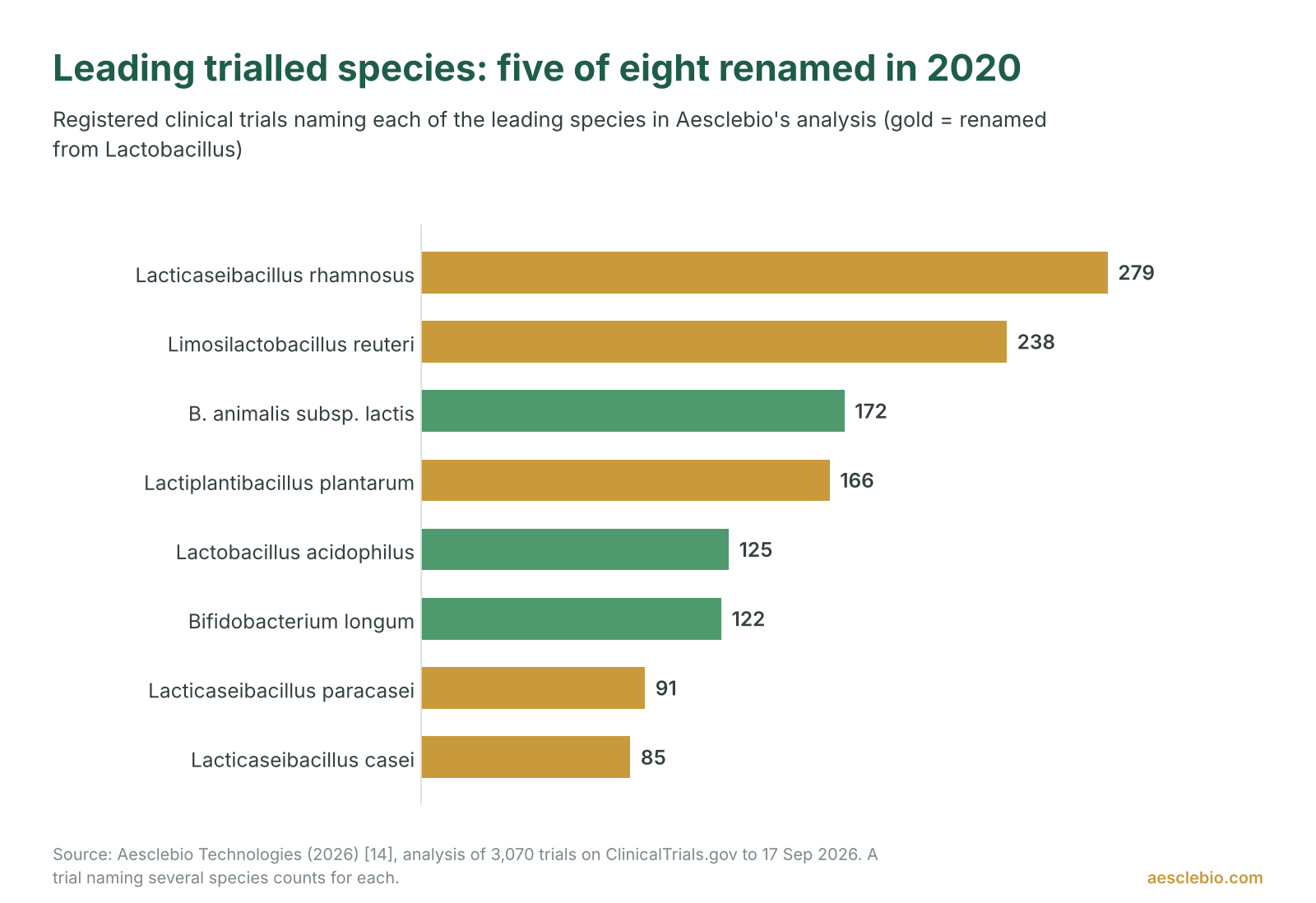
The same analysis found a bigger problem. Only 57.6% of these trials name a strain designation anywhere in the registry record, so more than two in five trials cannot be tied to a specific strain [14]. By contrast, a single neutral deposit code, L. reuteri DSM 17938, appears in 106 registered trials [14]. For anyone looking for probiotic strains with clinical data, or planning a study, the lesson is simple: good clinical trial design for probiotics starts with naming the exact strain in the record.
Myth or fact?
| Myth | What the evidence says |
|---|---|
| If a species has been studied, every strain of it has the same benefits. | Benefits are often strain-specific: among strains of the same or closely related species, some showed an effect in trials and others did not [3]. Some core benefits are shared more widely, but the strain should still be named [1, 2]. |
| Two strains with almost identical DNA are really the same strain. | L. acidophilus La-14 and NCFM are 99.98% identical yet are separate strains with separate codes [8]. Small differences can matter, which is why each strain needs its own evidence. |
| The 2020 renaming means the old Lactobacillus products were wrong or have changed. | Only the genus name moved. The species name, the strain and the product stayed the same [4, 5]. |
| A code on the label proves the product works. | A code proves only identity. Whether that strain helps with a particular problem depends on human trials of that strain, at that amount, in people like you [2, 3]. |
How to read a probiotic label: a strain checklist
Probiotic strain names explained in one line: genus + species (+ subspecies) + strain code. Use the code to check the evidence.
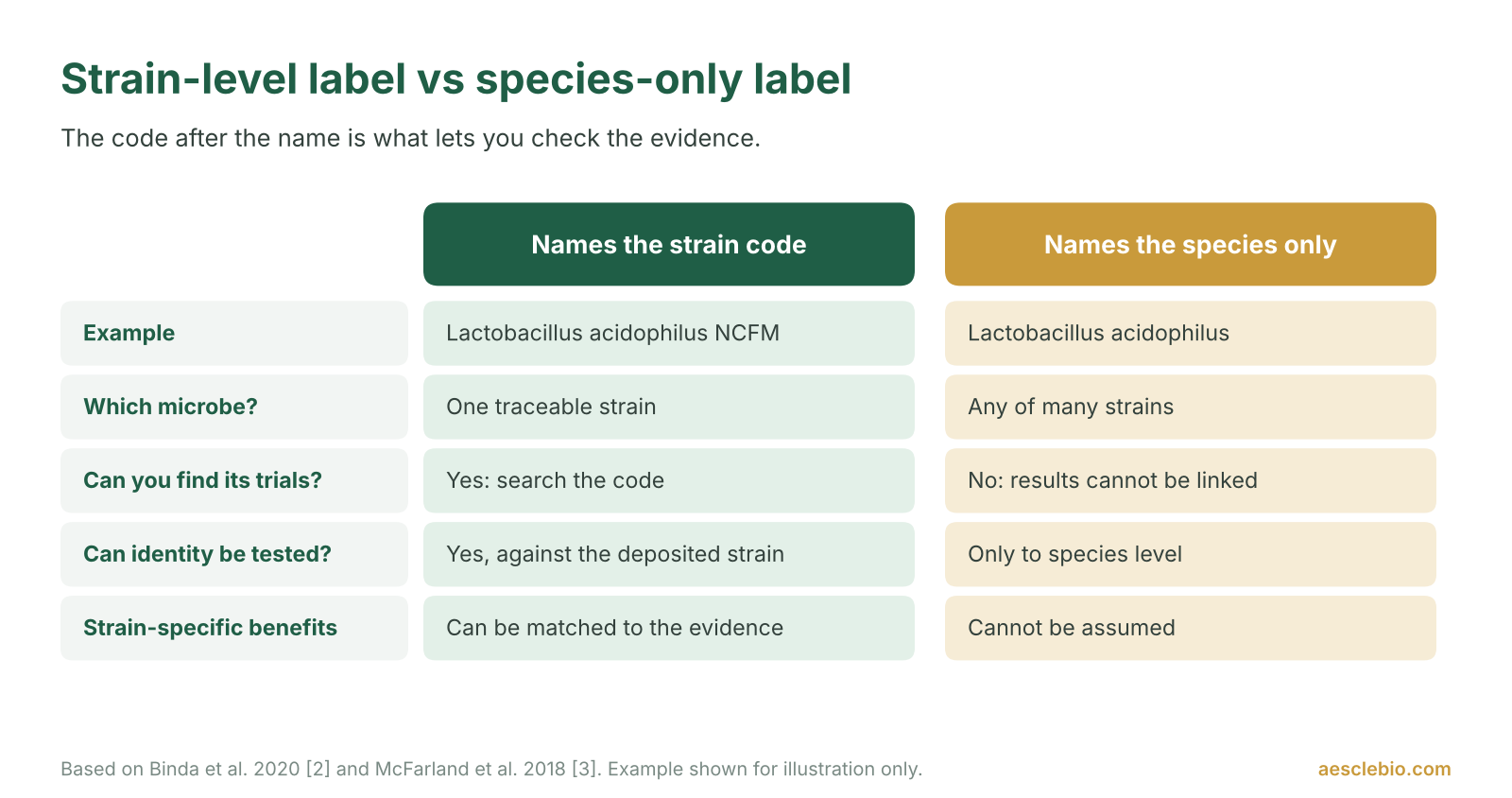
- Look for the full name of every strain in the probiotic supplement, including the code after the species. A label that lists only “Lactobacillus acidophilus” tells you the species, not the strain.
- Check the evidence for that exact code. Search the code on PubMed (a free database of medical research) or ClinicalTrials.gov and see whether it was tested in people for the benefit you want.
- Do not mind old or new genus names. L. plantarum and Lactiplantibacillus plantarum are the same species [5].
- Check the live count until the end of shelf life, stated in colony-forming units (CFU), the standard count of live microbes [2].
- Ask suppliers for proof of identity. Buyers and brands can request genome sequencing results and the culture-collection deposit number for each strain [2].
- If you are pregnant, breastfeeding, buying for a baby or child, or living with a health condition, speak to your doctor before choosing a probiotic.
The bottom line
Your probiotic is a strain, not a species. The letters and numbers after the name are not decoration; they are the identity number that links a product to the studies done with it. Benefits found with one strain do not automatically transfer to its cousins, even cousins with 99.98% of the same DNA. The 2020 renaming of Lactobacillus changed the family names on many labels, but not the microbes inside. When you read a label, look past the genus and species to the code, and then look for the human evidence behind that code.
Frequently asked questions
What is a probiotic strain?
A probiotic strain is one specific, traceable line of microbes within a species, grown from one original microbe and named by a code after the species name, such as the “NCFM” in Lactobacillus acidophilus NCFM. Experts recommend that each strain be identified by whole-genome sequencing and deposited in a recognised culture collection, so that its identity can always be checked [2].
What is Bifidobacterium lactis HN019, and what are its benefits?
HN019 is a strain code of Bifidobacterium animalis subsp. lactis, usually shortened to B. lactis [11]. This article does not assess the benefits of any named strain. Any benefit belongs to the exact strain, amount and group of people tested, so look up the published human trials for that code [3], and ask a doctor whether it suits you.
Is Lactobacillus acidophilus NCFM the same as La-14?
No. They are two separate strains of the same species, each with its own code. Their genomes are 99.98% the same, with about 111 small differences [8]. Because benefits are often strain-specific [3], evidence for one cannot simply be borrowed for the other; each strain needs its own studies in people.
What does a code like DSM 17938 or ATCC PTA 6475 mean?
These are deposit codes. “DSM” points to the German culture collection DSMZ (German Collection of Microorganisms and Cell Cultures) and “ATCC” to the American Type Culture Collection, both recognised international depositary authorities [6]. The number is the strain’s catalogue entry, so scientists can obtain the same strain and check it. Both of these codes are strains of L. reuteri [7, 10].
Why was Lactobacillus renamed, and what are the new names?
By 2020 the genus held 261 very different species. A whole-genome study split it into 25 genera so that names reflect true relationships [4]. Common changes: L. casei, L. paracasei and L. rhamnosus became Lacticaseibacillus; L. plantarum became Lactiplantibacillus; L. reuteri and L. fermentum became Limosilactobacillus; L. salivarius became Ligilactobacillus. L. acidophilus and L. gasseri kept the name Lactobacillus [5].
Did the 2020 name change alter my probiotic?
No. Only the genus part of the name changed; the species name stayed the same [5], and so did the strain code, which is a catalogue number rather than part of the scientific name [2]. A product labelled Lactobacillus rhamnosus and one labelled Lacticaseibacillus rhamnosus with the same strain code contain the same microbe.
Are strain-specific probiotics always better than species-level products?
Not always better, but always easier to check. Some core benefits, such as support for a healthy digestive tract, are seen across many strains of commonly studied species [1]. Still, experts say every probiotic should be identified to the strain level [2], because many other effects are strain-specific [1, 3].
How do companies prove probiotic strain identity?
The gold standard is whole-genome sequencing, which reads a strain’s full DNA and can tell even near-identical strains apart [2, 9]. Good suppliers also deposit each strain in a recognised culture collection and keep their production cultures genetically pure, so that every batch contains the same strain over time [2].
Related reading
- What Probiotics Are, and the Five Myths That Survive Every Explainer
- Billions of CFU, Little Meaning: Why the Biggest Number on the Label Rarely Wins
- Probiotic Foods vs Probiotic Supplements: Why a Probiotic Foods List Is Not a Dose
- L. reuteri: The Most Searched Probiotic Species (Aesclebio blog)
- Choosing a Probiotic Contract Manufacturer (Aesclebio blog)
References
- Hill C, Guarner F, Reid G, et al. Expert consensus document: the International Scientific Association for Probiotics and Prebiotics consensus statement on the scope and appropriate use of the term probiotic. Nature Reviews Gastroenterology & Hepatology. 2014;11(8):506–514. Open access. Link
- Binda S, Hill C, Johansen E, et al. Criteria to qualify microorganisms as “probiotic” in foods and dietary supplements. Frontiers in Microbiology. 2020;11:1662. Free full text: PubMed Central PMC7394020. Link
- McFarland LV, Evans CT, Goldstein EJC. Strain-specificity and disease-specificity of probiotic efficacy: a systematic review and meta-analysis. Frontiers in Medicine. 2018;5:124. Free full text: PubMed Central PMC5949321. Link
- Zheng J, Wittouck S, Salvetti E, et al. A taxonomic note on the genus Lactobacillus: description of 23 novel genera, emended description of the genus Lactobacillus Beijerinck 1901, and union of Lactobacillaceae and Leuconostocaceae. International Journal of Systematic and Evolutionary Microbiology. 2020;70(4):2782–2858. Open access. Link
- International Scientific Association for Probiotics and Prebiotics (ISAPP). New names for important probiotic Lactobacillus species. ISAPP; 15 April 2020, updated 21 June 2025. Free to read. Link
- World Intellectual Property Organization (WIPO). Budapest Treaty on the International Recognition of the Deposit of Microorganisms for the Purposes of Patent Procedure: International Depositary Authorities (status on 26 March 2026). Geneva: WIPO. Link
- Rosander A, Connolly E, Roos S. Removal of antibiotic resistance gene-carrying plasmids from Lactobacillus reuteri ATCC 55730 and characterization of the resulting daughter strain, L. reuteri DSM 17938. Applied and Environmental Microbiology. 2008;74(19):6032–6040. Free full text: PubMed Central PMC2565949. Link
- Stahl B, Barrangou R. Complete genome sequence of probiotic strain Lactobacillus acidophilus La-14. Genome Announcements. 2013;1(3):e00376-13. Free full text: PubMed Central PMC3707595. Link
- Briczinski EP, Loquasto JR, Barrangou R, et al. Strain-specific genotyping of Bifidobacterium animalis subsp. lactis by using single-nucleotide polymorphisms, insertions, and deletions. Applied and Environmental Microbiology. 2009;75(23):7501–7508. Free full text: PubMed Central PMC2786410. Link
- Mu Q, Tavella VJ, Luo XM. Role of Lactobacillus reuteri in human health and diseases. Frontiers in Microbiology. 2018;9:757. Free full text: PubMed Central PMC5917019. Link
- Miller LE, Lehtoranta L, Lehtinen MJ. The effect of Bifidobacterium animalis ssp. lactis HN019 on cellular immune function in healthy elderly subjects: systematic review and meta-analysis. Nutrients. 2017;9(3):191. Free full text: PubMed Central PMC5372854. Link
- Uusitupa HM, Rasinkangas P, Lehtinen MJ, et al. Bifidobacterium animalis subsp. lactis 420 for metabolic health: review of the research. Nutrients. 2020;12(4):892. Free full text: PubMed Central PMC7230722. Link
- Toscano M, De Grandi R, Stronati L, et al. Effect of Lactobacillus rhamnosus HN001 and Bifidobacterium longum BB536 on the healthy gut microbiota composition at phyla and species level: a preliminary study. World Journal of Gastroenterology. 2017;23(15):2696–2704. Free full text: PubMed Central PMC5403748. Link
- Aesclebio Technologies. Probiotic Clinical Trials: Where the Industry Is Heading. A registry-based analysis of ClinicalTrials.gov data to 17 September 2026. Hyderabad: Aesclebio Technologies Pvt. Ltd.; 2026. Link
Disclaimer
This article is for general education only. It is not medical advice and is not intended to diagnose, treat, cure or prevent any disease. It does not promote any specific product or brand, and it makes no claims about any product.
Statements about research describe the findings of published studies. They do not mean that any particular food or supplement will have the same effect for you. Always speak to a qualified healthcare professional before changing your diet or starting a supplement, especially if you are pregnant, breastfeeding, giving products to a baby or child, or living with a health condition.
Rules on how probiotics and supplements may be described differ from country to country. Nothing in this article should be read as a health claim for any product.
Some strain designations mentioned may be trademarks of their respective owners; they are used here only to illustrate how strains are named, and Aesclebio has no affiliation with those owners.
All graphics are original works of Aesclebio Technologies. Figures from other studies are credited to their sources. Quotations are limited to short passages with full attribution. Any clinical-trial figures from Aesclebio's own analysis come from public registry records and do not imply that any product is effective or safe.
Prepared by the Aesclebio Research Team with the help of AI tools, under the team's direction. © 2026 Aesclebio Technologies Pvt. Ltd. All rights reserved. Short extracts may be quoted with a link to the original article.