
Women's Health
Postpartum Gut Health: The First Bowel Movement and Beyond
Why the first poo after giving birth feels so daunting, when it usually happens, how to make it easier, and what the research really says about fibre and probiotics.
Why so many new mothers search for this
Every month, thousands of people type "first poo after giving birth", "pooping after birth", "after birth poop" or "first bowel movement after childbirth" into search engines. Many are in a hospital bed or at home with a newborn, a little sore, and quietly worried. That worry is normal, and the problem behind it is common. This article explains why the first bowel movement after birth can feel so hard, when it usually happens, and what genuinely helps. It also gives an honest answer about postpartum probiotics, because the evidence is much thinner than many shop shelves suggest.
A few words first. Postpartum (also written post partum, and called postnatal in many countries) means the weeks after giving birth. A bowel movement is the medical name for a poo. Constipation means pooing less often than usual, or finding poos hard, dry or difficult to pass [6].
First, the question everyone is too shy to ask: when giving birth, do you poop?
When you give birth, do you poop? Very often, yes. Doctors at Cleveland Clinic, a large US hospital, describe pooing during labour as "incredibly common" [5]. Hormones released in labour can stir up the bowels, the baby's head can press on the back passage, and pushing uses the same muscles as pooing [5]. Staff simply wipe it away quietly. Giving every woman an enema (liquid flushed into the back passage) or a laxative before birth has been dropped from routine care because these could cause discomfort and dehydration [5]. It happens a lot, and the team has seen it many times.
Why is pooping after birth so hard?
Several things pile up at once. A review by Cochrane, an independent international group that summarises medical research, lists the main ones: piles, pain from stitches, the effects of pregnancy hormones, and the iron tablets many women take in pregnancy [1]. Cleveland Clinic adds strong painkillers, iron taken after heavy blood loss at delivery, breastfeeding (which can be dehydrating), and the slow "wake-up" of the bowel after surgery [4].
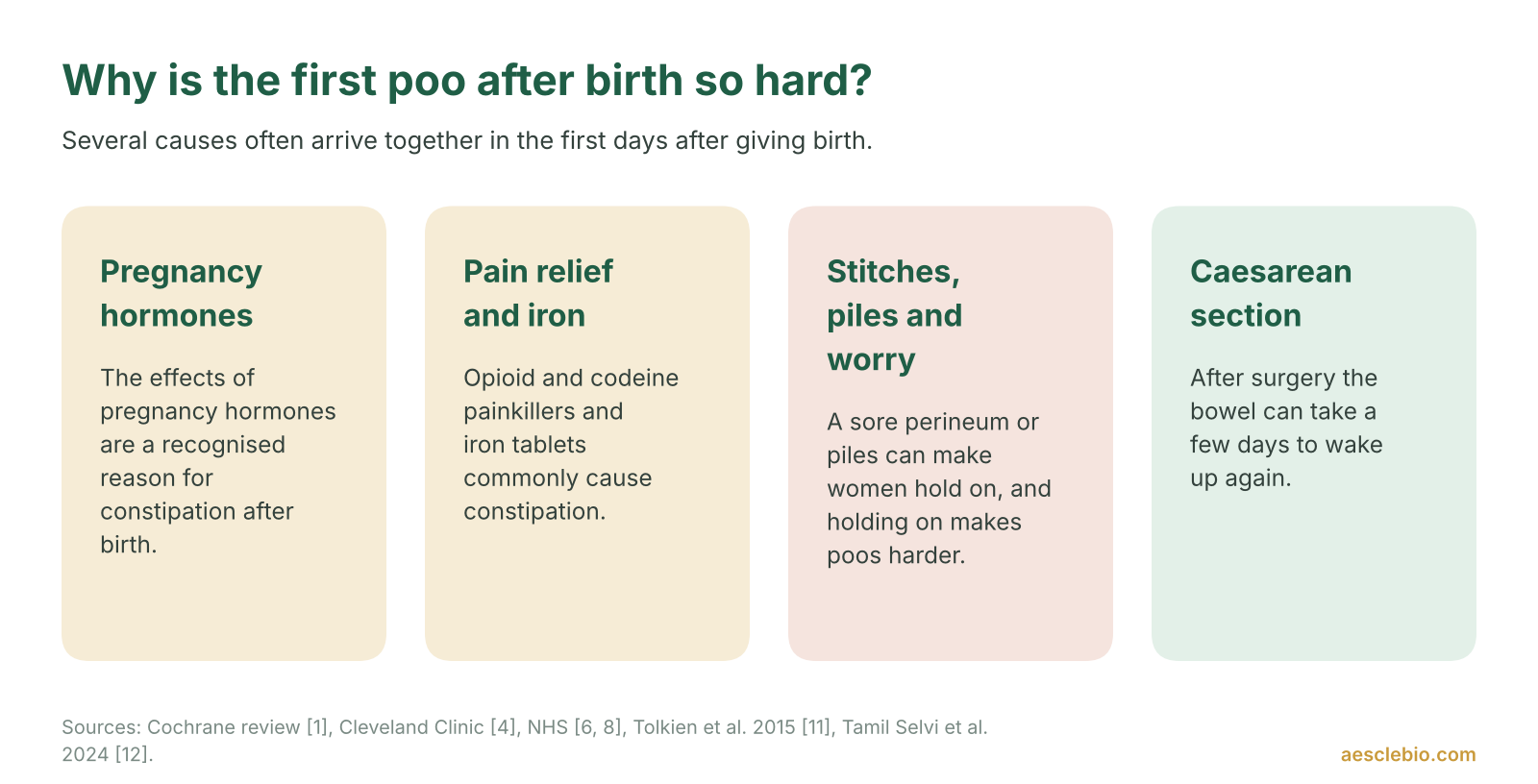
- Hormones. The effects of pregnancy hormones are one of the recognised reasons for constipation after birth [1].
- Pain relief. Strong painkillers called opioids, and painkillers containing codeine, are well known to cause constipation [4, 8].
- Iron tablets. In a large review of 43 trials, people taking ferrous sulfate, the most common iron tablet, had more stomach and bowel side effects than people given a dummy tablet or iron through a drip. Constipation was one of the most commonly reported, affecting about 12 in every 100 people taking iron tablets [11]. Never stop prescribed iron on your own; talk to your doctor first.
- Stitches, piles and worry. A tear, or a cut called an episiotomy, to the perineum (the skin between the vagina and the back passage) can make the area sore. Fear of pain can make women put off going to the toilet [12], but ignoring the urge is itself a cause of constipation [6].
- Caesarean section. After major surgery, "the bowels can take some time to wake up" [4].
When will the first poop after birth happen?
There is no exact clock, and official pages give a range rather than a deadline. According to Cleveland Clinic, after a vaginal birth you may poo within the first day or two. After a caesarean, or after opioid pain medicines, it can take three or four days [4].
| Situation | Typical timing | What helps |
|---|---|---|
| Vaginal birth | Often within the first day or two | Fluids, fibre, gentle walking, feet raised on a stool |
| Vaginal birth with stitches | Similar, but fear of pain can make women put off going | Clean pad held gently against the stitches; keep poos soft |
| Caesarean section (cesarean in US spelling) | Can take three or four days | Get up and move as soon as you are advised; eat and drink when hungry or thirsty |
| Strong (opioid) pain relief | Can take three or four days | Ask whether a stool softener is suitable for you |
How common is the problem? A Finnish study asked more than 400 new mothers about their bowels. A few days after birth, 47% of women who had a vaginal birth and 57% of those who had a caesarean had constipation. One month after birth, only 9% (vaginal birth) and 15% (caesarean) did. The 9% figure was even lower than the 21% seen in women of similar age who had not given birth in the past year [3].
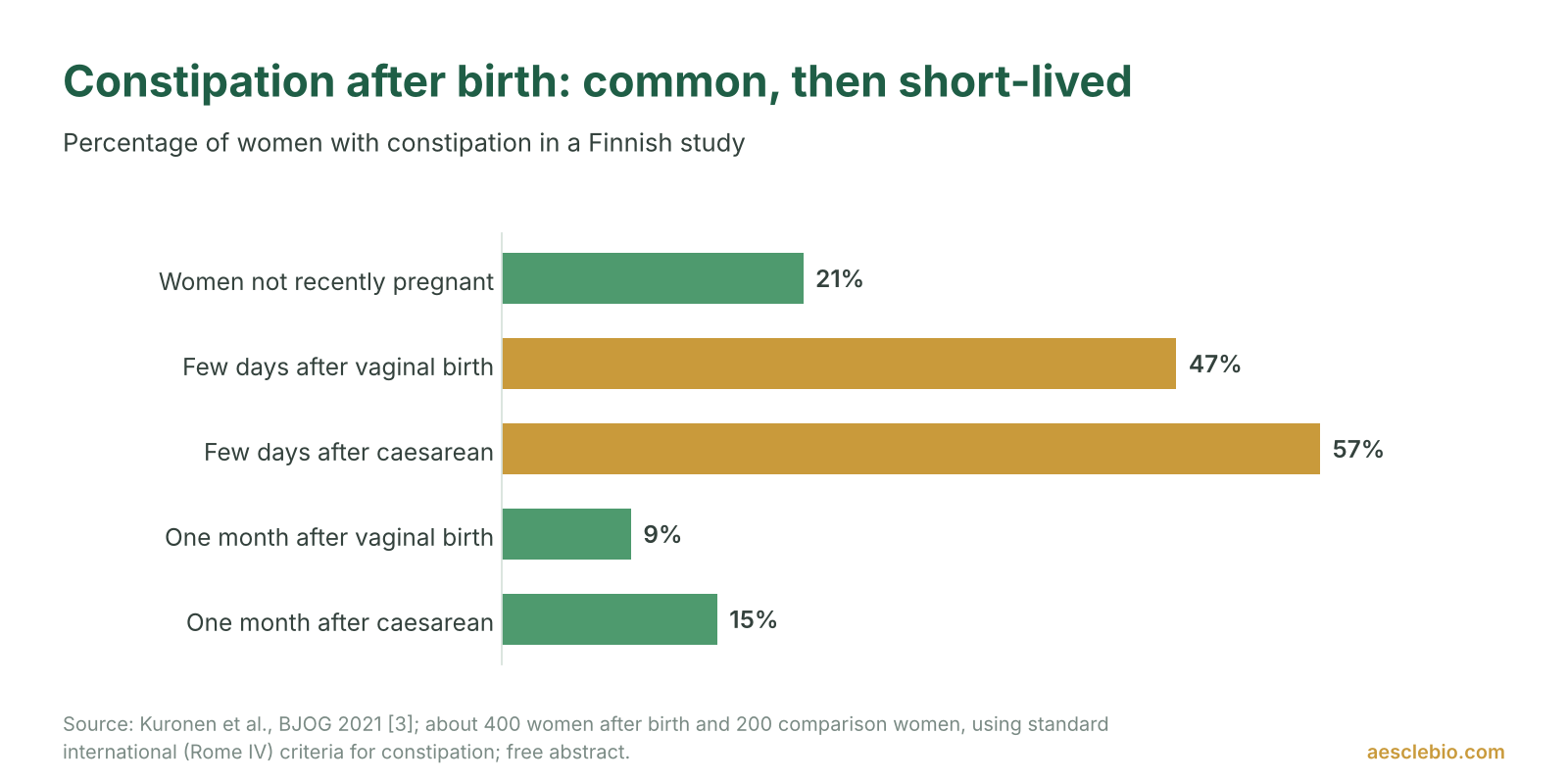
This is the reassuring core of the story. Postpartum bowel movement problems are common, but for most women they are short-lived. The first poo is often the hardest one.
How to poop after giving birth: simple remedies that help
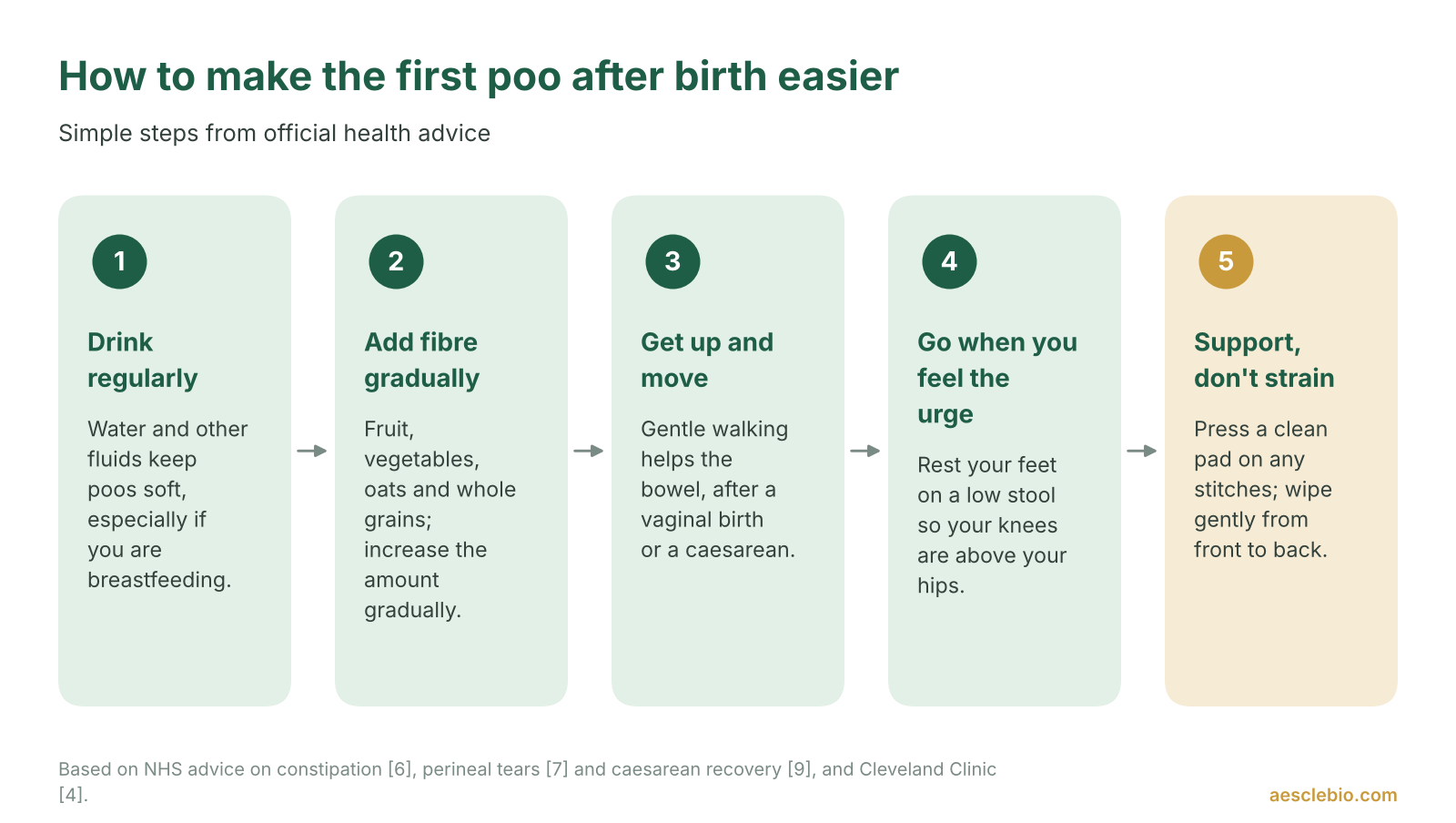
Official advice is simple, and most of it you can start in hospital. The NHS (the UK's National Health Service) recommends gradually adding fibre, drinking plenty of water and other fluids, not delaying when you feel the urge, resting your feet on a low stool so your knees are above your hips, and walking daily [6]. In a small Indian trial at the Jawaharlal Institute of Postgraduate Medical Education and Research (JIPMER) in Puducherry, 160 women late in pregnancy were put by chance into two groups: routine care (a leaflet at discharge) or a 20-minute teaching video about diet and exercise, shown before birth and again on the second day after birth. Among the 140 women followed up, 27% of the leaflet group were constipated two weeks after delivery, compared with about 6% of the video group. Eating fruit and green leafy vegetables, drinking more fluids and walking regularly were all linked with less constipation [12].
If you have stitches
- When you poo, place a clean pad on the stitches and press gently. This supports the area and eases the pressure [7].
- When wiping your bottom, wipe gently from front to back [7].
- Keep the area clean; rinsing with warm water after the toilet helps [7].
- Keep poos soft and avoid straining. After deeper tears this matters even more, to avoid putting pressure on the stitches [4, 8].
- If pooing is particularly painful, laxatives may help [7]. Ask your midwife, doctor or pharmacist which one is suitable for you, especially if you are breastfeeding.
After a caesarean
The first poop after a C-section often takes a little longer [4]. The NHS advises getting out of bed and moving around as soon as possible, eating and drinking when you feel hungry or thirsty, and going for a gentle daily walk once home [9].
Stool softeners and laxatives: only on medical advice
Hospitals often offer a stool softener after birth, sometimes "as a just-in-case measure" [4]. That is reasonable, but the research behind it is weaker than most people assume. A Cochrane review found only five trials, most published more than 40 years ago and poorly reported [1]. In one trial of 471 women, a laxative called senna may have made a first bowel movement within 24 hours more likely, but it may also have caused more tummy cramps; the reviewers rated this evidence as low certainty [1]. The reviewers concluded there was not enough evidence to make general conclusions about laxatives after birth [1]. A second Cochrane review looked for trials that treated women who were already constipated after birth and found none that met its standards [2].
So the sensible approach is the one your team will suggest: start with fluids, fibre and movement, and use a stool softener or laxative only when your doctor, midwife or pharmacist recommends one. They will choose one that suits you and, if you are breastfeeding, your baby. This article does not give doses for any medicine.
Piles after birth
Haemorrhoids, usually called piles, are swollen blood vessels in and around the back passage. Pregnancy, constipation and pushing hard when pooing all make them more likely [8]. Signs include bright red blood after a poo, itching, lumps or pain around the anus [8]. The NHS suggests drinking plenty of fluid and eating fibre to keep poos soft, taking a warm bath to ease pain, and avoiding painkillers that contain codeine [8].
What about fibre and probiotics after birth?
Fibre is the part of plant foods (fruit, vegetables, pulses, whole grains) that the body does not fully digest; it holds water and keeps poos soft. In adults with long-term constipation, a review of 16 randomised controlled trials (studies where people are put into groups by chance) found that 66% of people responded to fibre supplements, compared with 41% given a comparison treatment [13]. Fibre also caused more wind [13], and the NHS advises increasing it gradually [6]. These trials were not in new mothers, but the advice to eat more fibre after birth fits with them [1, 6].
Probiotics are live microbes that can give a health benefit when taken in a large enough amount [10]. Here the honest answer is: we do not know yet whether they help with postpartum constipation. The Cochrane reviews found no trials of probiotics, diet or education for constipation after birth that met their standards [1, 2]. Even for long-term constipation in adults generally, a review of the evidence found that the benefit of probiotics is uncertain and seems to depend on the exact strain used [10].
This does not mean probiotics are useless; the question has simply not been answered. If you are breastfeeding and thinking about a probiotic or any supplement, ask your doctor or midwife first.
Myth or fact?
| Myth | What the evidence says |
|---|---|
| Pooing during labour is rare and embarrassing. | It is "incredibly common", and staff clean it away discreetly as a normal part of birth [5]. |
| Your stitches will burst if you poo. | Official advice is to support the stitches with a clean pad and avoid straining, not to avoid pooing. Holding on makes constipation worse [6, 7]. |
| Everyone needs a laxative after birth. | Trials of laxatives after birth are few, old and weak; one caused more cramps. Use them when your team advises [1]. |
| Postpartum constipation lasts for months. | In a Finnish study most cases had gone within a month of birth [3]. If yours has not, see your doctor. |
| A postnatal probiotic is proven to help the first poo. | No good trials have tested this yet [1, 2, 15]. |
When to call your doctor or midwife
Most post partum pooping problems settle with time and simple steps. But some signs need a professional to check them, and you should never feel embarrassed to ask.
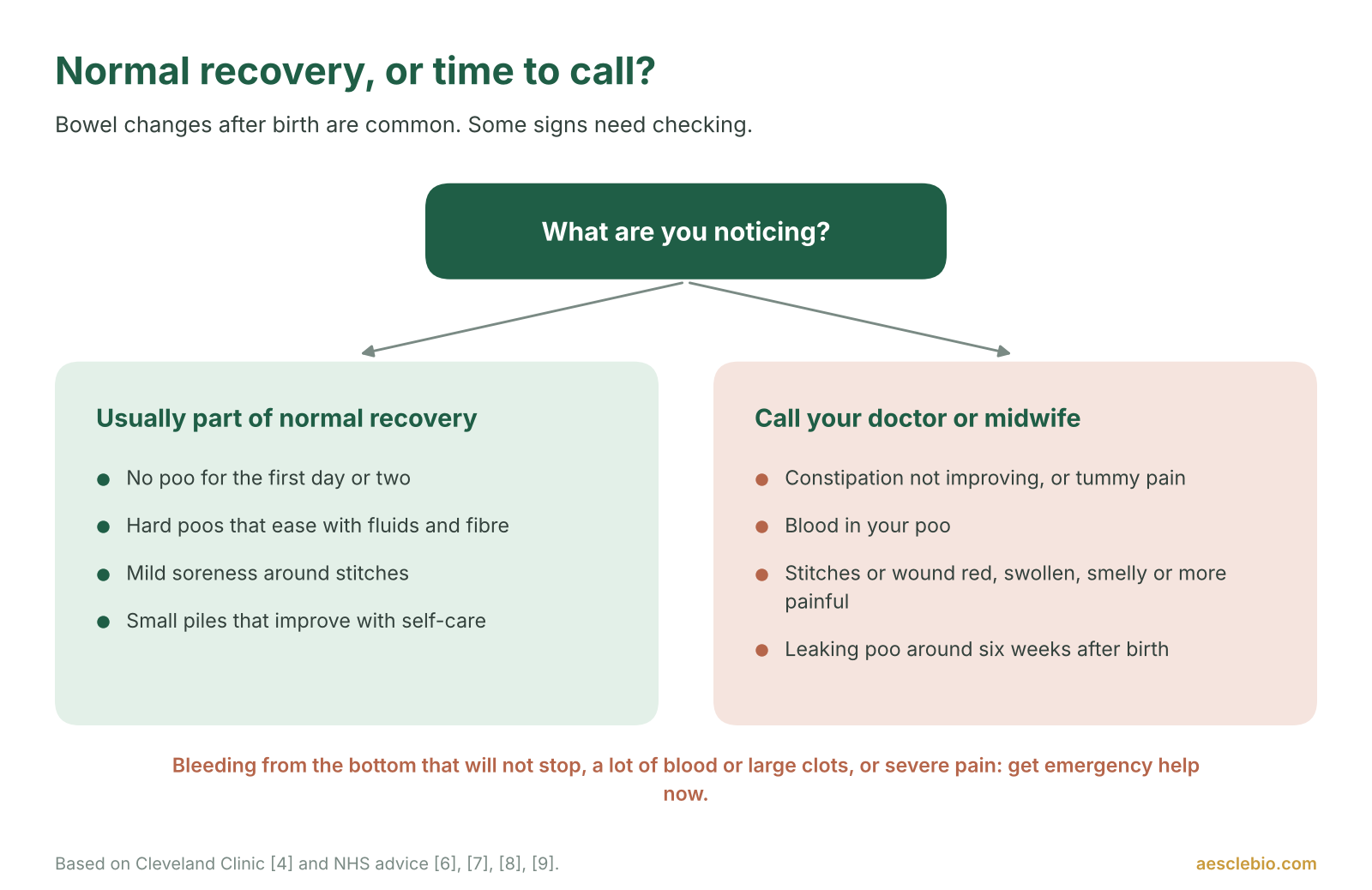
- See a GP (family doctor) or your midwife if constipation is not getting better with treatment, you have blood in your poo or tummy pain, or you are constipated and feel tired all the time [6].
- Call your midwife or GP if your stitches get more painful, there is a smelly discharge, or the skin around the cut or tear is red and swollen; these may be signs of infection [7].
- After a caesarean, contact your midwife or a GP straight away if you have severe pain, heavy vaginal bleeding, pain when peeing or leaking urine, a wound that becomes more red, painful and swollen or leaks pus or foul-smelling fluid, a cough or shortness of breath, or swelling or pain in your lower leg [9].
- If you have piles, ask for an urgent appointment if you have painless bleeding from the bottom, pus leaking from the piles, or a very high temperature or feel hot, cold, shivery and unwell [8].
- Get emergency help (go to an emergency department or call an ambulance) if you have piles and the bleeding will not stop, there is a lot of blood or large clots, or you are in severe pain [8].
- Tell your doctor if you are leaking poo around six weeks after birth; specialist pelvic floor help is available [4].
The bottom line
The first poo after giving birth is one of the least talked-about parts of recovery, yet about half of new mothers are constipated in the first few days [3]. Hormones, pain relief, iron tablets, stitches, piles and surgery all play a part [1, 4]. The good news is that it usually happens within a few days and the problem fades quickly for most women [3, 4]. Fluids, fibre, gentle movement, a footstool and a clean pad over any stitches are the tools with the best support from official advice [6, 7]. Stool softeners and laxatives can help some women, but the trials behind them are few and weak, so use them only on medical advice [1]. And probiotics? The research simply has not been done yet. An honest "we do not know" is better than a confident promise.
Frequently asked questions
How long does it take to poop after giving birth?
Most women have their first bowel movement within a few days. After a vaginal birth it is often within a day or two; after a caesarean section or opioid pain relief it can take three or four days [4]. If several days pass and you feel bloated or uncomfortable, tell your midwife or doctor, who can check whether you need help.
When will I have my first bowel movement after labor?
Usually within the first day or two after a vaginal birth, although it can take longer if you had strong pain relief or a caesarean [4]. Drinking enough, eating fibre, walking and not ignoring the urge all help bowel movements after labor return to normal [6]. Constipation is common in the first days and usually settles within a month [3].
Why does it hurt to poop after giving birth?
Hard, dry poos are common after birth because of pregnancy hormones, pain relief and iron tablets [1, 4]. Stitches or a tear in the perineum and piles can make the area sore [1, 8]. Keeping poos soft with fluids and fibre, supporting stitches with a clean pad and not straining make it more comfortable [6, 7]. Pain that is getting worse should be checked.
How do I poop after giving birth if I have stitches?
Go when you feel the urge rather than holding on, sit with your feet on a low stool so your knees are above your hips, and press a clean pad gently against the stitches while you poo [6, 7]. Try not to strain. If pooing is very painful, ask your midwife or pharmacist whether a laxative is suitable [7].
First poop after birth: how to wipe?
Wipe gently from front to back [7]. Keep the area clean: the NHS suggests rinsing with warm water after using the toilet [7]. If you have stitches, press a clean pad gently against them while you poo, and tell your midwife if the area becomes more painful, red, swollen or smelly, as these can be signs of infection [7].
When is the first poop after a C-section?
After a caesarean (cesarean) section it can take three or four days for the first poop, partly because the bowel slows after surgery and partly because of strong painkillers [4]. Getting up and moving as soon as you are advised, and eating and drinking when hungry or thirsty, help the bowel wake up [9].
I can't poop after birth. What should I do?
Drink plenty of fluids, add fibre gradually, take short walks and do not ignore the urge [6]. If that is not working, speak to your midwife, doctor or pharmacist; they may suggest a stool softener or laxative [6, 7]. Tell them if you are breastfeeding so they can choose one that suits you. See a doctor if you also have tummy pain or blood in your poo [6].
Are postpartum probiotics worth taking for constipation?
There is not enough evidence to say. Cochrane reviews found no qualifying trials of probiotics for constipation after birth [1, 2], and Aesclebio's review of trial registry records found none designed to test this [15]. In adults generally, any benefit seems to depend on the exact strain [10]. Ask your doctor or midwife before taking any supplement while breastfeeding.
Related reading
- Probiotics in Pregnancy (Aesclebio blog)
- Breastfeeding, Mastitis and the Breast-Milk Microbiome (Aesclebio blog)
- Prebiotic Fibres Decoded: Inulin, FOS, GOS and HMOs
- What Probiotics Are, and the Five Myths That Survive Every Explainer
- Your Probiotic Is a Strain, Not a Species: Reading the Code After the Name
References
- Turawa EB, Musekiwa A, Rohwer AC. Interventions for preventing postpartum constipation. Cochrane Database of Systematic Reviews. 2020;8(8):CD011625. Free full text: PubMed Central PMC8094226. Link
- Turawa EB, Musekiwa A, Rohwer AC. Interventions for treating postpartum constipation. Cochrane Database of Systematic Reviews. 2014;(9):CD010273. Free full text: PubMed Central PMC10823348. Link
- Kuronen M, Hantunen S, Alanne L, et al. Pregnancy, puerperium and perinatal constipation: an observational hybrid survey on pregnant and postpartum women and their age-matched non-pregnant controls. BJOG. 2021;128(6):1057–1064. Figures used here are from the free abstract (PubMed 33030260); a free summary is also available in the University of Eastern Finland news release, 9 October 2020 (uef.fi). Link
- Cleveland Clinic. Postpartum poop: what to expect and how to make it easier. Health Essentials. 18 July 2022. Link
- Cleveland Clinic. Is pooping during labor normal? Health Essentials. 27 February 2025. Link
- NHS (UK National Health Service). Constipation. nhs.uk. Link
- NHS (UK National Health Service). Episiotomy and perineal tears. nhs.uk. Link
- NHS (UK National Health Service). Piles (haemorrhoids). nhs.uk. Link
- NHS (UK National Health Service). Caesarean section: recovery. nhs.uk. Link
- Kamiński M, Skonieczna-Żydecka K, Łoniewski I, et al. Are probiotics useful in the treatment of chronic idiopathic constipation in adults? A review of existing systematic reviews, meta-analyses, and recommendations. Przegląd Gastroenterologiczny. 2020;15(2):103–118. Free full text: PubMed Central PMC7294971. Link
- Tolkien Z, Stecher L, Mander AP, et al. Ferrous sulfate supplementation causes significant gastrointestinal side-effects in adults: a systematic review and meta-analysis. PLoS One. 2015;10(2):e0117383. Open access. Free full text: PubMed Central PMC4336293. Link
- Tamil Selvi C, Kumari MJ, Vahitha S, Kubera NS. Effectiveness of video-assisted teaching on prevention of constipation among postpartum women admitted in postnatal ward at a tertiary care hospital: a randomised controlled trial. BMJ Nutrition, Prevention & Health. 2024;7(1):128–132. Open access. Free full text: PubMed Central PMC11221277. Link
- van der Schoot A, Drysdale C, Whelan K, Dimidi E. The effect of fiber supplementation on chronic constipation in adults: an updated systematic review and meta-analysis of randomized controlled trials. American Journal of Clinical Nutrition. 2022;116(4):953–969. Free full text: PubMed Central PMC9535527. Link
- Aesclebio Technologies. Probiotic Clinical Trials: Where the Industry Is Heading. A registry-based analysis of ClinicalTrials.gov data to 17 September 2026. Hyderabad: Aesclebio Technologies Pvt. Ltd.; 2026. Link
- Aesclebio Technologies. Aesclebio analysis of ClinicalTrials.gov records: 2,057 probiotic-type trials, including 62 enrolling pregnant or breastfeeding women (export February 2026). Trials cited: NCT06347770 and NCT06802042, free at ClinicalTrials.gov. Hyderabad: Aesclebio Technologies Pvt. Ltd.; 2026. Link
Disclaimer
This article is for general education only. It is not medical advice and is not intended to diagnose, treat, cure or prevent any disease. It does not promote any specific product or brand, and it makes no claims about any product.
Statements about research describe the findings of published studies. They do not mean that any particular food or supplement will have the same effect for you. Always speak to a qualified healthcare professional before changing your diet or starting a supplement, especially if you are pregnant, breastfeeding, giving products to a baby or child, or living with a health condition.
This topic concerns babies, pregnancy or new mothers. Nothing here is a recommendation to give any product to a baby or to use any product during pregnancy or breastfeeding. Decisions about care should always be made with a doctor, midwife or other qualified healthcare professional.
Rules on how probiotics and supplements may be described differ from country to country. Nothing in this article should be read as a health claim for any product.
All graphics are original works of Aesclebio Technologies. Figures from other studies are credited to their sources. Quotations are limited to short passages with full attribution. Any clinical-trial figures from Aesclebio's own analysis come from public registry records and do not imply that any product is effective or safe.
Prepared by the Aesclebio Research Team with the help of AI tools, under the team's direction. © 2026 Aesclebio Technologies Pvt. Ltd. All rights reserved. Short extracts may be quoted with a link to the original article.