
Probiotic Basics
Billions of CFU, Little Meaning: Why the Biggest Number on the Label Rarely Wins
What CFU means, how many CFU in probiotics you should look for, and why the right number beats the biggest one.
Why the biggest number on the label grabs attention
Pharmacy shelves and online shops shout numbers: 10 billion, 50 billion, even 100 billion CFU. So people search for "CFU meaning" and "what is CFU in probiotics", then ask: is a higher count better? Our answer is simple. The right number is the number that was studied for that strain, and it must still be alive on the last day of shelf life. A bigger number on the front of the pack is not, on its own, a sign of a better product.
CFU meaning: what is CFU in probiotics?
CFU stands for colony-forming units. It is the standard count of live microbes in a probiotic. Experts brought together by two United Nations bodies, the Food and Agriculture Organization (FAO) and the World Health Organization (WHO), define probiotics as "live microorganisms which when administered in adequate amounts confer a health benefit on the host" [1, 2]. Two parts of that sentence matter here: live and adequate amounts. The CFU count is how makers and scientists measure both.
The name comes from a laboratory test called the plate count. It has been used since the late 19th century and is still the "gold standard" for counting probiotics [3]. A diluted sample is spread on agar, a jelly-like food for microbes. Each living cell that can multiply grows into a visible dot, a colony. One colony equals one colony-forming unit [3].

Notice the word "unit" rather than "cell". A clump or chain of bacteria stuck together grows into just one colony, so it counts as one CFU [3]. Cells that are alive but too stressed to grow on the plate are not counted at all [3]. So the probiotic colony forming units on a label are a practical, useful measure, but not a perfect headcount.
Reading the number: billions, 300M CFU and other shorthand
Labels use shorthand. "1 billion CFU" means 1,000,000,000 live units, which scientists write as 1 × 10⁹. "300M CFU" means 300 million. Some labels squeeze this into "300M/CFU"; it means the same thing. Always check whether the figure is per capsule, per sachet or per daily serving.
Regulators have started to accept CFU alongside weight. In a 2018 draft guidance (still a draft, not a final rule), the US Food and Drug Administration (FDA) said it would allow supplement makers to declare CFU on the Supplement Facts label, as long as the weight is listed first [7]. The FDA explained why: weight measures all the cells, live and dead, and live cells can die during shelf life, so weight alone may not show how many are still alive. It also said the CFU figure should count only live microbes, not dead ones [7].
How many CFU should you take? The amount studied for that strain
This is the most common question, and the honest answer is not one number for everyone. The 2014 consensus statement of the International Scientific Association for Probiotics and Prebiotics (ISAPP), a non-profit scientific group, links the benefits of probiotics to strains delivered "at a functional dose" [2]. The FAO/WHO guidelines go further: the suggested serving on a label "must deliver the effective dose of probiotics related to the health claim" [1]. In plain words, the right probiotic dosage per day is the dose used in human studies of that exact strain.
A strain is a specific type within a species, like one member of a family. A 2018 systematic review and meta-analysis (a study that pools the results of many trials) looked at 228 trials and found strong evidence that probiotic benefits are both strain-specific and disease-specific [6]. Some strains of a species helped with a problem while other strains of the same species did not, and a strain that helped with one problem did not always help with another [6].
Some regulators set a general minimum for simple claims. ISAPP notes that Health Canada accepts certain Lactobacillus and Bifidobacterium species at 1 billion CFU per serving for claims that are not tied to a strain, and that Italy's Ministry of Health asks for at least 1 billion live cells a day [2]. In India, the regulations of the Food Safety and Standards Authority of India (FSSAI) set a minimum of 100 million CFU of the added probiotic in the recommended daily serving, and ask labels to state the live count at the end of shelf life [12]. These are minimums for labelling. They are not proof that a given dose will help.
What doses do researchers actually use?
Our own research gives a reality check. In Aesclebio's analysis of 3,070 probiotic-type clinical trials (research studies in people) registered on ClinicalTrials.gov, the public trial registry run by the US National Library of Medicine, 219 trials stated a daily dose in CFU. Their median, the middle value, was about 6.5 billion CFU a day, and 66% fell between 1 and 20 billion CFU [9]. In India's own registry, the Clinical Trials Registry – India, the median stated dose was lower still: about 2 billion CFU a day across 238 trials [10].

The chart above uses a smaller, earlier set: 83 trials from a February 2026 ClinicalTrials.gov export in which the highest daily dose could be read in CFU. Their median is about 4 billion CFU a day, a little lower than the 6.5 billion in the full report, and 64% fall between 1 and 20 billion. Very high doses are the exception: only 9 of the 83 used 100 billion CFU a day or more (Aesclebio analysis of ClinicalTrials.gov records).
Is a higher CFU count better? Inside the "billion arms race"
When products compete on one headline figure, that figure climbs. But the evidence does not show that more is automatically better:
- Dose made little difference across trials. A meta-analysis of 84 randomised controlled trials (studies in which people are placed in groups by chance) in gut conditions grouped trials by daily dose. None of the dose groups differed significantly from each other, and the authors concluded that dose had "relatively minor effects" compared with the choice of strain and condition [5]. The highest-dose group did not show a clearer benefit, although it held only seven trials [5].
- Higher is not usually harmful, but it is not proven better. A review by probiotic manufacturing scientists notes no sign that higher doses are harmful, and that in some cases they may help [4]. That is a reason to test a strain at different doses, not to assume.
- A big total can hide a small dose. For a product with many strains, one total CFU figure does not tell you how much of each strain is inside [8]. A 100 billion blend of ten strains could hold only a small amount of the one strain that was actually studied.
So the real question is not "how many billions?" but "how many of this strain, compared with the studies?"
| Myth | What the evidence says |
|---|---|
| The higher the CFU, the stronger the probiotic. | Benefit depends on the strain [6]. In a large meta-analysis, trials grouped by daily dose did not differ significantly from each other [5]. |
| The CFU count tells you which microbes are inside. | CFU is only a number. A good label also names the genus (the first, broader part of the name), the species and the strain code [1, 8]. |
| The number on the label is what you will get. | Only if it is guaranteed to the end of shelf life. A count "at time of manufacture" can fall during storage [4, 8]. |
| More strains always means a better product. | In the same meta-analysis, products with one species and products with several species worked about equally well overall [5]. |
CFU at time of manufacture vs end of shelf life
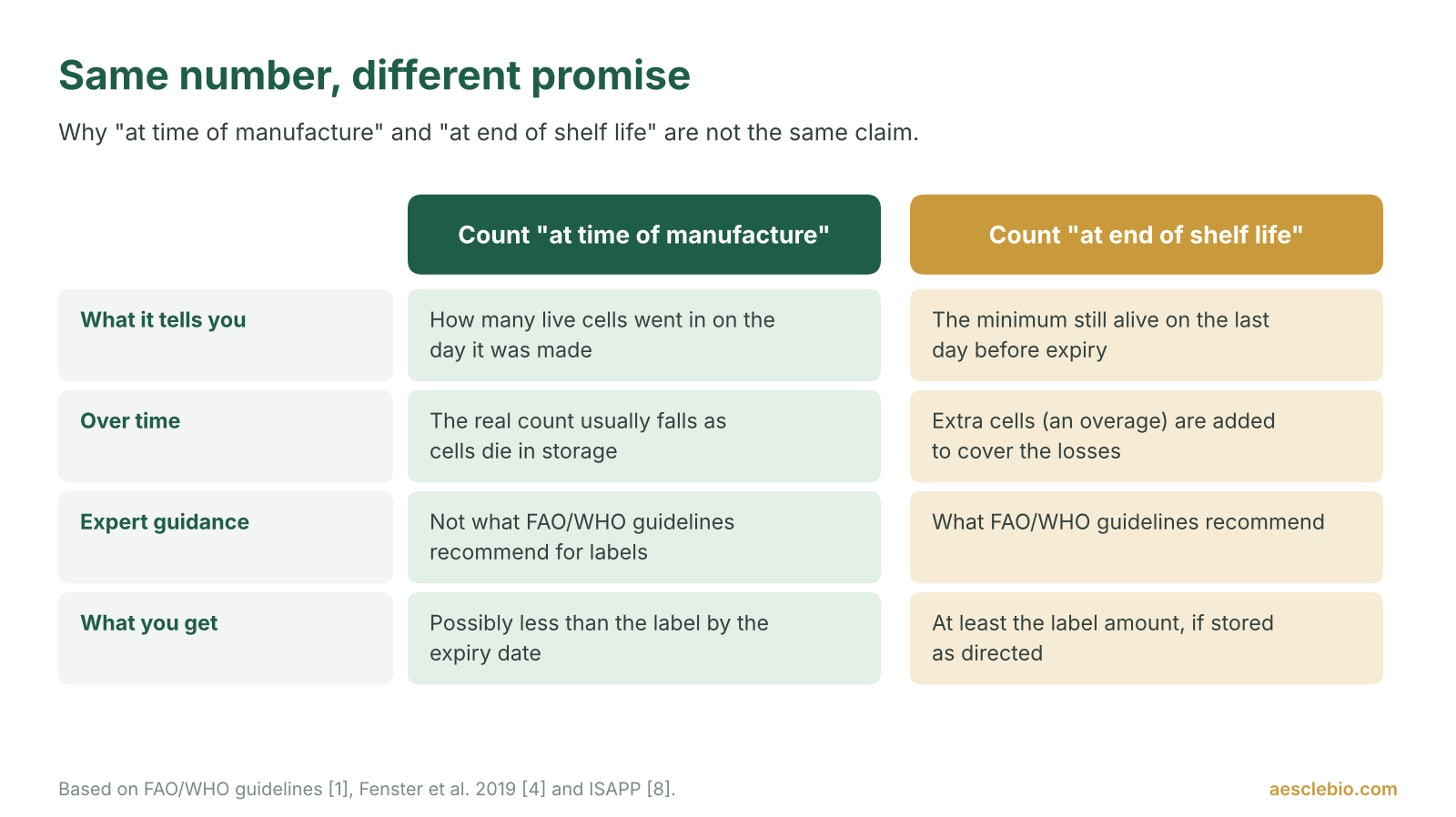
Probiotics are alive, and living cells slowly die, faster in heat and humidity. Most probiotic strains lose count over their shelf life [8]. So the same printed number can mean two very different promises. A count "at time of manufacture" tells you what went into the pack. A count "at expiry" or "through the end of shelf life" tells you the minimum you should still get on the last day.
The FAO/WHO guidelines recommend the second: labels should state the "minimum viable numbers of each probiotic strain at the end of the shelf-life" [1]. Many products fall short. In surveys of shop products in the Washington DC area, summarised by ISAPP, 45% of dietary supplements did not give a count through the end of shelf life, and only 35% of the supplements could be linked, by strain and dose, to evidence of a health benefit [8].
What is an overage?
To keep the end-of-shelf-life promise, makers add extra live cells at manufacture. This extra is called an overage, and it makes up for losses during storage and handling [4]. The right overage depends on how stable each strain is, so makers test every strain over time [4]. Aesclebio's own guide to Indian regulation notes that shops and delivery vans in India can reach 35 to 45°C, so this needs real stability data, and that the overage may not be printed as the count [11]. An overage is good practice, not a trick, as long as the printed figure is the one guaranteed at the end.
Newer ways to count: flow cytometry and AFU
The plate count has limits. It is slow, results can differ between laboratories, and it misses cells that are alive but will not grow on a plate, called "viable but non-culturable" cells [3]. These are common in probiotic powders, because freezing, freeze-drying and grinding all stress bacteria [3].
Flow cytometry is a newer method. A machine passes cells one at a time through a beam of light and reads coloured dyes that show whether each cell looks alive. An international standard from the International Organization for Standardization (ISO 19344), written for lactic acid bacteria (the group of bacteria most often used as probiotics), reports the results as active fluorescent units (AFU), a measure of live cells, and total fluorescent units (TFU), which counts all cells whether alive or dead [3].
| Method | What it counts | Strength | Limit |
|---|---|---|---|
| Plate count (CFU) | Cells that grow into colonies | Long established; matches the unit used in most trials | Slow and laborious; results vary between laboratories; misses non-culturable cells; a clump counts as one |
| Flow cytometry (AFU) | Cells that show signs of life | Faster; also counts cells that will not grow on a plate | Not directly equal to CFU; newer |
| Flow cytometry (TFU) | All cells, alive or dead | Gives the total number of cells | Includes dead cells, so it is not a live count |
Two cautions. Clinical trials usually state doses in CFU, so CFU links most directly to the evidence [3]. And as probiotics age, their ability to form colonies falls faster than their AFU count, so flow cytometry will likely read higher near the end of shelf life [3]. An AFU figure is not dishonest, but it cannot be compared one-to-one with a CFU figure.
How to read the CFU on a probiotic label

- Find the full name: genus, species and strain code [1].
- Check the count is guaranteed "until expiry" or "at end of shelf life", not only "at manufacture" [1, 8].
- See whether the count is per capsule or per daily serving, and how many servings a day the label suggests.
- For blends, look for each strain's count, not only the total [8].
- Compare the daily amount with the dose used in studies of that strain [1, 6].
- Follow the storage instructions. Heat and moisture kill live cells [4].
The trial figures in this article describe research, mostly in adults. They are not dosing advice. For babies, children, pregnancy or breastfeeding, or anyone with a serious illness or a weak immune system, ask a doctor which product and dose is right.
The bottom line
CFU meaning, in one line: colony-forming units are the standard count of live microbes that can grow in a laboratory test. It is useful, but only part of the story. The biggest number on the label rarely wins; the right number does: the dose studied for a named strain, guaranteed alive until the last day of shelf life. Look for the strain and the end-of-shelf-life promise, and you will know more than the billions can tell you.
Frequently asked questions
What does CFU stand for in probiotics?
CFU stands for colony-forming units. It is the standard count of live microbes in a probiotic that are able to multiply and form a visible colony in a laboratory plate test [3]. A clump of cells forms one colony, so it counts as one unit. CFU tells you how many live microbes there are, not which ones, so a good label also names the strain [1].
What are CFUs in probiotics?
CFUs are the units used to state how many live microbes a probiotic contains, usually in millions or billions per capsule or serving [3]. In a 2018 draft guidance, the US FDA said it would accept CFU alongside weight, because weight counts live and dead cells together and live cells can die during shelf life [7]. The CFU figure should count only live microbes [7].
How many CFU in probiotics should I take?
There is no single right number. The right amount is the dose that was tested in human studies of that exact strain, because benefits are strain-specific [1, 6]. For context, about two-thirds of registered clinical trials that state a dose use 1 to 20 billion CFU a day, with a median of about 6.5 billion [9]. For babies, children, pregnancy or breastfeeding, ask a doctor.
Is 50 billion CFU too much?
For healthy adults, research has not shown higher doses to be harmful in general, and in some cases they may help [4]. But there is also no proof that 50 billion beats 5 billion unless that strain was studied at that dose; across many trials, dose groups did not differ significantly [5]. People with a serious illness or weak immune system should check with a doctor first.
What does 300M CFU mean on a probiotic label?
"300M CFU", sometimes written "300M/CFU", means 300 million colony-forming units, usually per capsule or per serving. That is 0.3 billion. Whether it is enough depends on the strain and the dose used in its studies, not on the size of the figure [1]. In India, FSSAI rules set a minimum of 100 million CFU per recommended daily serving for probiotic foods [12].
What does "CFU at time of manufacture" mean?
It means the count was measured when the product was made. Live cells die during storage, so by the expiry date the real count is usually lower [8]. The FAO/WHO guidelines recommend stating the minimum number of live cells of each strain at the end of shelf life instead [1]. Look for wording such as "guaranteed until expiry".
Is there a recommended daily intake for probiotics?
Not in the way there is for vitamins. Probiotics have no single official daily intake, because each strain works at its own studied dose [2, 6]. Some regulators set label minimums: Health Canada accepts 1 billion CFU per serving for certain general claims [2], and India's FSSAI sets a minimum of 100 million CFU per daily serving, with the live count at the end of shelf life stated on the label [12].
Are probiotics with more strains or more CFU better?
Not automatically. A meta-analysis of 84 trials in gut conditions found that single-species and multi-species products worked about equally well overall, and that dose made relatively little difference [5]. What mattered most was matching the right strain to the right problem [5, 6]. A blend's total CFU also hides how much of each strain is inside [8].
What is AFU, and how is it different from CFU?
AFU stands for active fluorescent units. It comes from flow cytometry, a method that reads dyes to judge whether each cell is alive, including cells that will not grow on a plate [3]. CFU counts only cells that grow into colonies. Near the end of shelf life, AFU counts tend to be higher than CFU counts, so the two cannot be compared one-to-one [3].
Related reading
- Your Probiotic Is a Strain, Not a Species: Reading the Code After the Name
- What Probiotics Are, and the Five Myths That Survive Every Explainer
- Probiotic Foods vs Probiotic Supplements: Why a Probiotic Foods List Is Not a Dose
- Gummies vs Capsules vs Sachets vs Drops (Aesclebio blog)
- Choosing a Probiotic Contract Manufacturer (Aesclebio blog)
References
- Food and Agriculture Organization of the United Nations and World Health Organization. Probiotics in food: health and nutritional properties and guidelines for evaluation. FAO Food and Nutrition Paper 85. Rome: FAO; 2006. Includes the Joint FAO/WHO Working Group Guidelines for the Evaluation of Probiotics in Food (2002). Free to read. Link
- Hill C, Guarner F, Reid G, et al. Expert consensus document: the International Scientific Association for Probiotics and Prebiotics consensus statement on the scope and appropriate use of the term probiotic. Nature Reviews Gastroenterology & Hepatology. 2014;11(8):506–514. Open access. Link
- Jackson SA, Schoeni JL, Vegge C, et al. Improving end-user trust in the quality of commercial probiotic products. Frontiers in Microbiology. 2019;10:739. Free full text: PubMed Central PMC6499161. Link
- Fenster K, Freeburg B, Hollard C, et al. The production and delivery of probiotics: a review of a practical approach. Microorganisms. 2019;7(3):83. Free full text: PubMed Central PMC6463069. Link
- Ritchie ML, Romanuk TN. A meta-analysis of probiotic efficacy for gastrointestinal diseases. PLoS One. 2012;7(4):e34938. Free full text: PubMed Central PMC3329544. Link
- McFarland LV, Evans CT, Goldstein EJC. Strain-specificity and disease-specificity of probiotic efficacy: a systematic review and meta-analysis. Frontiers in Medicine. 2018;5:124. Free full text: PubMed Central PMC5949321. Link
- US Food and Drug Administration. Policy regarding quantitative labeling of dietary supplements containing live microbials: guidance for industry (draft guidance). Silver Spring, MD: FDA; September 2018. Free to read. Link
- International Scientific Association for Probiotics and Prebiotics. Decoding a probiotic product label. ISAPP; published 11 February 2022, updated 21 June 2025. Free to read. Link
- Aesclebio Technologies. Probiotic Clinical Trials: Where the Industry Is Heading. A registry-based analysis of ClinicalTrials.gov data to 17 September 2026. Hyderabad: Aesclebio Technologies Pvt. Ltd.; 2026. Link
- Aesclebio Technologies. Probiotic Clinical Trials in India: a landscape study of the Clinical Trials Registry – India (CTRI), 2007–2026. Hyderabad: Aesclebio Technologies Pvt. Ltd.; October 2026. Link
- Aesclebio Technologies. How India Regulates Probiotic Products: a plain-language guide. Status as of 21 September 2026. Hyderabad: Aesclebio Technologies Pvt. Ltd.; September 2026. Link
- Food Safety and Standards Authority of India. Food Safety and Standards (Health Supplements, Nutraceuticals, Food for Special Dietary Use, Food for Special Medical Purpose, and Prebiotic and Probiotic Food) Regulations, 2022: provisions for probiotic food (minimum viable count and labelling), as published by FSSAI. New Delhi: FSSAI; 2022. Free to read. Link
Disclaimer
This article is for general education only. It is not medical advice and is not intended to diagnose, treat, cure or prevent any disease. It does not promote any specific product or brand, and it makes no claims about any product.
Statements about research describe the findings of published studies. They do not mean that any particular food or supplement will have the same effect for you. Always speak to a qualified healthcare professional before changing your diet or starting a supplement, especially if you are pregnant, breastfeeding, giving products to a baby or child, or living with a health condition.
Rules on how probiotics and supplements may be described differ from country to country. Nothing in this article should be read as a health claim for any product.
All graphics are original works of Aesclebio Technologies. Figures from other studies are credited to their sources. Quotations are limited to short passages with full attribution. Any clinical-trial figures from Aesclebio's own analysis come from public registry records and do not imply that any product is effective or safe.
Prepared by the Aesclebio Research Team with the help of AI tools, under the team's direction. © 2026 Aesclebio Technologies Pvt. Ltd. All rights reserved. Short extracts may be quoted with a link to the original article.