
Why everyone is asking which format is best
The same nutrient now comes as a capsule, tablet, chewable, gummy, powder sachet or drops. People ask "capsules vs tablets vs gummies", "liquid probiotics vs capsules" and "probiotic capsules vs powder". People also search for questions such as "what is gummies made of", "what is gummies made out of" and "are chewable probiotics any good?"
This article makes one argument, aimed at brand owners and curious shoppers alike. For probiotics, the format is not a marketing choice. It follows the strain and the evidence. A format that kills the microbe before the expiry date is the wrong format, however nice it tastes.
First, what a dosage format has to do
A dosage format (also called a dose form or delivery system) is the physical shape in which a supplement is sold and taken. European food law lists the usual ones: food supplements are sold in "capsules, pastilles, tablets, pills", "sachets of powder, ampoules of liquids, drop dispensing bottles" and similar forms, "designed to be taken in measured small unit quantities" [10].
Probiotics are harder than vitamins, because they are "live microorganisms that, when administered in adequate amounts, confer a health benefit on the host" [1]: living microbes that help when you take enough. So a probiotic format has one extra job: keep the microbes alive, in the stated number, until the end of shelf life [3].
The three enemies: moisture, heat and oxygen
Most supplement probiotics are freeze-dried: the microbes are frozen and the ice is removed under vacuum, which leaves a dry powder of sleeping cells [3]. A review by probiotic manufacturing scientists names the main threat to that powder plainly: water activity, followed closely by storage temperature [3]. Many probiotic microbes are also sensitive to oxygen and heat [2, 3].
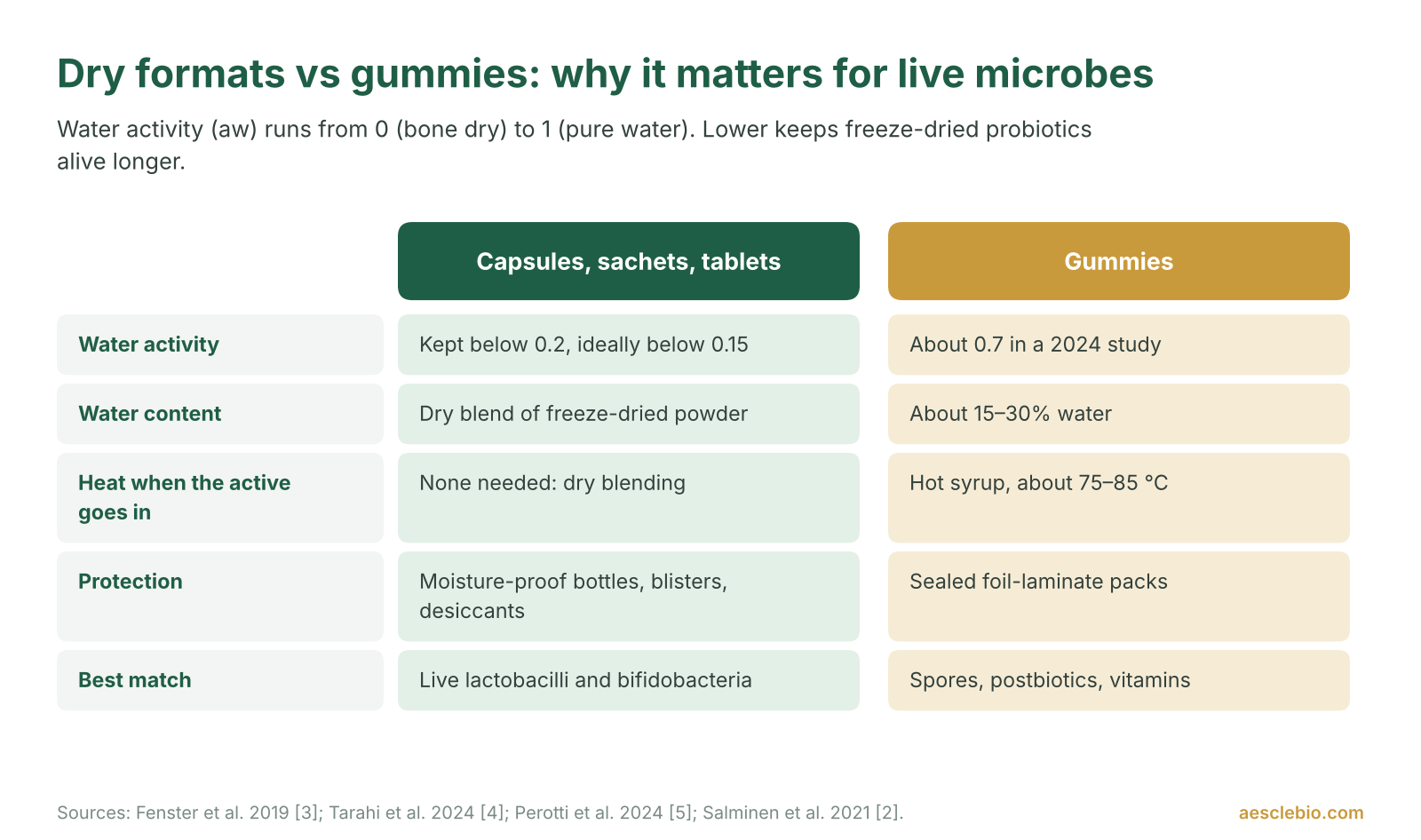
Water activity, written aw, is a scale from 0 to 1 that measures how much of the water in a product is free to move and react. Pure water scores 1. A product can feel dry and still have enough free water to wake up and slowly kill freeze-dried cells. The same review advises keeping the whole blend below 0.2, and ideally below 0.15 for long shelf lives, with low-humidity factory rooms and moisture-proof packs [3]. It warns that some plastic bottles let in too much moisture, and that desiccants (small moisture-absorbing packs) help [3].
Now compare a gummy. In a 2024 study of probiotic gummies, the finished sweets held about 20% moisture and had a water activity of 0.7 [5]. That one number explains most of the format debate.
What are gummies made out of?
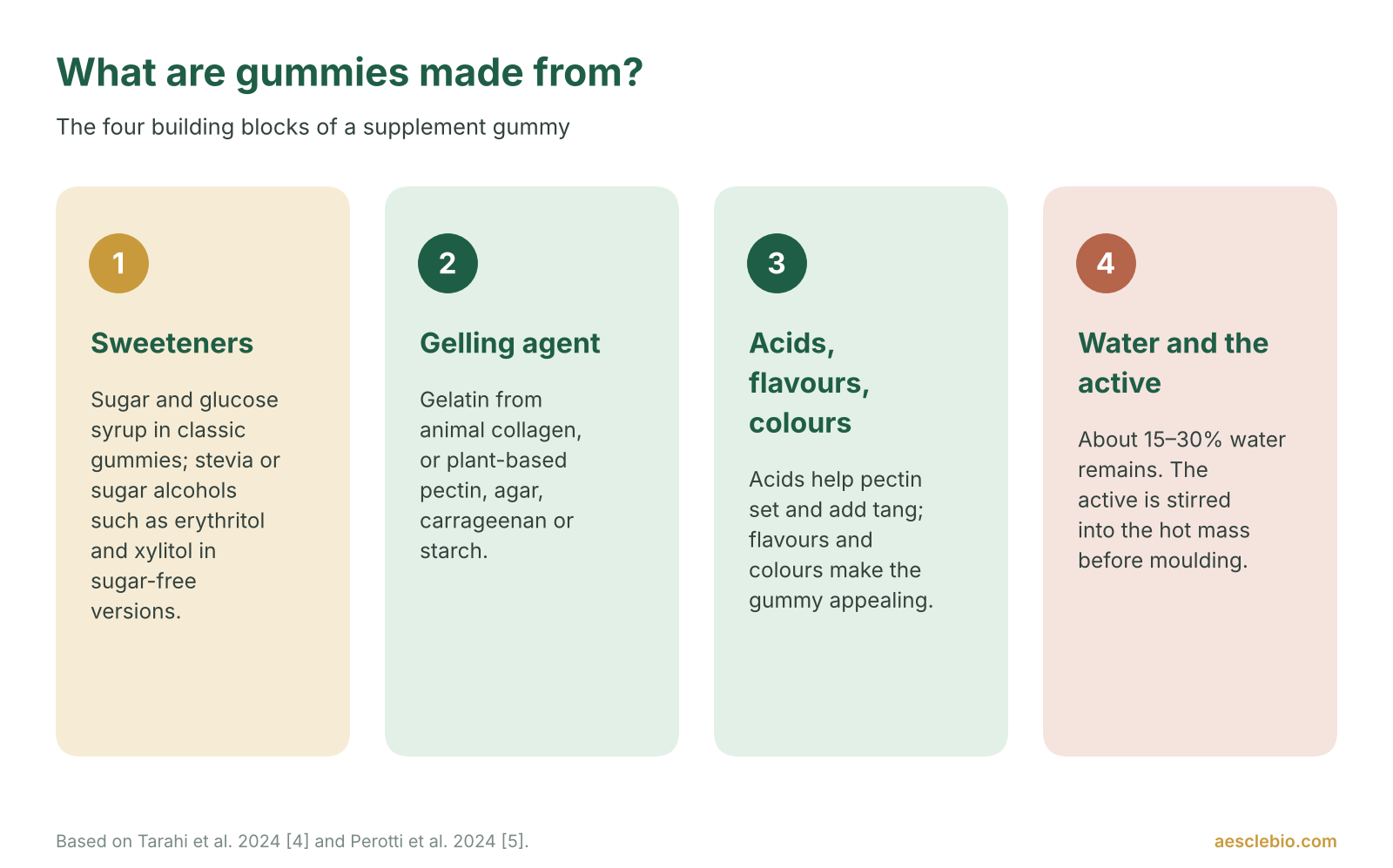
Gummies are traditionally made from large amounts of sugar (sucrose) and glucose syrup, set with a gelling agent, usually gelatin, plus flavours and colours [4]. The mix is heated, poured into moulds, then cooled and dried, but the finished gummy still holds about 15–30% water [4]. Gelatin comes from animal collagen; plant-based gummies use pectin (from fruit), agar or carrageenan (from seaweed) or starches instead [4]. Pectin needs an acidic mix to set, so acidic ingredients such as lemon juice or fruit acids are added [4]. Sugar-free versions swap sugar for sweeteners such as stevia or sugar alcohols like erythritol and xylitol [4].
The active ingredient goes in while the mass is still hot. In the 2024 study, the probiotic powder was stirred into the syrup at about 75–85 °C [5]. That is fine for a vitamin that copes with heat, or for a spore. It is very hard on ordinary live bacteria.
Live cells, spores and postbiotics need different formats
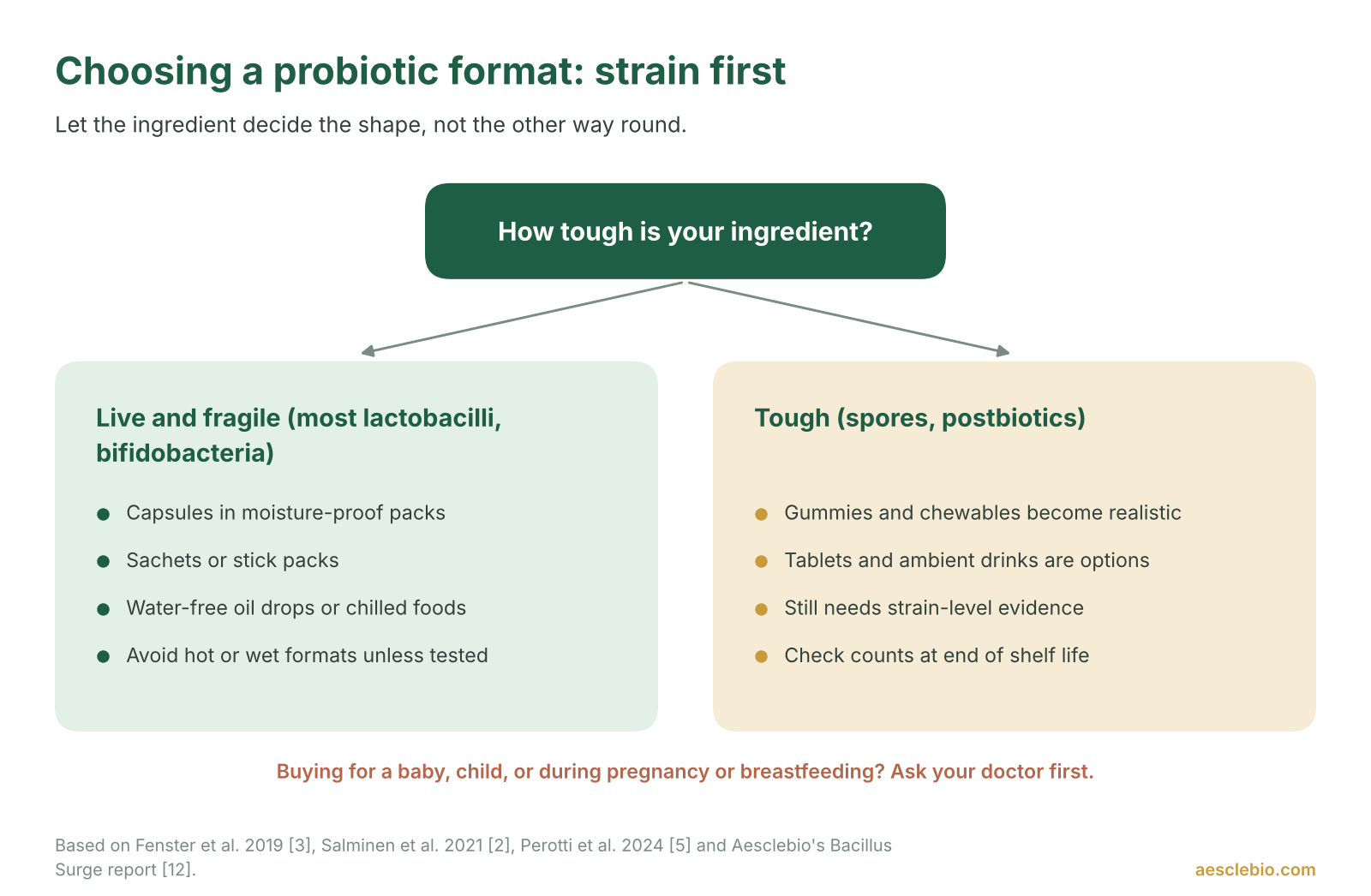
- Live non-spore bacteria (most Lactobacillus and Bifidobacterium strains). These are the most sensitive to moisture, heat and oxygen [2, 3]. Dry formats in moisture-proof packs, or chilled dairy foods, are their natural homes [3].
- Spore-forming bacteria (Bacillus and close relatives). A spore is a dormant, dried-out form that tolerates heat, acid and long storage and wakes up in the gut [6, 12]. In the 2024 study, gummies made with spores of Heyndrickxia coagulans (also called Weizmannia coagulans, and formerly Bacillus coagulans) lost only about a quarter of their live count (a drop of 0.12 on the logarithmic scale used for microbe counts) over 24 months at room temperature, and the spores germinated (woke up) in the gut of all 24 healthy adult volunteers [5]. That shows delivery, not a health benefit [5].
- Postbiotics. An international expert panel defines a postbiotic as "a preparation of inanimate microorganisms and/or their components that confers a health benefit on the host" [2]. Because postbiotics do not need to stay alive, a long shelf life is easier, and they may suit hot regions without reliable cold chains [2]. They still need their own evidence of benefit [2].
Our own research shows formats tracking this biology. In Aesclebio's analysis of ClinicalTrials.gov, the public trial registry run by the US National Library of Medicine, trials of spore-forming probiotics used tablets and chewable formats more than twice as often as other probiotic trials: 10% against 4% [12]. The same report adds a caution: being a spore-former does not by itself bring a benefit; each strain must be tested [12].
Format by format: the comparison
| Format | Stability for live probiotics | Dose and accuracy | Ease, taste and sugar | Usually best for |
|---|---|---|---|---|
| Capsule | Good: dry powder in a sealed shell; needs a moisture-proof pack [3] | Fixed fill per capsule; overage added to cover losses [3] | Tasteless; no sugar; some people find pills hard to swallow [7] | Most live strains; adults |
| Sachet or stick pack (powder) | Good: dry powder, sealed single doses [3] | Can hold larger doses than one capsule | Mixed into cool food or drink; may need a flavour | Larger doses; people who avoid pills |
| Tablet | Fair: pressing can reduce live counts, strain by strain [3] | Fixed per tablet | Must be swallowed; larger, rougher tablets are harder [7] | Robust strains, spores, vitamins |
| Chewable tablet | Fair: pressing and other ingredients can lower counts [3] | Fixed per tablet | Easy to take; flavoured; may contain sugar or polyols | Spores; people who dislike swallowing |
| Gummy | Poor for ordinary live bacteria: hot cooking, aw about 0.7 [5]; good for spores [5, 6] | Several gummies may be needed per serving [5] | Tasty; usually sugar or sugar alcohols [4, 8, 9] | Spores, postbiotics, vitamins |
| Oil drops | Depends on design: keeping water out and a sealed bottle are key; ask for stability data [3] | Measured by drops; dropper accuracy matters | No swallowing; mild taste | People who cannot swallow solids |
| Liquid shot or drink | Weak at room temperature: cells are wet and active; usually chilled [3] | One bottle per dose | Easy and familiar; may contain sugar | Chilled food channels |
Capsules and liquid-filled capsules
The capsule is the workhorse: freeze-dried powder blended with dry fillers, sealed in a shell and a moisture-proof pack [3]. Many makers use plant cellulose shells instead of gelatin for vegetarian and halal-friendly products [14]. Liquid-filled capsules hold an oil inside a sealed shell; for live microbes, any free water in the fill is the problem [3].
Sachets and stick packs
The same dry powder can go into sachets or slim stick packs. Low-humidity rooms for capsule filling and for stick pack and sachet filling are part of good practice [3, 14]. Stir powders into cool, not hot, food or drink.
Chewable probiotic tablets
Chewable probiotics are popular because nothing has to be swallowed whole. But a chewable is a pressed tablet, and the review warns that compression during tableting tends to reduce live counts, sometimes dramatically, depending on the formula and the strain [3]. Other active ingredients can raise water activity, and some plant extracts contain natural antimicrobial compounds [3]. So a lactobacillus chewable can work well, but only if the maker has tested that exact strain in that exact tablet. This is one reason spore-formers are over-represented in tablets and chewables [12].
Gummies
Gummies win on taste; their weak points are cooking heat, high water activity and sugar [4, 5]. The World Health Organization (WHO) advises keeping free sugars below 10% of daily energy intake [8]. Sugar-free gummies use sugar alcohols (polyols), which can cause wind, tummy discomfort and a laxative effect, and these effects grow with the amount eaten [9].
Drops and liquids
In juices and drinks, probiotics are wet and active rather than freeze-dried, so these products usually need refrigeration; some keep the powder in a separate cap or straw until drinking [3]. Oil-based drops are designed to keep water out, the same logic as the dry formats; ask for stability data on the finished drops.
Swallowing, taste and sticking with it
A supplement only works if people take it. A review estimated that 10 to 40% of adults have difficulty swallowing pills, made worse by large size, rough surfaces and bad taste, and some skip doses as a result [7]. Industry scientists also describe consumers tiring of pills, which they call "pill fatigue" [3]. That is a fair reason to offer chewables, powders, drops or gummies, as long as the strain survives in them.
Why the format decision should follow the strain and the evidence
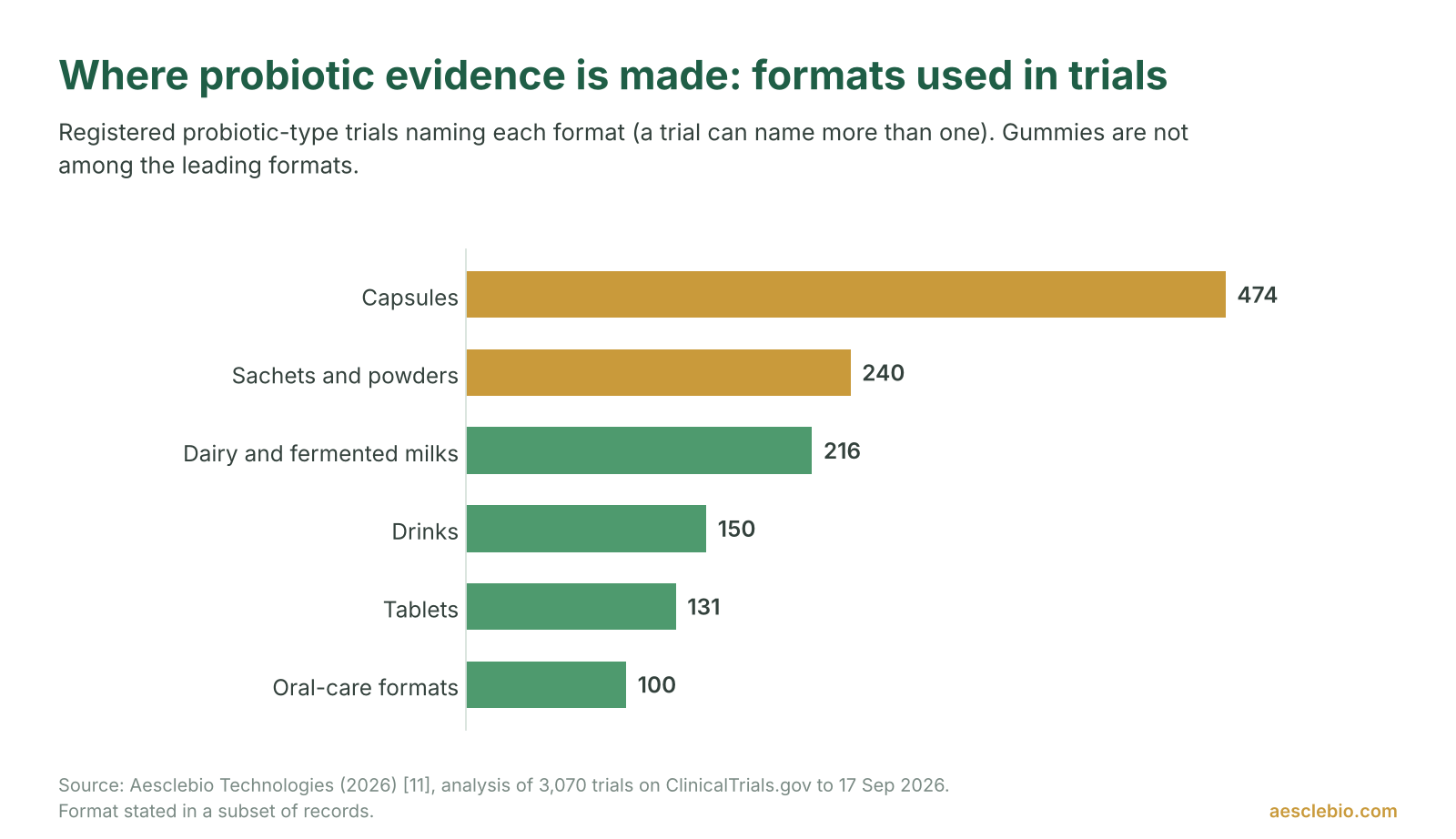
Look at where probiotic evidence is actually produced. In Aesclebio's analysis of 3,070 probiotic-type clinical trials registered to 17 September 2026, the formats named most often were capsules (474 trials), sachets and powders (240), dairy and fermented milks (216), drinks (150), tablets (131) and oral-care products (100) [11]. Gummies did not appear among the leading formats [11]. The 2024 gummy study makes the same point: human trials of probiotic survival are mostly run with capsules, powders or sachets [5].
So the contrarian point is simple. A strain studied in a capsule is not automatically proven in a gummy. Moving it to a harsher format needs data showing the same live count at the end of shelf life, and ideally evidence in people. The manufacturing review advises working out the consumer product in parallel with the clinical trials [3].
The trade data say the same thing from the market side. Aesclebio's own internal research based on internal trade databases found the declared value of India's supplement-gummy exports up 112% when the same seven and a half months of 2024 and 2025 are compared [13]. Its conclusion: the format is not the differentiator, because anyone can make a gummy; the ingredient story is [13].
Cost per dose: look past the price tag
The cheapest-looking pack is not always the cheapest dose. Three things drive the real cost:
- Overage. Makers add extra live cells at the start to cover losses during storage [3]. The harsher the format, the bigger the overage needed.
- Packaging. Moisture-proof bottles, blisters and desiccants add cost but protect the count [3].
- Units per serving. In the 2024 study, a serving that delivered at least 1 billion colony-forming units (CFU, the standard count of live microbes) was 24 g of gummies, about six pieces [5]. Aesclebio's own internal research based on internal trade databases puts the median declared export value of probiotic and gut-health gummies leaving India at about US$0.05 per gummy. Treat that as a rough guide only: it comes from a small sample of just 12 priced export lines, and it is an export-gate value, not a retail price [13]. Multiply by the gummies per serving to compare fairly.
Regulatory notes for brand owners
Formats are also a legal question. In the European Union, food supplements are defined as products marketed in dose forms such as capsules, tablets, sachets of powder and drop dispensing bottles [10]. In India, Aesclebio's regulatory guide notes that powders and sachets are the safest food-route format for live cultures. The guide adds that gummies work only with heat-tolerant spore-forming organisms. Under a 2022 draft rule that is still not final but has been applied by regulator directions since 2022, tablets, capsules, pills and drops for probiotic foods are allowed only with prior approval of the Food Safety and Standards Authority of India (FSSAI) [14]. And as of 21 September 2026, front-of-pack warning labels for foods high in sugar, fat or salt were before the Supreme Court, with the next hearing listed for 28 September 2026; sugary gummies could be affected, and whether supplements are exempt was unclear [14]. Check the current position before launch.
How to choose: a practical checklist
- Name the strain first. Genus, species and strain code, with studies behind it.
- Check the format used in those studies. Moving to another format needs new stability data [3].
- Match fragility to format. Live non-spore strains: capsules, sachets, sealed drops or chilled foods. Spores and postbiotics: gummies, chewables and tablets become realistic [2, 5, 6].
- Ask for end-of-shelf-life counts at real storage temperatures, not only the count on the day of making [3].
- Weigh the user. Swallowing, taste, sugar and units per serving [5, 7, 8].
- Check the rules in each market where you sell [10, 14].
The bottom line
Gummies, capsules, sachets, chewables and drops are all good formats for the right ingredient. Capsules and sachets protect fragile live bacteria best. Gummies, chewables and tablets shine with hardy spores, postbiotics and vitamins. The best supplement format is the one in which your studied strain is still alive, at the studied dose, on the last day of shelf life. Choose the strain, check the evidence, and only then choose the shape.
Frequently asked questions
What is gummies made of?
A typical supplement gummy is made from sugar and glucose syrup, a gelling agent such as gelatin, pectin, agar or starch, acids, flavours and colours, plus the active ingredient [4]. The cooked mass is moulded, cooled and dried, but still holds about 15–30% water [4]. Sugar-free gummies replace sugar with sweeteners such as stevia or sugar alcohols [4].
Are chewable probiotics as good as capsules?
They can be, but it depends on the strain and the product. Pressing a chewable tablet tends to reduce live counts, by an amount that depends on the formula and the strain [3]. Spore-forming probiotics cope better and are used more often in tablets and chewables [12]. Ask for the live count promised at the end of shelf life, not at manufacture.
Which is better: capsules vs tablets vs gummies?
For most live, non-spore probiotics, capsules usually protect the microbes best, because they hold a dry powder in a sealed shell [3]. Tablets involve pressing, which can lower counts [3]. Gummies are cooked and hold water, with a water activity around 0.7 in one study, so they suit spores, postbiotics and vitamins better [5].
Probiotic capsules vs powder: which should I choose?
Both use the same kind of dry, freeze-dried powder, so stability can be similar when the pack keeps moisture out [3]. Capsules are tasteless and convenient. Powder sachets and stick packs suit people who dislike pills and can hold larger doses. Stir powders into cool food or drink, not hot.
Liquid probiotics vs capsules: are liquids better absorbed?
There is no general rule that liquids work better. In juices and drinks, probiotics are wet and active rather than dried, so these products usually need refrigeration and have shorter shelf lives [3]. Capsules keep cells dry and dormant at room temperature [3]. What matters is the studied strain and the live count you actually swallow.
What are probiotic chewable tablets for kids?
They are flavoured tablets meant to be chewed rather than swallowed. They may contain sugar or sugar alcohols, and large amounts of sugar alcohols can cause wind or loose stools [9]. Because they look like sweets, store them out of reach of children. We do not give doses for children: ask your doctor which product and amount suit your child.
Are yogurt tablets a probiotic?
Yogurt tablets are usually chewable tablets made with yogurt powder or cultures. Whether they count as probiotic depends on three things: the named strain, how many microbes are still alive at the end of shelf life, and studies in people [1]. Pressing tablets can reduce live counts [3], so check the label for a strain name and a live count.
What is the best supplement format for hot, humid countries?
Heat and moisture are the main enemies of live probiotics [3]. In hot climates, sealed dry formats with desiccants, spore-forming strains or postbiotics are the more realistic choices [2, 3, 6]. Spore gummies kept their count over 24 months at room temperature in one study [5]. Ask for stability data at tropical storage conditions.
Related reading
- Gelatin, Pectin or Agar? The Vegan Gummy Formulation Decision
- Kids, Toddlers and Probiotics: Dose, Format and the Sugar Problem
- Infant Probiotic Drops: Strains, Oil Suspensions, Spores and What Makes a Drop Work
- Billions of CFU, Little Meaning: Why the Biggest Number on the Label Rarely Wins
- Choosing a Probiotic Contract Manufacturer (Aesclebio blog)
References
- Hill C, Guarner F, Reid G, et al. Expert consensus document: the International Scientific Association for Probiotics and Prebiotics consensus statement on the scope and appropriate use of the term probiotic. Nature Reviews Gastroenterology & Hepatology. 2014;11(8):506–514. Open access (free to read on the publisher site). Link
- Salminen S, Collado MC, Endo A, et al. The International Scientific Association of Probiotics and Prebiotics (ISAPP) consensus statement on the definition and scope of postbiotics. Nature Reviews Gastroenterology & Hepatology. 2021;18(9):649–667. Free full text: PubMed Central PMC8387231. Link
- Fenster K, Freeburg B, Hollard C, et al. The production and delivery of probiotics: a review of a practical approach. Microorganisms. 2019;7(3):83. Open access / Free full text: PubMed Central PMC6463069. Link
- Tarahi M, Tahmouzi S, Kianiani MR, et al. Current innovations in the development of functional gummy candies. Foods. 2024;13(1):76. Open access / Free full text: PubMed Central PMC10778822. Link
- Perotti S, Mantegazza G, Pierallini E, et al. Human in vivo assessment of the survival and germination of Heyndrickxia coagulans SNZ1969 spores delivered via gummy candies. Current Research in Food Science. 2024;9:100793. Open access / Free full text: PubMed Central PMC11278553. Link
- Elshaghabee FMF, Rokana N, Gulhane RD, et al. Bacillus as potential probiotics: status, concerns, and future perspectives. Frontiers in Microbiology. 2017;8:1490. Open access / Free full text: PubMed Central PMC5554123. Link
- Forough AS, Lau ET, Steadman KJ, et al. A spoonful of sugar helps the medicine go down? A review of strategies for making pills easier to swallow. Patient Preference and Adherence. 2018;12:1337–1346. Open access / Free full text: PubMed Central PMC6065591. Link
- World Health Organization. Guideline: sugars intake for adults and children. Geneva: WHO; 2015. Free to download from the WHO website. Link
- Lenhart A, Chey WD. A systematic review of the effects of polyols on gastrointestinal health and irritable bowel syndrome. Advances in Nutrition. 2017;8(4):587–596. Free full text: PubMed Central PMC5508768. Link
- European Parliament and Council of the European Union. Directive 2002/46/EC of 10 June 2002 on the approximation of the laws of the Member States relating to food supplements. Official Journal of the European Communities. 2002;L183:51–57. Free to read on EUR-Lex. Link
- Aesclebio Technologies. Probiotic Clinical Trials: Where the Industry Is Heading. A registry-based analysis of ClinicalTrials.gov data to 17 September 2026. Hyderabad: Aesclebio Technologies Pvt. Ltd.; 2026. Link
- Aesclebio Technologies. The Bacillus Surge: clinical-trial trends for spore-forming probiotics and what they mean for formulation. A registry-based analysis of ClinicalTrials.gov data to 17 September 2026. Hyderabad: Aesclebio Technologies Pvt. Ltd.; 2026. Link
- Aesclebio Technologies. India's Gummy Supplement Trade: exports and imports of supplement gummies, year by year. Aesclebio's own internal research based on internal trade databases, January 2020 to August 2025. Hyderabad: Aesclebio Technologies Pvt. Ltd.; October 2026. Link
- Aesclebio Technologies. How India Regulates Probiotic Products: a plain-language guide to the food route and the medicine route. Status as of 21 September 2026. Hyderabad: Aesclebio Technologies Pvt. Ltd.; 2026. Link
Disclaimer
This article is for general education only. It is not medical advice and is not intended to diagnose, treat, cure or prevent any disease. It does not promote any specific product or brand, and it makes no claims about any product.
Statements about research describe the findings of published studies. They do not mean that any particular food or supplement will have the same effect for you. Always speak to a qualified healthcare professional before changing your diet or starting a supplement, especially if you are pregnant, breastfeeding, giving products to a baby or child, or living with a health condition.
Rules on how probiotics and supplements may be described differ from country to country. Nothing in this article should be read as a health claim for any product.
All graphics are original works of Aesclebio Technologies. Figures from other studies are credited to their sources. Quotations are limited to short passages with full attribution. Any clinical-trial figures from Aesclebio's own analysis come from public registry records and do not imply that any product is effective or safe.
Prepared by the Aesclebio Research Team with the help of AI tools, under the team's direction. © 2026 Aesclebio Technologies Pvt. Ltd. All rights reserved. Short extracts may be quoted with a link to the original article.