
Why so many people search for a vegan gelatin substitute
Every month, thousands of people search for a "vegan gelatin substitute", a "vegetarian alternative to gelatin" or ask "can I use pectin instead of gelatin?". Most are cooks; others make or buy gummy supplements. This article answers the kitchen question first. Then it makes one argument for supplement gummies: the gelling agent is not a box to tick on the label. It is a formulation decision that shapes texture, heat stability, sugar content and whether sensitive ingredients survive manufacturing at all.
What gelatin is, and why gelatin is not vegan or vegetarian
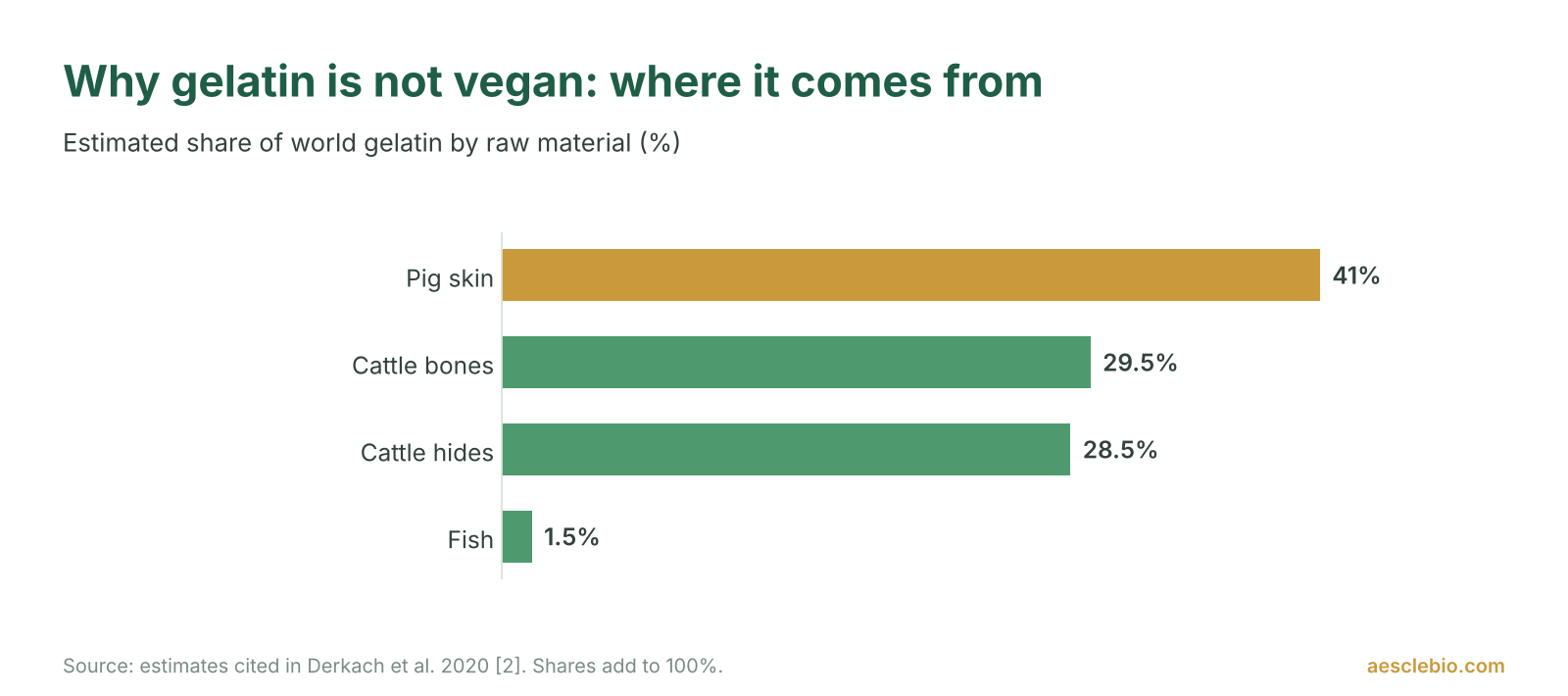
Gelatin is a protein made from collagen, the tough protein in animal skin, bones and connective tissue [1, 2]. It is a gelling agent: an ingredient that turns a liquid into a soft solid, or gel. Commercial gelatin comes mainly from pigs and cattle [1]. One review cited estimates that about 41% of the world's gelatin is made from pig skin, 28.5% from cattle hides, 29.5% from cattle bones and only 1.5% from fish [2].
So why is gelatin not vegan or vegetarian? It is made from parts of slaughtered animals. Gelatin can be halal or kosher when it comes from permitted animals and is certified, and fish gelatin exists for people who avoid pork and beef [1, 2]. But there is no plant gelatin. Products sold as "vegan gelatin" are different substances that do a similar job.
Gelatin's special trick is how it sets. It dissolves in warm water, and a gelatin from pigs or cattle sets into a gel as the liquid cools below about 35 °C [2]. The gel is thermo-reversible, meaning it melts again when warmed and sets again when cooled [2]. That is what gives gelatin sweets their soft, elastic, melt-in-the-mouth chew.
The plant-based gelatin substitutes, and how they differ
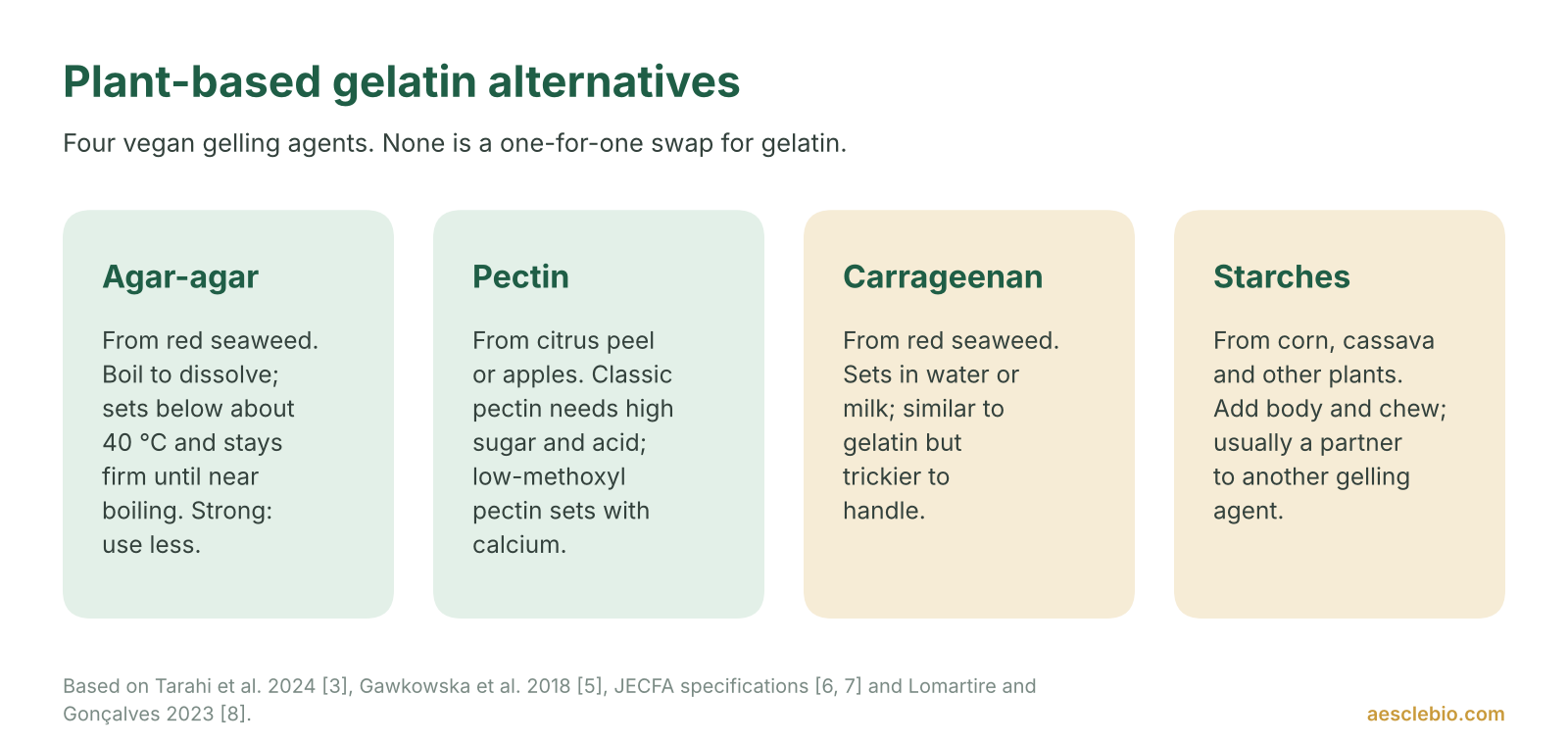
There is no single plant based gelatin substitute that behaves exactly like gelatin. These are the four main gelatin alternatives:
- Agar-agar (agar). A gelling agent extracted from red seaweeds [7, 8]. It does not dissolve in cold water and must be boiled [7]. It sets as it cools (its main gelling part, agarose, gels below about 40 °C) [8], and once set it does not melt even at 70 °C; it only turns liquid again above about 95 °C, close to boiling [7]. Agar gels are stronger than gelatin gels, so you need less, but too much gives a firm, rubbery bite [3]. It is a popular vegan-friendly gelatin alternative for home desserts.
- Pectin. A plant fibre usually extracted from citrus fruits or apples [6]. High-methoxyl pectin (the classic jam pectin) only sets with a lot of sugar, more than 55%, and in acidic conditions below pH 3.5 [5]. (pH is a scale of acidity; the lower the number, the more acidic.) Low-methoxyl pectin sets with calcium instead, so it does not rely on high sugar [5]. Pectin gives a softer, more delicate texture than gelatin [3].
- Carrageenan. Another red-seaweed extract that forms gels in water or milk [8]. Its gelling profile is similar to gelatin's, but it is harder to work with and may need extra ingredients, such as calcium, to set [3].
- Starches. From corn, cassava (tapioca) and other plants. Starches thicken and add body, and gummy makers use them as texture builders, usually alongside other gelling agents [3].
Can you use pectin instead of gelatin, or gelatin instead of pectin?
Not one-for-one. First, what makes them set: gelatin sets just by cooling, while pectin needs sugar and acid, or calcium [2, 5]. Put pectin into a low-sugar gelatin dessert and it may never set. Second, strength: agar and pectin do not gel at the same dose as gelatin, so the amounts differ [3]. Third, texture: gelatin is elastic and bouncy; pectin is softer and shorter; agar is firmer [3]. So if you want to substitute pectin for gelatin, or gelatin for pectin, use a recipe written for the gelling agent you have rather than swapping gram for gram.
Supplement gummies: where the gelling agent becomes a formulation decision
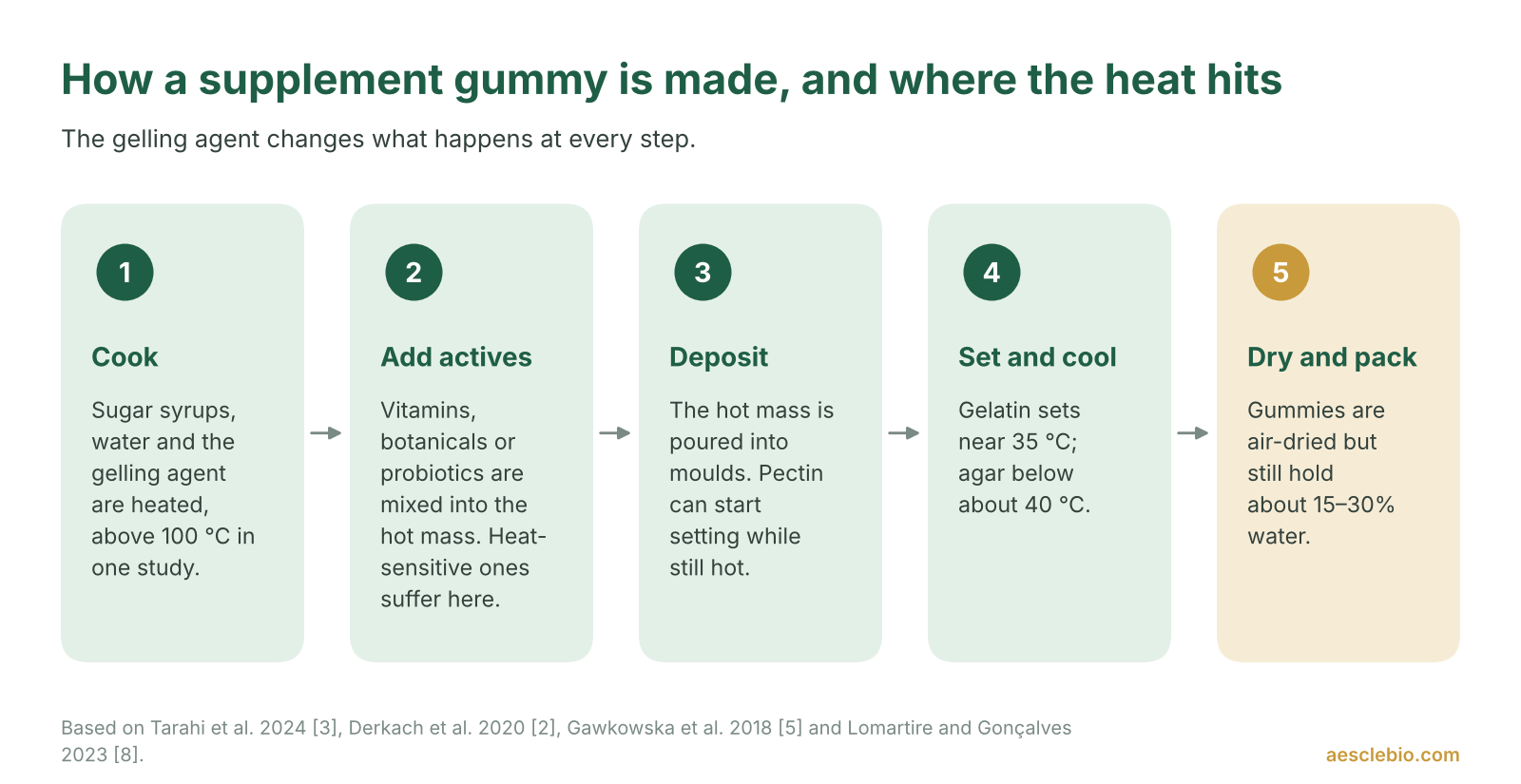
A gummy is made by cooking sugar syrups with a gelling agent, acid and flavours, pouring the hot mass into moulds (a step called depositing), then cooling and drying it. Finished gummies still hold about 15–30% water [3]. Each gelling agent behaves differently at each step, with four practical consequences.
1. Texture
Gelatin gives the elastic chew most people expect [3]. Plant gels often need blending to get close. In an Indian laboratory study, agar alone and guar gum alone (a thickener from guar-bean seeds) each fell short, but a blend of 1% agar and 5.5% guar gum gave a chew resembling gelatin gummies and scored highly with tasters [4].
2. Heat stability in hot climates
Because a gelatin gel forms at around 35 °C and melts again when warmed [2], a gelatin gummy kept in a hot warehouse or delivery van sits close to its melting zone. Agar sits at the other extreme: its gel stays firm until it is heated close to boiling [7]. Pectin can begin to set while the mix is still hot: in one laboratory study of low-methoxyl pectin, the gel point was about 70 °C [5]. That is one reason pectin gummies have to be deposited quickly. In tropical markets, these numbers matter as much as flavour.
3. Sugar and acid
High-methoxyl pectin needs more than 55% sugar and an acidic mix to set [5], and a review of gummy innovations notes that some gelatin alternatives need more sugar than gelatin to reach the desired flavour [3]. For low-sugar gummies, low-methoxyl pectin, which sets with calcium instead of sugar [5], or a blend of gelling agents, is usually the route.
4. Halal, kosher, vegetarian and vegan positioning
Religious dietary rules restrict gelatin from pigs, and sometimes from cattle, so manufacturers are under pressure to prove where their gelatin comes from [1, 2]. A review of gummy innovations notes that some consumers now ask for vegan, halal and kosher-certified products [3]. Halal gelatin gummies made with certified bovine or fish gelatin answer the halal question, but they are still not vegetarian. Pectin, agar, carrageenan and starch come from plants or seaweed, so vegan gummy supplements built on them avoid the animal-source question altogether, as long as every other ingredient is also plant-based and the finished product is certified.
Vitamins, probiotics and the heat problem
Cooking a gummy mass is hot work. In one gummy study, processing temperatures went above 100 °C. The beta-carotene (a plant pigment the body can turn into vitamin A) was micro-encapsulated, that is, wrapped in a tiny protective coating, and about two-thirds of it survived processing [3]. Other heat-sensitive vitamins, colours and botanicals face the same problem.
Live probiotics face it most. Probiotics are "live microorganisms that, when administered in adequate amounts, confer a health benefit on the host" [9]. An international panel of experts notes that many probiotic organisms are sensitive to oxygen and heat [10].
So gummy makers can turn to two alternatives. Spore-forming probiotics, such as Bacillus species and their relatives, can switch into a spore: a dormant, dried-out form that tolerates heat, acid and long storage and wakes up again in the gut [12]. A review describes them as more stable during processing and storage [11]. Postbiotics are "a preparation of inanimate microorganisms and/or their components that confers a health benefit on the host" [10]. Because they need not stay alive, a long shelf life is easier, and they may suit regions without reliable cold chains or with high temperatures [10].
Aesclebio's own analysis of ClinicalTrials.gov, the public trial registry run by the US National Library of Medicine, found 108 clinical trials of spore-forming probiotics, 3.5% of probiotic trials. These trials used tablets and chewable formats more often than other probiotic trials, at 10% against 4% [12]. The same report stresses that being a spore-former does not by itself bring a health benefit: each strain still has to be shown to work in people [12].
Pectin vs gelatin gummies, agar and starch: the comparison
| Gelling agent | Source | How it sets | In a hot climate | Texture and fit |
|---|---|---|---|---|
| Gelatin | Animal collagen, mostly pig and cattle | Cooling alone; gel forms near 35 °C | Melts again when warmed | Elastic chew; not vegan; halal or kosher only if certified |
| Pectin | Citrus peel or apples | High-methoxyl: sugar above 55% plus acid. Low-methoxyl: calcium | Can start setting while hot (gel point about 70 °C in one study) | Softer bite; vegan; sugar must suit the type |
| Agar-agar | Red seaweed | Boil to dissolve; sets below about 40 °C | Stays firm until near boiling | Firm, can turn rubbery; vegan; often blended |
| Carrageenan | Red seaweed | Cooling; may need added calcium | Depends on type and blend | Similar to gelatin, harder to handle; vegan |
| Starch | Corn, cassava and other plants | Heating with water, then cooling | Depends on starch type | Adds body; usually a partner gel |
Myth or fact?
| Myth | What the evidence says |
|---|---|
| Pectin works in any gelatin recipe. | Classic pectin only sets with high sugar and acid; low-methoxyl pectin needs calcium [5]. |
| Vegan gummies are automatically healthier. | Some gelatin alternatives need more sugar than gelatin to reach the desired flavour [3]. Check the label. |
| Any probiotic can go into a gummy. | Many probiotic microbes are sensitive to heat [10]. Spore-formers and postbiotics are used because they cope better with processing and storage [10, 11, 12]. |
India's gummy exports: why the gel is now an export question
Aesclebio's own internal research based on internal trade databases shows a fast-moving market. Comparing the same period, 1 January to 14 August, India's supplement-gummy exports rose from US$2.31 million in 2024 to US$4.88 million in 2025, up 112% [13]. Probiotic and gut-health gummies grew from US$18 thousand to US$202 thousand over the same window, about elevenfold, though from a small base [13]. The United States took 43% of 2025 export value and the Philippines, a hot and humid tropical market, 35% [13].
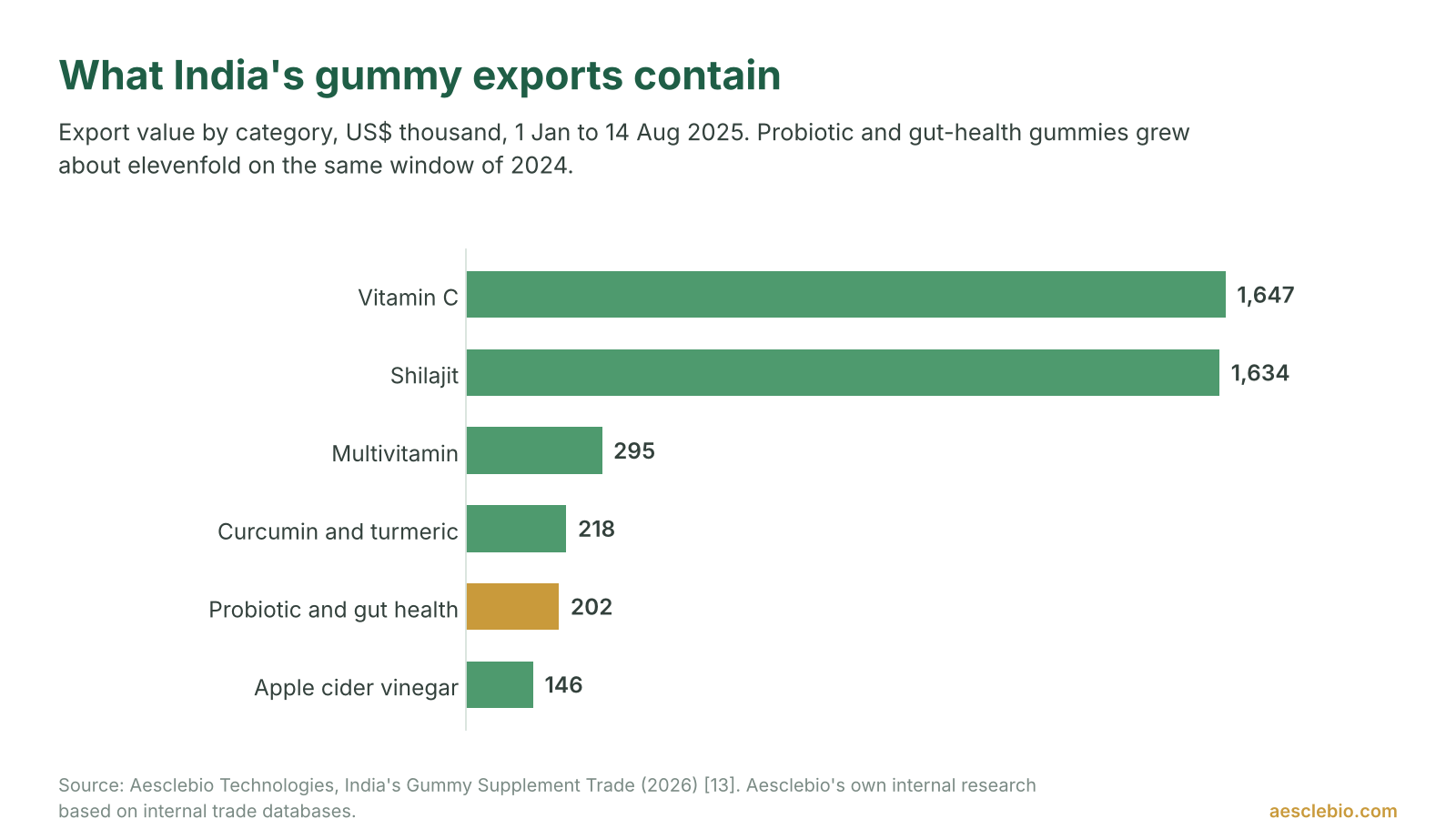
Shilajit, the second bar in the chart, is a dark, sticky mineral substance collected from mountain rocks and used in traditional Indian (Ayurvedic) preparations. It appears here only as a trade category; this article makes no claim about shilajit or any other product in the chart. Our research does not record which gel each product used, but it shows that Indian gummies now travel long distances into warm markets, so the gel has to be chosen for the journey, not only for the chew.
How to choose: a practical checklist
- Start with the buyer. Vegan or vegetarian rules out gelatin. Halal or kosher needs certified gelatin or a plant-based gel [1, 3].
- Map the climate and supply chain. Hot storage favours agar- or pectin-based systems over a plain gelatin gel [2, 5, 7].
- Set the sugar target early. Low-sugar products point towards low-methoxyl pectin with calcium, or blends [5].
- Match the active to the process. For probiotics, consider spore-formers or postbiotics, and check the count at the end of shelf life [10, 12].
- Expect to blend. Blends such as agar with guar gum can come closer to a gelatin-like chew [4].
- Ask your manufacturer for proof. Whether you need a halal supplement manufacturer or a private label vegan gummy supplier in Europe or India, ask for certificates and stability data at real-world temperatures.
The bottom line
For the kitchen, the answer is simple: agar is the usual vegan alternative to gelatin, pectin is the choice for jams, and neither swaps one-for-one. For supplement gummies, going gelatin-free is a decision, not a substitution. Each gel sets differently, copes with heat differently and needs different amounts of sugar and acid. The right one depends on who will eat the gummy, where it will be stored and what must survive inside it. Choose the gel for the product, not the product for the gel.
Frequently asked questions
What is the best vegan gelatin substitute?
For most desserts, agar-agar is the best vegan gelatin substitute. It comes from red seaweed, must be boiled to dissolve and sets firmly as it cools [7, 8]. Use less than you would gelatin, because agar gels are stronger [3]. For jams, pectin is the traditional choice [5]. Carrageenan suits milky desserts [8]. Always follow a recipe written for the substitute you are using.
Is agar the best vegan friendly gelatin alternative for gummies?
Agar makes firm gummies that stay solid in warm weather, because its gel only melts close to boiling [7]. On its own, though, it can feel firm or rubbery rather than bouncy [3]. In one study, a blend of agar and guar gum gave a chew resembling gelatin gummies [4]. Pectin is another popular alternative gelling agent, used alone or in blends [3].
Why is gelatin not vegan or vegetarian?
Gelatin is made from collagen taken from the skin, bones and hides of animals, mostly pigs and cattle, and sometimes fish [1, 2]. Because it comes from slaughtered animals, it is not suitable for vegans or vegetarians, even when the finished food contains no visible meat.
Is gelatin vegetarian or non-vegetarian? Is there a non-meat gelatin?
Gelatin is non-vegetarian, because it is an animal product [1, 2]. There is no true non-meat gelatin made from plants. Products sold as vegetarian gelatin or vegetarian-friendly gelatin are really agar, pectin, carrageenan or starch blends that do a similar job [3]. For gelatin alternatives for vegetarians and vegans, check the ingredient list for these names.
Can I use pectin instead of gelatin?
Not one-for-one. Gelatin sets simply by cooling, but classic pectin needs a lot of sugar (above 55%) and acid, and low-methoxyl pectin needs calcium [2, 5]. Pectin also gives a softer texture [3]. If you want to substitute pectin for gelatin, use a recipe designed for pectin.
Can you use gelatin instead of pectin?
You can make a set fruit jelly with gelatin, but it will not behave like a pectin jam. Gelatin melts again when warmed [2], whereas pectin can start to set while still hot [5], and the textures differ [3]. Gelatin also makes the recipe unsuitable for vegetarians and vegans. Choose a recipe written for gelatin rather than swapping amounts.
What can I use as a replacement for gelatin powder?
Agar powder is a common replacement for gelatin powder and a usual substitute of gelatin powder in vegan baking and desserts [3, 7]. Remember to boil it to dissolve it [7]. Pectin powder suits jams and fruit fillings [5]. Plant based gelatin alternatives are not interchangeable, so the amount and method change with each one.
Are halal gelatin gummies vegetarian?
No. Halal gelatin gummies use gelatin from permitted animals, usually certified cattle or fish, so they meet halal rules but still contain an animal product [1, 2]. Gummies set with pectin, agar or other plant gelling agents can suit halal, kosher, vegetarian and vegan buyers at once, if the whole product is certified [3].
Why do many probiotic gummies use spore-forming probiotics or postbiotics?
Gummies are cooked and deposited hot [3], and many probiotic microbes are sensitive to heat [10]. Spore-forming probiotics survive heat, acid and storage in a dormant form [11, 12]. Postbiotics are non-living preparations that do not need to stay alive [10]. Either way, the strain still needs evidence of a benefit [12].
Related reading
- Gummies vs Capsules vs Sachets vs Drops (Aesclebio blog)
- Prebiotics, Probiotics, Postbiotics, Synbiotics: A Field Guide Beyond the Buzzwords
- Kids, Toddlers and Probiotics: Dose, Format and the Sugar Problem
- Choosing a Probiotic Contract Manufacturer (Aesclebio blog)
- Billions of CFU, Little Meaning: Why the Biggest Number on the Label Rarely Wins
References
- Garcia-Vaquero M, Mirzapour-Kouhdasht A. A review on proteomic and genomic biomarkers for gelatin source authentication: challenges and future outlook. Heliyon. 2023;9(6):e16621. Open access. Free full text: PubMed Central PMC10248112. Link
- Derkach SR, Voron'ko NG, Kuchina YA, et al. Modified fish gelatin as an alternative to mammalian gelatin in modern food technologies. Polymers. 2020;12(12):3051. Open access. Free full text: PubMed Central PMC7766531. Link
- Tarahi M, Tahmouzi S, Kianiani MR, et al. Current innovations in the development of functional gummy candies. Foods. 2024;13(1):76. Open access. Free full text: PubMed Central PMC10778822. Link
- Rawat S, Rai S, Sangeeta S, et al. Application of plant-based hydrocolloids on the textural profile of vegan gummies supplemented with turmeric and black pepper. International Journal of Food Science. 2024;2024:7127635. Open access. Free full text: PubMed Central PMC11057949. Link
- Gawkowska D, Cybulska J, Zdunek A. Structure-related gelling of pectins and linking with other natural compounds: a review. Polymers. 2018;10(7):762. Open access. Free full text: PubMed Central PMC6404037. Link
- Joint FAO/WHO Expert Committee on Food Additives (JECFA). Pectins (INS 440). Specification prepared at the 71st JECFA (2009). FAO JECFA Monographs 7. Rome: Food and Agriculture Organization of the United Nations; 2009. Link
- Joint FAO/WHO Expert Committee on Food Additives (JECFA). Agar (INS 406). Specification prepared at the 49th JECFA (1997). FAO Food and Nutrition Paper 52 Add 5. Rome: Food and Agriculture Organization of the United Nations; 1997. Link
- Lomartire S, Gonçalves AMM. Algal phycocolloids: bioactivities and pharmaceutical applications. Marine Drugs. 2023;21(7):384. Open access. Free full text: PubMed Central PMC10381318. Link
- Hill C, Guarner F, Reid G, et al. Expert consensus document: the International Scientific Association for Probiotics and Prebiotics consensus statement on the scope and appropriate use of the term probiotic. Nature Reviews Gastroenterology & Hepatology. 2014;11:506–514. Open access. Link
- Salminen S, Collado MC, Endo A, et al. The International Scientific Association of Probiotics and Prebiotics (ISAPP) consensus statement on the definition and scope of postbiotics. Nature Reviews Gastroenterology & Hepatology. 2021;18(9):649–667. Free full text: PubMed Central PMC8387231. Link
- Elshaghabee FMF, Rokana N, Gulhane RD, et al. Bacillus as potential probiotics: status, concerns, and future perspectives. Frontiers in Microbiology. 2017;8:1490. Open access. Free full text: PubMed Central PMC5554123. Link
- Aesclebio Technologies. The Bacillus Surge: clinical-trial trends for spore-forming probiotics and what they mean for formulation. A registry-based analysis of ClinicalTrials.gov data to 17 September 2026. Hyderabad: Aesclebio Technologies Pvt. Ltd.; 2026. Link
- Aesclebio Technologies. India's Gummy Supplement Trade: exports and imports of supplement gummies, year by year. Aesclebio's own internal research based on internal trade databases, January 2020 to August 2025. Hyderabad: Aesclebio Technologies Pvt. Ltd.; October 2026. Link
Disclaimer
This article is for general education only. It is not medical advice and is not intended to diagnose, treat, cure or prevent any disease. It does not promote any specific product or brand, and it makes no claims about any product.
Statements about research describe the findings of published studies. They do not mean that any particular food or supplement will have the same effect for you. Always speak to a qualified healthcare professional before changing your diet or starting a supplement, especially if you are pregnant, breastfeeding, giving products to a baby or child, or living with a health condition.
Rules on how probiotics and supplements may be described differ from country to country. Nothing in this article should be read as a health claim for any product.
All graphics are original works of Aesclebio Technologies. Figures from other studies are credited to their sources. Quotations are limited to short passages with full attribution. Any clinical-trial figures from Aesclebio's own analysis come from public registry records and do not imply that any product is effective or safe.
Prepared by the Aesclebio Research Team with the help of AI tools, under the team's direction. © 2026 Aesclebio Technologies Pvt. Ltd. All rights reserved. Short extracts may be quoted with a link to the original article.