
Gut Health
The Traveller's Gut: Jet Lag, Flight Bloating and Traveller's Diarrhoea
Why flying and new time zones upset your stomach, what probiotics for travel can and cannot do, and the simple steps that matter more.
Why travel and your gut so often disagree
Every month, thousands of people search for things like "how to get rid of bloated stomach after flying", "jet lag diarrhea" or "best probiotics for travel". Behind those searches is one question: why does travel upset my stomach, and can I stop it? The honest answer starts by separating three problems: flight bloating is about physics, jet lag is about your body clock, and traveller's diarrhoea is about germs. Probiotics fit only one of them, and only partly.
Bloated after a flight? Blame the cabin pressure
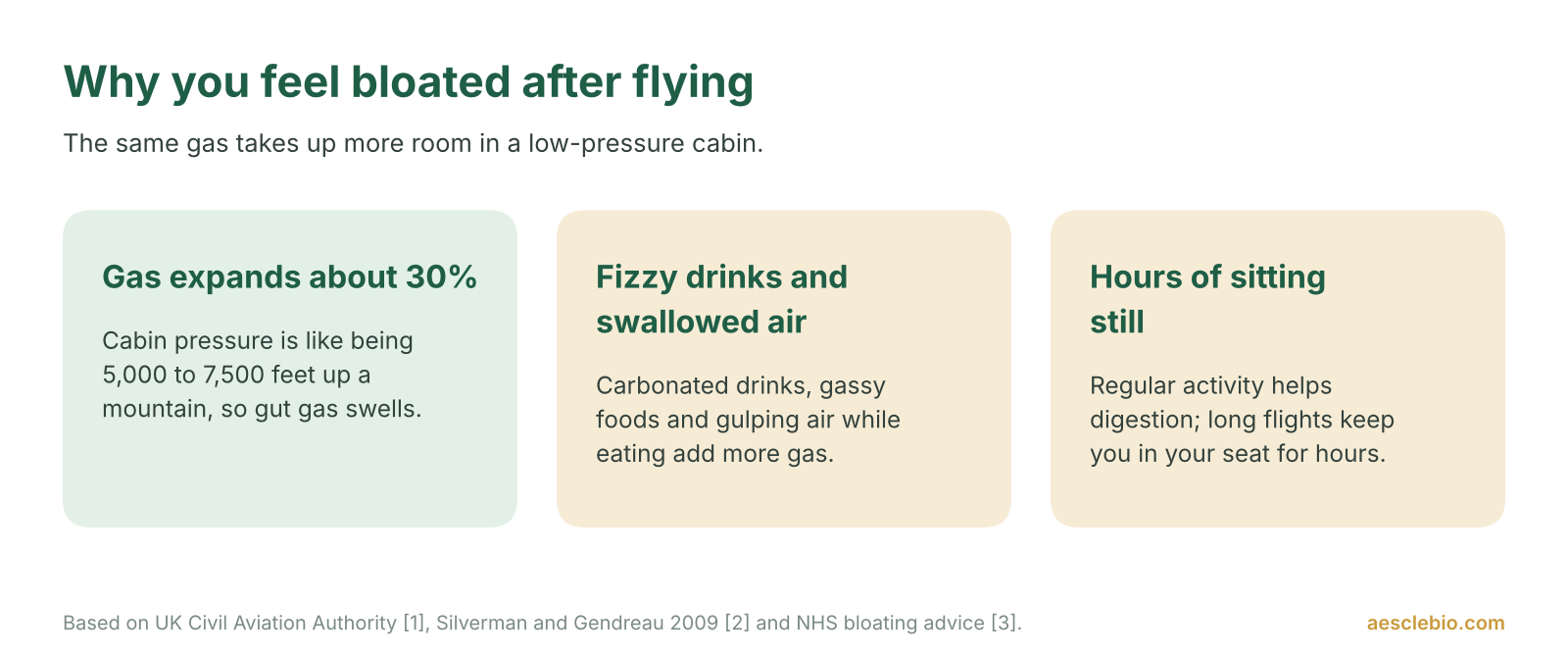
Aeroplane cabins are pressurised, but not to sea level. The UK Civil Aviation Authority explains that the air pressure inside a cabin is usually like being on a mountain 5,000 to 7,500 feet high, and should not go above 8,000 feet in normal flights [1]. As the plane climbs and the pressure drops, any gas increases in volume by about 30% [1]. That includes the gas that is always present in your stomach and intestines. A review of medical problems on commercial flights in The Lancet, a leading medical journal, notes that in healthy passengers this expansion can cause minor abdominal cramping [2].
So if you are gassy after flying, feel bloat after flying, or notice stomach cramps after flying, the most likely reason is simple: the same amount of gas is taking up more room. The UK National Health Service (NHS) adds fizzy drinks, gassy foods and swallowed air as common causes of trapped gas, and says regular exercise helps digestion [3]. A long flight combines these with hours of sitting still.
How to prevent gas when flying, and ease it afterwards
There is no probiotic trial showing a cure for flight bloating. The practical steps come from everyday gut advice [3]:
- Go easy on fizzy drinks, alcohol and very gassy foods (beans, lentils, cabbage) on the day you fly.
- Eat smaller meals before boarding, and chew with your mouth closed to swallow less air.
- Drink water, and walk the aisle when it is safe; staying active helps digestion.
- After landing, a gentle walk can help you get rid of a bloated stomach after flying. The extra gas shrinks back as the cabin pressure returns to normal [1, 2].
Bloating after travel that does not settle, or that comes with vomiting, a swelling in the tummy, blood in your poo, or being unable to pass wind or stools, is a reason to see a doctor [3]. Severe stomach pain after flying should never be put down to "just gas" without medical advice.
Can jet lag cause diarrhoea? Your gut has a body clock too
Your body runs on a circadian rhythm, an internal 24-hour clock set mainly by light and by meal times. It is not only in your brain: clock genes work in almost every cell, including the cells of the gut [5]. When you fly across several time zones quickly, that internal clock falls out of step with local time. The CDC's travel health guide, the Yellow Book, defines jet lag as a sleep disorder after crossing at least two time zones, and lists "gastrointestinal disturbances" (stomach and bowel upsets) among its symptoms, alongside poor sleep, daytime sleepiness and feeling unwell [4]. A Lancet review also lists constipation as a jet-lag symptom [2].
So yes, jet lag can affect your bowels, and diarrhoea and jet lag can arrive together. But be careful with the popular story that jet lag "wrecks your microbiome" (the community of microbes living in your gut). Most of that research is in mice. The often-quoted human evidence comes from just two people who flew eight time zones ahead: their gut bacteria shifted, and the changes settled within two weeks of landing [5]. Far too small to build advice on. Jetlag diarrhea and jet lag indigestion usually settle as your clock resets; a stomach ache after traveling that lasts more than a few days is more likely an infection.
What helps the body clock is well established and free: shift your sleep towards the new time zone before you go, time meals and light exposure to the destination, seek morning light after flying east, avoid long daytime naps, drink enough water and keep alcohol low [4].
Traveller's diarrhoea: an infection, not a mood of the gut
Traveller's diarrhoea is the big one. Depending on destination and season, about 30% to 70% of travellers get it over a two-week trip, and rates are especially high in South Asia in the hot months before the monsoon [6]. Diarrhoea itself means passing three or more loose or watery stools in a day [7]. Bacteria cause at least 75% to 90% of traveller's diarrhoea cases, most often types of Escherichia coli (E. coli); viruses such as norovirus cause at least 10% to 25%, and parasites cause about 10%, mostly in people who travel for longer [6]. These germs spread through contaminated food and water and through poor hand hygiene [7].
Diarrhea after flying is therefore usually not caused by the flight. It is more often the first sign of something you ate or drank around the time you travelled. Untreated, bacterial traveller's diarrhoea usually lasts three to seven days, and viral diarrhoea two to three days [6].
Here is a surprising point from the CDC: food and water precautions are still advised, but studies suggest that simply teaching travellers about food and water hygiene may not lower their risk, partly because restaurant hygiene is out of your control [6]. Handwashing with soap remains sensible, and a hand sanitiser with at least 60% alcohol is the fallback before eating when there is no soap [6]. Choose hot, freshly cooked food and safe water, but do not expect perfect protection.
Probiotics for travelers diarrhea: what the meta-analyses show
A meta-analysis pools the results of many trials to get a clearer overall answer. For probiotics and travel, the pooled answers have barely changed in almost 20 years.
- A 2006 meta-analysis of four trials found no significant difference between probiotics and a placebo (a dummy product). A 2007 meta-analysis that added three more trials found about 15% fewer cases of traveller's diarrhoea with probiotics. An update in 2018 of 11 double-blind trials found the same figure [9].
- A 2012 meta-analysis of probiotics across eight gut conditions found significant effects in six of them, but no significant effect for traveller's diarrhoea [11].
- A 2024 network meta-analysis, which compares several options at once, included 31 randomised controlled trials (studies where people are put into groups by chance) with 10,879 travellers. Probiotics as a group again lowered cases by about 15% compared with placebo, but most of the comparisons in the analysis were rated low or very low confidence [10]. The same analysis also looked at medicines and vaccines; whether either suits your trip is a question for your doctor, who may advise them in some cases.
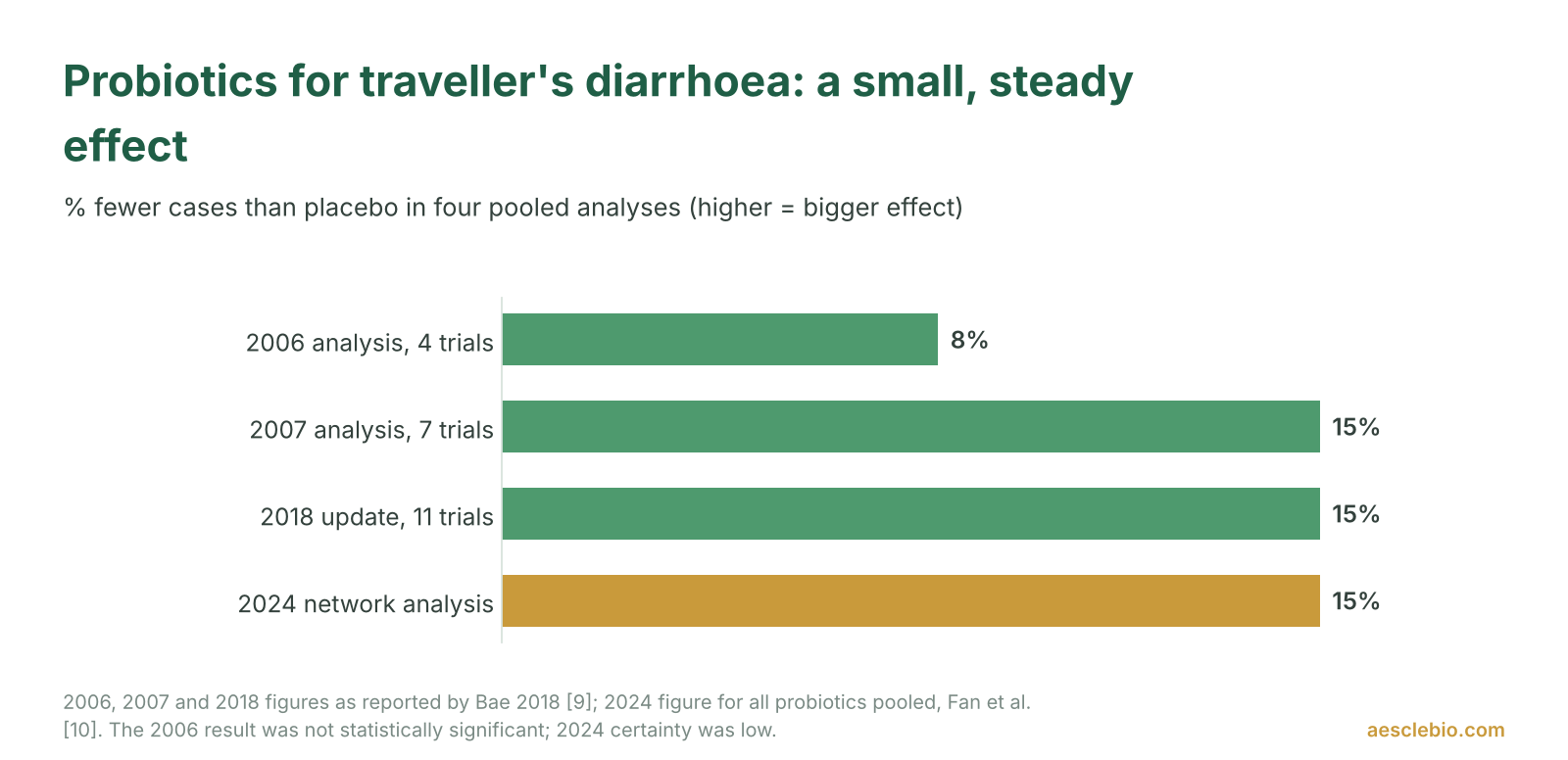
What does "15% fewer" mean in real life? As a rough illustration: if 40 out of 100 travellers on a trip would normally get diarrhoea, a 15% reduction would bring that to about 34. Six people spared; 34 still ill. Real, but modest.
What about Saccharomyces boulardii?
Saccharomyces boulardii is a probiotic yeast, not a bacterium, and it is the most-studied single probiotic for travel. A 2010 systematic review concluded it could be strongly recommended for traveller's diarrhoea in adults [12]. Newer analyses are more cautious. In the 2024 network meta-analysis, trials of S. boulardii pointed towards fewer cases than placebo, but the result was uncertain: its likely range included no effect at all [10]. The honest summary: the effect depends on the exact probiotic, and no single one has strong, consistent proof.
That is why expert bodies stay neutral. A 2017 guideline from the International Society of Travel Medicine found "insufficient evidence to recommend the use of commercially available prebiotics or probiotics to prevent or treat" traveller's diarrhoea [8, 9], and the 2026 CDC Yellow Book calls the results "inconclusive", partly because standardised probiotic preparations are not reliably available [6].
Our own research shows why the evidence is thin. Aesclebio's registry report counts 3,070 probiotic trials on ClinicalTrials.gov, the public trial registry run by the US National Library of Medicine, up to September 2026, and one in four of them (727) enrols healthy people [14]. Yet in Aesclebio's analysis of 2,057 probiotic trial records (ClinicalTrials.gov export, February 2026), only 3 trials studied probiotics for traveller's diarrhoea, and one of those enrolled just three people [15]. Three more, all registered in 2025 or 2026, look at how travel changes gut bacteria. Travel is a much-searched reason to take a probiotic, yet one of the least tested.
Myth or fact?
| Myth | What the evidence says |
|---|---|
| Any probiotic will protect you from travel tummy. | Results differ between probiotics; some showed no clear benefit in pooled trials, and none has strong, consistent proof [9, 10, 11]. |
| Diarrhoea after a flight is caused by the flight. | Cabin pressure causes gas and bloating, not infection. Traveller's diarrhoea is mostly caused by bacteria from food and water [1, 6]. |
| Jet lag permanently damages your gut bacteria. | The often-quoted human evidence comes from just two people, and their gut bacteria changes settled within two weeks of landing [5]. |
| Fizzy drinks or fruit juice are the best fix for diarrhoea. | Very sugary drinks can make diarrhoea worse. Oral rehydration solution is the recommended choice for real fluid loss [6, 13]. |
Choosing travel probiotics, if you decide to use one
Nobody can honestly name the single best probiotic for travelers diarrhea, but if you want to try one, choose like a scientist, not like a shopper:
- Look for the exact strain (genus, species and strain code) and check that this exact strain has been tested in travellers, not just "for gut health".
- Think about timing. In the trials, travellers took probiotics through the trip, usually for one to three weeks in total [10]. If you want to start probiotics before travel, follow the label.
- Check the live count until the end of shelf life, measured in colony-forming units (CFU), the standard count of live microbes.
- Pick shelf stable probiotics for travel if you will not have a fridge. Read the storage instructions: heat in luggage or a hot hotel room can reduce live counts.
- Do not let a probiotic replace the basics: handwashing, safe food and water, and oral rehydration salts in your bag.
- If you are pregnant, breastfeeding, travelling with children, have a weak immune system or a long-term illness, ask your doctor first. We give no doses for children.
If diarrhoea starts: rehydrate first
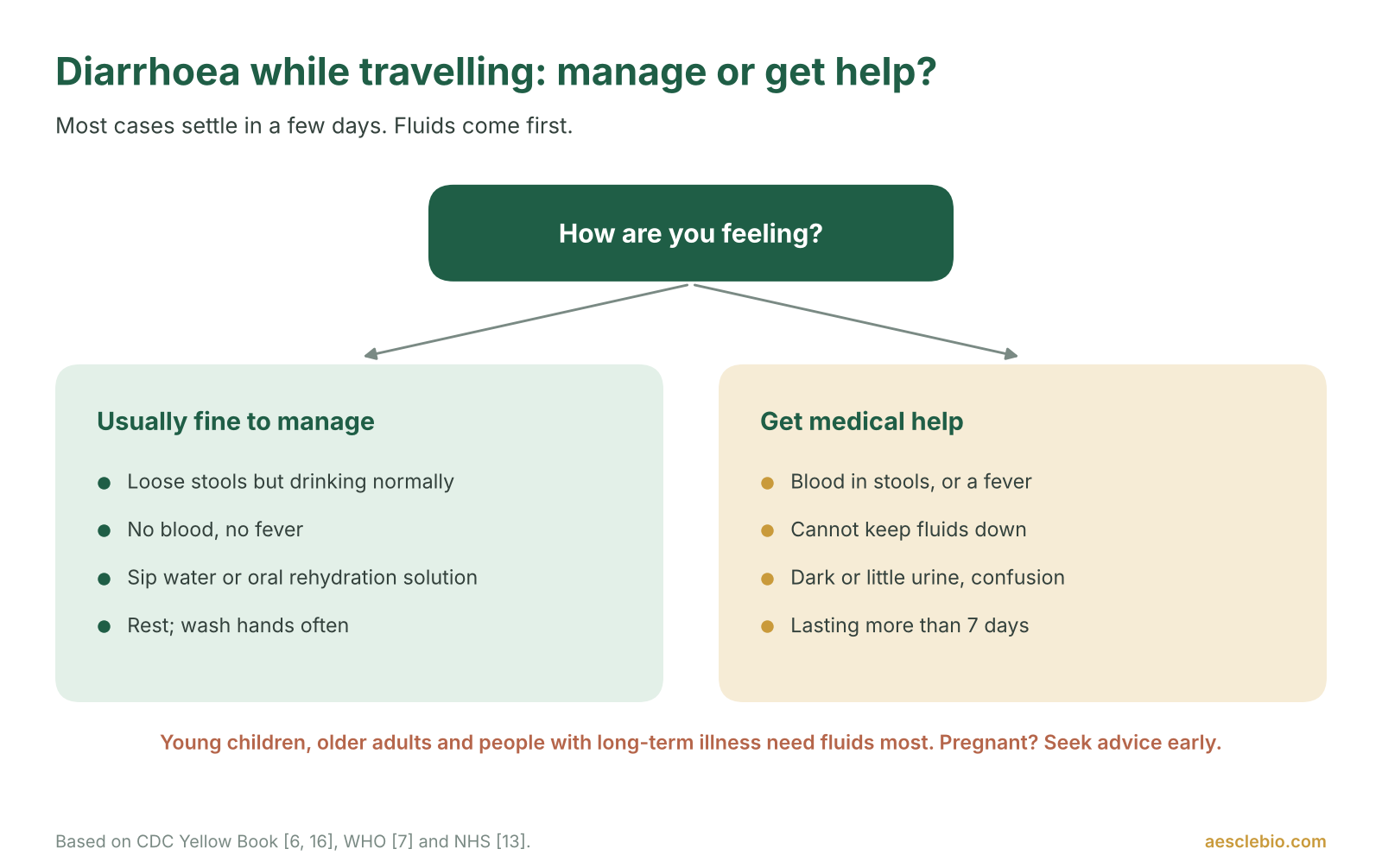
Most traveller's diarrhoea gets better on its own within a few days [6]. The main danger is losing too much fluid [7]. Oral rehydration solution (ORS) is a mix of clean water, sugar and salt in the right balance [7]. Packets are widely sold in pharmacies; dissolve one in the amount of boiled or treated water shown on the packet, usually 1 litre [6]. For mild diarrhoea, drinking more fluids may be all you need [8], but very sugary drinks, fruit juice and fizzy drinks can make diarrhoea worse [6, 13]. Medicines exist, but they have side effects; the choice belongs to a doctor or pharmacist [6, 8].
Flying with diarrhoea is uncomfortable but usually possible if you can drink and keep fluids down. If you are wondering how to stop diarrhea before a flight, speak to a pharmacist or doctor: the right option depends on your symptoms, and you should not use anti-diarrhoea medicine on its own if there is blood in your stools or a fever [6].
Red flags: see a doctor
- Blood in your diarrhoea, or bleeding from the bottom [13].
- A fever with diarrhoea [6].
- You keep vomiting and cannot keep fluids down [13].
- Signs of dehydration: very dark or little urine, sunken eyes, strong thirst, confusion or unusual sleepiness [7, 13].
- Diarrhoea lasting more than 7 days [13], or stomach problems after traveling that continue once you are home.
- Babies, young children, older adults and people with long-term illness lose fluid faster and should get help sooner [6].
The bottom line
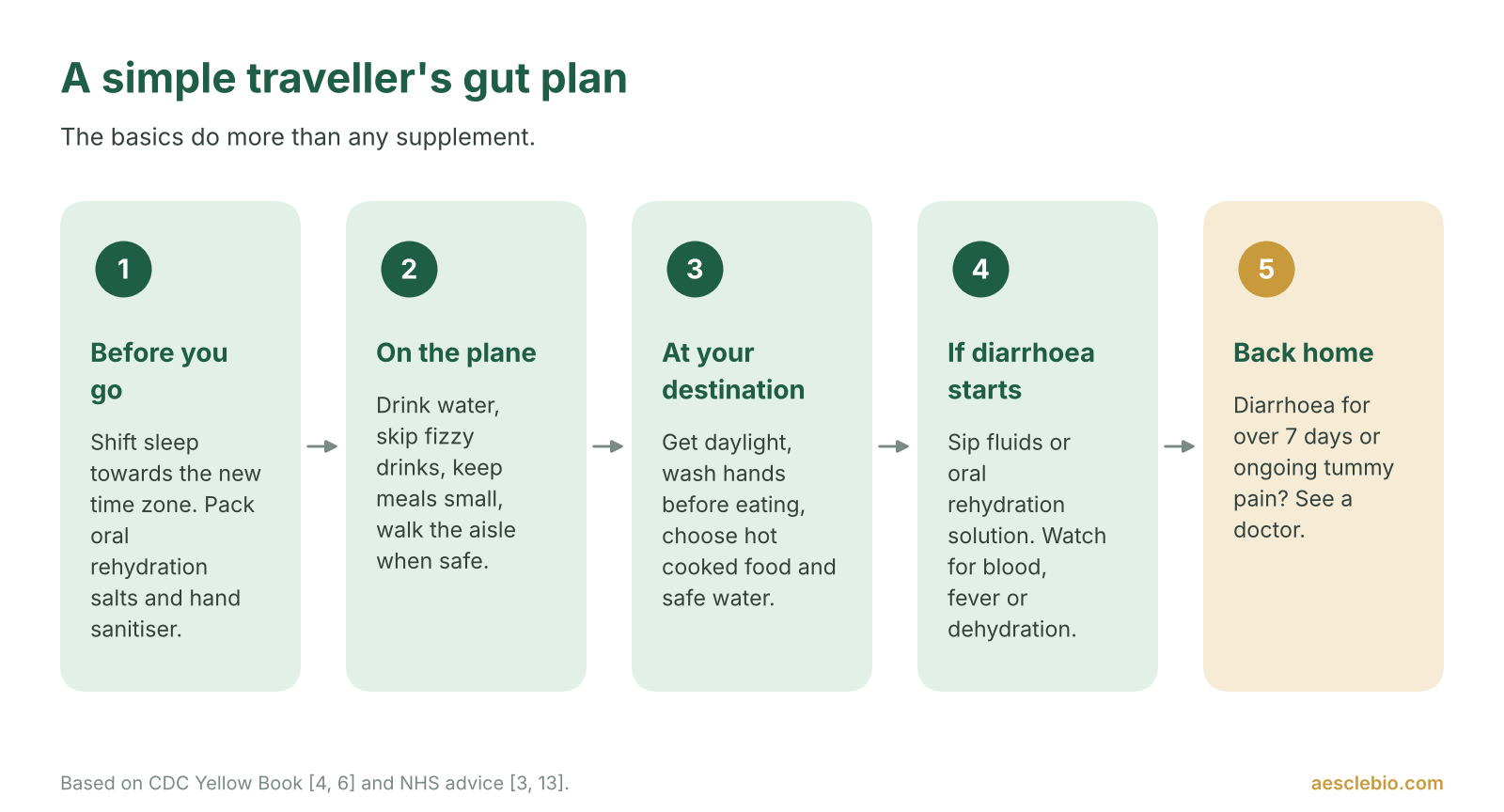
Most travel tummy trouble has nothing to do with a lack of probiotics. Bloating after flying is physics: gas expands in a low-pressure cabin, and it eases when you land and move. Jet lag is a clock problem, best handled with light, sleep and meal timing. Traveller's diarrhoea is an infection, and your best tools are hand hygiene, sensible food and water choices, oral rehydration and knowing the red flags. Probiotics and travel can go together, but the evidence shows a small effect that depends on the exact strain, with low certainty. Pack the oral rehydration salts first; treat a probiotic as an optional extra, not a shield.
Frequently asked questions
Do probiotics help with travelers diarrhea?
Possibly, a little. Meta-analyses of randomised trials found about 15% fewer cases with probiotics than with a placebo, but the certainty is low and results differ between probiotics; one large review found no significant effect [9, 10, 11]. The CDC says the data are insufficient to recommend them [6]. Hand hygiene and oral rehydration matter more.
What are the best probiotics for travel?
No single probiotic has strong, consistent proof. Saccharomyces boulardii, a probiotic yeast, is the most studied, but newer pooled analyses rate its effect as uncertain [10, 12]. If you choose travel probiotics, pick a named strain tested in travellers, with a live count guaranteed to the end of shelf life and storage that suits your trip.
Do you get bloated after flying, and why?
Many people do. Cabin pressure on a plane is like being 5,000 to 7,500 feet up a mountain, so gas, including gas in your gut, expands by about 30% [1, 2]. In healthy passengers this can cause mild cramping [2]. Fizzy drinks, gassy foods, swallowed air and sitting still make it worse [3].
How do I get rid of a bloated stomach after flying?
Walk around once you land, drink water and keep the next meal small. The extra gas shrinks as pressure returns to normal. Avoid fizzy drinks and very gassy foods for a while [3]. If bloating does not settle, or comes with vomiting, a lump, blood in your poo, or you cannot pass wind, see a doctor [3].
Can jet lag cause diarrhea or stomach issues?
Yes. The CDC lists stomach and bowel upsets among jet-lag symptoms, along with poor sleep and tiredness [4], and constipation is also reported [2]. These usually ease as your body clock adjusts, by about 1 to 1.5 hours per day on average [4]. Diarrhoea that lasts several days, or comes with fever, is more likely an infection.
Why do I get diarrhea after a flight?
The flight itself rarely causes diarrhoea. Cabin pressure causes gas, not infection. Diarrhoea after a flight usually comes from germs in food or water eaten shortly before or after travelling, or occasionally from jet lag upsetting the gut [4, 6]. Drink fluids and watch for red flags such as blood, fever or dehydration.
Should I start probiotics before travel?
In the trials, travellers took probiotics around the trip, usually for one to three weeks in total [10]. If you decide to try one before or during travel, follow the label. Remember the effect seen in trials was modest [9, 10]. If you are pregnant, breastfeeding, travelling with children or have a health condition, ask a doctor first.
What is the best way to treat traveler's diarrhea at home or abroad?
Replace lost fluids. For real fluid loss, use oral rehydration solution, a mix of clean water, sugar and salt [6, 7]. Avoid very sugary and fizzy drinks [13]. See a doctor for blood in stools, fever, constant vomiting, signs of dehydration or diarrhoea lasting over 7 days [6, 13].
Related reading
- What Probiotics Are, and the Five Myths That Survive Every Explainer
- Your Probiotic Is a Strain, Not a Species: Reading the Code After the Name
- Billions of CFU, Little Meaning: Why the Biggest Number on the Label Rarely Wins
- Probiotics and Immunity (Aesclebio blog)
- Gummies vs Capsules vs Sachets vs Drops (Aesclebio blog)
References
- UK Civil Aviation Authority. Physiology of flight: guidance for health professionals. London: Civil Aviation Authority. Free to read online. Link
- Silverman D, Gendreau M. Medical issues associated with commercial flights. The Lancet. 2009;373(9680):2067–2077. Free full text: PubMed Central PMC7137984. https://doi.org/10.1016/S0140-6736(09)60209-960209-9)
- National Health Service (NHS). Bloating. NHS website; page last reviewed 21 January 2026. Link
- Riedy SM, Williams SG. Jet lag disorder. In: CDC Yellow Book: Health Information for International Travel, 2026 edition. Atlanta: US Centers for Disease Control and Prevention; 2025. Link
- Kaczmarek JL, Thompson SV, Holscher HD. Complex interactions of circadian rhythms, eating behaviors, and the gastrointestinal microbiota and their potential impact on health. Nutrition Reviews. 2017;75(9):673–682. Free full text: PubMed Central PMC5914376. Link
- Connor BA, Leung DT. Travelers' diarrhea. In: CDC Yellow Book: Health Information for International Travel, 2026 edition. Atlanta: US Centers for Disease Control and Prevention; 2025. Link
- World Health Organization. Diarrhoeal disease: fact sheet. Geneva: WHO; 7 March 2024. Link
- Riddle MS, Connor BA, Beeching NJ, et al. Guidelines for the prevention and treatment of travelers' diarrhea: a graded expert panel report. Journal of Travel Medicine. 2017;24(suppl 1):S57–S74. Free full text: PubMed Central PMC5731448. Link
- Bae JM. Prophylactic efficacy of probiotics on travelers' diarrhea: an adaptive meta-analysis of randomized controlled trials. Epidemiology and Health. 2018;40:e2018043. Free full text: PubMed Central PMC6232657. Link
- Fan H, Liu IC, Gao L, Wu L. Bismuth subsalicylate, probiotics, rifaximin and vaccines for the prevention of travelers' diarrhea: a systematic review and network meta-analysis. Frontiers in Pharmacology. 2024;15:1361501. Free full text: PubMed Central PMC11063717. Link
- Ritchie ML, Romanuk TN. A meta-analysis of probiotic efficacy for gastrointestinal diseases. PLoS One. 2012;7(4):e34938. Free full text: PubMed Central PMC3329544. Link
- McFarland LV. Systematic review and meta-analysis of Saccharomyces boulardii in adult patients. World Journal of Gastroenterology. 2010;16(18):2202–2222. Free full text: PubMed Central PMC2868213. Link
- National Health Service (NHS). Diarrhoea and vomiting. NHS website; page last reviewed 21 December 2023. Link
- Aesclebio Technologies. Probiotic Clinical Trials: Where the Industry Is Heading. A registry-based analysis of ClinicalTrials.gov data to 17 September 2026. Hyderabad: Aesclebio Technologies Pvt. Ltd.; 2026. Link
- Aesclebio analysis of ClinicalTrials.gov records (export February 2026; 2,057-trial analytic set). Hyderabad: Aesclebio Technologies Pvt. Ltd.; 2026. Link
- Galang RR, Roy SC. Pregnant travelers. In: CDC Yellow Book: Health Information for International Travel, 2026 edition. Atlanta: US Centers for Disease Control and Prevention; 2025. Link
Disclaimer
This article is for general education only. It is not medical advice and is not intended to diagnose, treat, cure or prevent any disease. It does not promote any specific product or brand, and it makes no claims about any product.
Statements about research describe the findings of published studies. They do not mean that any particular food or supplement will have the same effect for you. Always speak to a qualified healthcare professional before changing your diet or starting a supplement, especially if you are pregnant, breastfeeding, giving products to a baby or child, or living with a health condition.
Rules on how probiotics and supplements may be described differ from country to country. Nothing in this article should be read as a health claim for any product.
All graphics are original works of Aesclebio Technologies. Figures from other studies are credited to their sources. Quotations are limited to short passages with full attribution. Any clinical-trial figures from Aesclebio's own analysis come from public registry records and do not imply that any product is effective or safe.
Prepared by the Aesclebio Research Team with the help of AI tools, under the team's direction. © 2026 Aesclebio Technologies Pvt. Ltd. All rights reserved. Short extracts may be quoted with a link to the original article.