
Probiotic Basics
What Probiotics Are, and the Five Myths That Survive Every Explainer
A plain-language guide to what probiotics are, how they work, common examples, and the five beliefs the evidence does not support.
Why the same questions keep coming back
What are probiotics? How do probiotics work? Do probiotics work at all? People type these questions into search engines every day, and most explainers answer with the same few lines: "good bacteria", "gut health", "found in yoghurt". Those lines are not wrong, but they leave room for five myths that keep surviving. This article gives you probiotics 101 in plain words, then tests each myth against the evidence. One idea runs through all of it: a probiotic is defined by what it has been shown to do, not by what it is called.
Probiotics 101: what are probiotics?
In 2001 and 2002, experts brought together by two United Nations bodies, the Food and Agriculture Organization (FAO) and the World Health Organization (WHO), defined probiotics as "live microorganisms which when administered in adequate amounts confer a health benefit on the host" [1]. In 2014, the International Scientific Association for Probiotics and Prebiotics (ISAPP), a non-profit group of scientists, kept this definition with only a small grammar correction [2]. A "microorganism", or microbe, is a living thing too small to see, such as a bacterium or a yeast.
So the definition has three parts. The microbes must be alive. There must be enough of them. And they must have shown a health benefit in studies. The ISAPP panel added that the microbes should be named down to the strain, the specific type within a species, because benefits often belong to particular strains [2]. Microbes that have been killed on purpose and still give a benefit have their own name: postbiotics [9].
Probiotics often come up alongside the word microbiome, which means the whole community of microbes living in a place such as your gut, together with their genes. The microbes themselves are called the microbiota. Every person carries a different gut community, and different body sites have different microbiomes. A probiotic is a small, chosen visitor to that community.
How do probiotics work?
Scientists have described several ways probiotics may help. A major review of the research listed a number of them; four of the main ones are easy to picture [4]:
- Crowding out unwanted microbes. Probiotics compete with harmful microbes for space and food, and some make natural substances that slow those microbes down. Scientists call these substances bacteriocins [4].
- Making acids and other useful substances. Many probiotics turn sugars into acids, such as lactic acid, and help produce short-chain fatty acids, small compounds that act in the gut and also as signals elsewhere in the body [4, 5].
- Talking to the immune system. The immune system is the body's defence network. Some probiotic strains send signals that help keep its responses balanced [4].
- Supporting the gut lining. Some strains help the gut wall make mucus, its protective slippery layer, and help keep the barrier between the gut and the rest of the body in good shape [4].
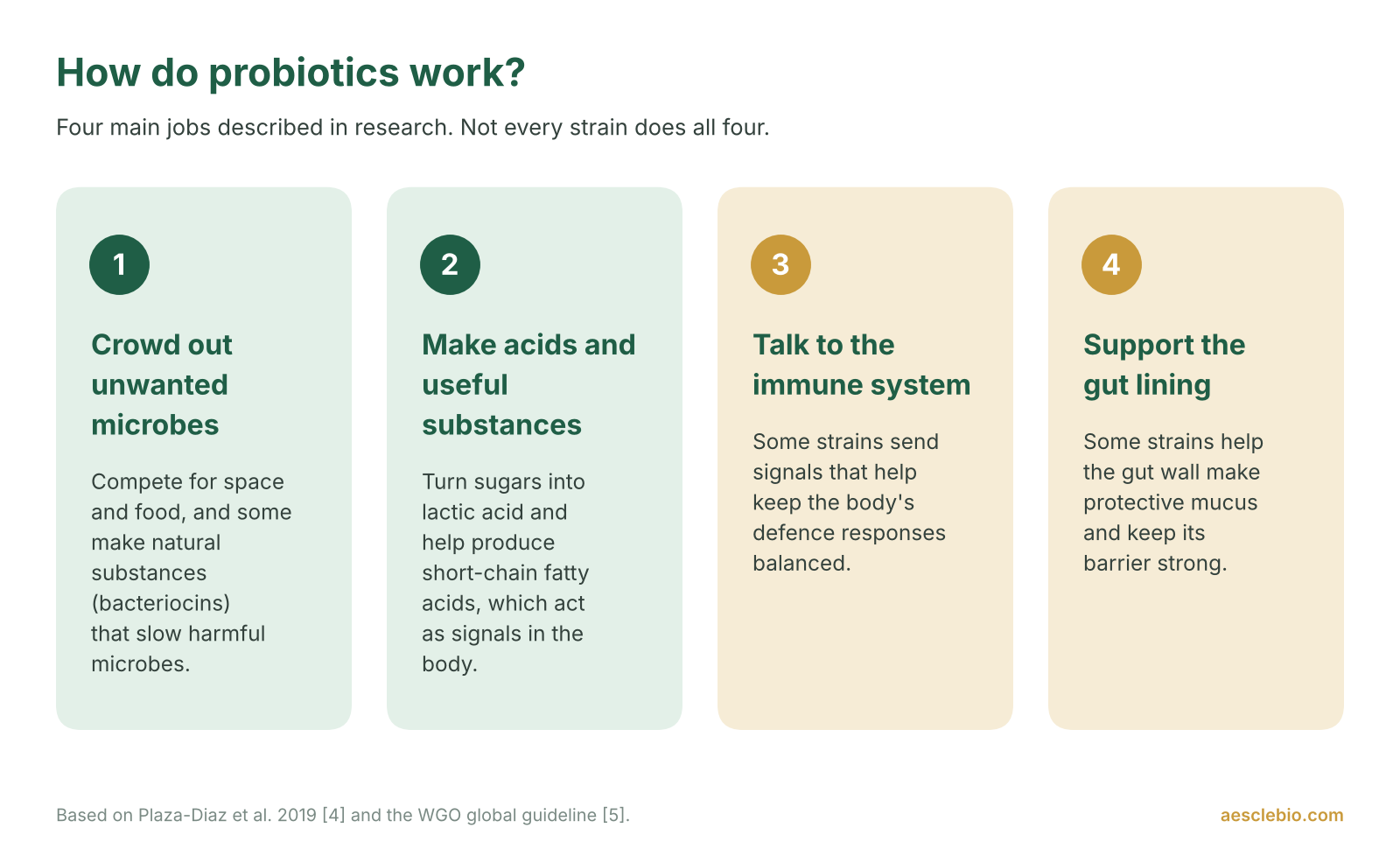
Not every probiotic does all four. The ISAPP panel explained that some effects, such as blocking unwanted microbes and making useful acids, are common across many probiotics, while others, especially immune effects, may be found in only a few strains [2]. That point matters for three of the five myths below.
Examples of probiotics, and what "probiotic ingredients" means
On a label, the probiotic ingredients are the named microbes, not the capsule, powder or gummy around them. Lactobacilli and bifidobacteria have long been the most common probiotics. The yeast Saccharomyces boulardii, some Bacillus species and some strains of Escherichia coli are also used [5]. In 2020, scientists split the big Lactobacillus group, creating 23 new genera (a genus is the family-level name before the species) [5, 11]. So some familiar names changed: Lactobacillus rhamnosus, for example, is now Lacticaseibacillus rhamnosus [11]. Many labels still use the old names, and "lactobacilli" remains a handy umbrella word.
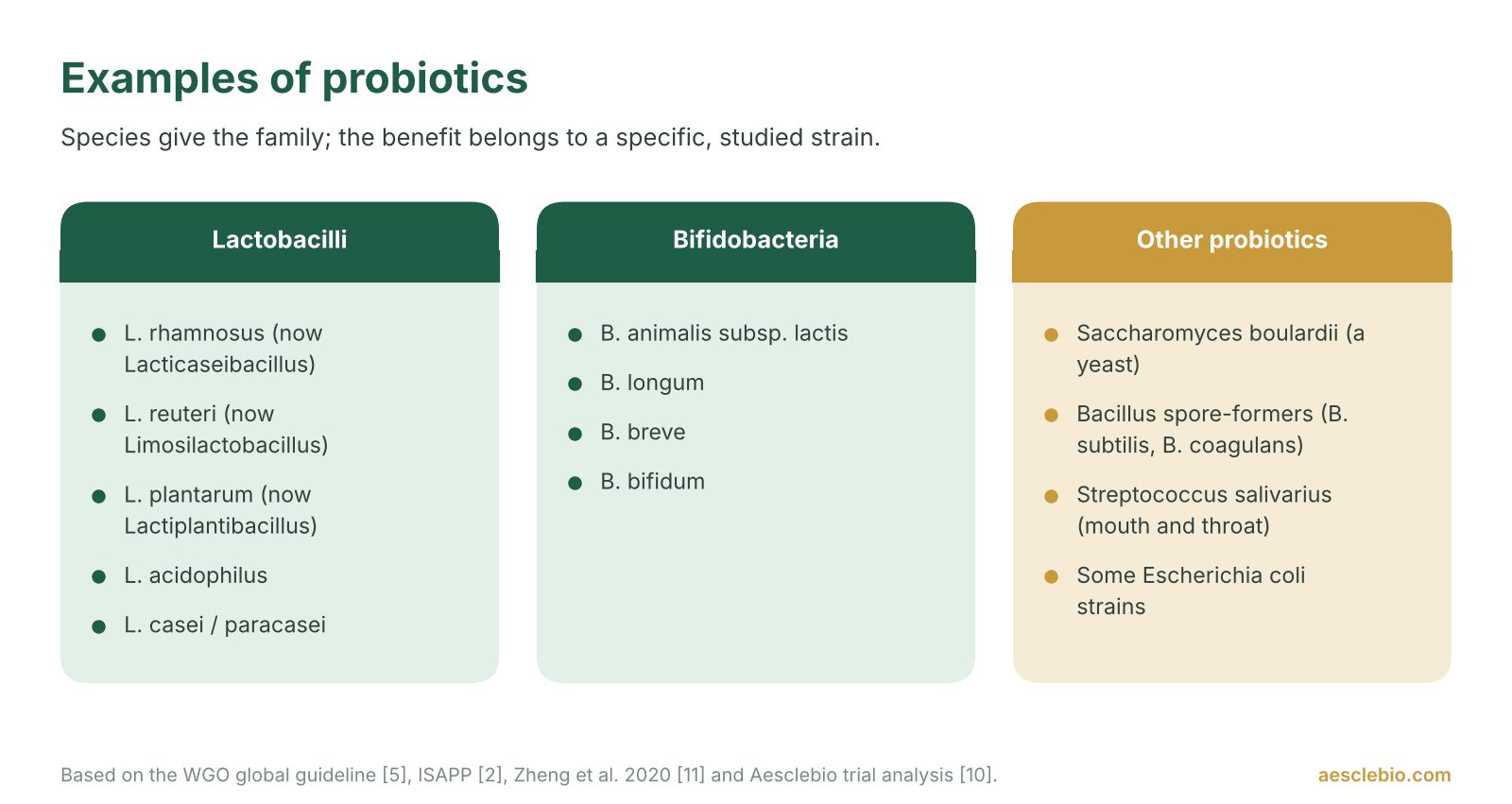
Our own research shows which probiotics examples scientists study most. In Aesclebio's analysis of 3,070 clinical trials (research studies in people) of probiotic-type products registered on ClinicalTrials.gov, the public trial registry run by the US National Library of Medicine, the most-studied species were L. rhamnosus (279 trials), L. reuteri (238), Bifidobacterium animalis subspecies lactis (172) and L. plantarum (166). Spore-forming Bacillus species were among the fastest-growing [10].
The five probiotic myths that survive every explainer
Myth 1: Probiotics move in and stay for good
Many people picture probiotics as new settlers that "repopulate" the gut. In most cases they behave more like visitors. In a study at the Weizmann Institute of Science in Israel, volunteers took an 11-strain probiotic. The microbes survived the trip through the gut, but how well they settled on the gut lining differed from person to person, and the effect on the gut community was temporary [8]. A systematic review (a study that gathers and weighs all the trials on a question) of seven trials in healthy adults found no clear change in the overall mix of gut bacteria, compared with a placebo (a dummy product), in all but one of them [7].
This does not mean probiotics fail. Benefits that do not need the microbes to settle and multiply are fully within the definition [2]. Yoghurt cultures, for example, help people digest lactose (milk sugar) even though they do not grow in the gut [2]. The practical point is simple: effects generally last while you keep taking them.
Myth 2: More strains and higher CFU are always better
Labels compete on big numbers: 10 strains, 50 billion colony-forming units (CFU), the standard count of live microbes. But the World Gastroenterology Organisation's global guideline says the dose "should be based on human studies showing a health benefit" [5]. The guideline's own examples show how wide the range is: one product eased the symptoms of irritable bowel syndrome (a common long-term gut complaint) at 100 million CFU a day, while the effective dose of others was 300 to 450 billion CFU taken three times a day [5]. Health Canada, for comparison, accepts general claims for certain common species at 1 billion CFU per serving [2].
The same applies to strain counts. A review of 228 trials found that results depended on the exact strain or mix and on the health problem being studied [6]. So what counts is whether that particular combination was tested, not simply how many strains it contains. A larger number is only better when that larger number was what the studies tested.
Myth 3: All probiotics do the same thing
Because many are called "good bacteria", it is easy to assume they are interchangeable. They are not. In the same 228-trial review, some strains within one species helped prevent antibiotic-linked diarrhoea in adults while other strains of the same species did not; the same strain could also help with one problem and not another [6]. The global guideline is blunt: "the effects of probiotics are strain-specific and dose-specific" [5]. Think of a species as a surname. Two people with the same surname can have very different skills.
Myth 4: Any fermented food is a probiotic
Fermented foods such as yoghurt, kefir and kimchi are made by microbes, and many still contain live ones. But the ISAPP panel says foods with live cultures should be described as "containing live and active cultures", not called probiotic, unless the microbes are defined and shown to give a benefit [2]. A later ISAPP panel on fermented foods agreed, adding that many fermented foods are baked, heated or filtered so that no live microbes remain [3]. Fermented foods are a good part of a varied diet; they are just not the same thing as a defined probiotic.
Myth 5: Probiotics are only for digestion
Gut health is still the anchor of probiotic research, but it is no longer the whole story. In Aesclebio's analysis, gut and digestive health accounted for 656 of the 3,070 trials (21%), the largest single area. Metabolic and weight health (314 trials), mental health and thinking (282), breathing and immune health (276), women's health (220), oral health (200) and skin (106) were also major areas [10]. Overall, registrations have grown by about 9% a year for 16 years, and trials on mental health and thinking have grown by about 14% a year [10].
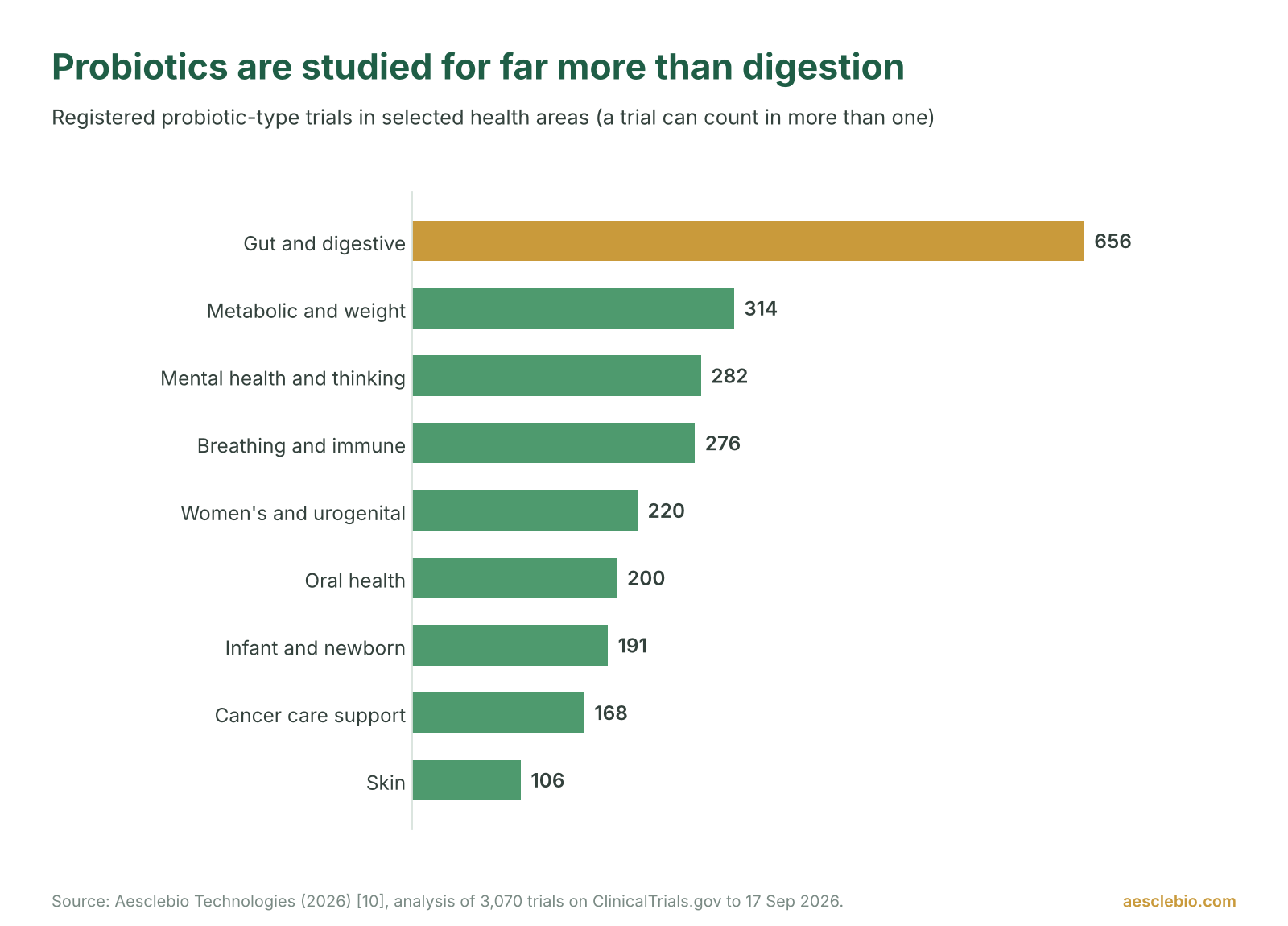
A note of caution: a registered trial is a question being asked, not an answer. Many of these areas are still early, and the strongest evidence remains for specific strains in specific situations [5, 6].
Myth or fact? A quick recap
| Myth | What the evidence says |
|---|---|
| Probiotics settle in your gut for good. | Most pass through. Their effects on the gut community are usually temporary and differ between people [7, 8]. |
| More strains and more CFU always work better. | The right amount is the amount tested in human studies for that strain and purpose [5, 6]. |
| All probiotics do the same thing. | Effects are strain-specific and depend on the health problem studied [5, 6]. |
| Any fermented food is a probiotic. | Only defined microbes with shown benefits qualify; many fermented foods contain no live microbes at all [2, 3]. |
| Probiotics are only for digestion. | About one in five registered trials is about gut health; about four in five study other areas, such as immunity, mood, metabolism, women's and oral health [10]. |
So, are probiotics worth it?
Probiotics benefits are real for some strains, in some situations, at some amounts. They are not a general tonic. A probiotic is most likely to be worth it when you can answer yes to four questions:
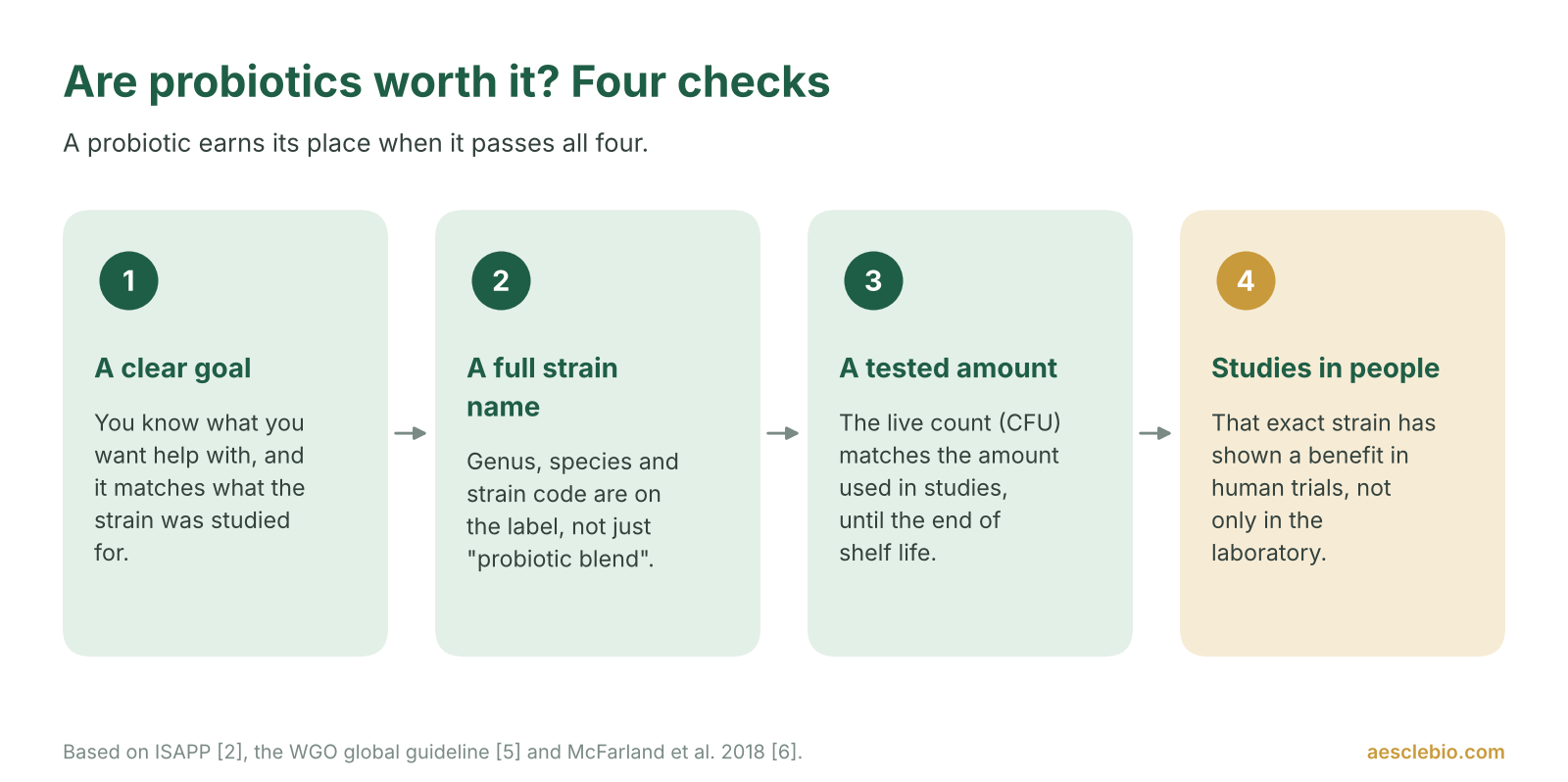
Our analysis also found that only about 58% of registered trials name a strain anywhere in the record [10]. If researchers do not always name the strain, a product label that skips it should make you more careful, not less. And if you are pregnant, breastfeeding, buying for a baby or child, have a weakened immune system or live with a health condition, speak to your doctor before starting any probiotic.
The bottom line
What do probiotics do? The honest answer is: it depends on the strain. Probiotics are live microbes with a proven benefit at a known amount. They mostly pass through rather than settle, more is not automatically better, they are not all alike, fermented food is not automatically one, and their research now reaches well beyond the gut. Judge a probiotic by its full strain name, its live count and its human studies, not by the size of the number on the front of the pack.
Frequently asked questions
What are probiotics, in simple words?
Probiotics are live microbes, usually bacteria or yeasts, that give a health benefit when you take enough of them. That is the definition used by experts working with the World Health Organization and the Food and Agriculture Organization [1], and confirmed by scientists in 2014 [2]. To count, the microbes must be alive, present in a known amount and backed by studies in people.
What are some examples of probiotics?
Common examples of probiotics include strains of Lacticaseibacillus rhamnosus, Limosilactobacillus reuteri, Lactiplantibacillus plantarum (all formerly called Lactobacillus), Bifidobacterium longum, Bifidobacterium animalis subspecies lactis, the yeast Saccharomyces boulardii and spore-forming Bacillus species [5, 10, 11]. Remember that a species name alone is not enough: the benefit belongs to a specific, studied strain [2, 6].
How do probiotics work?
Research suggests four main ways: competing with unwanted microbes for space and food, making acids and other useful substances such as short-chain fatty acids, sending signals to the immune system, and helping the gut lining stay strong [4]. Different strains do different combinations of these, which is why results vary from one probiotic to another [2].
Do probiotics work?
Some do, for some purposes. Reviews of many trials show that benefits depend on the exact strain, the amount and the health problem being studied [5, 6]. A strain that helps in one situation may do nothing in another. That is why a good product names its strain and points to studies in people.
What do probiotics do in the gut?
While they pass through, probiotics can compete with unwanted microbes, make acids and other useful substances, and interact with the gut lining and immune cells [4]. Most do not settle permanently: their effect on the gut community is usually temporary and varies from person to person [7, 8].
What are probiotic ingredients on a label?
The probiotic ingredients are the named live microbes, ideally written in full as genus, species and strain code, with the number of live microbes (in CFU) promised until the end of shelf life [2, 5]. Everything else, such as starch, gelatin or capsule shell, carries or protects the microbes.
Is a yogurt or other fermented food a probiotic?
Not automatically. Yoghurt (yogurt in US spelling) and other fermented foods may contain live cultures, but experts say they should be called probiotic only when the microbes are defined and shown to give a health benefit [2, 3]. Many fermented foods, such as bread, wine and heat-treated soy sauce, contain no live microbes at all [3].
Are probiotics worth it for healthy people?
In healthy adults, a systematic review found that probiotics generally did not change the overall mix of gut bacteria [7]. That does not rule out other benefits, but it means a probiotic should be chosen for a specific, studied purpose rather than as a general tonic [5]. Ask your doctor first if you are pregnant, breastfeeding, buying for a child or living with a health condition.
Are probiotics and the microbiome the same thing?
No. The microbiome is the whole community of microbes living in a place such as your gut, together with their genes; the microbes themselves are the microbiota. Probiotics are specific, chosen microbes taken for a benefit [1, 2]. Every person's gut microbiome is different, which is one reason people respond differently to the same probiotic [8].
Related reading
- Prebiotics, Probiotics, Postbiotics, Synbiotics: A Field Guide Beyond the Buzzwords
- Microbiome vs Microbiota: The Words Everyone Uses and Almost Nobody Defines
- Billions of CFU, Little Meaning: Why the Biggest Number on the Label Rarely Wins
- Your Probiotic Is a Strain, Not a Species: Reading the Code After the Name
- Probiotic Foods vs Probiotic Supplements: Why a Probiotic Foods List Is Not a Dose
References
- Food and Agriculture Organization of the United Nations and World Health Organization. Probiotics in food: health and nutritional properties and guidelines for evaluation. FAO Food and Nutrition Paper 85. Rome: FAO; 2006. Link
- Hill C, Guarner F, Reid G, et al. Expert consensus document: the International Scientific Association for Probiotics and Prebiotics consensus statement on the scope and appropriate use of the term probiotic. Nature Reviews Gastroenterology & Hepatology. 2014;11(8):506–514. Open access. Link
- Marco ML, Sanders ME, Gänzle M, et al. The International Scientific Association for Probiotics and Prebiotics (ISAPP) consensus statement on fermented foods. Nature Reviews Gastroenterology & Hepatology. 2021;18:196–208. Free full text: PubMed Central PMC7925329. Link
- Plaza-Diaz J, Ruiz-Ojeda FJ, Gil-Campos M, et al. Mechanisms of action of probiotics. Advances in Nutrition. 2019;10(Suppl 1):S49–S66. Free full text: PubMed Central PMC6363529. Link
- Guarner F, Sanders ME, Szajewska H, et al. Probiotics and prebiotics. World Gastroenterology Organisation Global Guidelines. Milwaukee: WGO; February 2023. Free to read. Link
- McFarland LV, Evans CT, Goldstein EJC. Strain-specificity and disease-specificity of probiotic efficacy: a systematic review and meta-analysis. Frontiers in Medicine. 2018;5:124. Free full text: PubMed Central PMC5949321. Link
- Kristensen NB, Bryrup T, Allin KH, et al. Alterations in fecal microbiota composition by probiotic supplementation in healthy adults: a systematic review of randomized controlled trials. Genome Medicine. 2016;8(1):52. Free full text: PubMed Central PMC4862129. Link
- Zmora N, Zilberman-Schapira G, Suez J, et al. Personalized gut mucosal colonization resistance to empiric probiotics is associated with unique host and microbiome features. Cell. 2018;174(6):1388–1405.e21. Free to read (Cell Press open archive). Link
- Salminen S, Collado MC, Endo A, et al. The International Scientific Association of Probiotics and Prebiotics (ISAPP) consensus statement on the definition and scope of postbiotics. Nature Reviews Gastroenterology & Hepatology. 2021;18(9):649–667. Free full text: PubMed Central PMC8387231. Link
- Aesclebio Technologies. Probiotic Clinical Trials: Where the Industry Is Heading. A registry-based analysis of ClinicalTrials.gov data to 17 September 2026. Hyderabad: Aesclebio Technologies Pvt. Ltd.; 2026. Link
- Zheng J, Wittouck S, Salvetti E, et al. A taxonomic note on the genus Lactobacillus: description of 23 novel genera, emended description of the genus Lactobacillus Beijerinck 1901, and union of Lactobacillaceae and Leuconostocaceae. International Journal of Systematic and Evolutionary Microbiology. 2020;70(4):2782–2858. Open access. Link
Disclaimer
This article is for general education only. It is not medical advice and is not intended to diagnose, treat, cure or prevent any disease. It does not promote any specific product or brand, and it makes no claims about any product.
Statements about research describe the findings of published studies. They do not mean that any particular food or supplement will have the same effect for you. Always speak to a qualified healthcare professional before changing your diet or starting a supplement, especially if you are pregnant, breastfeeding, giving products to a baby or child, or living with a health condition.
Rules on how probiotics and supplements may be described differ from country to country. Nothing in this article should be read as a health claim for any product.
All graphics are original works of Aesclebio Technologies. Figures from other studies are credited to their sources. Quotations are limited to short passages with full attribution. Any clinical-trial figures from Aesclebio's own analysis come from public registry records and do not imply that any product is effective or safe.
Prepared by the Aesclebio Research Team with the help of AI tools, under the team's direction. © 2026 Aesclebio Technologies Pvt. Ltd. All rights reserved. Short extracts may be quoted with a link to the original article.