Women's Health
Probiotics in Pregnancy: Safety, Evidence and What to Look For
Are pregnancy probiotics safe, do they help, and what is a "maternity probiotic" really offering? What the best reviews say, in plain language.
Why so many expectant mothers search for pregnancy probiotics
Pregnancy changes almost everything, including the gut. Many women notice constipation, bloating or heartburn, and the idea of supporting a "pregnant gut" with friendly bacteria is appealing. Shops and websites now sell maternity probiotics and prenatal probiotics, sometimes mixed into prenatal vitamins with probiotics added.
This article takes a clear position: the safety data for probiotics in pregnancy are reassuring, but the case for benefit is much weaker than the marketing suggests. We will look at what the strongest reviews found, area by area, and finish with a practical checklist.
First, what counts as a probiotic?
Probiotics are "live microorganisms that, when administered in adequate amounts, confer a health benefit on the host" [1]. In plain words: living microbes that do you some good when you take enough of them. A microbe (or microorganism) is a living thing too small to see, such as a bacterium or a yeast. Experts stress that many benefits are tied to a specific strain, a particular type within a species, so evidence for one strain does not automatically apply to another [1]. That matters in pregnancy, because almost every trial has tested a different probiotic species or mix [2].
When we say "the evidence" below, we mean mostly systematic reviews (studies that gather every trial on a question and judge their quality) and meta-analyses (reviews that combine the trials' numbers into one answer). Several come from Cochrane, an independent international network known for careful, cautious reviews of medical research.
Are probiotics safe during pregnancy?
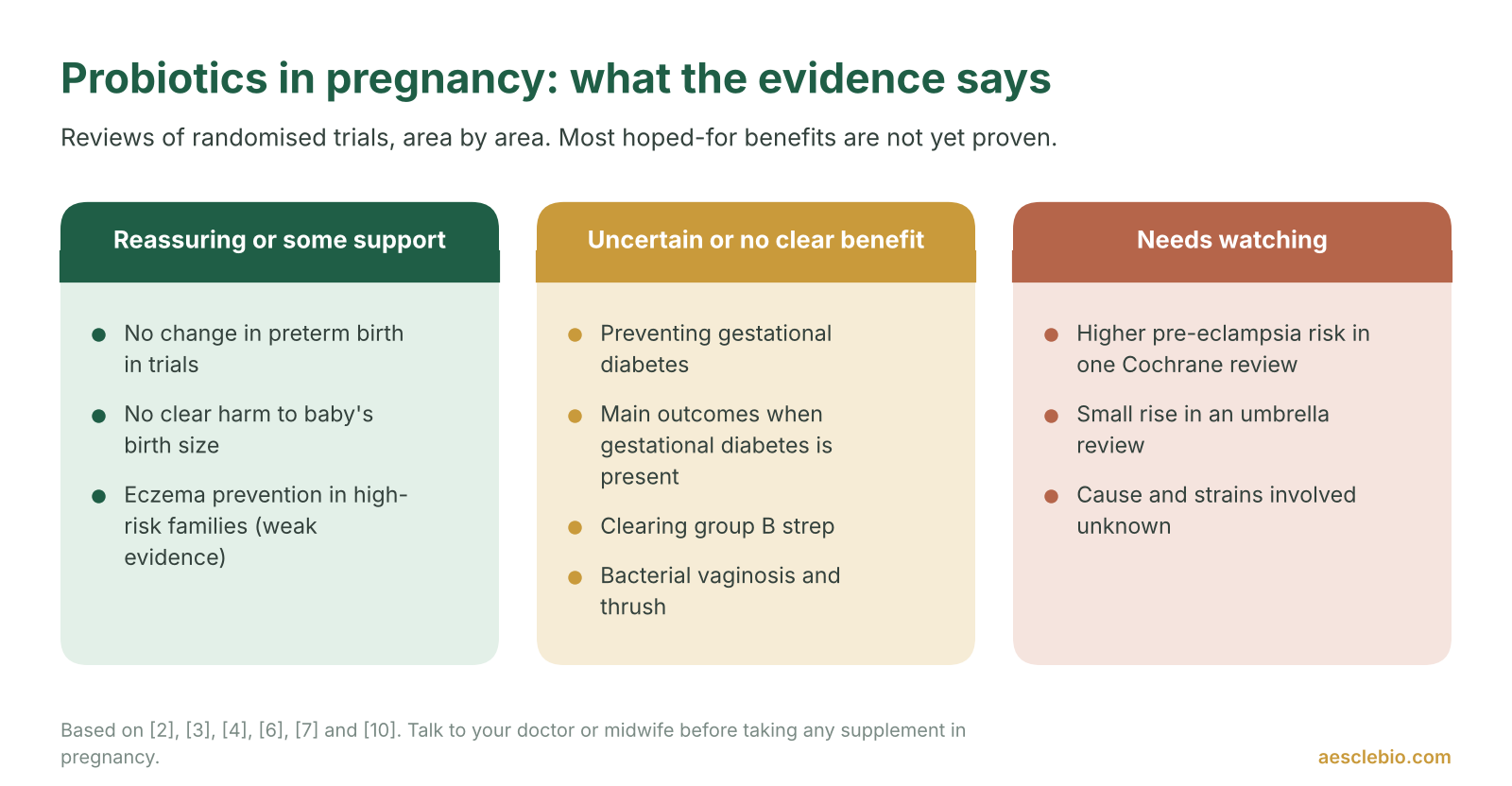
A 2018 safety review pooled 21 randomised controlled trials (studies where women are put into groups by chance) with 4,098 pregnant women, almost all of them testing probiotics. In the 11 trials (2,484 women) that reported it, taking probiotics during pregnancy neither increased nor decreased the risk of preterm birth (birth before 37 weeks), and there were no clear differences in other outcomes such as the baby being unusually small or large at birth, or early breaking of the waters [2]. Trials of probiotics for women who already have gestational diabetes also reported no adverse events [4].
Two important cautions come with this good news. First, the trials used carefully made study products. The same review warned that shop-bought probiotics do not always contain what the label says, so its findings "might not apply outside the context of randomized research" [2]. Second, safety in healthy women is not the same as safety for every woman. The US National Institutes of Health notes that the risk of harmful effects from probiotics is greater in people with severe illness or a weakened immune system [14]. If you have any serious health condition, for example a weakened immune system, a heart-valve problem or a central line (a long-term drip tube), ask your doctor before taking any probiotic.
What research has tested, and what it found
Here is the overall picture before we look at the main areas one by one.
Probiotics for gestational diabetes
Gestational diabetes is high blood sugar that first appears in pregnancy. It affects roughly 15% of pregnant women worldwide, depending on the country, ethnic background and how it is tested [5]. Because gut bacteria influence how the body handles sugar [3], probiotics for gestational diabetes became one of the most studied ideas.
The results are disappointing so far. A 2021 Cochrane review included seven placebo-controlled trials (1,647 women). In the six trials that measured gestational diabetes (1,440 women), the authors concluded that "it is uncertain if probiotics have any effect on the risk"; the evidence was low certainty [3]. For women who already have it, a 2020 Cochrane review of nine small trials (695 women) found small improvements in some blood markers of insulin resistance (how well the body responds to insulin), but no clear difference in the outcomes that matter most, such as high blood pressure in pregnancy, caesarean birth or the baby being born large [4]. Some broader reviews that combine earlier meta-analyses do report a lower risk of gestational diabetes [6], so the question is not closed. But it is fair to say probiotics are not a proven way to prevent or manage gestational diabetes.
The pre-eclampsia question
Pre-eclampsia is a serious condition of pregnancy with high blood pressure and signs of strain on organs such as the kidneys. In the same 2021 Cochrane review, four trials (955 women) reported pre-eclampsia, and women given probiotics had a higher risk of pre-eclampsia than women given a placebo, a dummy capsule: about 1.85 times the risk (risk ratio 1.85; the plausible range ran from 1.04 to 3.29 times). The authors rated this evidence as high certainty and wrote that they "urge caution in using probiotics during pregnancy" [3]. Four of the seven trials in that review enrolled only women who were overweight or obese [3].
An umbrella review (a review of reviews) that pooled 27 earlier meta-analyses also found a small rise in pre-eclampsia risk with probiotics, while reporting a lower risk of gestational diabetes [6]. Researchers do not yet know why this might happen or whether it applies to every strain. It is a good reason not to treat a probiotic as a harmless extra in pregnancy, and to let your doctor or midwife weigh it up, especially if you have high blood pressure or other risk factors.
Probiotics and group B strep in pregnancy
Group B streptococcus (group B strep, or GBS) is a common bacterium that lives harmlessly in the gut and vagina of many women. Carrying it is called colonisation. Rarely, it passes to the baby during birth and causes serious infection [12]. Some countries, such as Canada, therefore screen all pregnant women for it and offer antibiotics during labour to those who carry it [12]. In one Austrian trial, about 1 in 5 women screened carried group B strep [9]. Could probiotics clear it and spare women the antibiotics?
The evidence on probiotics and group B strep in pregnancy is mixed. A 2026 meta-analysis of 18 studies (3,705 women) found slightly higher odds of clearing group B strep with probiotics overall, but the effect was no longer statistically clear when only randomised trials, or only placebo-controlled randomised trials, were counted [7]. An earlier review pooled six small clinical studies (709 women) and found a benefit too, but judged only one of those studies to be at low risk of bias [8]. A small double-blind trial in Austria that gave four Lactobacillus strains for two weeks found no significant difference: among the 60 women analysed, about 64% of those given probiotics were still positive, against 78% of those given placebo [9]. The same 2026 review found no clear benefit for bacterial vaginosis or thrush (vaginal yeast infection) either [7]. Probiotics are not a substitute for group B strep testing or the antibiotics your maternity team recommends.
Allergy and eczema in the baby
This is the area with the most practical guidance. A panel convened by the World Allergy Organization (WAO) reviewed randomised trials and found that probiotics did not lower the overall risk of allergy in children, but that there was a "likely net benefit" mainly from preventing eczema (itchy, inflamed skin) [10]. The panel suggested probiotics for pregnant women at high risk of having an allergic child, for breastfeeding mothers of babies at high risk, and for high-risk babies themselves. "High risk" usually means a parent or brother or sister has an allergic disease [10]. Every recommendation was conditional and based on very low quality evidence [10]. It dates from 2015, so this is a conversation to have with your doctor, not a reason for every pregnant woman to take one.
| Research question | What the best reviews found | Strength of evidence |
|---|---|---|
| Is it safe for healthy pregnant women? | No rise or fall in preterm birth or other main outcomes examined in trials [2] | Reassuring, from trials |
| Does it prevent gestational diabetes? | Effect uncertain [3]; some broader reviews more positive [6] | Low certainty |
| Does it help women who have gestational diabetes? | Small changes in blood markers; no clear effect on main outcomes [4] | Low certainty |
| Pre-eclampsia | Higher risk with probiotics in one Cochrane review [3]; small rise in an umbrella review [6] | High certainty in one Cochrane review; cause unknown |
| Does it clear group B strep? | Possible small effect, not clear in the best-controlled trials [7, 9] | Mixed |
| Eczema in high-risk babies | Guideline suggests use, mainly to prevent eczema [10] | Conditional, very low |
How much research looks at pregnancy? Less than you might think
Our own research shows how thin this evidence base is. In Aesclebio's analysis of 3,070 probiotic-type clinical trials registered on ClinicalTrials.gov (the public trial registry run by the US National Library of Medicine), trials in women only made up 13%, covering vaginal health, pregnancy and menopause together. Trials focused on maternal health (pregnancy and breastfeeding) numbered just 108, about 3.5%, and their share dipped from 4.8% of new trials in 2016–2020 to 3.1% in 2021–2025, a change the report classes as broadly stable rather than a clear trend [11].
In a second Aesclebio analysis of ClinicalTrials.gov records (2,057 trials), only 62 trials (3%) enrolled pregnant or breastfeeding women, and 35 of them used the strongest design: randomised, placebo-controlled and double-blind, meaning neither volunteers nor researchers know who gets what [13]. The figure groups those trials roughly by their main focus. The grouping is our own approximate judgement from trial titles and listed conditions, so treat the counts as a guide rather than exact figures.
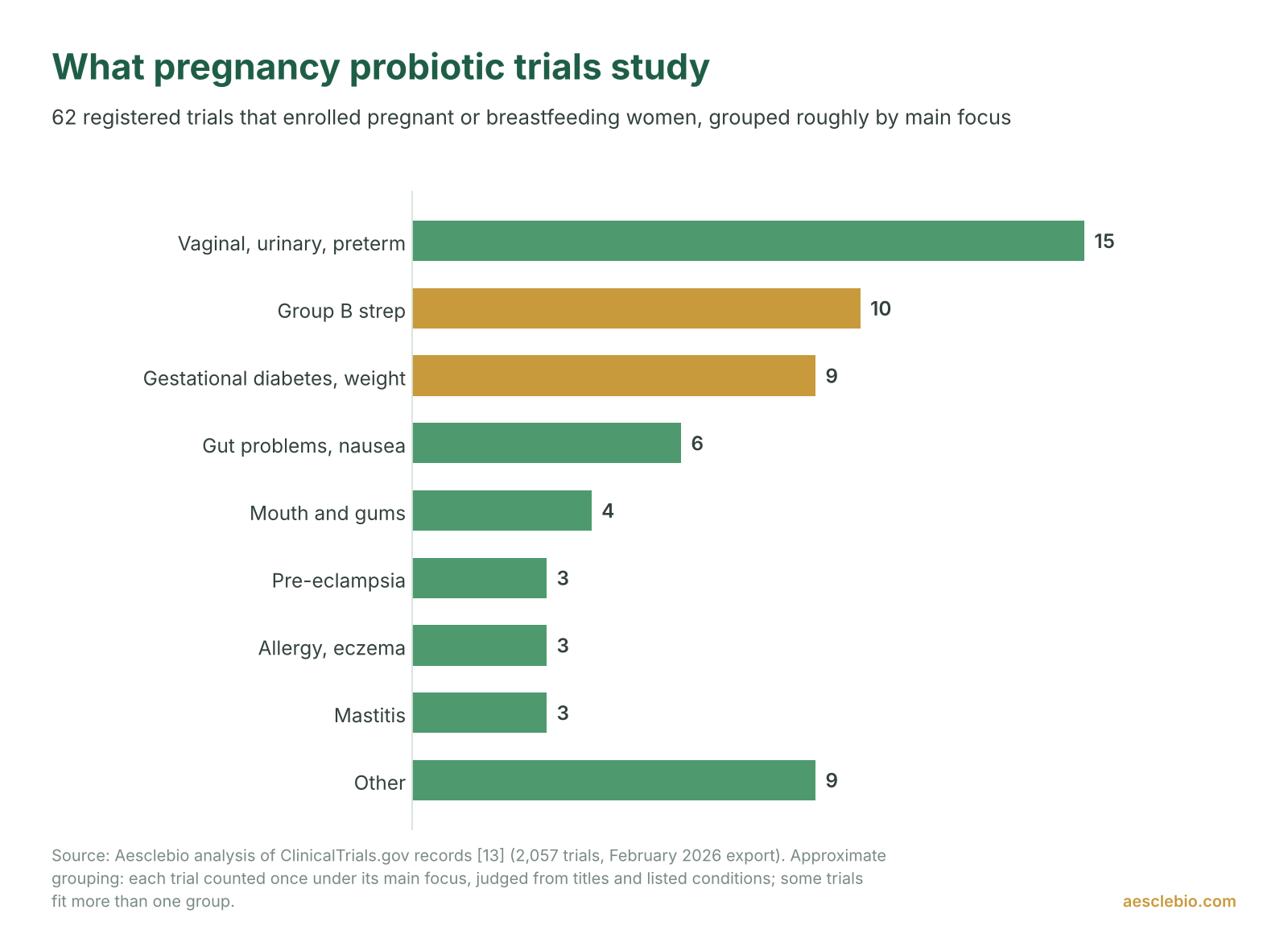
Most research targets specific problems in specific groups of women. Very little tests the everyday promise of many maternity probiotic products: general gut health during pregnancy for healthy women.
Myth or fact?
| Myth | What the evidence says |
|---|---|
| Every pregnant woman should take a prenatal probiotic. | No guideline recommends routine probiotics for all pregnant women. The main suggestion is a conditional one for families at high risk of allergy [10]. |
| Probiotics are natural, so they cannot do any harm in pregnancy. | Trials look reassuring for preterm birth and other outcomes [2], but one Cochrane review found a higher pre-eclampsia risk and urged caution [3]. |
| Probiotics prevent gestational diabetes. | A Cochrane review found the effect uncertain, based on low-certainty evidence [3]. |
| A probiotic can replace group B strep antibiotics. | Results are mixed and not statistically clear in the randomised, placebo-controlled trials [7]. Follow your maternity team's testing and treatment advice. |
| Any probiotic will do; they all work the same. | Many benefits are linked to specific strains, and pregnancy trials tested many different species and mixes [1, 2]. |
Maternity probiotics on the market: what are you buying?
Products sold as maternity probiotics or probiotic supplements for pregnancy are often blends of Lactobacillus and Bifidobacterium species, sometimes with strains chosen for vaginal health, and sometimes combined with folic acid, iron or other nutrients in a "prenatal with probiotic" format. The word "prenatal" or "maternity" on the pack is a marketing label. It does not mean the exact strains inside were tested in pregnant women, or tested for the benefit the pack hints at.
Combination products deserve extra care: swapping the prenatal vitamin your doctor recommended, or doubling up on nutrients from several products, is something to check first.
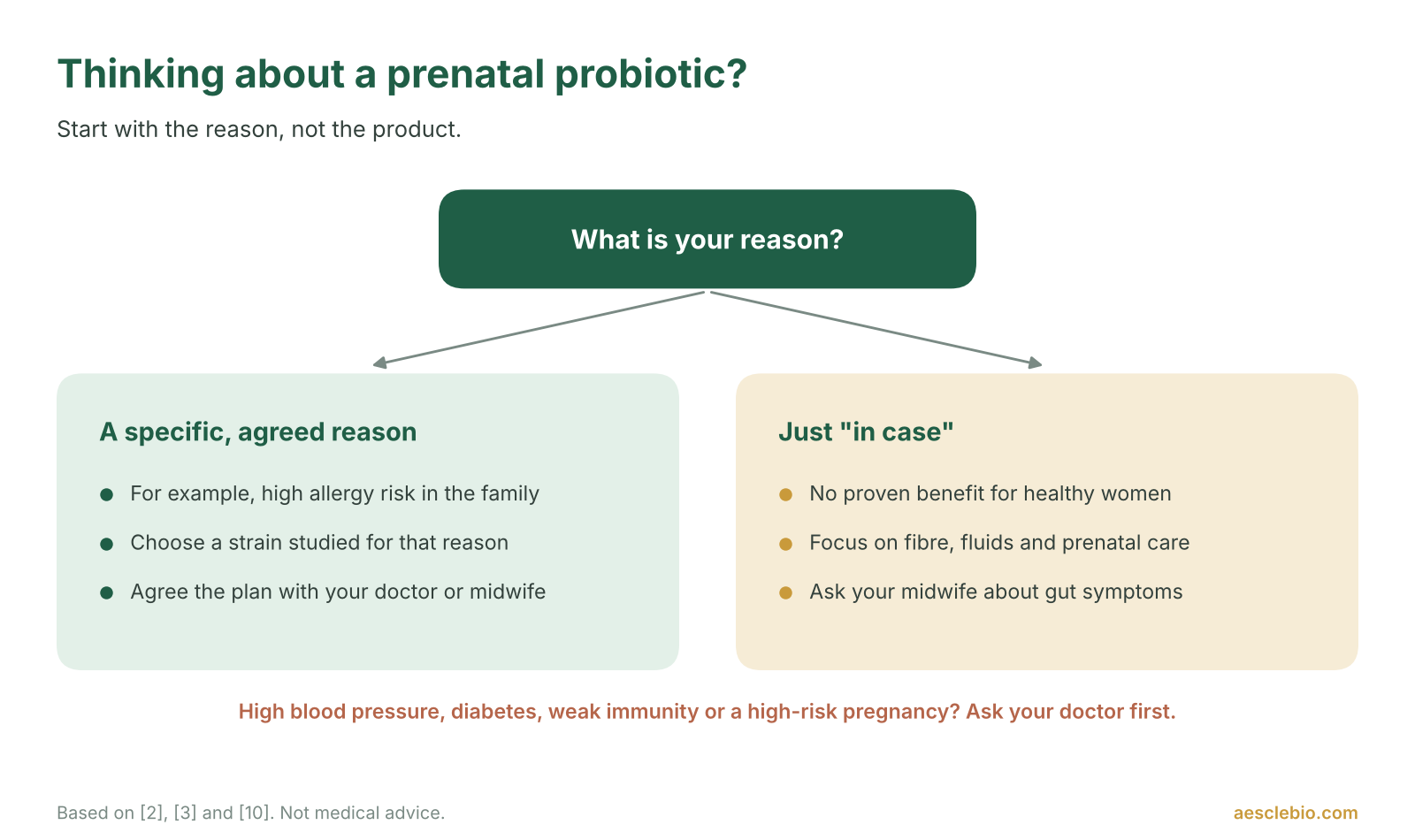
How to choose: a checklist before you buy
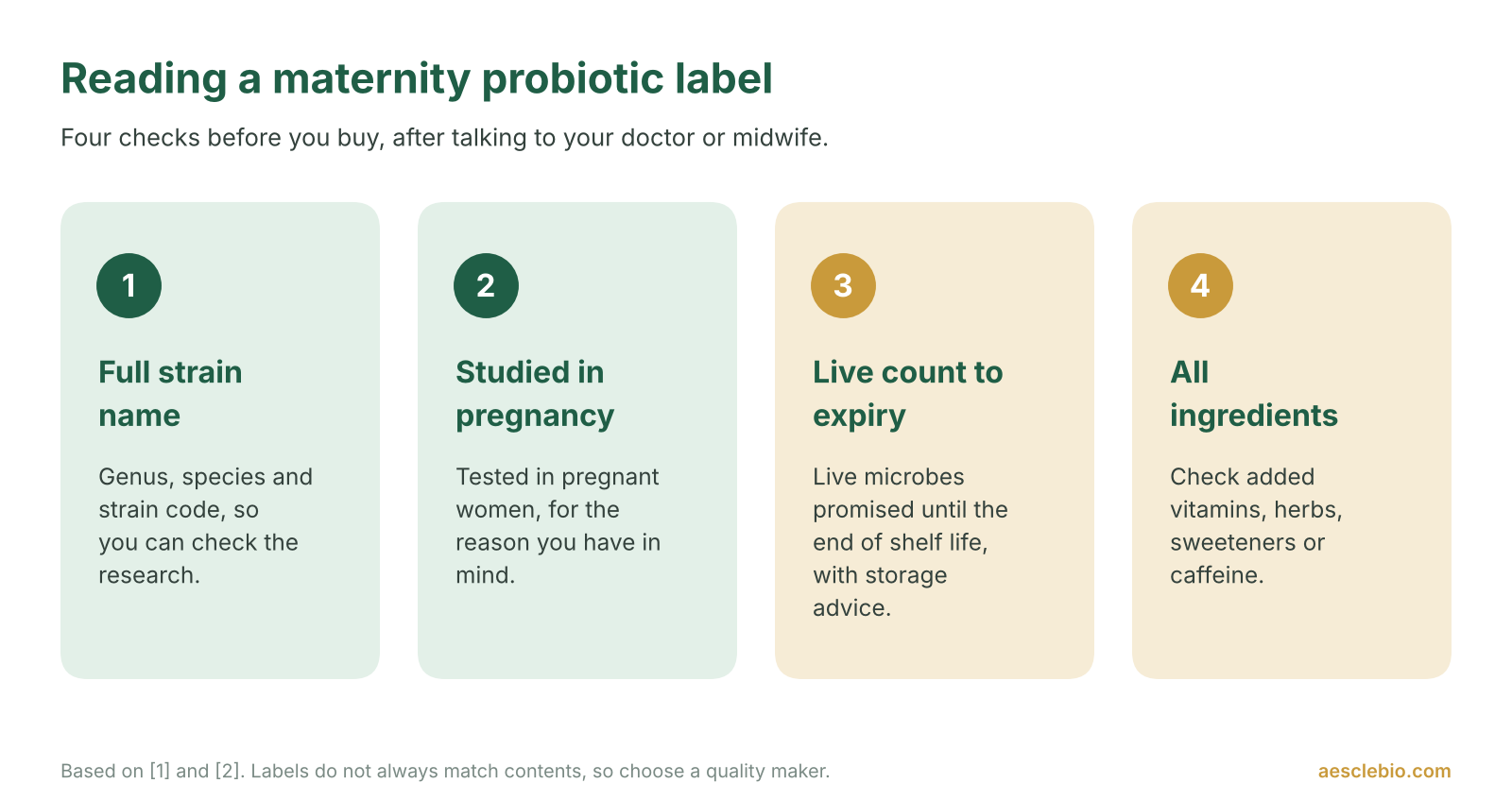
If you and your doctor or midwife decide a probiotic is worth trying, these questions separate a thoughtful product from a hopeful one.
- Talk to your doctor or midwife first. Tell them about every supplement you take, especially if you have high blood pressure, diabetes, a weakened immune system or a high-risk pregnancy.
- Ask "for what?" Name the reason. "General wellness" is not a reason with evidence behind it in pregnancy.
- Look for the full strain name: genus, species and the strain code after it. Without it, you cannot check the research [1].
- Check that the strain was studied in pregnancy, for the reason you have in mind. A strain tested for adult gut comfort is not automatically tested in pregnancy.
- Check the live count until the end of shelf life, not just "at manufacture", and follow the storage instructions.
- Read the full ingredient list: added vitamins, herbs, sweeteners or caffeine in combination products.
- Choose a maker that follows good manufacturing practice (GMP), the quality rules for making foods and supplements safely and consistently, because label accuracy is a known problem [2].
The bottom line
Probiotics in pregnancy look safe in research trials for preterm birth and other key outcomes. But the popular reasons for taking them, preventing gestational diabetes, clearing group B strep or boosting a pregnant gut, are not proven, and a pre-eclampsia warning from a Cochrane review means probiotics should not be treated as a harmless extra. The strongest case is narrow: allergy prevention in high-risk families, and even that rests on weak evidence. A pregnancy probiotic should be a specific, studied strain, chosen for a specific reason, with your doctor or midwife on board.
Frequently asked questions
Can I take probiotics while pregnant?
Many women can, but decide with your doctor or midwife first. Reviews of randomised trials found no rise or fall in preterm birth or other harmful pregnancy outcomes with probiotics [2]. However, one Cochrane review found a higher risk of pre-eclampsia in probiotic groups and urged caution [3]. Your doctor can weigh this against your own health and reasons.
What are pregnancy safe probiotics?
No probiotic carries an official "pregnancy safe" label that guarantees safety for every woman. Trials have mostly used Lactobacillus and Bifidobacterium strains without a clear effect on preterm birth [2], though one Cochrane review linked probiotics with a higher risk of pre-eclampsia [3]. Each product is different and label accuracy varies [2]. Choose a named, studied strain from a quality maker, and only with your doctor or midwife's agreement.
What is the best probiotic for pregnant women?
There is no single best probiotic for pregnant women, because the right choice depends on the reason. For allergy prevention in high-risk families, a guideline suggests probiotics on very low quality evidence [10]. For gestational diabetes or group B strep, benefits are uncertain [3, 7]. A probiotic studied for your specific reason, approved by your doctor, is the best choice.
Do probiotics help with gestational diabetes?
Not clearly. A Cochrane review found it uncertain whether probiotics change the risk of developing gestational diabetes, based on six trials that measured it [3]. For women who already have it, trials showed small changes in blood markers of insulin resistance, but no clear effect on outcomes such as caesarean birth or baby size [4]. Diet, with or without medicine, under medical care remains the standard treatment [3].
Can probiotics prevent group B strep in pregnancy?
Evidence is mixed. A 2026 review of 18 studies found a possible small increase in clearing group B strep, but it was not statistically clear when only randomised or placebo-controlled trials were counted [7]. A probiotic is not a replacement for group B strep testing or for antibiotics during labour when your maternity team recommends them [12].
Are prenatal vitamins with probiotics a good idea?
They are convenient, but the probiotic part is rarely tested in pregnancy as a combination, and the strains may not be named. Check that the vitamin part still matches what your doctor recommends, such as folic acid, and avoid doubling up on nutrients from several products. Trial results may not apply to shop-bought products [2].
Is a probiotic for a pregnant lady different from a normal probiotic?
Not necessarily. Products labelled "prenatal" or "maternity" often contain the same kinds of Lactobacillus and Bifidobacterium found in general probiotics. What matters is whether the exact strain was studied in pregnant women, for a clear reason [1, 2]. Ask your doctor or midwife before choosing any probiotic for a pregnant lady.
Can pregnant women drink prebiotic soda?
Prebiotic sodas are fizzy drinks with added fibre, the food that gut bacteria feed on. There is little or no research on them in pregnancy specifically. Read the label for sugar, sweeteners, caffeine and herbal extracts, which matter more in pregnancy, and ask your midwife if unsure. Fibre from vegetables, fruit, pulses and whole grains is a well-established choice.
Do probiotics help gut health during pregnancy, such as constipation?
Only a handful of registered trials have looked at constipation or nausea in pregnancy [13], so there is no strong evidence yet. Fibre, fluids and gentle activity are the usual first steps. If symptoms are troublesome, ask your doctor or midwife what is safe for you.
Related reading
- Breastfeeding, Mastitis and the Breast-Milk Microbiome (Aesclebio blog)
- Women's Intimate Health: Vaginal Probiotics (Aesclebio blog)
- Postpartum Gut Health: The First Bowel Movement and Beyond
- Your Probiotic Is a Strain, Not a Species: Reading the Code After the Name
- Probiotics for Babies and Newborns: The Questions Paediatricians Get Asked Most
References
- Hill C, Guarner F, Reid G, et al. Expert consensus document: the International Scientific Association for Probiotics and Prebiotics consensus statement on the scope and appropriate use of the term probiotic. Nature Reviews Gastroenterology & Hepatology. 2014;11:506–514. Open access. Link
- Jarde A, Lewis-Mikhael AM, Moayyedi P, et al. Pregnancy outcomes in women taking probiotics or prebiotics: a systematic review and meta-analysis. BMC Pregnancy and Childbirth. 2018;18(1):14. Free full text: PubMed Central PMC5759212. Link
- Davidson SJ, Barrett HL, Price SA, et al. Probiotics for preventing gestational diabetes. Cochrane Database of Systematic Reviews. 2021;4(4):CD009951. Free full text: PubMed Central PMC8094741. Link
- Okesene-Gafa KAM, Moore AE, Jordan V, et al. Probiotic treatment for women with gestational diabetes to improve maternal and infant health and well-being. Cochrane Database of Systematic Reviews. 2020;6(6):CD012970. Free full text: PubMed Central PMC7386668. Link
- Griffith RJ, Alsweiler J, Moore AE, et al. Interventions to prevent women from developing gestational diabetes mellitus: an overview of Cochrane Reviews. Cochrane Database of Systematic Reviews. 2020;6(6):CD012394. Free full text: PubMed Central PMC7388385. Link
- Gao Q, Sun Y, Qu Y, et al. The effect of probiotic supplementation during pregnancy on pregnancy complications: an umbrella meta-analysis. Medicine (Baltimore). 2025;104(51):e46409. Free full text: PubMed Central PMC12727282. Link
- Liu Z, Huang R, Sun T, et al. Probiotic supplementation during pregnancy for vaginal microbiota improvement and pathogen clearance: a systematic review and meta-analysis. Acta Obstetricia et Gynecologica Scandinavica. 2026;105(6):999–1016. Free full text: PubMed Central PMC13191816. Link
- Hanson L, VandeVusse L, Malloy E, et al. Probiotic interventions to reduce antepartum Group B streptococcus colonization: a systematic review and meta-analysis. Midwifery. 2022;105:103208. Free full text: PubMed Central PMC9574470. Link
- Farr A, Sustr V, Kiss H, et al. Oral probiotics to reduce vaginal group B streptococcal colonization in late pregnancy. Scientific Reports. 2020;10(1):19745. Free full text: PubMed Central PMC7665007. Link
- Fiocchi A, Pawankar R, Cuello-Garcia C, et al. World Allergy Organization-McMaster University Guidelines for Allergic Disease Prevention (GLAD-P): Probiotics. World Allergy Organization Journal. 2015;8(1):4. Free full text: PubMed Central PMC4307749. Link
- Aesclebio Technologies. Probiotic Clinical Trials: Where the Industry Is Heading. A registry-based analysis of ClinicalTrials.gov data to 17 September 2026. Hyderabad: Aesclebio Technologies Pvt. Ltd.; 2026. Link
- Hayes K, Janssen P, Payne BA, et al. Oral Probiotic Supplementation in Pregnancy to Reduce Group B Streptococcus Colonisation (OPSiP trial): study protocol for a double-blind parallel group randomised placebo trial. BMJ Open. 2024;14(2):e076455. Free full text: PubMed Central PMC10860072. Link
- Aesclebio Technologies. Aesclebio analysis of ClinicalTrials.gov records (export February 2026). Hyderabad: Aesclebio Technologies Pvt. Ltd.; 2026. Link
- National Center for Complementary and Integrative Health (US National Institutes of Health). Probiotics: What You Need To Know. Last updated August 2019. Free to read. Link
Disclaimer
This article is for general education only. It is not medical advice and is not intended to diagnose, treat, cure or prevent any disease. It does not promote any specific product or brand, and it makes no claims about any product.
Statements about research describe the findings of published studies. They do not mean that any particular food or supplement will have the same effect for you. Always speak to a qualified healthcare professional before changing your diet or starting a supplement, especially if you are pregnant, breastfeeding, giving products to a baby or child, or living with a health condition.
This topic concerns babies, pregnancy or new mothers. Nothing here is a recommendation to give any product to a baby or to use any product during pregnancy or breastfeeding. Decisions about care should always be made with a doctor, midwife or other qualified healthcare professional.
Rules on how probiotics and supplements may be described differ from country to country. Nothing in this article should be read as a health claim for any product.
All graphics are original works of Aesclebio Technologies. Figures from other studies are credited to their sources. Quotations are limited to short passages with full attribution. Any clinical-trial figures from Aesclebio's own analysis come from public registry records and do not imply that any product is effective or safe.
Prepared by the Aesclebio Research Team with the help of AI tools, under the team's direction. © 2026 Aesclebio Technologies Pvt. Ltd. All rights reserved. Short extracts may be quoted with a link to the original article.