Gut Health
Teen Gut, Teen Skin: Do Probiotics Help Adolescent Acne and Wellbeing?
What the gut–skin connection really is, what acne trials of probiotic capsules and creams show, and why almost nobody has tested probiotics in teenagers.
Why so many families search for probiotics for teens
Adolescence, which the World Health Organization (WHO) defines as the years from 10 to 19 [2], brings fast changes in the body, in food habits and in skin. Acne is part of that story for most young people: about 85% of people aged 12 to 25 are affected at some point [3]. So it is no surprise that parents and teenagers search for "probiotics for teenagers", "probiotics for acne", the best probiotics for teens, or the best probiotic for teen girls or teen boys. Social media adds talk of a "gut–skin connection" that will fix acne from the inside.
This article makes one clear argument. The gut–skin link is real science, but the products sold on the back of it are far ahead of the evidence, and teenagers are the group science has studied least. Here is what is known, what is not, and what a sensible family can do.
First, what is a probiotic?
An international panel of scientists defines probiotics as "live microorganisms that, when administered in adequate amounts, confer a health benefit on the host" [1]. In plain words: living microbes that do you some good when you take enough of them. A microbe is a living thing too small to see, such as a bacterium or a yeast. Many benefits are tied to particular strains (one exact type within a species), so a result from one product cannot simply be applied to another [1].
The gut–skin connection for acne, explained simply
Acne starts in the tiny pores that hold a hair and an oil gland. Three things combine: too much sebum (the skin's natural oil), dead skin cells that block the pore, and inflammation (redness and swelling caused by the body's defence system), helped along by a skin bacterium called Cutibacterium acnes [3, 6]. Changes in hormone levels, such as at puberty and around periods, are a well-known trigger [8], which helps explain why acne is so common in the teenage years [3].
Where does the gut come in? The trillions of microbes in the gut, called the gut microbiome, help train the immune system. When they break down fibre from food, they make short-chain fatty acids, small compounds that calm inflammation, and these effects can reach well beyond the gut, including the skin [3]. Scientists also think that stress and mood may link the gut, the brain and the skin in a three-way loop, the so-called gut–brain–skin axis, though this is still a theory [3]. A few small studies have found that people with acne tend to have a less varied mix of gut bacteria than people without it [6].
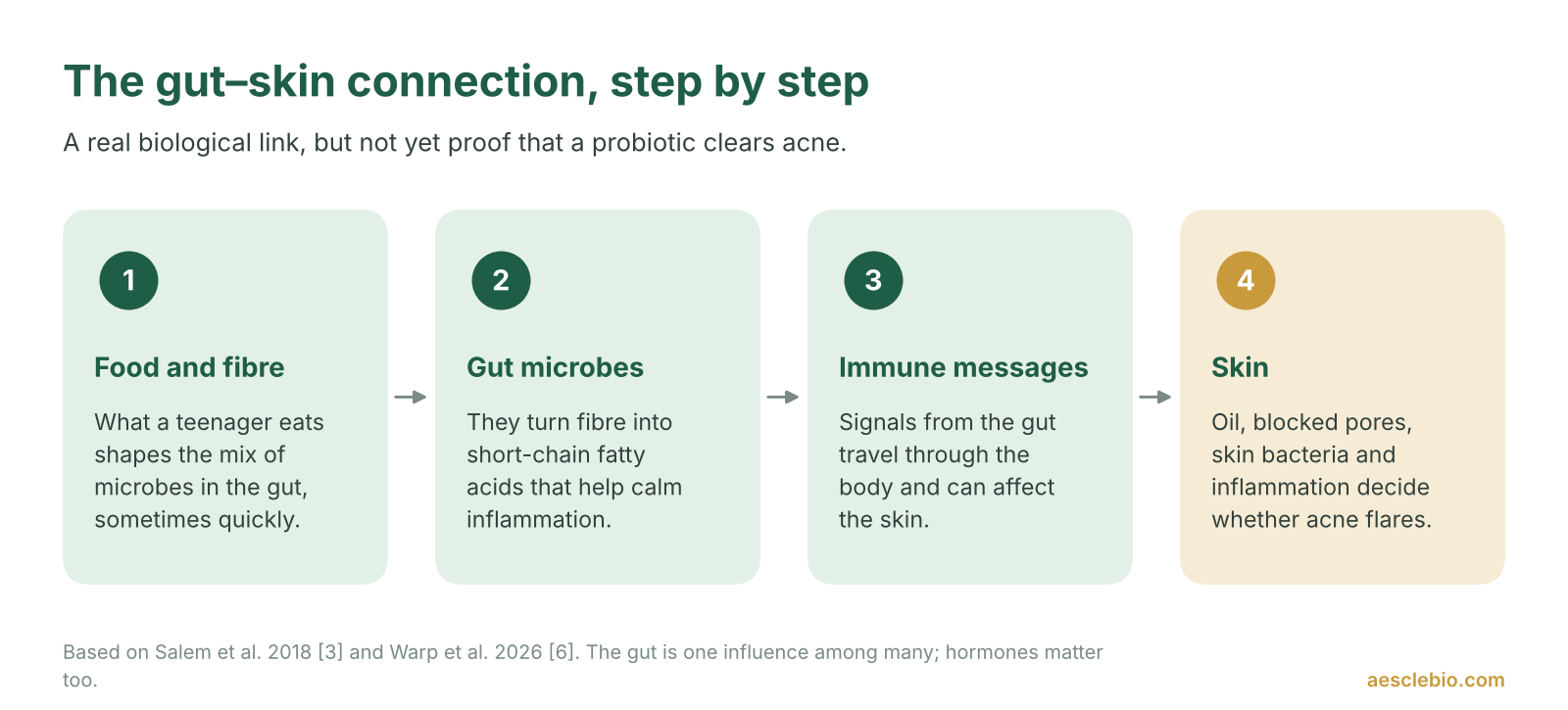
Notice the words "may" and "think". A gut–skin link does not prove that swallowing a probiotic clears spots. That has to be tested in trials.
Do probiotics help with acne? What the trials show
Researchers combine many trials in a meta-analysis, a study that pools the results of several trials to get a clearer answer. In 2025 and 2026, three reviews of the evidence (two of them meta-analyses) were published free to read, and they do not agree:
- A modest benefit for oral probiotics. A meta-analysis of three double-blind, randomised controlled trials (studies in which people are placed in groups by chance and neither they nor the researchers know who gets the real product), with 231 people in total, found a modest drop in inflamed spots with probiotics taken by mouth. But the authors rated their confidence as only low to moderate, and said future studies could plausibly find no meaningful effect [4].
- *No clear benefit for Lactobacillus products. A second meta-analysis of five randomised trials (332 people) tested oral or topical products based on Lactobacillus*, a common family of probiotic bacteria. It found no significant drop in spot counts compared with a placebo (a dummy product) or with a standard acne cream [5].
- Encouraging, but mostly as an add-on. A wider review of 33 studies (2,112 people) found that spots fell in people using probiotics, but also fell in the comparison groups, because most studies added the probiotic on top of normal acne treatment. The difference between the groups was not statistically significant [6].
Side effects were usually mild, such as occasional bloating, with no serious problems reported, but the studies were short [4, 6]. Products also differed widely in strains, amounts and length of use, so no single proven product can be named [4]. As Tjiu and Lu point out, the 2024 acne guideline of the American Academy of Dermatology (AAD), a US doctors' body, found too little evidence to recommend probiotics as a main acne treatment [4].
| Question | What the evidence says | Strength |
|---|---|---|
| Is the gut–skin link real? | Yes, gut microbes influence immunity and inflammation, which can affect skin | Good for the idea; mechanisms still being worked out [3] |
| Do probiotic capsules reduce acne spots? | A modest drop in inflamed spots in one analysis; no clear drop in others | Low to moderate, mixed [4, 5] |
| Do probiotic creams help acne? | Small, short studies show some promise | Weak; many studies were small or not blinded [6] |
| Have these been tested in teenagers? | Hardly at all; trial volunteers averaged about 25 years old | Very little evidence [6, 10] |
The best probiotic for hormonal acne? Handle that search with care
"Hormonal acne" is a popular search term, often used by teenage girls whose spots flare around their period. Hormone changes during puberty and periods really can trigger acne [8]. But acne can sometimes be a sign of an underlying hormone condition, such as polycystic ovary syndrome (PCOS), a common hormone condition that can affect periods, skin and hair [4]; the NHS now calls it polyendocrine metabolic ovarian syndrome (PMOS) [8]. So spots that are severe or sudden, or that come with irregular periods or extra hair growth, need a doctor to check, not a supplement.
No trial has shown that any probiotic is the best probiotic for hormonal acne, and no probiotic changes hormone levels in a way that has been proven to treat acne. Doctors do have proven options, including treatments that work on hormones, which they choose for each person [4]. For period-related spots, the most useful step is a visit to a doctor or dermatologist, together with a parent.
Teen diet, the gut and the skin
WHO notes that eating habits formed in adolescence can protect health or put it at risk for years [2]. For acne, the best-studied food link is glycaemic load, a measure of how much a food raises blood sugar. Several studies found that people with acne who ate a diet with a low glycaemic load (fewer sugary drinks, sweets and refined white-flour foods) had fewer spots than those on a high glycaemic load diet [7]. Some studies have also linked milk, especially whey protein, with acne, although the evidence is less certain [7].
Fibre is where diet and the gut meet. Gut microbes turn fibre into the calming short-chain fatty acids described above, and big changes in diet can alter the mix of gut bacteria quickly [3]. So a fibre-rich everyday diet with fewer high-sugar foods supports the gut, may help the skin, and costs far less than any supplement. It does not replace acne treatment.
Probiotic cream and topical probiotic spray: cosmetic or medicine?
Searches for "probiotic cream" and "topical probiotic spray" are popular. Topical means applied to the skin rather than swallowed. Not every "probiotic" skin product contains live microbes. In studies, some products contained postbiotics, which are inactivated (no longer living) microbes or the substances they make, and some contain bacteria grown in a fermented ingredient [6].
The legal line between a cosmetic and a medicine depends on what the product is meant to do, not on what is in it. The United States Food and Drug Administration (FDA), for example, explains that a cosmetic is meant for cleansing or beautifying, while a product meant to treat or prevent a disease is a drug, and cleansers intended to treat acne may be regulated as drugs, or as both a drug and a cosmetic [9]. So a probiotic cream sold as a cosmetic can say it cares for or balances the skin; it should not claim to treat acne.
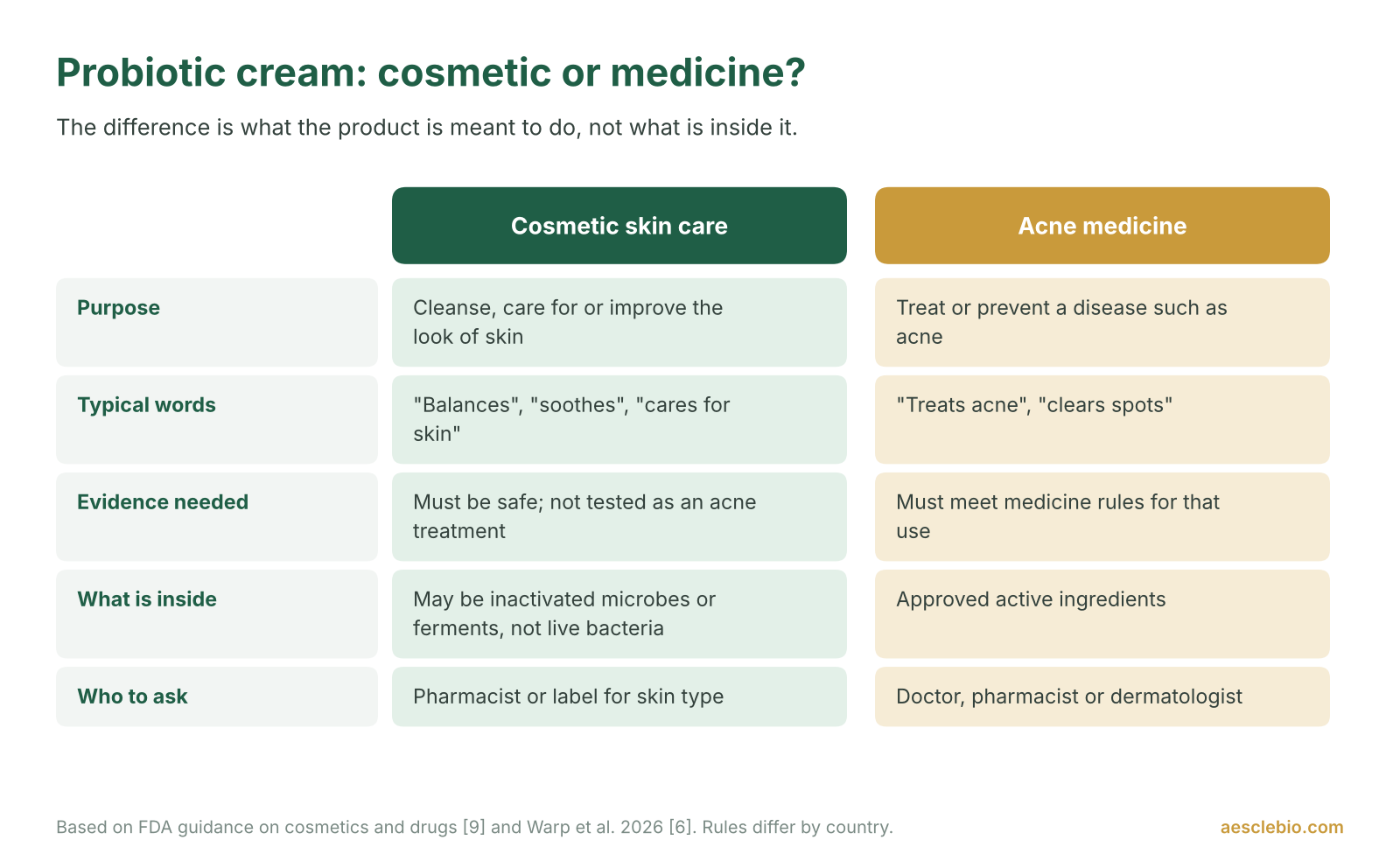
What do studies of these topical products show? In the 33-study review, 11 studies tested probiotics on the skin, and some small split-face studies (one side of the face treated, the other not) found less redness with a probiotic cream than with a plain base cream [6]. But most topical studies were short, small and often not blinded, so the results may look better than they really are [6].
Digestion and mood: what about probiotics for teenagers' wellbeing?
Teenagers also look for probiotics for a bloated stomach, low mood or stress. Mental health is a fast-growing area of probiotic research, with 282 registered trials in Aesclebio's analysis [10], but most of them involve adults [10]. Stomach pain, constipation or low mood that keeps coming back deserves a doctor's check, not a supplement alone. Acne itself can cause anxiety and low self-esteem [8], so talking to a parent, doctor or school counsellor matters more than any capsule.
Why teen-specific probiotics are a white space
Our own research shows how little has been done for this age group. In Aesclebio's analysis of 3,070 probiotic-type clinical trials registered on ClinicalTrials.gov, the public trial registry run by the US National Library of Medicine, adults were the main group in 73% of trials and children in only 10% [10]. Skin health accounted for 106 trials across all ages [10].
When we looked more closely at a set of 2,057 trial records, only 14 enrolled teenagers alone (ages 10 to 19). Six of them studied teeth and gums, three studied weight and blood sugar, and none studied acne, skin or mood [10]. Of the 11 acne trials in the set, six allowed some volunteers under 18, but all of them mixed teenagers with adults up to age 35 or 45 [10].
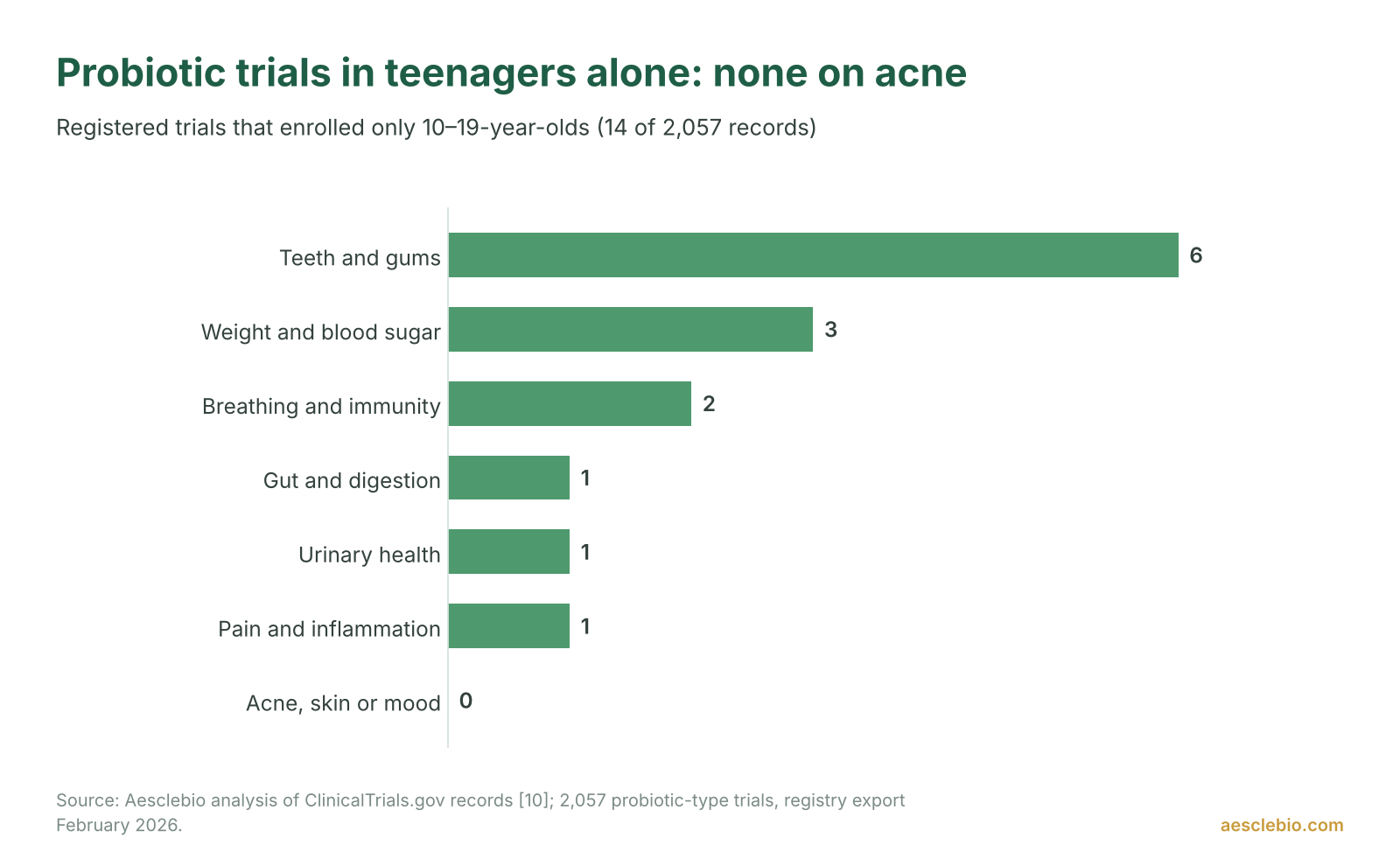
So a "teen probiotic" is, in practice, a product whose strains were tested mainly in adults, if at all. That is a genuine gap: an opportunity for companies willing to run proper trials in adolescents, and a reason for families to read teen marketing with care.
Myth or fact?
| Myth | What the evidence says |
|---|---|
| Acne is caused by a "dirty" gut, so a probiotic will clear it. | Acne comes from oil, blocked pores, bacteria on the skin, inflammation and hormones. The gut may play a part, but trials of probiotics give mixed results [3, 4, 5]. |
| A probiotic can replace acne medicine. | There is not enough evidence. In most studies, probiotics were added on top of standard acne treatment, not used instead of it [6]. |
| Teen probiotics are made and tested for teenagers. | Hardly any probiotic trials have enrolled teenagers alone, and none of those we found studied acne or skin [10]. |
| Food has nothing to do with acne. | Studies link high-sugar, high glycaemic load diets with more acne, and lower glycaemic load diets with fewer spots [7]. |
What to do: a practical guide for teens and parents
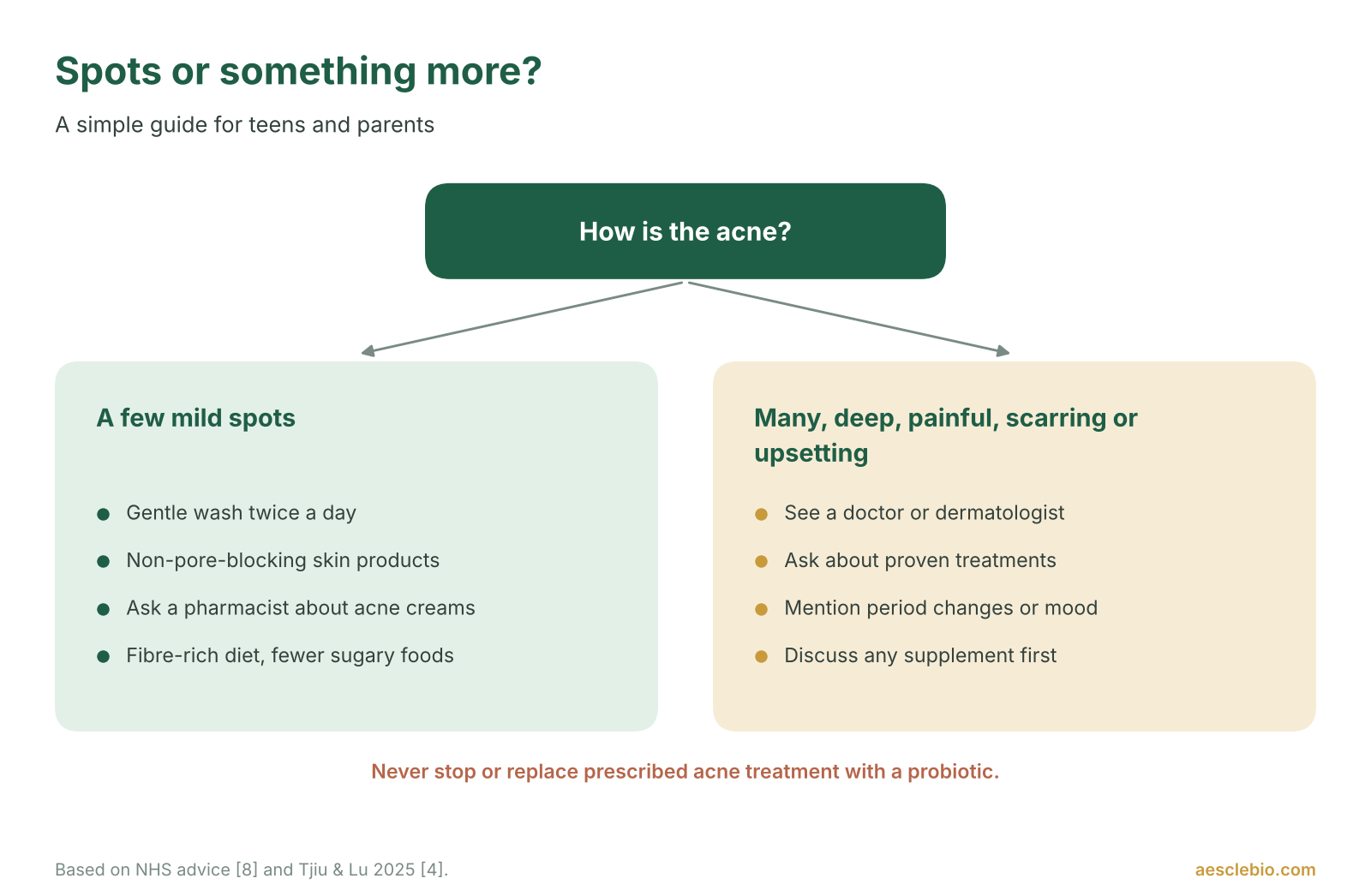
- Start with the basics. Wash gently twice a day with a mild cleanser, remove make-up at the end of the day, choose products labelled "non-comedogenic" (not pore-blocking), and avoid picking or squeezing spots [8].
- Ask a pharmacist about over-the-counter acne creams for mild spots [8].
- See a doctor if self-care is not working, if spots are deep, painful or scarring, or if acne is affecting mood [8].
- Never stop or swap prescribed treatment for a probiotic. If you want to try one alongside treatment, ask the doctor first.
- If considering probiotic supplements for teens, decide together with a parent and a doctor. Look for a product that names the full strain, states the live count until the end of shelf life, and is made under good manufacturing practice (GMP), the quality rules for making foods and supplements safely. Follow the doctor's advice and the label on how much to take.
The bottom line
The gut–skin connection is real science, and it is a good reason to research probiotics for acne. But today's trials are small, short and mixed, and they were done mostly in young adults. No probiotic is proven to clear teenage acne, and teen-specific products are largely untested. For most teenagers, the steps that matter are a sensible daily skin routine, a fibre-rich diet with fewer sugary foods, and early help from a doctor or dermatologist when spots are painful, persistent or upsetting. Probiotics may one day have a supporting role; for now, they are an add-on to discuss with a doctor, not a cure.
Frequently asked questions
What is the best probiotic for teens?
There is no single best probiotic for teens, because almost no probiotic trials have been done in teenagers alone, and none of those we found studied acne or skin [10]. If a family wants to try one, choose a product with a named strain, a stated live count and good manufacturing standards, and discuss it with a doctor first. For acne, proven treatments from a doctor or pharmacist come first [8].
Do probiotics help with acne?
Possibly, a little, but the evidence is mixed. One meta-analysis of three high-quality trials found a modest drop in inflamed spots with oral probiotics, with low to moderate confidence [4]. Another, of five trials of Lactobacillus products, found no significant benefit [5]. Most studies used probiotics alongside standard acne treatment, not instead of it [6].
What is the best probiotic for hormonal acne?
No probiotic has been proven to treat hormonal acne. Hormone changes at puberty and around periods can trigger spots [8], but acne can sometimes signal a hormone condition such as polycystic ovary syndrome [4], so severe or sudden acne, especially with irregular periods, needs a doctor's check. Doctors have proven hormonal and non-hormonal treatments.
Is a probiotic cream good for acne?
Small studies of probiotic creams and lotions, including some split-face studies, have shown less redness, but most were short and not blinded, so the evidence is weak [6]. Some creams contain inactivated microbes rather than live ones. A cream sold as a cosmetic is not tested or approved as an acne medicine [9].
Are probiotics safe for teenagers?
In acne trials, side effects were usually mild, such as occasional bloating, and no serious problems were reported, but the studies were short [4, 6]. Teenagers with a long-term illness, a weakened immune system or who take regular medicines should ask a doctor before taking any supplement. A doctor or pharmacist can also advise on how much to take.
Is there a difference between probiotics for teen girls and teen boys?
Products marketed as probiotics for teen girls or probiotics for teen boys are not backed by sex-specific trials in teenagers. Girls may notice acne flaring with periods, and both sexes get acne at puberty [8]. The same rules apply to both: named strain, stated live count, quality manufacturing, and a doctor's advice for acne.
Can probiotics improve a teenager's mood or digestion?
Mental health is a fast-growing area of probiotic research, but most trials involve adults, and none of the teen-only trials we found studied mood [10]. Stomach problems or low mood that keep coming back should be checked by a doctor. Talking to a parent or school counsellor also matters.
Related reading
- What Probiotics Are, and the Five Myths That Survive Every Explainer
- Kids, Toddlers and Probiotics: Dose, Format and the Sugar Problem
- Your Probiotic Is a Strain, Not a Species: Reading the Code After the Name
- Prebiotics, Probiotics, Postbiotics, Synbiotics: A Field Guide Beyond the Buzzwords
- Dietary Supplement or Food Supplement? (Aesclebio blog)
References
- Hill C, Guarner F, Reid G, et al. Expert consensus document: the International Scientific Association for Probiotics and Prebiotics consensus statement on the scope and appropriate use of the term probiotic. Nature Reviews Gastroenterology & Hepatology. 2014;11:506–514. Open access. Link
- World Health Organization. Adolescent health (health topic). Geneva: WHO. Link
- Salem I, Ramser A, Isham N, Ghannoum MA. The gut microbiome as a major regulator of the gut-skin axis. Frontiers in Microbiology. 2018;9:1459. Free full text: PubMed Central PMC6048199. Link
- Tjiu JW, Lu CF. Oral probiotics in acne vulgaris: a systematic review and meta-analysis of double-blind randomized clinical trials. Medicina (Kaunas). 2025;61(12):2152. Free full text: PubMed Central PMC12734792. Link
- Abedin ZU, Shah A, Mazhar S, et al. Lactobacillus-based microbiome therapy for acne vulgaris: a GRADE systematic review and meta-analysis of randomized controlled trials. Journal of Cosmetic Dermatology. 2026;25(3):e70792. Free full text: PubMed Central PMC13000680. Link
- Warp PV, Bilik SM, Ferrari LM, Keri JE. Prebiotics, probiotics, and postbiotics for acne vulgaris: a systematic review. Dermatology and Therapy. 2026;16(3):1531–1550. Free full text: PubMed Central PMC13013907. Link
- Baldwin H, Tan J. Effects of diet on acne and its response to treatment. American Journal of Clinical Dermatology. 2021;22(1):55–65. Free full text: PubMed Central PMC7847434. Link
- National Health Service (NHS). Acne. NHS website (nhs.uk). Link
- US Food and Drug Administration. Is it a cosmetic, a drug, or both? (Or is it soap?). FDA website. Link
- Aesclebio Technologies. Probiotic Clinical Trials: Where the Industry Is Heading. A registry-based analysis of ClinicalTrials.gov data to 17 September 2026. Hyderabad: Aesclebio Technologies Pvt. Ltd.; 2026. Link
Disclaimer
This article is for general education only. It is not medical advice and is not intended to diagnose, treat, cure or prevent any disease. It does not promote any specific product or brand, and it makes no claims about any product.
Statements about research describe the findings of published studies. They do not mean that any particular food or supplement will have the same effect for you. Always speak to a qualified healthcare professional before changing your diet or starting a supplement, especially if you are pregnant, breastfeeding, giving products to a baby or child, or living with a health condition.
This topic concerns babies, pregnancy or new mothers. Nothing here is a recommendation to give any product to a baby or to use any product during pregnancy or breastfeeding. Decisions about care should always be made with a doctor, midwife or other qualified healthcare professional.
Rules on how probiotics and supplements may be described differ from country to country. Nothing in this article should be read as a health claim for any product.
All graphics are original works of Aesclebio Technologies. Figures from other studies are credited to their sources. Quotations are limited to short passages with full attribution. Any clinical-trial figures from Aesclebio's own analysis come from public registry records and do not imply that any product is effective or safe.
Prepared by the Aesclebio Research Team with the help of AI tools, under the team's direction. © 2026 Aesclebio Technologies Pvt. Ltd. All rights reserved. Short extracts may be quoted with a link to the original article.