
Gut Health
Oral Probiotics: Can Bacteria Fix Bad Breath, Gums and Teeth?
What probiotic lozenges, chewing gum and mints can and cannot do for your mouth, judged by the best available reviews of the evidence.
Why people want a probiotic for mouth, teeth and gums
Searches such as "best probiotics for teeth and gums", "probiotics for bad breath" and "oral probiotic lozenges" have one thing in common: people hope that friendly bacteria can do what toothpaste and mouthwash have not. It is an attractive idea. Mouth problems are extremely common: the World Health Organization (WHO) estimates that oral diseases affect nearly 3.7 billion people, and that severe gum disease accounts for more than 1 billion cases worldwide [3]. This article looks at what the best summaries of the research really show, and argues one clear point: oral probiotics are a fine-tuning tool, not a repair kit.
The mouth has its own microbiome
Your mouth is home to a crowded community of microbes, called the oral microbiome. It holds more than 700 species of bacteria, plus fungi and viruses, and is the second-largest and most varied microbial community in the body after the gut [2]. Some microbes live on the hard surfaces of the teeth; others live on the soft lining of the cheeks, gums and tongue [2]. The mouth is also where digestion begins [2], which is why we file this topic under gut health.
Most of these microbes are harmless or helpful. Problems start when the balance tips. A sticky layer of bacteria on the teeth, called plaque or biofilm, can feed gum inflammation and tooth decay. Bad breath, known by dentists as halitosis, comes mainly from foul-smelling sulphur gases made by mouth bacteria as they break down proteins and other leftover material, especially on a coated tongue, in plaque and around diseased gums; in 80–90% of genuine cases the smell starts in the mouth itself [6].
Probiotics are "live microorganisms which when administered in adequate amounts confer a health benefit on the host" [1]. In plain words: living microbes that do you some good when you take enough of them. The idea behind an oral probiotic is to add friendly bacteria that compete with the troublemakers for space and food, and that may make substances which slow them down [4].
How oral probiotics differ from gut probiotics
A gut probiotic is usually a capsule or powder that you swallow, so that the microbes travel to the intestine. An oral probiotic is designed to stay in the mouth for a while. That is why most oral probiotic products, and most trials, use formats that melt, dissolve or are chewed slowly: probiotic lozenges (also sold as dental probiotic lozenges, oral lozenges or simply an "oral biotic"), probiotic chewing gum, tablets that dissolve on the tongue, and powders or rinses held in the mouth [7, 10]. Probiotic mints work on the same idea.
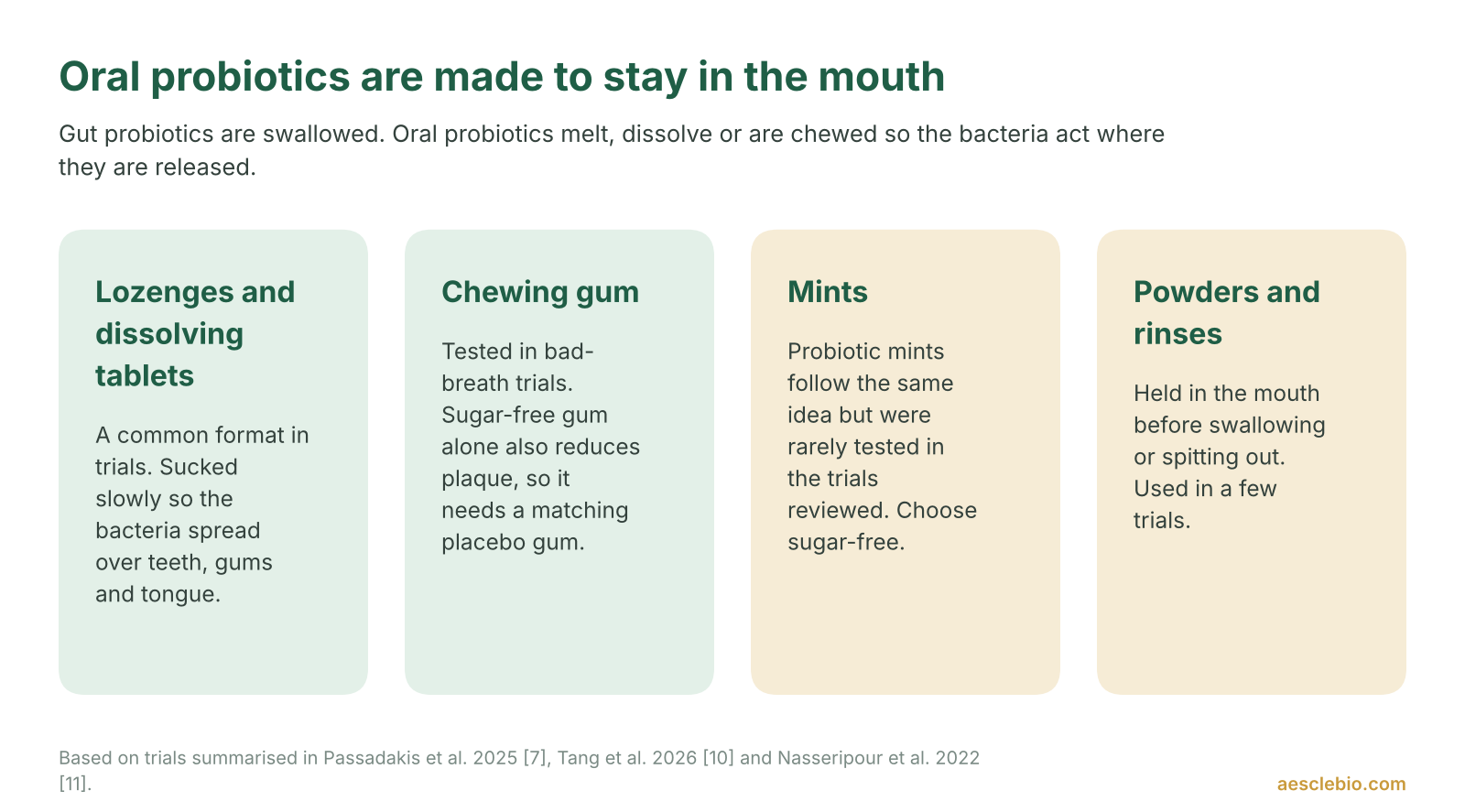
One catch with gum and mints: the format itself can help. A review of eight studies found that chewing sugar-free gum, particularly gum sweetened with xylitol (a sugar substitute), reduced the amount of plaque compared with not chewing gum or chewing ordinary gum [11]. So a good trial of probiotic gum or chewing gum probiotic products must compare it with an identical gum without the bacteria. Most of the trials discussed below compared the probiotic with a look-alike placebo (a dummy product) [4, 6].
What the evidence shows, condition by condition
Single small studies can point in any direction, so here we rely on systematic reviews (studies that gather all the trials on a question using strict rules) and meta-analyses (reviews that pool the numbers from those trials). We also report how certain the reviewers were, because that matters as much as the result.
Gum disease: gingivitis and periodontitis
Gingivitis is early, reversible gum inflammation: red, swollen gums that bleed when you brush. Periodontitis is the advanced form, in which the gums pull away from the teeth to form deep "pockets", and the bone holding the teeth can be lost. The standard treatment for periodontitis is a professional deep cleaning, called scaling and root planing, which removes plaque and hardened deposits above and below the gum line [4].
A 2025 meta-analysis of 24 randomised controlled trials (studies in which people are placed in groups by chance), with 951 participants, looked at probiotics for both conditions [4]. In the 10 gingivitis trials, plaque and gum bleeding were slightly lower with probiotics, but the difference was not statistically reliable. In the 14 periodontitis trials, where probiotics were always used on top of deep cleaning and never instead of it, people taking probiotics had less plaque and less bleeding; the bleeding benefit showed up mainly in studies lasting 12 weeks or less [4]. The reviewers rated the overall certainty of the evidence as low and said the clinical importance of these small differences is still uncertain [4].
For one species in particular, Limosilactobacillus reuteri (long known as Lactobacillus reuteri [15]), a 2024 systematic review of 11 trials in 369 adults with periodontitis found that eight trials reported a greater reduction in pocket depth when it was added to deep cleaning; the reviewers judged the evidence limited [5]. So oral probiotics for gum disease, or for periodontal disease more broadly, are best seen as a possible add-on to treatment by a dentist, never a replacement.
Bad breath (halitosis)
Bad breath is where probiotic lozenges for bad breath get most of their attention. A 2022 meta-analysis of seven placebo-controlled trials found that probiotics lowered breath-odour scores given by trained judges, and lowered the sulphur gases measured by machines, over the short term (four weeks or less) [6]. Over longer periods, only the odour scores stayed lower, and there was no effect on tongue coating or plaque, the main sources of the smell [6]. A 2025 review of six trials in 360 people without gum disease, mostly adults, found that five reduced sulphur gases, and reported no serious side effects [7]. The trials tested lozenges containing Streptococcus salivarius, chewing gum containing L. reuteri, tablets containing Weissella cibaria and a powder containing Lactiplantibacillus plantarum with Ligilactobacillus salivarius [7]. Both reviews warned that the trials were small and varied, which limits how far the results can be trusted [6, 7].
Tooth decay (dental caries)
Tooth decay, which dentists call dental caries, happens when bacteria feed on sugar and make acid that dissolves tooth enamel. Streptococcus mutans is one of the main bacteria linked to it [10]. Here the picture is genuinely mixed. A 2026 meta-analysis found that in children (12 trials, about 2,300 participants) probiotics lowered the risk of new or worsening cavities by about one-fifth, with moderate certainty, while trials in adults (6 trials, about 1,100 participants) showed no clear benefit [8]. The most studied species were Lacticaseibacillus rhamnosus and L. reuteri, given in lozenges or dairy foods [8]. But a 2024 meta-analysis of 19 trials in 2,622 children and teenagers found no reliable effect on the number of decayed teeth (low certainty), even though probiotics probably reduced counts of S. mutans (moderate certainty) [9]. Fewer decay-linked bacteria is encouraging, but it is not the same as fewer fillings.
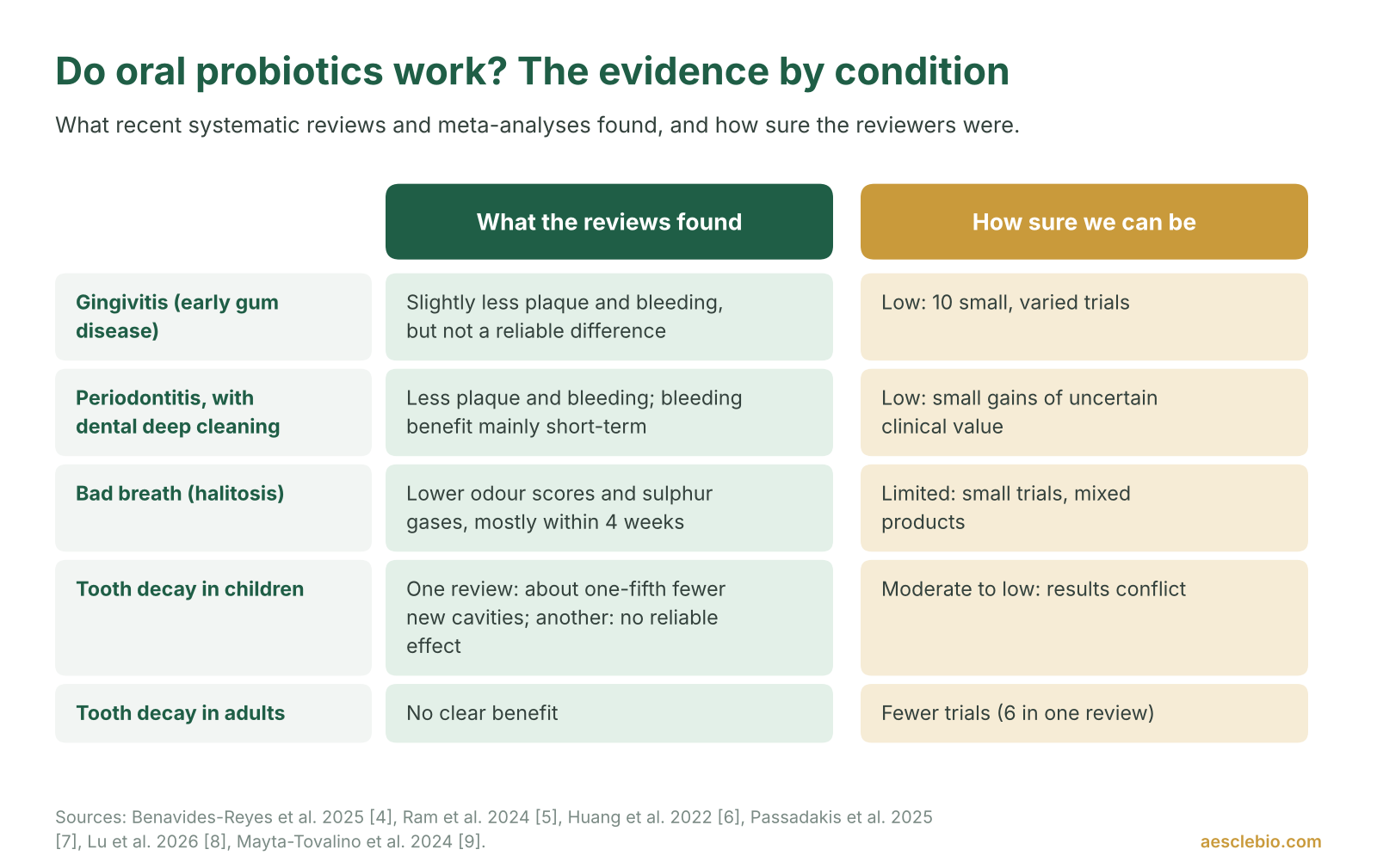
A 2026 "umbrella review", which compared 11 earlier meta-analyses, reached the same overall verdict: modest benefits of certain strains on decay-linked bacteria and bad breath, but certainty limited by mixed products, short studies and reliance on stand-in measures such as bacterial counts [10].
Which species have been studied?
Teeth probiotics are not one thing. Each species, and each strain within it, behaves differently, so a result for one cannot be assumed for another. The table lists the species that appear most often in the trials summarised above.
| Species | Formats used in trials | Mainly studied for |
|---|---|---|
| Streptococcus salivarius, a natural resident of the mouth and throat | Lozenges, dissolving tablets | Bad breath [7]; included in some studies of decay-linked bacteria [10] |
| Limosilactobacillus reuteri | Chewing gum, lozenges, dairy foods | Gum disease alongside deep cleaning; bad breath; decay [5, 7, 8] |
| Lacticaseibacillus rhamnosus | Lozenges, milk and other dairy foods | Tooth decay in children [8] |
| Weissella cibaria | Tablets | Bad breath [7] |
| Lactiplantibacillus plantarum and Ligilactobacillus salivarius | Powder held in the mouth | Bad breath [7] |
| Bifidobacterium species | Various | Decay-linked bacteria; one review found no clear effect [10] |
What Aesclebio's own research shows
Oral health is a small but active corner of probiotic research. In Aesclebio's analysis of 3,070 probiotic-type clinical trials registered on ClinicalTrials.gov, the public trial registry run by the US National Library of Medicine, 200 trials targeted oral health [12]. Gum disease (gingivitis and periodontitis) was the largest group, with 102 trials, followed by 76 on bad breath, mouth sores and other oral conditions, and 39 on tooth decay; a trial can count in more than one group [12]. Across the whole dataset, 100 trials named an oral-care format such as a lozenge, gum or mouth rinse [12].
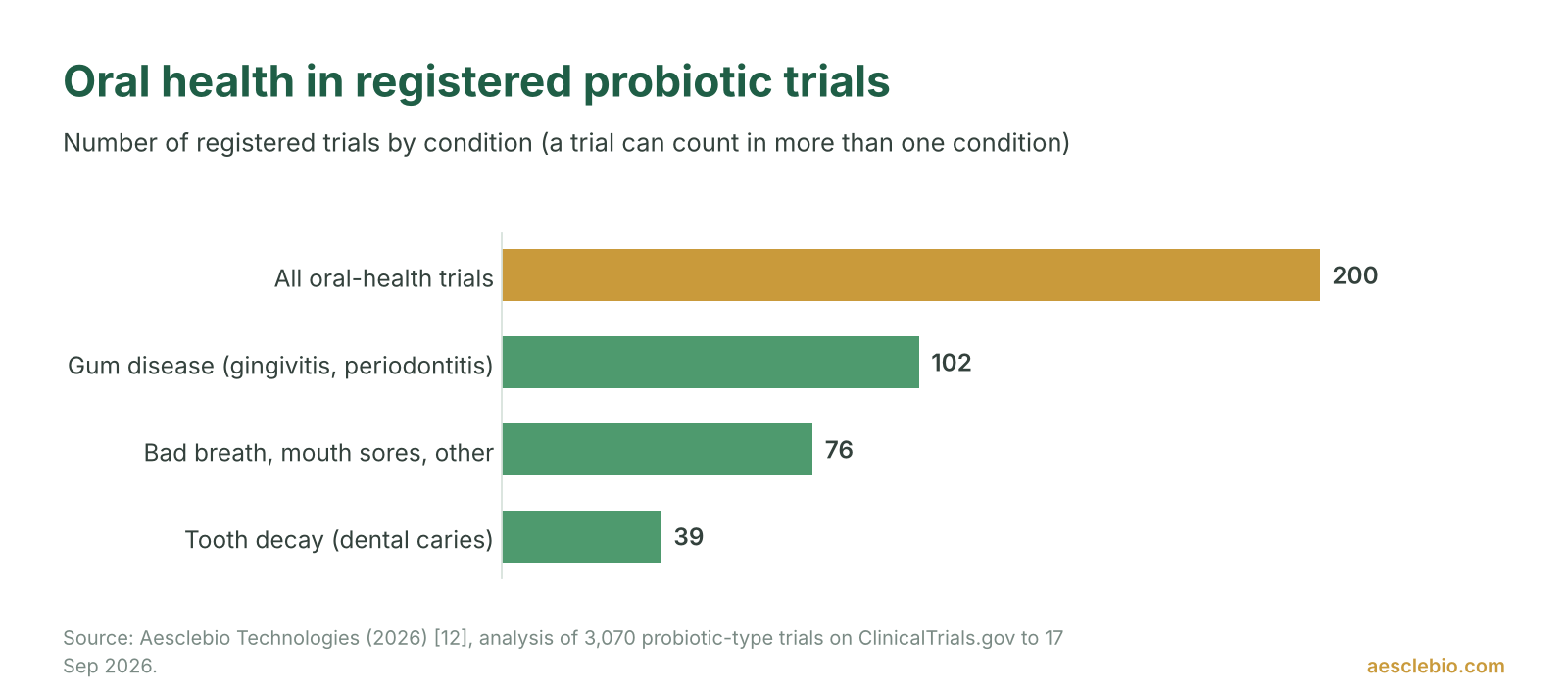
Two trends stand out. New oral-health trial registrations rose from 9 in January–August 2025 to 21 in the same months of 2026 [12]. And Streptococcus salivarius, the species most closely tied to the mouth and throat, has 38 registered trials and is among the fastest-growing organisms in the whole dataset, at about 27% a year [12]. More trials are welcome: they are exactly what the reviews above say is missing.
Myth or fact?
| Myth | What the evidence says |
|---|---|
| A probiotic lozenge can replace brushing. | No review supports this. In periodontitis trials, probiotics were tested as an add-on to professional cleaning, and they did not reduce tongue coating or plaque in bad-breath trials [4, 6]. WHO advises brushing twice a day with fluoride toothpaste [3]. |
| Oral probiotics cure gum disease. | In periodontitis trials, adding probiotics to deep cleaning gave small extra improvements, mostly short-term, and the evidence is rated low certainty [4, 5]. |
| If a probiotic lowers decay bacteria, it prevents cavities. | Not necessarily. One large review found fewer S. mutans bacteria but no reliable drop in decayed teeth in children [9]. |
| Oral probiotics do nothing. | Also wrong. Several reviews found real, if modest, short-term improvements in bad breath, and some benefit for gum bleeding and plaque in periodontitis [4, 6, 7]. |
How to choose and use an oral probiotic sensibly
The daily basics do the heavy lifting. WHO recommends brushing twice a day with a fluoride toothpaste and a diet low in free sugars [3]. For a coated tongue, the UK National Health Service (NHS) suggests brushing the tongue or using a tongue scraper [13]. An oral probiotic sits at the end of this list, not the start.
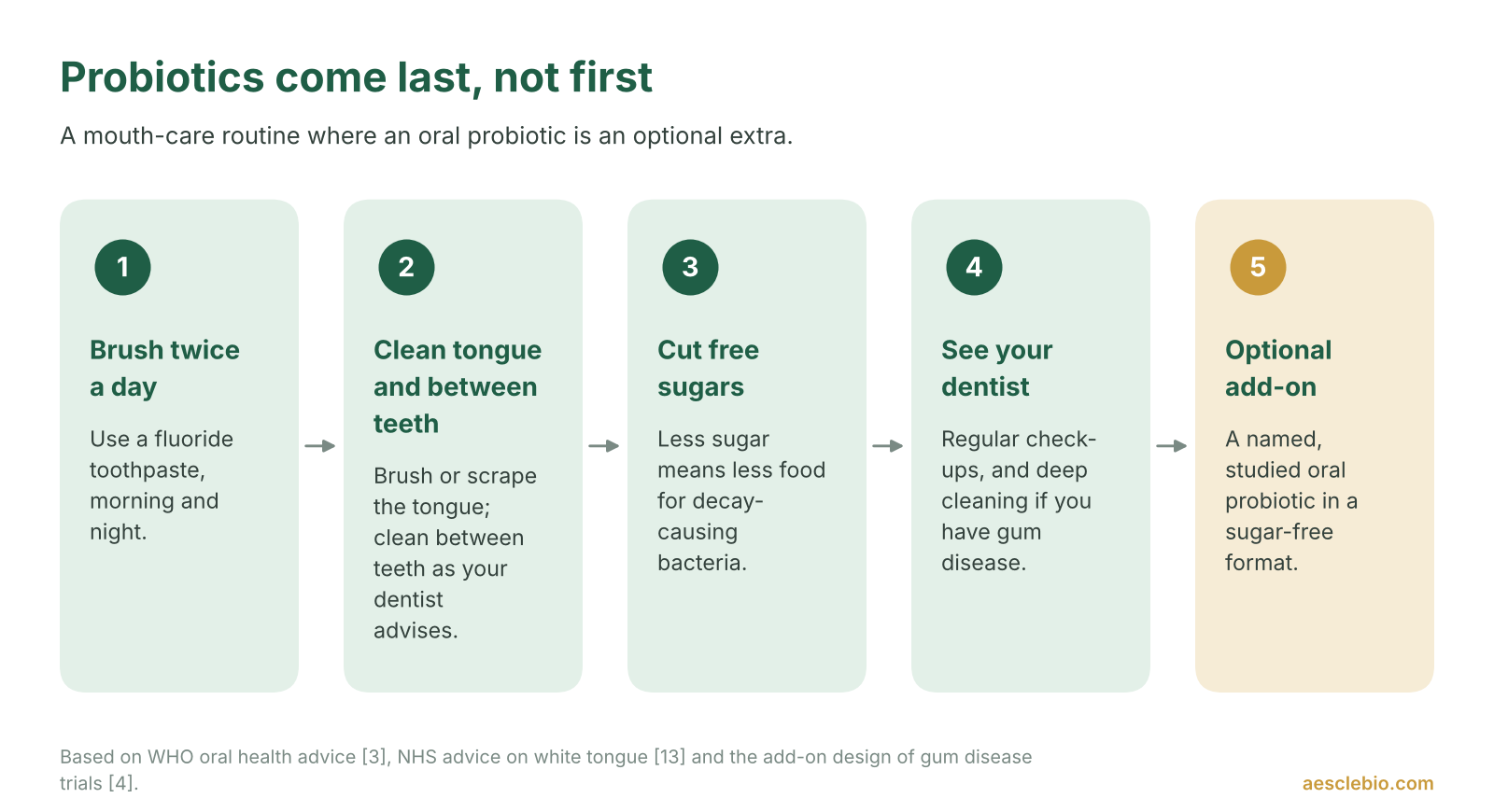
If you decide to try probiotic dental products, these checks help:
- Look for the full name: genus, species and strain code. Results belong to specific strains, not to "probiotics" in general.
- Check the format matches the goal: lozenges, gum and dissolving tablets keep the bacteria in the mouth; a swallowed capsule is designed for the gut.
- Check the live count until the end of shelf life, measured in colony-forming units (CFU), the standard count of live microbes.
- Choose sugar-free. A sugary lozenge or mint works against your teeth.
- Give it a fair test and keep your dentist informed. Most trials lasted weeks, not months [4, 6].
- For children, ask first. Speak to your child's dentist or doctor before giving any oral probiotic, including which format suits their age.
The bottom line
Oral probiotics are a real area of science, not just marketing, and the number of trials is growing. The best reviews show modest, mostly short-term benefits for bad breath, small extra gains when added to dental treatment for periodontitis, and mixed results for tooth decay in children. None of this makes bacteria a fix for a mouth that is not being cleaned. Brush, clean between your teeth, cut back on sugar and see your dentist; then, if you want to add an oral probiotic, choose a named, studied strain in a format that stays in the mouth.
Frequently asked questions
What are the best probiotics for teeth and gums?
No single product can be called the best probiotic for teeth and gums. The species studied most are Streptococcus salivarius, Limosilactobacillus reuteri and Lacticaseibacillus rhamnosus, usually as lozenges, gum or dairy foods [7, 8, 10]. Look for a named strain tested for your specific concern, and remember that the gum-disease benefits were seen as an add-on to dental cleaning [4].
Do probiotics for bad breath really work?
Partly. Reviews found that oral probiotic lozenges for bad breath, gum and tablets lowered breath-odour scores and sulphur gases, mostly over four weeks or less [6, 7]. They did not reduce tongue coating or plaque, the main sources of the smell [6]. Most bad breath starts in the mouth, from a coated tongue, plaque and gum disease, so tongue cleaning, brushing and treating gum disease matter most [6, 13].
Are oral probiotics good for gum disease?
They may help a little alongside treatment. In periodontitis trials, adding probiotics to professional deep cleaning reduced plaque and gum bleeding slightly, with low-certainty evidence; for gingivitis, the differences were not reliable [4]. A review of L. reuteri trials found similar small extra gains [5]. Bleeding gums should always be checked by a dentist.
Can probiotics help white tongue?
There is no good evidence that probiotics treat a white tongue. In bad-breath trials, probiotics did not reduce tongue coating compared with placebo [6]. A white tongue can have many causes, including oral thrush (a yeast infection), lichen planus and other conditions. The NHS suggests brushing the tongue or using a scraper, and seeing a GP or dentist if you have white patches on your tongue or tongue pain that does not go away [13].
Can probiotics cause mouth sores?
Reviews of oral probiotic trials have not flagged mouth sores as a problem: in the bad-breath trials no serious side effects, pain or discomfort were reported [7], and in tooth-decay trials side effects were mild and infrequent [8]. Mouth ulcers are common and have many causes, such as biting the cheek, a sharp tooth, braces or rough fillings, certain medicines and low levels of iron, zinc, folic acid or some vitamins [14]. If a sore appears after starting any new product, stop it and see a dentist or doctor if it lasts more than 3 weeks [14].
Are probiotic lozenges for kids a good idea?
Several trials have tested probiotics for teeth in children, with mixed results: one review found fewer new cavities, another found no reliable effect on decayed teeth [8, 9]. Whether a lozenge or chewing gum is a safe format depends on your child's age, so ask their dentist or doctor before giving any oral probiotic; Aesclebio does not give dosing advice for children.
What are the benefits of Streptococcus salivarius?
Streptococcus salivarius is a natural resident of the mouth and throat. As a lozenge it has been studied mainly for bad breath, where some trials improved odour scores [7], and it appears in some studies of decay-linked bacteria [10]. It is also being tested in throat trials [12]; products aimed at the ear, nose and throat are sometimes marketed as "ENT probiotics", a marketing label rather than a medical category. Benefits are strain-specific.
Is probiotic chewing gum as good as a probiotic lozenge?
Both keep bacteria in the mouth, and both have been tested in trials, for example gum containing L. reuteri for bad breath [7]. Sugar-free gum on its own also reduces plaque [11], so the fair comparison is probiotic gum versus the same gum without bacteria. Probiotic mints follow the same idea but have been studied less. Choose whichever format has evidence for the strain.
Can oral probiotics replace brushing, flossing or the dentist?
No. In periodontitis trials, probiotics were always used alongside professional cleaning, never instead of it [4], and WHO's advice remains twice-daily brushing with fluoride toothpaste and less sugar [3]. Think of an oral probiotic as a small extra on top of good daily care and regular dental visits.
Related reading
- What Probiotics Are, and the Five Myths That Survive Every Explainer
- Your Probiotic Is a Strain, Not a Species: Reading the Code After the Name
- L. reuteri: The Most Searched Probiotic Species (Aesclebio blog)
- Gummies vs Capsules vs Sachets vs Drops (Aesclebio blog)
- Kids, Toddlers and Probiotics: Dose, Format and the Sugar Problem
References
- Food and Agriculture Organization of the United Nations and World Health Organization. Probiotics in food: health and nutritional properties and guidelines for evaluation. FAO Food and Nutrition Paper 85. Rome: FAO; 2006. Link
- Deo PN, Deshmukh R. Oral microbiome: unveiling the fundamentals. Journal of Oral and Maxillofacial Pathology. 2019;23(1):122–128. Free full text: PubMed Central PMC6503789. Link
- World Health Organization. Oral health: fact sheet. Geneva: WHO. Link
- Benavides-Reyes C, Cabello I, Magán-Fernández A, et al. Clinical effects of probiotics on the treatment of gingivitis and periodontitis: a systematic review and meta-analysis. BMC Oral Health. 2025;25(1):490. Free full text: PubMed Central PMC11971800. Link
- Ram J, Awan KH, Freitas CMT, et al. Clinical effects of Lactobacillus reuteri probiotic in chronic periodontitis: a systematic review. European Review for Medical and Pharmacological Sciences. 2024;28(5):1695–1707. Open access (CC BY-NC-ND 4.0), free PDF on the publisher's website. Link
- Huang N, Li J, Qiao X, et al. Efficacy of probiotics in the management of halitosis: a systematic review and meta-analysis. BMJ Open. 2022;12(12):e060753. Free full text: PubMed Central PMC9809225. Link
- Passadakis G, Neophytou C, Davidopoulou S, et al. Effectiveness of probiotics in managing oral halitosis: a systematic review of randomized controlled trials. Journal of International Society of Preventive and Community Dentistry. 2025;15(4):301–312. Free full text: PubMed Central PMC12425399. Link
- Lu C, Zhang S, Hong G. Comparative effectiveness of probiotics, prebiotics, synbiotics, and postbiotics in preventing dental caries: a meta-analysis from an oral microbiota modulation perspective. BMC Oral Health. 2026;26(1):342. Free full text: PubMed Central PMC12918589. Link
- Mayta-Tovalino F, Maguiña-Quispe J, Barja-Ore J, et al. Efficacy of probiotic consumption on oral outcomes in children and/or adolescents: a meta-analysis. International Dental Journal. 2024;74(6):1205–1219. Free full text: PubMed Central PMC11551580. Link
- Tang Z, Deng Y, Guo G, et al. The effects of probiotics intervention on oral health outcomes: a comprehensive umbrella review of meta-analyses. Frontiers in Oral Health. 2026;7:1768508. Free full text: PubMed Central PMC13062169. Link
- Nasseripour M, Newton JT, Warburton F, et al. A systematic review and meta-analysis of the role of sugar-free chewing gum on plaque quantity in the oral cavity. Frontiers in Oral Health. 2022;3:845921. Free full text: PubMed Central PMC9006880. Link
- Aesclebio Technologies. Probiotic Clinical Trials: Where the Industry Is Heading. A registry-based analysis of ClinicalTrials.gov data to 17 September 2026. Hyderabad: Aesclebio Technologies Pvt. Ltd.; 2026. Link
- National Health Service (NHS). Sore or white tongue. NHS website. Link
- National Health Service (NHS). Mouth ulcers. NHS website. Link
- Zheng J, Wittouck S, Salvetti E, et al. A taxonomic note on the genus Lactobacillus: description of 23 novel genera, emended description of the genus Lactobacillus Beijerinck 1901, and union of Lactobacillaceae and Leuconostocaceae. International Journal of Systematic and Evolutionary Microbiology. 2020;70(4):2782–2858. Free full text on the publisher's website. Link
Disclaimer
This article is for general education only. It is not medical advice and is not intended to diagnose, treat, cure or prevent any disease. It does not promote any specific product or brand, and it makes no claims about any product.
Statements about research describe the findings of published studies. They do not mean that any particular food or supplement will have the same effect for you. Always speak to a qualified healthcare professional before changing your diet or starting a supplement, especially if you are pregnant, breastfeeding, giving products to a baby or child, or living with a health condition.
Rules on how probiotics and supplements may be described differ from country to country. Nothing in this article should be read as a health claim for any product.
All graphics are original works of Aesclebio Technologies. Figures from other studies are credited to their sources. Quotations are limited to short passages with full attribution. Any clinical-trial figures from Aesclebio's own analysis come from public registry records and do not imply that any product is effective or safe.
Prepared by the Aesclebio Research Team with the help of AI tools, under the team's direction. © 2026 Aesclebio Technologies Pvt. Ltd. All rights reserved. Short extracts may be quoted with a link to the original article.