
Strain Science
L. reuteri: The Most Searched Probiotic Species and What the Science Supports
An honest, strain-by-strain look at Lactobacillus reuteri: colic, diarrhoea, gums, bones, H. pylori, safety, foods and the home-made yoghurt trend.
Why so many people search for Lactobacillus reuteri
Type "Lactobacillus reuteri", "L reuteri" or "L.reuteri" into a search engine and you will find two very different worlds. One is a large body of careful clinical research. The other is a wave of social-media posts promising better skin, deeper sleep and even a younger body from home-made "L. reuteri yogurt".
Our argument is simple: L. reuteri is not one probiotic. It is a species with many strains, and each benefit belongs to a specific strain tested for a specific use. When a result from one strain is borrowed to sell every L. reuteri product, or every jar of home-made yoghurt, the science gets left behind.
What is L. reuteri?
Lactobacillus reuteri is a species of lactic acid bacteria, the family of microbes that turn sugars into lactic acid. In 2020 scientists split the very large Lactobacillus group into 25 smaller groups based on the bacteria's genes, and this species was moved into a new genus (a group of closely related species) called Limosilactobacillus [1]. So Limosilactobacillus reuteri and Lactobacillus reuteri are the same bacteria.
L. reuteri was first isolated in 1962 [2]. It is one of the bacteria that live naturally in the human gut, and it has also been found in breast milk, the urinary tract and on the skin, although the amount varies a lot from person to person [2]. Many strains make reuterin, a natural substance that stops the growth of a wide range of other microbes [2]. One small note for searchers: some people type "Bacillus reuteri", but L. reuteri is not a Bacillus. Bacillus species form tough spores; L. reuteri does not.
One species, many strains: why the code matters
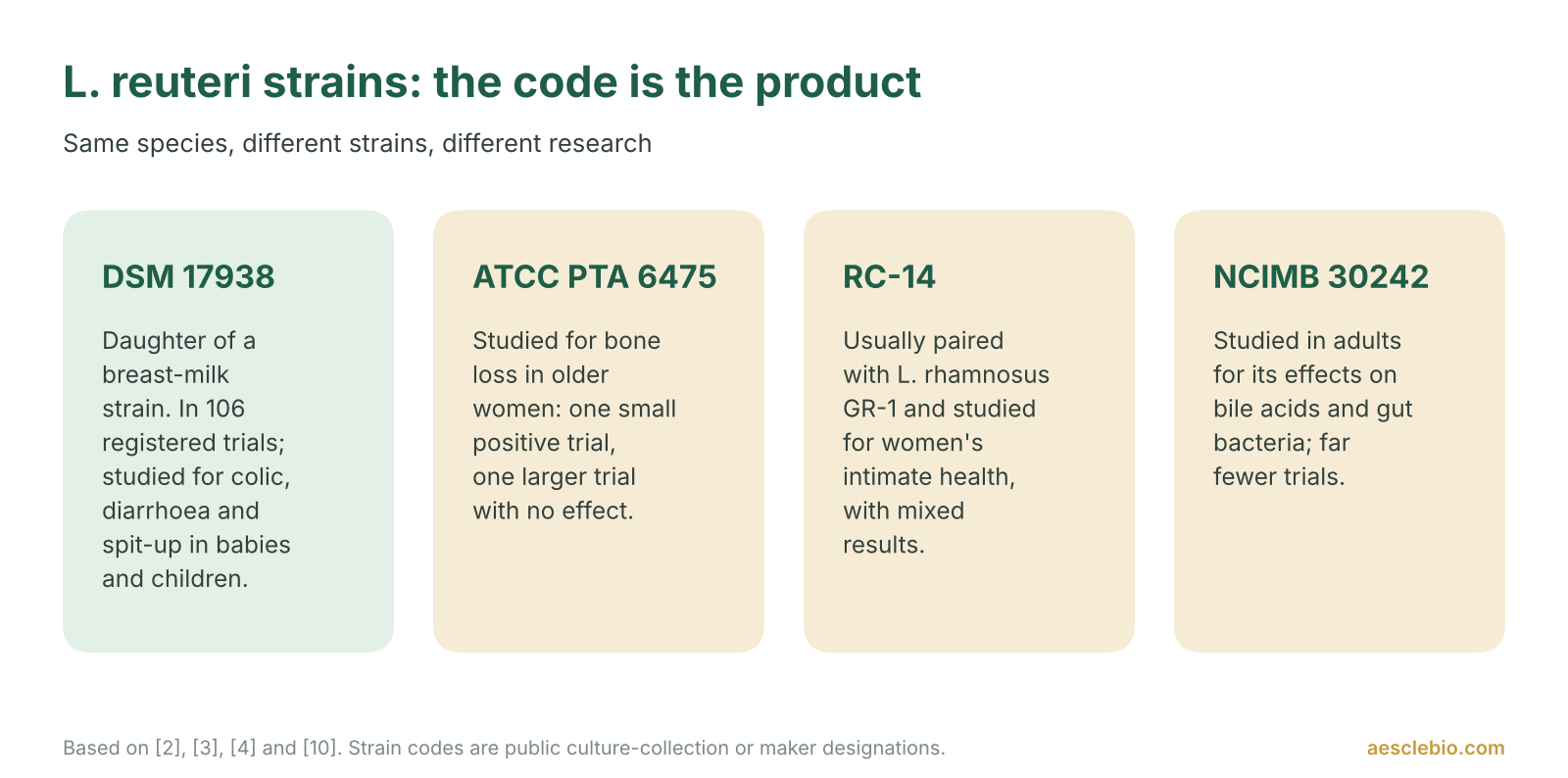
A strain is a specific type within a species. On a well-made label the strain is shown as a code after the species name. Many codes are deposit numbers from public culture collections, official "libraries" of living microbes: DSM (the German Collection of Microorganisms and Cell Cultures), ATCC (the American Type Culture Collection) and NCIMB (the UK National Collection of Industrial, Food and Marine Bacteria). Others are a maker's own code, such as RC-14 or LR08.
The best-known L. reuteri strains, DSM 17938 and ATCC PTA 6475, were developed and have been studied for many years by BioGaia AB, a Swedish company [3, 10]. DSM 17938 is the "daughter" of an older strain, ATCC 55730, which was first isolated from the breast milk of a mother in Peru; the daughter strain was created by removing small pieces of DNA that carried resistance to two antibiotics [4]. Credit where it is due: few probiotic strains have been researched so thoroughly. In Aesclebio's analysis of 3,070 probiotic-type clinical trials (research studies in people) on ClinicalTrials.gov, the public trial registry of the US National Library of Medicine, L. reuteri DSM 17938 appeared in 106 trials, one of the three most-trialled named strains or formulas [3]. BioGaia AB was the lead sponsor of 57 trials, and 86% of them used the strongest design: randomised, double-blind and placebo-controlled [3].
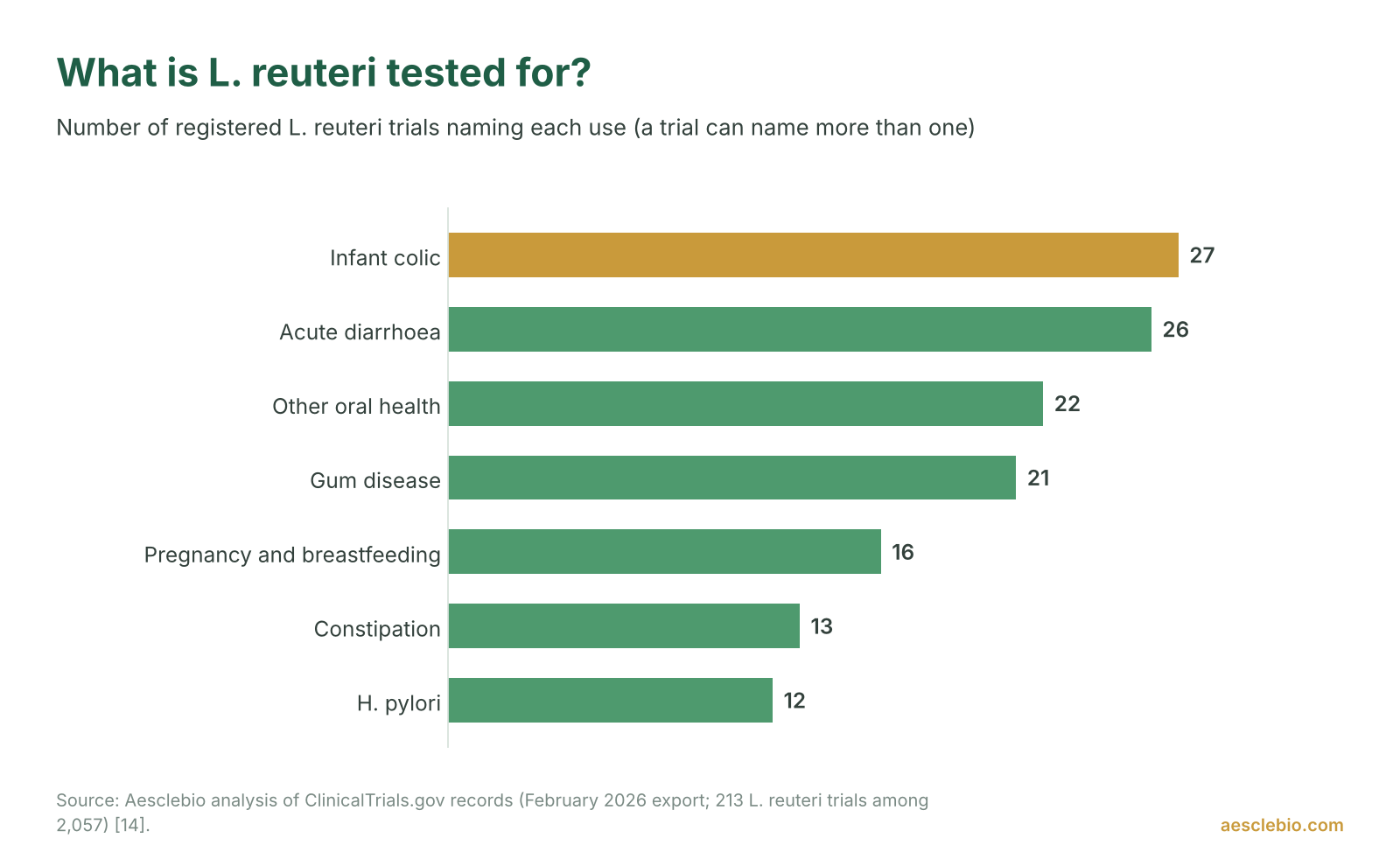
Across all strains, L. reuteri was named in 238 registered trials, second only to Lactobacillus rhamnosus (279) [3]. In an earlier export of the same registry (February 2026), our team classified the 213 L. reuteri trials by what they tested. Infant colic and acute diarrhoea lead, closely followed by oral health and gum disease [14].
L. reuteri benefits: what the science supports, use by use
For each use, ask two questions: which strain was tested, and how strong is the evidence? A review or meta-analysis that pools all the good trials carries more weight than any single study.
Infant colic: the strongest evidence, mainly in breastfed babies
Infant colic means long bouts of crying, often defined as at least three hours a day, three days a week, in an otherwise healthy baby [5]. A review that pooled three trials of DSM 17938 in 244 babies with colic found about 43 minutes less crying a day after 21 days, with the effect seen mainly in babies who were exclusively or mostly breastfed [4]. One of the three trials, which included formula-fed babies, found no benefit [4]. For formula-fed babies the data are still too thin to say. Giving probiotics to newborns to prevent colic is less clear: a Cochrane review (a leading independent review series) found less daily crying with L. reuteri, but no clear drop overall in the number of babies who developed colic, and rated the certainty as low [5]. A few trials also found fewer daily spit-ups (regurgitation) in babies given DSM 17938, which reviewers called preliminary [4].
Acute diarrhoea in children: a small effect
In a 2019 review of four trials (347 children), DSM 17938 shortened acute diarrhoea by a little under one day on average (0.87 days), though the authors warned that the effect was small and the trials had weaknesses [6]. A Cochrane review of all probiotics for acute infectious diarrhoea concluded that, overall, they probably make little or no difference to whether diarrhoea lasts 48 hours or more; its six L. reuteri trials agreed with each other, but all had some risk of bias [7]. In short: a modest, strain-specific signal, not a replacement for the rehydration a doctor recommends.
Gums and oral health
In a 2023 review of nine studies with 287 adults who had gum disease (periodontitis), most studies found better gum measurements when L. reuteri was given alongside a professional deep cleaning than with the cleaning alone. The studies differed a lot, so the authors urged care [8]. Changes in mouth bacteria also fade quickly: in one trial they disappeared four weeks after people stopped taking the strains [2].
H. pylori support, alongside medical treatment
Helicobacter pylori (H. pylori) is a stomach bacterium linked to gastritis and ulcers. In a 2019 meta-analysis, adding lactobacilli to standard antibiotic treatment raised the rate at which the infection was cleared; in the L. reuteri trials the rate was about 18% higher than without it [9]. This is support alongside antibiotics prescribed by a doctor, not a stand-alone treatment.
Bone health in older women: one positive trial, one larger negative trial
In an earlier Swedish trial of 90 older women, those taking ATCC PTA 6475 for a year lost about half as much bone in the shin as those on a placebo, a dummy product, though the effect was small [10]. A larger follow-up trial of 239 women in early menopause, taking the same strain for two years, found no effect on bone loss in the shin, spine or hip [10]. The researchers suggested the strain might help only older women or those with low bone density, which has not been proven [10]. Fair summary: interesting, unproven, and not a replacement for proven bone care.
Women's intimate health, and children's tummy pain
The strain L. reuteri RC-14 is usually studied as a pair with L. rhamnosus GR-1. Taken by mouth, the pair increased vaginal lactobacilli in some studies, but not in a study of pregnant women [2]. For children with long-lasting tummy pain, a 2026 meta-analysis of seven trials found no consistent benefit from DSM 17938 [11].
| Use | What the trials show | Evidence strength |
|---|---|---|
| Infant colic, breastfed babies (DSM 17938) | About 43 minutes less crying a day after 21 days [4] | Moderate, for this strain |
| Preventing colic in newborns | Less crying, but no clear drop in new cases [5] | Low |
| Acute diarrhoea in children (DSM 17938) | About 0.87 days shorter, small trials [6] | Low to moderate |
| Spitting up (regurgitation) in babies | Fewer episodes in a few trials [4] | Early |
| Gum disease, with deep cleaning | Better gum measures in most of 9 studies [8] | Low; studies differ |
| H. pylori, with antibiotics | Higher clearance rate [9] | Low to moderate |
| Bone, older women (ATCC PTA 6475) | Less bone loss, small effect, one trial of 90 women [10] | Early |
| Bone, women in early menopause | No effect over 2 years in 239 women [10] | Not supported |
| Tummy pain in children (DSM 17938) | No consistent benefit in 7 trials [11] | Not supported |
| Oxytocin, skin, ageing (home yoghurt claims) | Oxytocin and wound-healing findings come from mice [2]; no trials of the home-made product | No human evidence |
Myth or fact?
| Myth | What the evidence says |
|---|---|
| Every L. reuteri product works like the studied strain. | Benefits are strain-specific. Reviewers even debated whether DSM 17938 and its own parent strain can be treated as equal [4]. A different strain needs its own trials. |
| Home-made L. reuteri yogurt raises oxytocin and reverses ageing. | The oxytocin and social-behaviour findings come from mice [2]. We found no published trial testing home-made L. reuteri yoghurt in people. |
| Once you take L. reuteri, it moves in for good. | Effects usually last only while you take it. In one trial, changes in mouth bacteria vanished four weeks after stopping [2]. |
L. reuteri side effects and safety
For healthy people, L. reuteri has a good safety record. A review of DSM 17938 trials in babies and children reported no adverse events linked to the strain, no effect on growth, and no safety concerns in people with a normal immune system [4].
Evidence in very small premature babies is limited [4], and people with a weakened immune system, serious illness, a central line (a long-term drip) or recent surgery should speak to their doctor before taking any live microbe. For babies, children, pregnancy and breastfeeding, any use and any amount should be agreed with a doctor.
Lactobacillus reuteri foods: where you will, and won't, find it
Very few everyday foods are a reliable source of L. reuteri. Under the international Codex Alimentarius standard, set by the Food and Agriculture Organization (FAO) and the World Health Organization (WHO), classic yoghurt is made with two starter bacteria, Streptococcus thermophilus and Lactobacillus delbrueckii subsp. bulgaricus [12]. The standard also allows "alternate culture" yoghurts made with other lactobacilli [12], but L. reuteri is not a usual yoghurt starter. Kefir is defined by kefir grains and microbes such as Lactobacillus kefiri, not by L. reuteri [12]. Curd and fermented vegetables carry many lactic acid bacteria, but their labels rarely name L. reuteri or a strain code. Breast milk is one natural source in which it has been found, though not in every mother [2, 4].
Can you buy L. reuteri yogurt? Some dairy products in some countries add it as an extra culture. If you see one, the same rule applies as for supplements: look for the full strain code and a live count. We do not list yogurt brands: the label, not the brand, tells you what is inside.
The viral "L. reuteri yogurt" trend: a balanced look
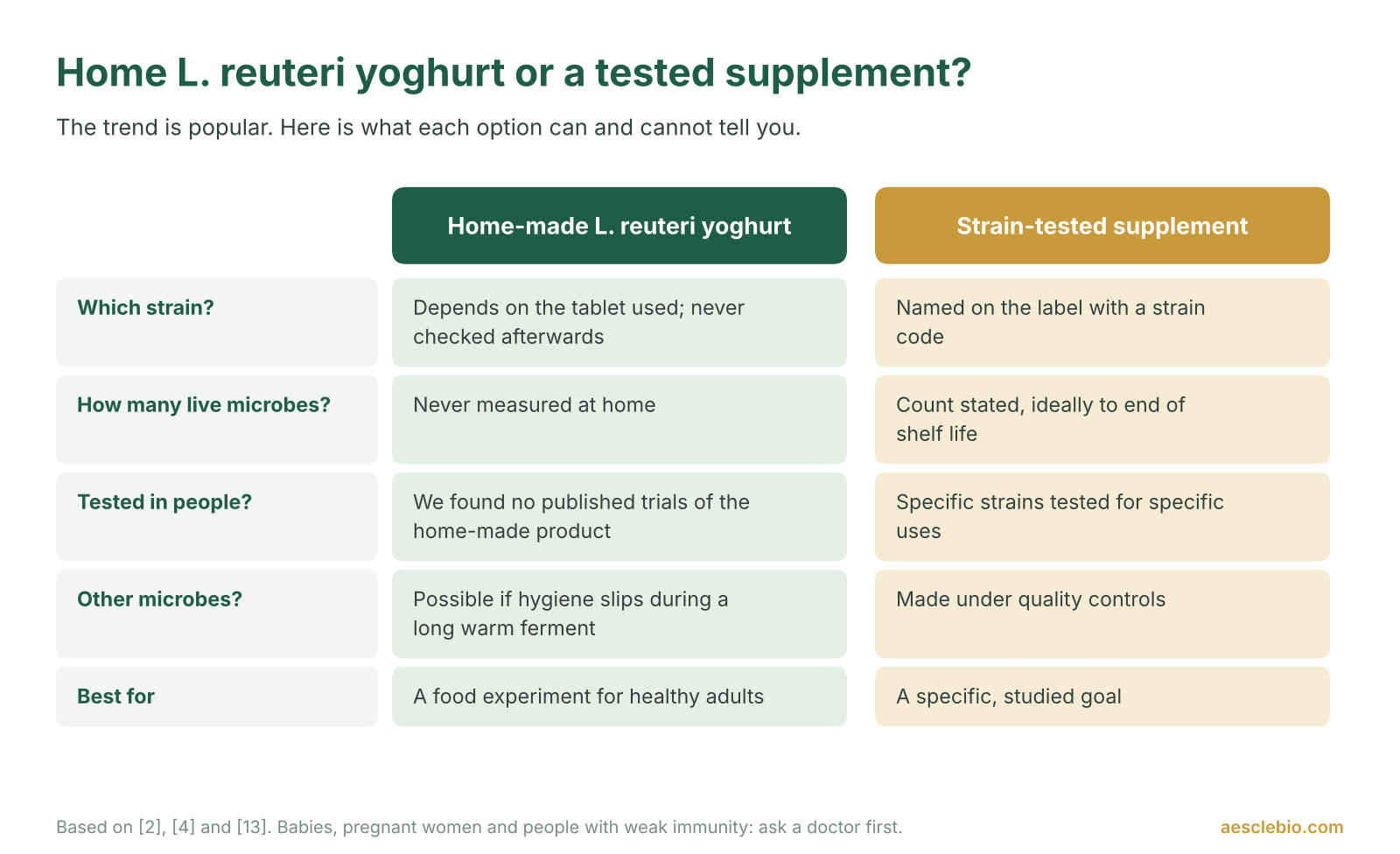
Online recipes ferment milk or cream with crushed L. reuteri tablets and a fibre such as inulin, kept warm for many hours, far longer than ordinary yoghurt. It is a fun kitchen experiment, and fermented dairy is a normal food. But four facts are worth knowing.
- The benefit claims come mainly from animal research, not from trials of the home-made product [2].
- Nobody knows what is in your jar. Neither the L. reuteri count nor other microbes are measured at home.
- Long, warm ferments need strict hygiene. The WHO advises keeping food clean and at safe temperatures because harmful microbes can also multiply in food kept warm [13].
- Not for everyone. Babies, pregnant women and anyone with a weakened immune system should not try it without a doctor's advice.
How to choose an L. reuteri supplement
L. reuteri supplements come as chewable tablets, chews, lozenges, drops (usually an oil suspension for babies), capsules, powders and, more recently, as a gummy. The format matters less than these checks:
- Look for the full name and strain code, for example L. reuteri DSM 17938, ATCC PTA 6475 or NCIMB 30242, not just "L. reuteri".
- Match the strain to the research. A strain studied in breastfed babies with colic tells you nothing about bones or skin.
- Check the live count in CFU (colony-forming units, the standard count of live microbes) promised until the end of shelf life.
- Follow the storage instructions; drops and gummies can be sensitive to heat and moisture.
- Ask a doctor first for babies, children, pregnancy, breastfeeding or any health condition.
The bottom line
L. reuteri deserves its fame, but its research belongs to specific strains, tested for specific uses: the best evidence is for DSM 17938 in breastfed babies with colic, with smaller or earlier signals for childhood diarrhoea, spit-up, gum care and H. pylori support, and no convincing human evidence yet for bones, tummy pain in children, skin or ageing. Read the strain code, match it to the trial, and treat the rest as a story still waiting for evidence.
Frequently asked questions
What are the main L reuteri benefits?
The best-supported benefit is less crying in breastfed babies with colic, seen with the strain DSM 17938 [4]. Smaller or earlier signals exist for acute diarrhoea in children [6], spit-up in babies [4], gum health alongside dental cleaning [8] and H. pylori support alongside antibiotics [9]. Each finding belongs to the strain that was tested, so check the strain code on the label.
What does Lactobacillus reuteri do in the body?
L. reuteri lives naturally in the human gut and has been found in breast milk [2]. Many strains make reuterin, a natural substance that slows the growth of other microbes, and some strains can calm the body's immune responses in laboratory and animal studies [2]. How much of this happens in people depends on the strain and the amount taken.
Is L. reuteri safe for infants and newborns?
Trials of DSM 17938 in babies and children reported no adverse events linked to the strain and no effect on growth [4]. Evidence in very small premature babies is limited [4]. Never give any probiotic to a baby without speaking to your doctor first, and ask the doctor about the product and amount.
What yogurt has Lactobacillus reuteri, and can you buy L. reuteri yogurt?
Classic yogurt is made with two other starter bacteria, so ordinary yogurt usually does not contain L. reuteri [12]. A few dairy products add it as an extra culture. If you find one, look for the strain code and a live count on the label, rather than relying on the brand.
Does kefir have L. reuteri?
Kefir is made with kefir grains, a mix of bacteria and yeasts such as Lactobacillus kefiri, Leuconostoc and Lactococcus; L. reuteri is not part of the international definition [12]. A particular kefir might contain it, but labels rarely say so. Kefir is good for variety in the diet, but it cannot replace a strain tested for a specific use.
How much L. reuteri per day should I take?
There is no single right amount. Trials used set amounts of specific strains for specific uses, so follow the label of a product whose strain matches the research, and ask a doctor or pharmacist if unsure. For babies, children, pregnancy and breastfeeding, the amount must be agreed with a doctor. There is also no sensible amount of home-made L. reuteri yoghurt to eat per day for a health goal, because its count is unknown.
Are there L. reuteri benefits for women and men?
For women, the pair L. rhamnosus GR-1 and L. reuteri RC-14 has been studied for vaginal health, with mixed results [2], and one small trial in older women found slightly less bone loss [10]. A larger bone trial in younger women found no effect [10]. For men there is no strain with specific evidence; findings in adults, such as gum care alongside dental cleaning and H. pylori support alongside antibiotics, apply to men and women alike [8, 9].
What is the difference between L. rhamnosus and L. reuteri?
They are two different species of lactic acid bacteria. L. rhamnosus is the most trialled probiotic species, with 279 registered trials, and L. reuteri is second, with 238 [3]. Some products combine them, most often the strains GR-1 and RC-14 for women's intimate health [2]. As always, the benefit belongs to the exact strains tested.
Are there Lactobacillus reuteri deficiency symptoms?
No. There is no medically recognised L. reuteri deficiency and no symptoms that show you lack it. The amount of L. reuteri varies naturally between people, and a reported fall over recent decades is only a link, not proof that it causes illness [2].
Do Lactobacillus reuteri before and after stories prove it works?
No. Personal before and after stories cannot separate the effect of the bacteria from diet changes, the passing of time or expectation. That is why researchers use placebo-controlled trials. The bone trials in women are a good example: one small trial looked promising, and a larger trial found no effect [10].
Related reading
- Your Probiotic Is a Strain, Not a Species: Reading the Code After the Name
- Infant Colic and Probiotics: What the Trials Actually Show
- Oral Probiotics: Bad Breath, Gums and Teeth (Aesclebio blog)
- Probiotic Foods vs Probiotic Supplements: Why a Probiotic Foods List Is Not a Dose
- Infant Probiotic Drops: Strains, Oil Suspensions, Spores and What Makes a Drop Work
References
- Zheng J, Wittouck S, Salvetti E, et al. A taxonomic note on the genus Lactobacillus: description of 23 novel genera, emended description of the genus Lactobacillus Beijerinck 1901, and union of Lactobacillaceae and Leuconostocaceae. International Journal of Systematic and Evolutionary Microbiology. 2020;70(4):2782–2858. Open access. Link
- Mu Q, Tavella VJ, Luo XM. Role of Lactobacillus reuteri in human health and diseases. Frontiers in Microbiology. 2018;9:757. Free full text: PubMed Central PMC5917019. Link
- Aesclebio Technologies. Probiotic Clinical Trials: Where the Industry Is Heading. A registry-based analysis of ClinicalTrials.gov data to 17 September 2026. Hyderabad: Aesclebio Technologies Pvt. Ltd.; 2026. Link
- Urbańska M, Szajewska H. The efficacy of Lactobacillus reuteri DSM 17938 in infants and children: a review of the current evidence. European Journal of Pediatrics. 2014;173(10):1327–1337. Free full text: PubMed Central PMC4165878. Link
- Ong TG, Gordon M, Banks SS, et al. Probiotics to prevent infantile colic. Cochrane Database of Systematic Reviews. 2019;3(3):CD012473. Free full text: PubMed Central PMC6415699. Link
- Patro-Gołąb B, Szajewska H. Systematic review with meta-analysis: Lactobacillus reuteri DSM 17938 for treating acute gastroenteritis in children. An update. Nutrients. 2019;11(11):2762. Free full text: PubMed Central PMC6893691. Link
- Collinson S, Deans A, Padua-Zamora A, et al. Probiotics for treating acute infectious diarrhoea. Cochrane Database of Systematic Reviews. 2020;12(12):CD003048. Free full text: PubMed Central PMC8166250. Link
- Ochôa C, Castro F, Bulhosa JF, et al. Influence of the probiotic L. reuteri on periodontal clinical parameters after nonsurgical treatment: a systematic review. Microorganisms. 2023;11(6):1449. Free full text: PubMed Central PMC10303645. Link
- Yu M, Zhang R, Ni P, et al. Efficacy of Lactobacillus-supplemented triple therapy for H. pylori eradication: a meta-analysis of randomized controlled trials. PLoS One. 2019;14(10):e0223309. Free full text: PubMed Central PMC6774518. Link
- Gregori G, Pivodic A, Magnusson P, et al. Limosilactobacillus reuteri 6475 and prevention of early postmenopausal bone loss: a randomized clinical trial. JAMA Network Open. 2024;7(6):e2415455. Free full text: PubMed Central PMC11170297. Link
- Rodríguez-Brown F, Guerra Valencia J, Hernández-Vásquez A. Efficacy and safety of Limosilactobacillus reuteri DSM 17938 in pediatric functional abdominal pain disorders: a systematic review and meta-analysis of randomized controlled trials. Nutrients. 2026;18(17):2795. Free full text: PubMed Central PMC13567511. Link
- Codex Alimentarius Commission. Standard for Fermented Milks (CXS 243-2003). Rome: FAO and WHO. Link
- World Health Organization. Five keys to safer food manual. Geneva: WHO; 2006. Link
- Aesclebio Technologies. Aesclebio analysis of ClinicalTrials.gov records: 2,057 interventional probiotic-type trials, registry export February 2026 (classification of 213 L. reuteri trials by use). Hyderabad: Aesclebio Technologies Pvt. Ltd.; 2026. Link
Disclaimer
This article is for general education only. It is not medical advice and is not intended to diagnose, treat, cure or prevent any disease. It does not promote any specific product or brand, and it makes no claims about any product.
Statements about research describe the findings of published studies. They do not mean that any particular food or supplement will have the same effect for you. Always speak to a qualified healthcare professional before changing your diet or starting a supplement, especially if you are pregnant, breastfeeding, giving products to a baby or child, or living with a health condition.
This topic concerns babies, pregnancy or new mothers. Nothing here is a recommendation to give any product to a baby or to use any product during pregnancy or breastfeeding. Decisions about care should always be made with a doctor, midwife or other qualified healthcare professional.
Rules on how probiotics and supplements may be described differ from country to country. Nothing in this article should be read as a health claim for any product.
BioGaia is a trademark of BioGaia AB. Company and strain names are mentioned for information only, based on published research; Aesclebio has no affiliation with BioGaia AB.
All graphics are original works of Aesclebio Technologies. Figures from other studies are credited to their sources. Quotations are limited to short passages with full attribution. Any clinical-trial figures from Aesclebio's own analysis come from public registry records and do not imply that any product is effective or safe.
Prepared by the Aesclebio Research Team with the help of AI tools, under the team's direction. © 2026 Aesclebio Technologies Pvt. Ltd. All rights reserved. Short extracts may be quoted with a link to the original article.