
Manufacturing
Choosing a Probiotic Contract Manufacturer: GMP, Halal and the Questions to Ask
How probiotics are made, what GMP, ISO 22000 and halal certificates really prove, and the questions that separate a safe partner from a risky one.
Why choosing a probiotic contract manufacturer is harder than it looks
Most brand owners start their search for a GMP certified supplement manufacturer by collecting certificates. A factory with a wall full of them feels safe. But probiotics are not vitamins. They are living microbes, and they start dying from the moment they are made. Heat, moisture and time all reduce the count of live cells [1]. So the real question is not "Is this factory certified?" but "Can this factory keep my strains alive, in the right numbers, until the last day of shelf life?"
This guide is for brand owners and buyers in health supplement B2B development, from digestive health supplement production to a first probiotic launch. It explains the manufacture of probiotics in plain words, what each certificate proves, and the questions that show whether a partner offering probiotic manufacturing services can deliver.
How are probiotics manufactured? The probiotic manufacturing process in five steps
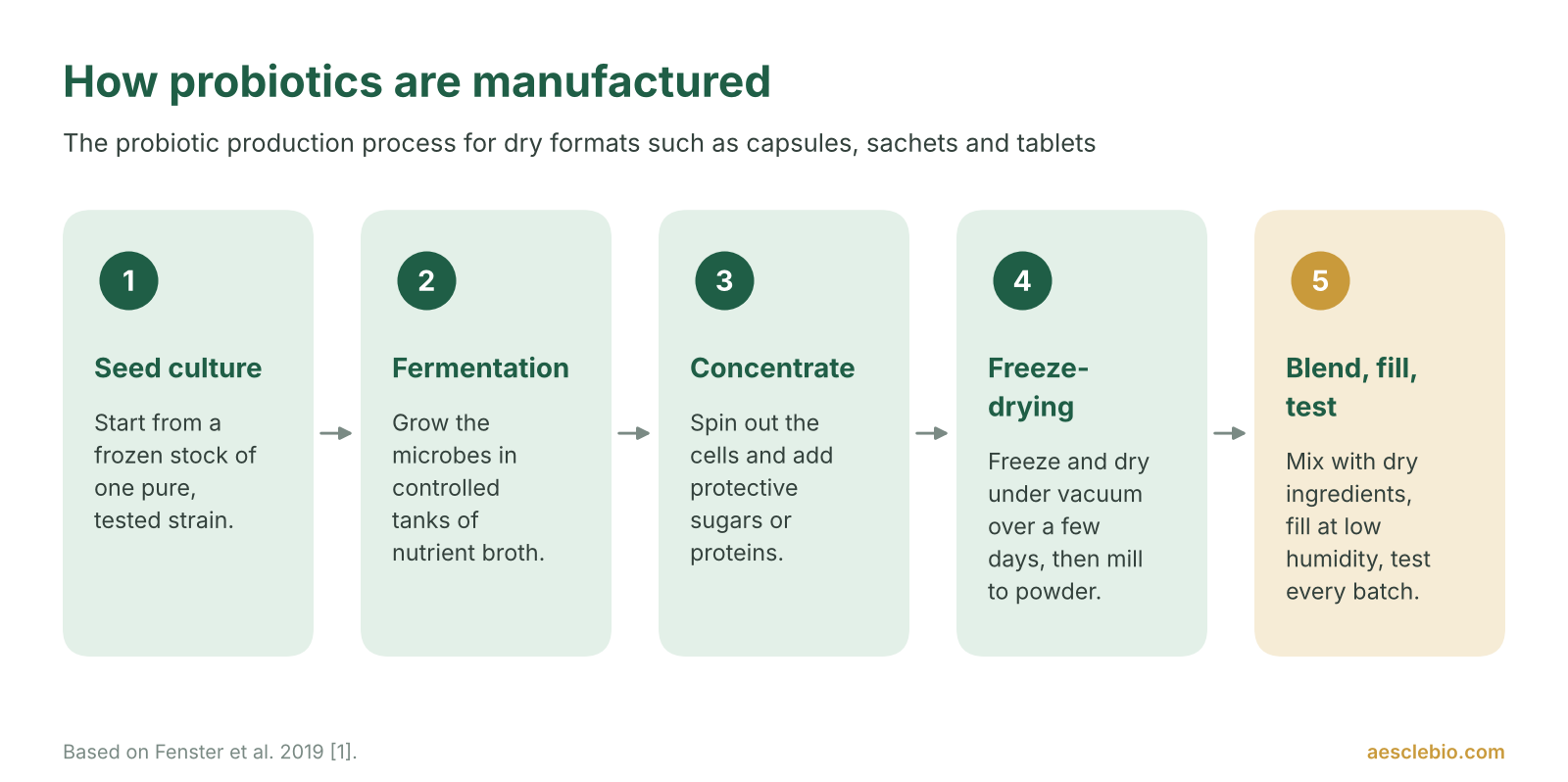
The manufacturing of probiotics is closer to brewing than to mixing powders. A review of industrial practice describes the main steps [1]:
- Seed culture. Production starts from a frozen stock of one pure strain, checked to be free of contaminants. Only a few growth stages are allowed between this stock and the final batch, to limit the risk of the strain slowly changing ("genetic drift") [1].
- Fermentation. The microbes grow in large, controlled tanks in a heat-treated broth of water, protein sources, sugars, salts and trace nutrients [1].
- Concentration. A centrifuge, a machine that spins the broth very fast, separates the cells from the used broth. Protective sugars or proteins are then added so the cells survive freezing and drying [1].
- Freeze-drying. The concentrate is frozen and dried under vacuum. This usually takes a few days, and keeps the cells cold to limit damage. The dry cake is then milled into a powder [1].
- Blending, filling and testing. The powder is mixed with fillers and other ingredients, then filled into capsules, sachets, stick packs or tablets. Quality-control tests are run during and after production [1].
Two details matter most for buyers. First, water is the enemy. Water activity, a measure of how much "free" water is available to the cells, is the main factor deciding how long probiotics stay alive, followed by storage temperature. Industry guidance aims to keep the blend's water activity below 0.2, and ideally below 0.15, which means dry ingredients, a low-humidity filling room and moisture-tight packaging [1]. Second, each format has its own risks. Pressing tablets can sharply reduce live counts, mixing probiotics with other active ingredients can raise moisture, and some plant ingredients may harm the microbes [1]. That is why a probiotic manufacturing facility needs different skills from a general supplement plant, whether you want delayed-release capsules, custom flavoured stick packs or multigrain probiotic bars.
What GMP means, and why GMP and cGMP are not a quality guarantee
The World Health Organization (WHO) describes good manufacturing practice as the part of quality management that ensures products are "consistently produced and controlled" to the quality standards right for their intended use [4]. In plain words, GMP is about making every batch the same validated way, and keeping records that prove it.
Different markets put GMP into law in different ways:
- United States. GMP for dietary supplements is set out in Title 21 of the Code of Federal Regulations, Part 111 (21 CFR 111), called "Current Good Manufacturing Practice" (cGMP); "current" means methods must stay up to date. A maker must set specifications for identity, purity, strength and composition, and run at least one identity test on each dietary ingredient before use [3].
- India. Every food business licensed to manufacture, including health supplement and probiotic makers, must follow the general hygiene and manufacturing rules set by the Food Safety and Standards Authority of India (FSSAI) for licensed businesses, which sit in Part II of Schedule 4 of its licensing regulations [5, 13]. Aesclebio's India guide notes that probiotics sold as medicines follow the drug-factory rules (Revised Schedule M), which were brought in line with WHO standards [13].
- Medicines worldwide. WHO GMP sets the principles many drug regulators use, including detailed rules for contract production [4].
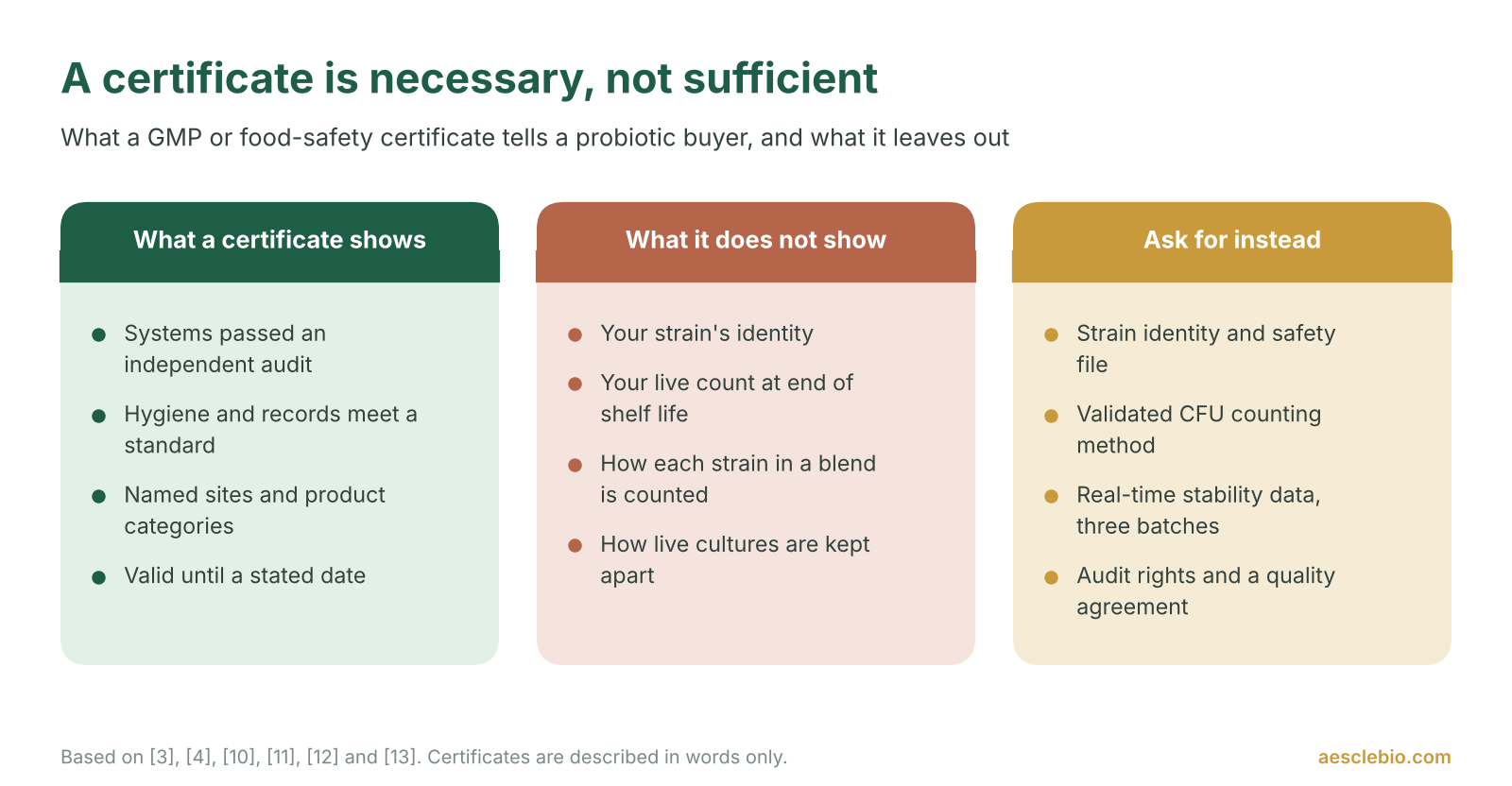
Here is the uncomfortable truth: GMP is necessary, but it is not sufficient. In a 2020 study, researchers in India tested 20 probiotic products bought from pharmacies and found poor agreement between the label and the laboratory results, both for live counts and for the species present; some contained microbes not named on the pack [10]. A 2025 study of probiotics sold in the United Kingdom found more variation in products for people than in products for poultry, and one product for people contained no live bacteria that could be detected [11]. Whether you are comparing global probiotic manufacturers or probiotic manufacturers in the UK or India, the lesson is the same: the certificate covers the system, not your batch.
Food-safety certificates: HACCP, ISO 22000 and FSSC 22000
GMP standards ask whether every batch is made the same validated way. Food-safety standards ask what could make a product unsafe, and how to stop it [12].
- HACCP (hazard analysis and critical control points) is the method, set out by the Codex Alimentarius, the international food-standards body of the Food and Agriculture Organization (FAO) and WHO, for finding hazards at each step and controlling them [6]. Aesclebio's internal guide notes that a supplement plant typically ends up with only one to three critical control points, such as metal detection [12].
- ISO 22000, a standard from the International Organization for Standardization (ISO), sets the requirements for a food safety management system and can be used by any organisation in the food chain, whatever its size [7]. FSSC 22000 builds on ISO 22000 with extra requirements, such as food fraud and environmental monitoring, and is widely asked for by large retailers and importers [12].
- One common misunderstanding: ISO itself does not certify anyone. Certificates are issued by independent certification bodies [8]. So "ISO certified" always means "certified by someone else to an ISO standard".
For an ISO 22000 supplement manufacturer, also check the scope printed on the certificate. As Aesclebio's internal guide points out, a certificate covers named sites and product categories. If your gummies or capsules are made on a line outside that scope, the certificate does not apply to them [12].
| Standard | What it covers | What it does not prove |
|---|---|---|
| FSSAI Schedule 4 (India) | Legal minimum hygiene and manufacturing practice for every licensed food business | That your strain survives to the end of shelf life |
| 21 CFR 111 (USA, cGMP) | Specifications, identity testing, batch records and quality-control release for dietary supplements | That the strain is backed by human studies |
| WHO GMP (medicines) | Full quality system, validation and written rules for contract production | That a food-route supplement line works the same way |
| HACCP | Control of safety hazards at critical steps | Live count, strain identity or label accuracy |
| ISO 22000 / FSSC 22000 | A certified food safety management system, often required by large buyers | Anything outside the scope printed on the certificate |
| Halal / kosher | Lawful ingredients, clean equipment and separation under religious rules | Product quality or safety in themselves |
Halal and kosher: more than an ingredient list
A halal certified supplement manufacturer must control more than the formula. The Codex guidelines on the term "halal" say halal food must contain nothing unlawful under Islamic law, must not be processed or stored with equipment that is not free of unlawful substances, and must not come into direct contact with non-halal food. Halal food may be made on separate lines in a plant that also makes non-halal food, as long as contact is prevented, and equipment once used for non-halal food may be used after proper cleaning under Islamic requirements [9]. Halal claims must not cast doubt on the safety of similar foods or claim that halal food is healthier [9].
For probiotics there is a hidden layer: the fermentation broth. Common growth media can contain dairy or meat ingredients, so halal, kosher, vegan or allergen-free claims must be documented back to the broth used to grow the culture [1]. Plant-based capsule shells and pectin gummies make these claims simpler. Aesclebio's India guide notes that, in India, halal and kosher are voluntary private certifications [13].
The questions to ask before you sign
Most of the risk sits in eight areas. Ask in writing, and ask to see the evidence.
1. Strain documentation
Ask for the full name of each strain (genus, species and strain code), how it was identified, and its safety file. A group of probiotic scientists called whole genome sequencing, reading the strain's complete DNA, the "gold standard" for strain identity. It recommended depositing strains in a recognised culture collection and advised against selling strains whose antibiotic resistance genes could be passed on [2]. Aesclebio's India guide adds that, in India, strains must not carry transferable resistance genes, and the species must be on the permitted list or have prior approval [13].
2. How live microbes are counted
Colony-forming units (CFU) are the standard count of live microbes. Ask which validated counting method the laboratory uses, for example the international standard ISO 29981, a plate-count method for bifidobacteria, or ISO 19344, which counts lactic acid bacteria by flow cytometry, a machine that counts cells one by one [2, 13]. In multi-strain blends, counting each strain separately is hard, and no generally applicable method exists, so ask how the maker proves each strain's count [1]. Aesclebio's India guide notes that India has no official counting method, so the method must be chosen and validated [13].
3. End-of-shelf-life stability data
Ask for real-time stability data, not only a count on the day of manufacture. Aesclebio's India guide recommends testing at least three batches in the final pack at 30 °C and 75% humidity, at set points from the start to the end of shelf life [13]. Makers add extra cells, called an "overage", so the label count is still met at the end [1, 13].
4. Cross-contamination control for live cultures
Ask how the plant separates areas that handle live cultures, stops one strain from mixing into another, and stores cultures dry and cool. According to Aesclebio's India guide, Indian rules on both the food and medicine routes expect these controls [13]. The same guide warns that contract laboratories sometimes wrongly fail probiotic batches on "total plate count", a general count of all microbes, so write into the specification that this limit does not apply to the probiotic, while disease-causing germs such as Salmonella and Listeria must still be absent [13].
5. Audits and subcontracting
Ask for the right to audit and for the latest audit findings. WHO GMP says the client may audit the contract maker and its approved subcontractors, and the maker may not subcontract without the client's approval [4]. Check records too: Aesclebio's internal guide lists the data-integrity principles that electronic batch records and other software solutions for supplement manufacturing should meet, so that every entry is attributable to a person, legible, recorded at the time, original and accurate [12].
6. Minimum order quantity (MOQ) and lead times
Ask for the minimum order quantity for each blend and pack format, and a lead time that includes culture sourcing, freeze-drying (which alone takes days) and release testing [1]. A quote that ignores testing time is a warning sign.
7. Technology transfer
If you bring your own formula or strain, ask how scale-up will be managed. Strains often behave differently at commercial scale, where longer holding times, pumping and spinning add stress [1]. WHO GMP says contract arrangements, including technology transfer and any proposed changes, must be agreed in line with the product's approval [4].
8. The quality agreement
A written quality agreement should say who does what: sampling, testing, batch release, access to records for complaints, and changes [4]. Aesclebio's India guide notes that contract manufacturing is allowed in India, but both the brand owner and the maker are responsible, and the name on the pack is the one an inspector will chase. So agree in writing who approves every label claim [13].
Red flags when comparing probiotics manufacturing partners
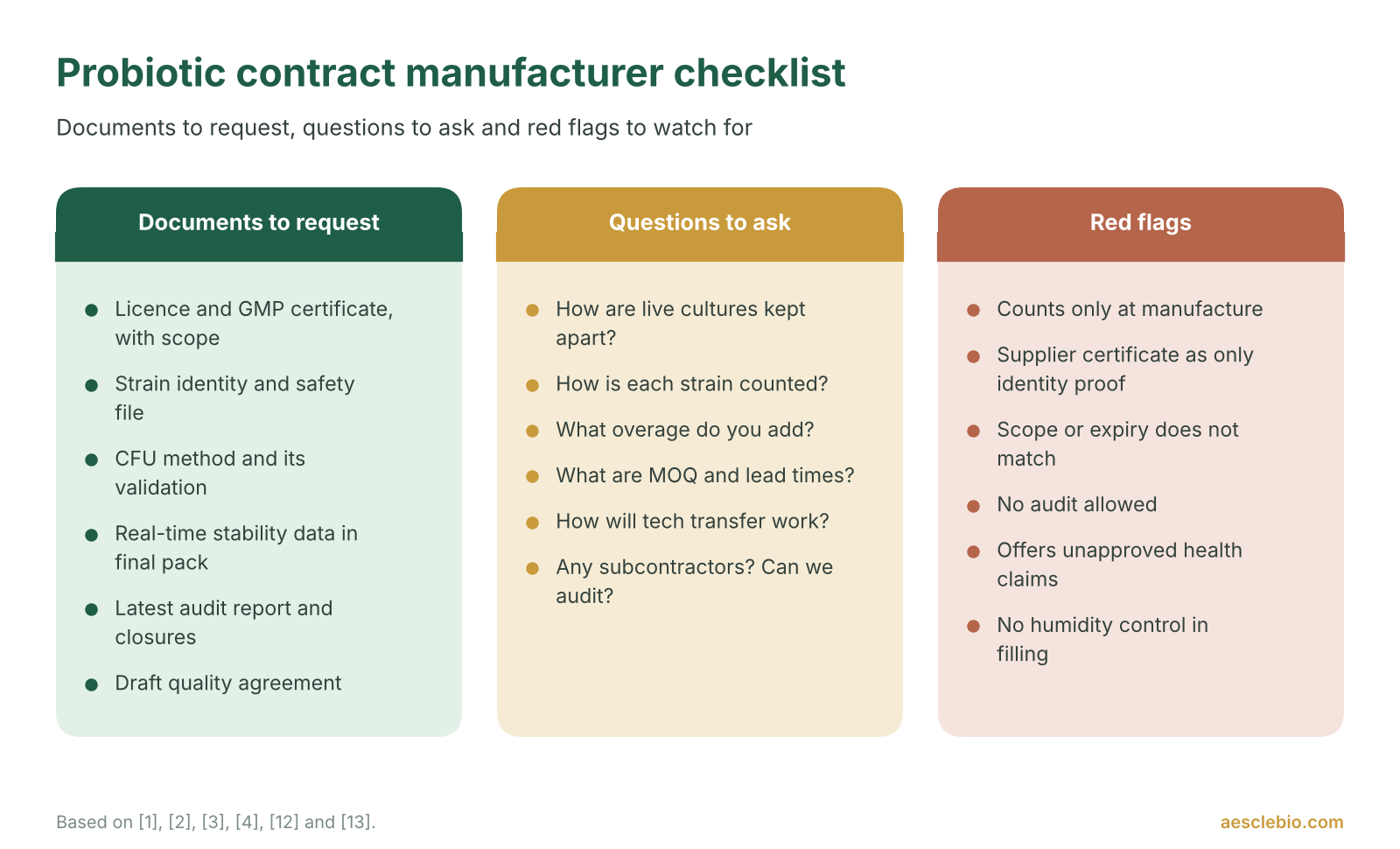
- Live counts quoted only "at manufacture", with no end-of-shelf-life data.
- No strain identity evidence beyond the culture supplier's certificate of analysis, when US rules require the maker to run its own identity test [3].
- A certificate whose scope, site or expiry date does not match your product [12].
- Refusal to allow an audit, or vague answers about subcontractors [4].
- A probiotics factory that cannot explain how it controls humidity in the filling room [1].
Use the checklist below as a starting point for your supplier questionnaire.
How long does it take a plant to get certified?
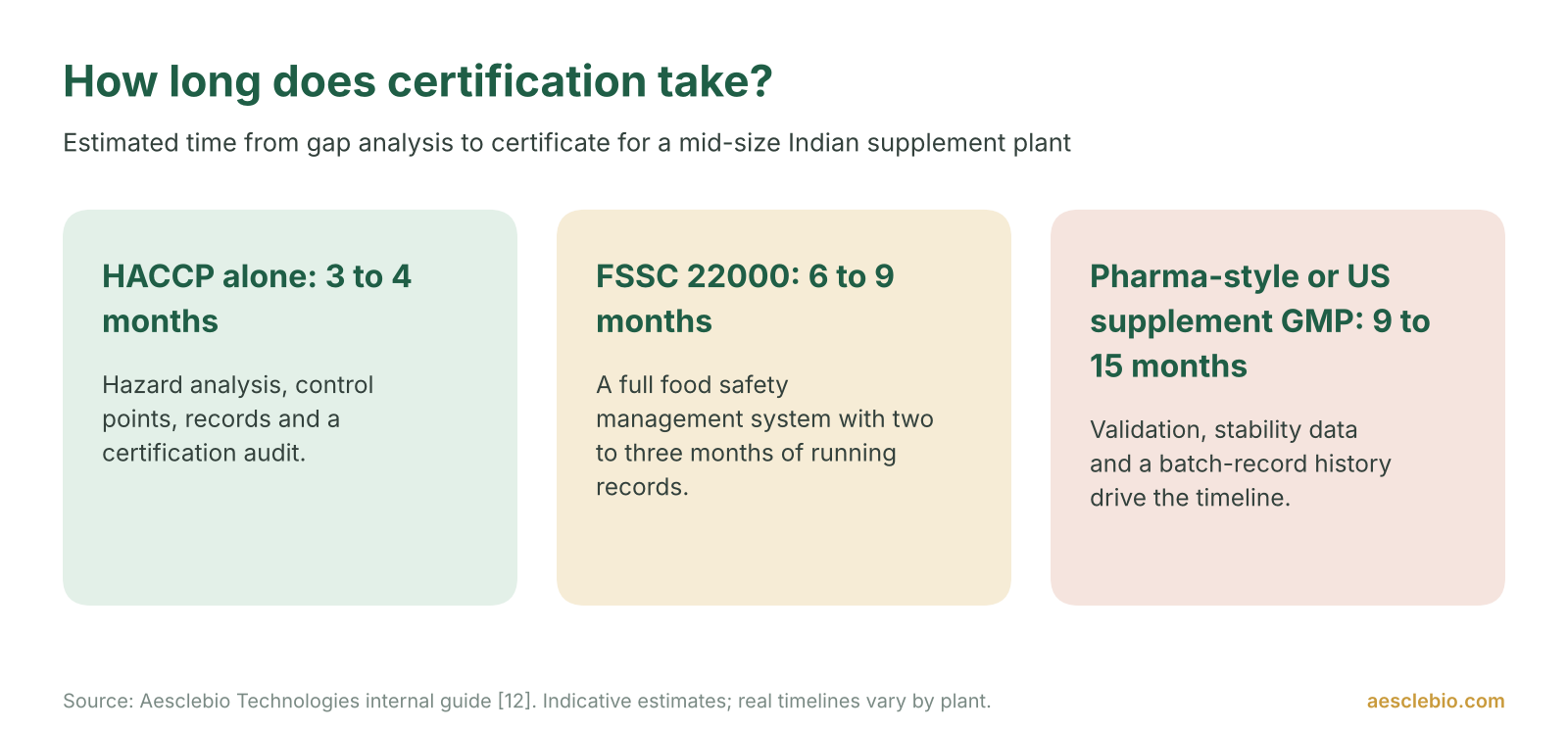
If a partner says it is "getting certified soon", ask when. Aesclebio's internal guide estimates that a mid-size Indian supplement plant needs three to four months for HACCP alone, six to nine months for FSSC 22000, and nine to fifteen months for pharmaceutical-style or US supplement GMP, because validation, stability data and batch-record history take time [12].
The bottom line
Probiotic production is a living process, and a certificate is a snapshot of systems on audit day. Treat GMP, HACCP, ISO 22000 and halal certificates as the entry ticket, not the decision. The decision rests on evidence about your product: named strains with identity proof, a validated counting method, real-time stability data to the end of shelf life, controls that stop live cultures mixing, and a quality agreement that says who is responsible for what. Ask for the data, read the scope, and audit before you sign.
Frequently asked questions
How are probiotics manufactured?
A pure strain is grown from a frozen seed stock in controlled fermentation tanks, separated from the broth in a centrifuge, protected with sugars or proteins, freeze-dried and milled into powder. The powder is then blended with dry ingredients and filled into capsules, sachets or tablets under low humidity, with quality tests during and after production [1].
What is GMP for dietary supplements?
Good manufacturing practice (GMP) is a set of rules that makes sure every batch is made the same validated way, with records to prove it [4]. In the United States, 21 CFR 111 sets cGMP for dietary supplements, including specifications and identity testing of each dietary ingredient [3]. In India, FSSAI Schedule 4 sets the legal hygiene and manufacturing rules for supplement makers [5, 13].
What is the difference between GMP and cGMP?
cGMP stands for current good manufacturing practice. It is the term used in US rules, such as 21 CFR 111 for dietary supplements [3]. The word "current" signals that methods and equipment must stay up to date. In practice the two terms describe the same idea: consistent, controlled, documented manufacturing.
Is an ISO 22000 supplement manufacturer the same as a GMP certified one?
No. ISO 22000 sets the requirements for a food safety management system [7], while GMP covers the whole manufacturing quality system [12]. Many good plants hold both. Remember that ISO itself does not issue certificates; independent certification bodies do [8]. Always check the scope printed on the certificate.
What makes a halal certified supplement manufacturer?
Under the Codex guidelines, halal products must contain nothing unlawful under Islamic law and must not be processed with equipment or stored in contact with non-halal materials [9]. For probiotics, the broth used to grow the culture must also comply, so ask for documentation back to the fermentation media [1].
Where can I find a list of GMP certified supplement manufacturers?
Directories and registers can give you names, but a listing is only a starting point. For each candidate, ask for the certificate itself, check its site, scope and expiry with the issuing body, and then ask for strain, counting and stability evidence for your product [12, 13]. Audit before you sign.
How to choose a supplement manufacturing partner for probiotics?
Start with the legal licence and GMP for your market, then any certificates your buyers expect. Then ask for strain identity evidence, the CFU counting method, real-time end-of-shelf-life stability data, cross-contamination controls, audit rights, MOQ and lead times, and a written quality agreement [2, 4, 13].
Who is responsible if a contract-made probiotic fails its label claim?
Aesclebio's India guide notes that, in India, both the brand owner and the maker are responsible, and the name and licence number on the pack is the one an inspector will pursue [13]. WHO GMP also expects the client's quality system to cover outsourced work [4]. A clear quality agreement reduces disputes, but it cannot move legal responsibility away from you.
Related reading
- Your Probiotic Is a Strain, Not a Species: Reading the Code After the Name
- Billions of CFU, Little Meaning: Why the Biggest Number on the Label Rarely Wins
- Gummies vs Capsules vs Sachets vs Drops (Aesclebio blog)
- Gelatin, Pectin or Agar? The Vegan Gummy Formulation Decision
- Dietary Supplement or Food Supplement? (Aesclebio blog)
References
- Fenster K, Freeburg B, Hollard C, et al. The production and delivery of probiotics: a review of a practical approach. Microorganisms. 2019;7(3):83. Open access; free full text: PubMed Central PMC6463069. Link
- Binda S, Hill C, Johansen E, et al. Criteria to qualify microorganisms as "probiotic" in foods and dietary supplements. Frontiers in Microbiology. 2020;11:1662. Open access; free full text: PubMed Central PMC7394020. Link
- US Food and Drug Administration. 21 CFR Part 111: Current Good Manufacturing Practice in Manufacturing, Packaging, Labeling, or Holding Operations for Dietary Supplements. Electronic Code of Federal Regulations. Link
- World Health Organization. WHO good manufacturing practices for pharmaceutical products: main principles. WHO Technical Report Series No. 986, Annex 2. Geneva: WHO; 2014. Link
- Food Safety and Standards Authority of India. Frequently asked questions: food safety and hygiene requirements for food business operators (Parts 1 to 5; Part 2 applies to all licensed manufacturing, processing, packaging, storage and distribution businesses). New Delhi: FSSAI. Link
- Codex Alimentarius Commission. Hazard Analysis and Critical Control Point (HACCP) system and guidelines for its application. Annex to the Recommended International Code of Practice: General Principles of Food Hygiene (CAC/RCP 1-1969, Rev. 3, 1997). In: Food Hygiene Basic Texts. Rome: FAO and WHO. Free full text. Link
- International Organization for Standardization. ISO 22000: Food safety management. Free web page. Link
- International Organization for Standardization. Certification. Free web page. Link
- Codex Alimentarius Commission. General guidelines for use of the term "halal" (CAC/GL 24-1997). In: Codex Alimentarius: Food Labelling, Complete Texts. Rome: FAO and WHO; 2001. Link
- Kesavelu D, Rohit A, Karunasagar I, Karunasagar I. Composition and laboratory correlation of commercial probiotics in India. Cureus. 2020;12(11):e11334. Open access; free full text: PubMed Central PMC7647373. Link
- Taha MW, Fenwick DJC, Marrs ECL, Chaudhry AS. Assessing bacterial viability and label accuracy in human and poultry probiotics sold in the United Kingdom. Microorganisms. 2025;13(8):1933. Open access; free full text: PubMed Central PMC12388622. Link
- Aesclebio Technologies. Food Safety and GMP Certifications: purpose, key SOPs and differences, a deep dive. Aesclebio internal guidance; timelines are indicative estimates. Hyderabad: Aesclebio Technologies Pvt. Ltd.; September 2026. Link
- Aesclebio Technologies. Probiotic Regulation in India: a plain-language guide. Aesclebio internal guidance, status as of 21 September 2026. Hyderabad: Aesclebio Technologies Pvt. Ltd.; 2026. Link
Disclaimer
This article is for general education only. It is not medical advice and is not intended to diagnose, treat, cure or prevent any disease. It does not promote any specific product or brand, and it makes no claims about any product.
Statements about research describe the findings of published studies. They do not mean that any particular food or supplement will have the same effect for you. Always speak to a qualified healthcare professional before changing your diet or starting a supplement, especially if you are pregnant, breastfeeding, giving products to a baby or child, or living with a health condition.
Rules on how probiotics and supplements may be described differ from country to country. Nothing in this article should be read as a health claim for any product.
All graphics are original works of Aesclebio Technologies. Figures from other studies are credited to their sources. Quotations are limited to short passages with full attribution. Any clinical-trial figures from Aesclebio's own analysis come from public registry records and do not imply that any product is effective or safe.
Prepared by the Aesclebio Research Team with the help of AI tools, under the team's direction. © 2026 Aesclebio Technologies Pvt. Ltd. All rights reserved. Short extracts may be quoted with a link to the original article.