
Women's Health
Women's Intimate Health: Vaginal Probiotics and the Strains with Evidence
What a women's probiotic can and cannot do for vaginal and urinary health, which species have been tested, and when to see a doctor first.
Why so many women search for a women's probiotic
Itching, an unusual discharge, a new smell, or an infection that keeps coming back: these worries are why searches such as "best probiotic for women vaginal health" and "what does women's probiotic do" are so popular. This article looks at what the research really shows, species by species, and where the marketing runs ahead of the evidence.
First, a definition. Experts brought together by the Food and Agriculture Organization (FAO) and the World Health Organization (WHO), two United Nations bodies, define probiotics as "live microorganisms which when administered in adequate amounts confer a health benefit on the host" [1]. In plain words: living microbes that do you some good when you take enough of them.
The vaginal microbiome: a small, acidic ecosystem
The vaginal microbiome is the community of microbes that lives in the vagina. Unlike the gut and other body sites, which hold much more varied communities, the vagina of a woman of reproductive age is often dominated by just *one species of Lactobacillus** [3]. A landmark study of 396 North American women without vaginal symptoms sorted their vaginal bacteria into five "community state types", that is, five common patterns. Four were dominated by a single species: L. crispatus_, L. gasseri, L. iners _or L. jensenii*. The fifth had fewer lactic acid bacteria and a mix of other bacteria that grow without oxygen [2].
These lactobacilli feed on glycogen, a store of sugar made by the cells lining the vagina, and turn it into lactic acid [3]. Lactic acid keeps the vagina acidic, often around pH 4 (pH is a scale of acidity; the lower the number, the more acidic) [3]. This acidity is thought to hold back many unwanted microbes [3]. About a quarter of North American women have communities that are not dominated by lactobacilli, and many of them feel perfectly well [3].
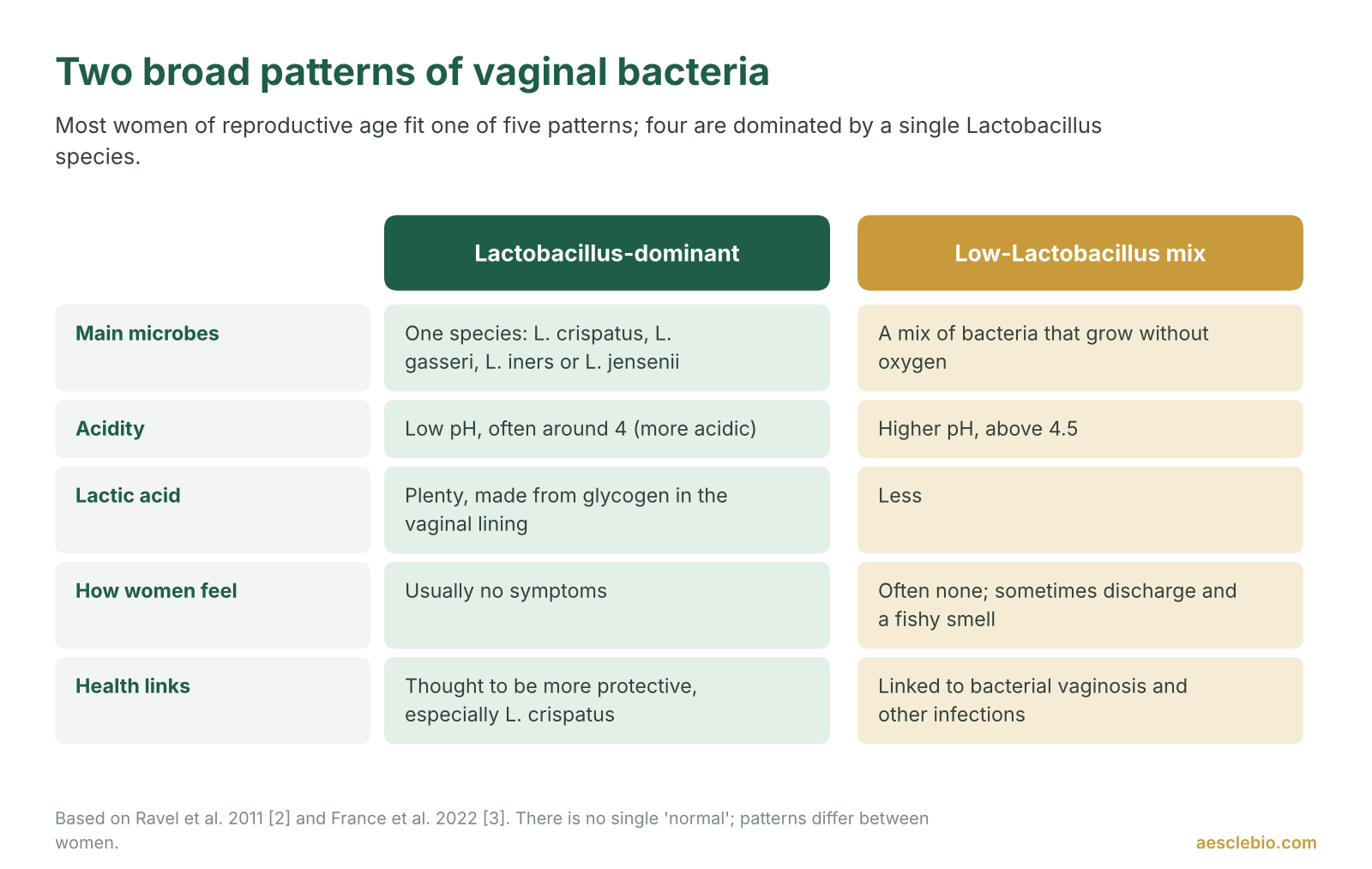
Not all lactobacilli are equal. Communities dominated by L. crispatus are thought to be the most protective, while those dominated by L. iners are less stable and more often shift to the low-Lactobacillus pattern [3]. This is the first clue for anyone choosing a probiotic for women's health: the species matters.
Hormones and life stages
Oestrogen, a female sex hormone, keeps the vaginal lining thick and rich in glycogen, which feeds lactobacilli [3]. That is why the vaginal microbiome changes across life. Before puberty, and again after menopause when oestrogen falls, lactobacilli are less likely to dominate [3]. After menopause the vaginal pH also rises, and a pH of 4.7 or above is one of the more sensitive signs of menopause [3]. The microbiome can also shift around a period, and after unprotected sex, because semen is less acidic than the vagina [3]. Pregnancy is a special case: any probiotic use then should be discussed with a doctor, and this article gives no dosing advice for pregnancy.
Probiotics for bacterial vaginosis: an add-on, not a replacement
Bacterial vaginosis (BV) happens when the usual lactobacilli give way to a mix of other bacteria. It is the most common cause of vaginal discharge worldwide, although most women with BV have no symptoms at all [4]. When symptoms appear, they include a thin, milky discharge and a fishy smell [4]. Doctors treat it with antibiotics, which work, but BV often comes back [3, 4].
Most of the useful research on probiotics for bacterial vaginosis asks one question: after antibiotics, can probiotics help stop BV returning? A 2022 meta-analysis (a study that pools the results of many trials) combined 10 randomised controlled trials with 1,234 women. Randomised controlled trials are studies in which people are placed in groups by chance. Women who took probiotics after standard antibiotic treatment had BV come back less often: about 15% compared with about 26% [6]. The authors rated the evidence as moderate in quality, and they found that whether the probiotic was swallowed or used vaginally did not clearly change the result [6]. A 2023 meta-analysis of vaginal probiotics added to antibiotics also found fewer recurrences, but that estimate rested on only two studies [7].
The clearest single result comes from a 2020 trial published in the New England Journal of Medicine. After a course of vaginal antibiotic gel, 228 women used either a vaginal product containing one strain of L. crispatus or a placebo (a dummy product) for 11 weeks. By week 12, BV had come back in 30% of the probiotic group and 45% of the placebo group [9]. The United States Centers for Disease Control and Prevention (CDC) mentions this result in its 2021 treatment guidelines, but notes that the product was not yet cleared by the US Food and Drug Administration (FDA) or on sale [4].
Probiotics for yeast infection
A vaginal yeast infection, called vulvovaginal candidiasis by doctors, is caused by an overgrowth of Candida yeast. About 75% of women will have at least one episode [5].
A Cochrane review (a careful, independent summary of all good-quality trials) looked at probiotics for yeast infection in 10 trials with 1,656 non-pregnant women. In every trial, probiotics were given together with antifungal medicine. The extra probiotic slightly raised short-term cure rates and lowered relapse at one month, but there was no clear long-term benefit, and the evidence was rated low to very low in quality [8]. The CDC states that there is no substantial evidence for using probiotics to treat yeast infections [5].
Urinary tract infections: the weakest link
Many products also promise "urinary support". A Cochrane review of 9 studies with 735 people found no significant reduction in repeat urinary tract infections with probiotics compared with placebo. The studies were small and poorly reported, so a benefit cannot be ruled out, but it has not been shown either [11].
What our own research shows about women's health trials
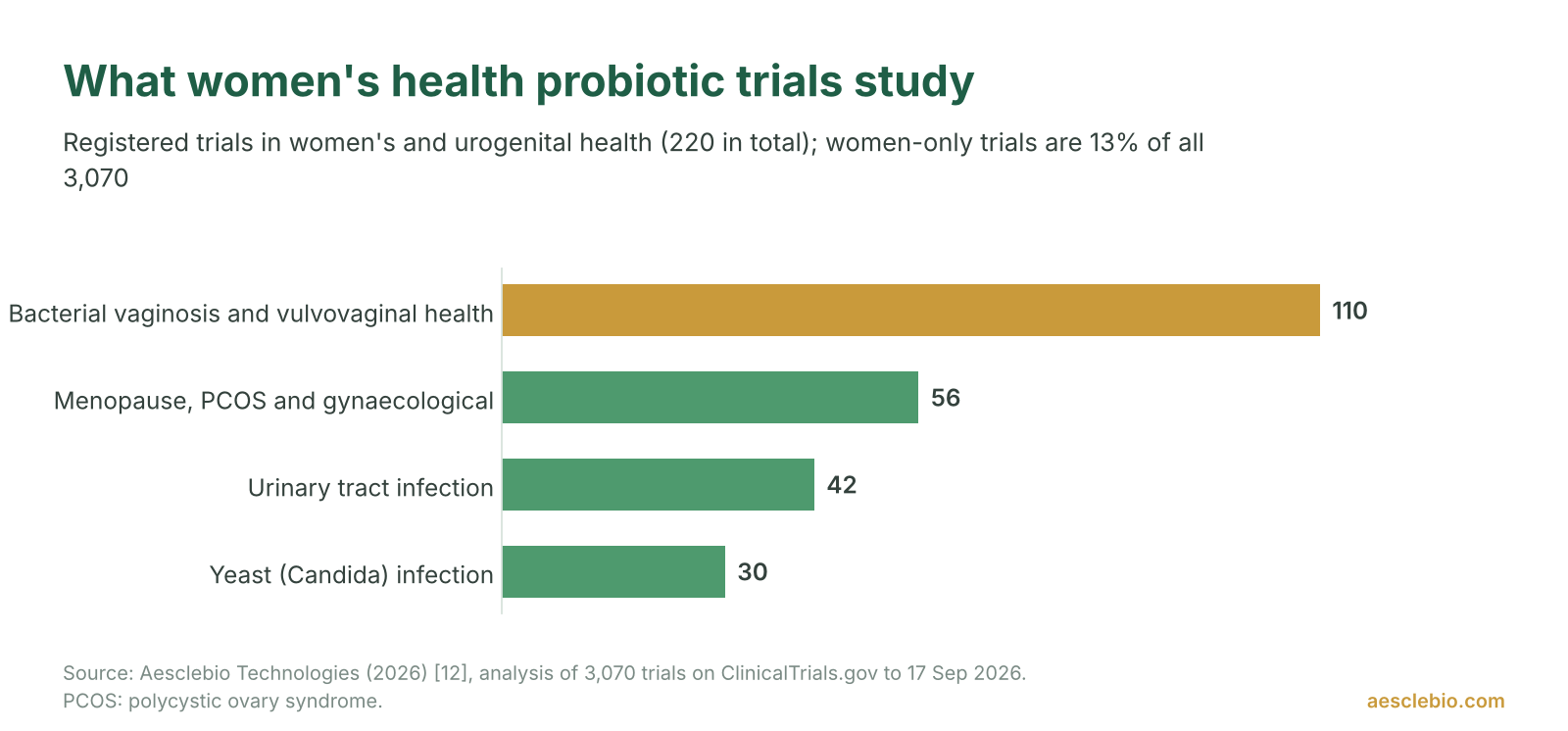
Aesclebio's analysis of 3,070 probiotic-type clinical trials registered on ClinicalTrials.gov, the public trial registry run by the US National Library of Medicine, found that women-only trials make up 13% of the total, covering vaginal health, pregnancy and menopause [12]. The women's and urogenital health area holds 220 trials, and L. crispatus is one of the fastest-growing species in the whole registry, rising by about 26% a year, mainly in vaginal health trials [12].
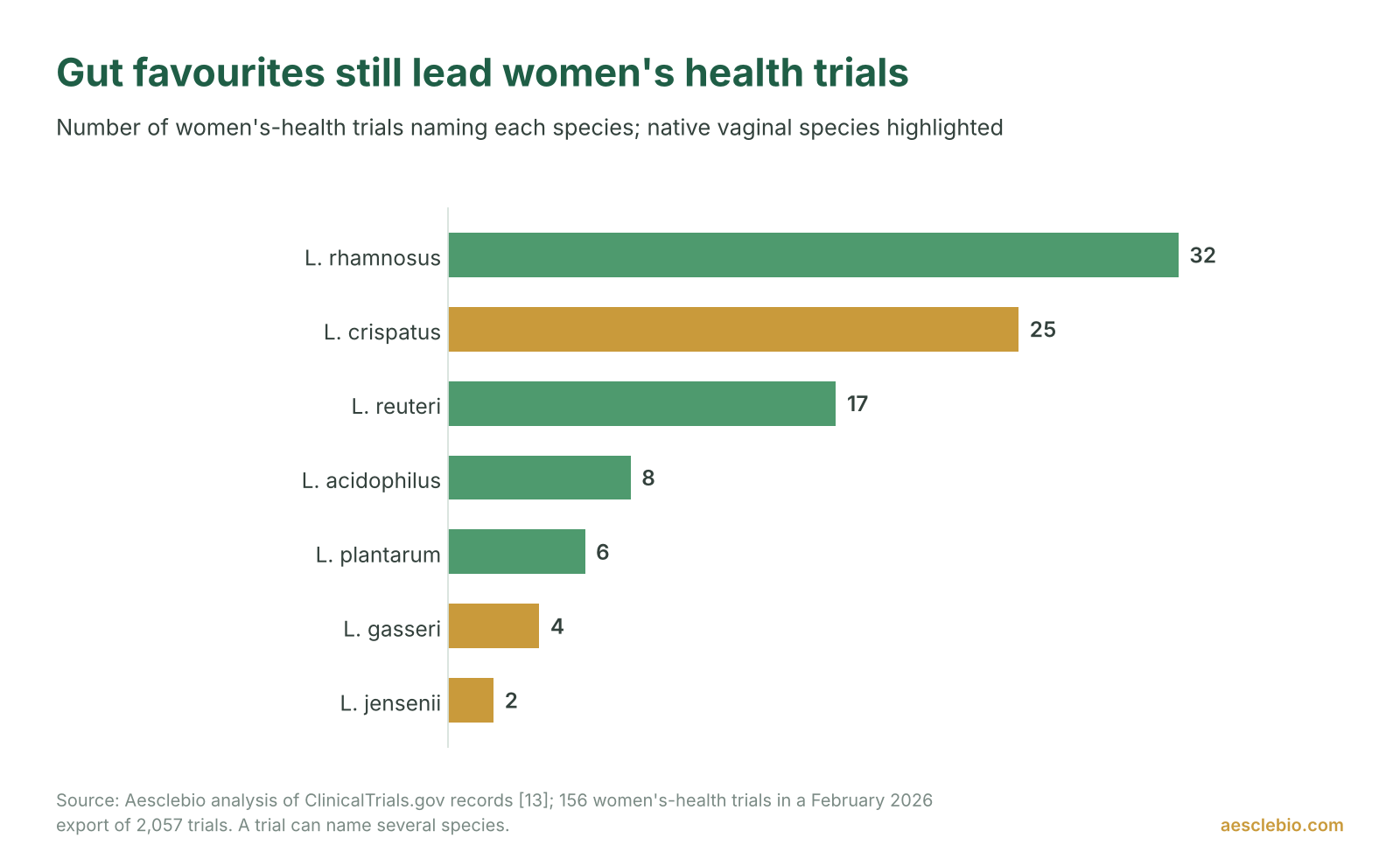
We then looked at which species these trials actually test. In a separate Aesclebio analysis of ClinicalTrials.gov records (2,057 trials, February 2026 export), 156 trials sat in the women's health area. The species named most often were L. rhamnosus and L. reuteri, two species better known from gut probiotics, while the species that naturally dominate the vagina appeared less often, except for L. crispatus [13]. Capsules (21 trials) and vaginal products (13) were the commonest formats; only 3 used yoghurt or other dairy foods [13].
The strains with evidence: a species-by-species guide
Results belong to specific strains, the "identity numbers" within a species, so a finding for one strain does not automatically apply to another.
| Species | Natural home | What trials show | Evidence |
|---|---|---|---|
| L. crispatus | Dominates many healthy vaginal communities [2] | Used vaginally after antibiotics, one strain: BV came back in 30% of women vs 45% on placebo at 12 weeks [9] | Most promising |
| L. rhamnosus and L. reuteri (often paired) | Mainly gut-probiotic species; not one of the main vaginal dominants [2, 3] | The two species named most often in registered trials [13]; a strain pair taken by mouth in a pregnancy trial did not change the vaginal microbiome [10] | Mixed |
| L. gasseri | Dominates some healthy vaginal communities [2] | Few registered trials so far (4 in our data) [13] | Early |
| L. jensenii | Dominates some healthy vaginal communities [2] | Very few registered trials (2 in our data) [13] | Early |
| L. iners | Very common in the vagina, but less stable and thought to be less protective [3] | Not used as a probiotic | Not a target |
A review by leading vaginal microbiome researchers noted that some vaginal probiotics fell short partly because they used species borrowed from gut probiotics rather than species common in the human vagina, and some were given as oral tablets in the hope that they would reach the vagina indirectly [3]. Yet the 2022 meta-analysis found no clear difference by route [6]. It means the label should tell you which species and strain you are getting, and whether that exact strain was tested for the purpose you care about.
Myth or fact?
| Myth | What the evidence says |
|---|---|
| A women's probiotic can replace antibiotics for BV. | Trials test probiotics after standard treatment, and the CDC found no studies supporting them as a replacement [4, 6]. |
| Any Lactobacillus is a vaginal Lactobacillus. | Healthy vaginal communities are usually dominated by L. crispatus, L. gasseri, L. jensenii or L. iners [2]. Many general probiotics use gut species instead [3]. |
| Probiotics prevent urinary tract infections. | A Cochrane review found no significant reduction in repeat infections; the studies were small [11]. |
| Washing inside the vagina (douching) keeps it healthy. | The CDC warns that douching might increase the risk of BV coming back, and no data support it for treatment [4]. |
| Eating yoghurt is enough to protect vaginal health. | Yoghurt is a fermented food with live microbes [14], but the BV trials that showed benefit used capsules, sachets or vaginal products, and food-based probiotics were excluded from the 2022 meta-analysis [6]. |
Probiotic rich foods for women: helpful, but not a treatment
People often ask for the best probiotic foods for women. Yoghurt, curd, kefir and other fermented foods can contain plenty of live microbes and are a good part of a varied diet [14]. But their microbes are there to make the food, and they are often an undefined mix at levels that vary [14]. In our data, only 3 women's-health trials used a dairy food [13]. So probiotic rich foods for women are welcome on the plate, but there is no evidence that any single food, even the best probiotic food for women, treats or prevents vaginal infections.
How to choose a probiotic for feminine health
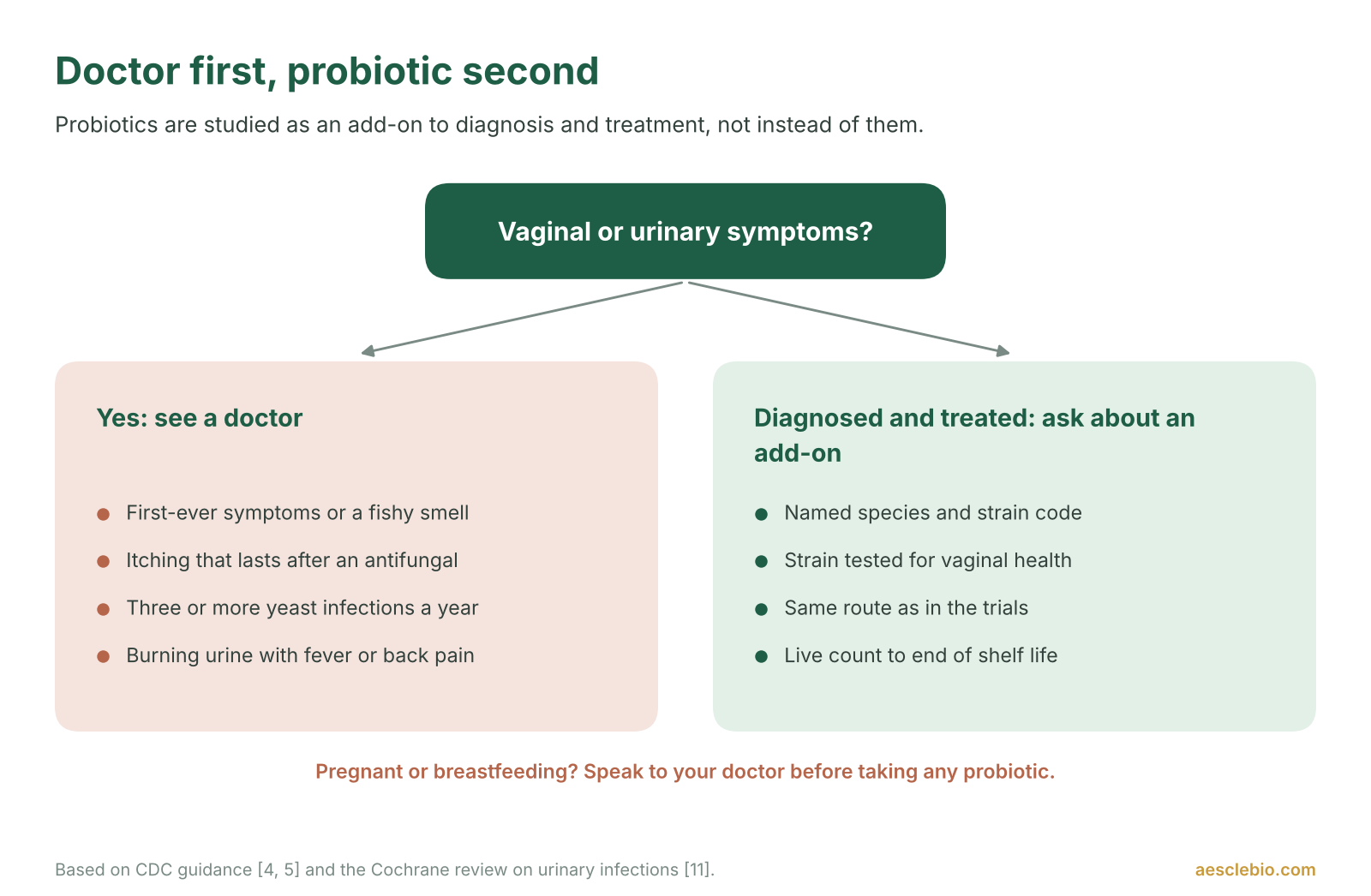
There is no single best probiotic for women's health or best probiotic for female health that suits everyone, and no product should be chosen before a diagnosis. If you and your doctor decide a probiotic is worth trying as an add-on, these checks help:
- Full strain name: genus, species and strain code, not just "Lactobacillus blend".
- A vaginal species where possible: L. crispatus has the strongest recent trial result [9].
- Evidence for that exact strain in vaginal or urinary health, not borrowed from gut studies.
- The route that was tested: vaginal or oral, as in the trials [6, 9].
- Live count to the end of shelf life, measured in colony-forming units (CFU), the standard count of live microbes.
- Dairy free? Many capsules contain no milk, but check the label for milk-derived ingredients if you need the best probiotic for women, dairy free.
- Quality: made under good manufacturing practice (GMP), the quality rules for making supplements safely and consistently.
For brands, the same checklist applies before any bulk order for women's health probiotic products.
When to see a doctor
- Symptoms for the first time, or a discharge with a fishy smell [4].
- Itching or soreness that continues after an over-the-counter antifungal [5].
- Three or more yeast infections in a year (doctors call this recurrent) [5].
- Burning when passing urine with fever, back pain or feeling unwell, because a urinary infection can spread to the kidneys [11].
- Any vaginal symptoms during pregnancy [4, 5].
- Any chance of a sexually transmitted infection, because yeast-infection symptoms are not specific and other infections can look similar [5].
The bottom line
The vaginal microbiome is a simple, acidic ecosystem in which a few native Lactobacillus species do most of the work. Probiotics influence on women's health is real but modest and specific: the best evidence is that, in trials, probiotics given after antibiotics reduced how often BV came back, with a small short-term benefit alongside yeast treatment and little proof for urinary infections. The words "for women" on a label prove nothing. The species, the strain, the route and the trial behind it do. See a doctor for a diagnosis first, then ask whether a well-studied probiotic belongs alongside your treatment.
Frequently asked questions
What does a women's probiotic do?
A women's probiotic aims to support the lactobacilli that keep the vagina acidic [3]. In trials, probiotics taken after antibiotics reduced how often bacterial vaginosis came back [6, 9], and alongside antifungal medicine they slightly improved short-term results in yeast infections [8]. They are not a treatment on their own, and evidence for urinary infections is weak [11].
What is the best probiotic for women's vaginal health?
No single product suits everyone. The strongest recent trial used a strain of Lactobacillus crispatus, a species that naturally dominates many healthy vaginal communities, given vaginally after antibiotics [2, 9]. Look for a named strain that was tested for vaginal health by the same route, and talk to your doctor first.
What are the main women's probiotic benefits?
The best-supported benefit is fewer repeat episodes of bacterial vaginosis when probiotics follow standard treatment: in pooled trials, about 15% of women had BV return compared with about 26% without probiotics [6]. Benefits for yeast infections are small and short-term [8], and benefits for urinary tract infections have not been shown [11].
Do probiotics for bacterial vaginosis work without antibiotics?
The trials that showed benefit gave probiotics after standard antibiotic treatment [6, 9]. The CDC found no studies supporting probiotics as a replacement for treatment [4]. If you think you have BV, see a doctor for a diagnosis and treatment first.
Can probiotics help with a yeast infection?
A Cochrane review found that probiotics added to antifungal medicine slightly improved short-term cure and relapse at one month, but not long-term results, and the evidence was low quality [8]. The CDC says there is no substantial evidence for probiotics as a treatment for yeast infections [5].
Do probiotics prevent urinary tract infections (UTIs)?
So far, this is not proven. A Cochrane review of 9 small studies found no significant reduction in repeat urinary tract infections with probiotics compared with placebo [11]. Burning when passing urine, especially with fever or back pain, needs a doctor, because untreated infections can spread to the kidneys [11].
Is it safe to make a probiotic suppository at home?
People sometimes search how to make probiotic suppository inserts from yoghurt or opened capsules. Please don't, and we give no instructions for it. Homemade inserts are not what the trials tested, you cannot know which microbes or how many you are putting in, and foods and capsule contents are not made to go into the vagina. Treating yourself without a diagnosis can also delay the right treatment, because other infections cause similar symptoms [5]. See a doctor instead.
Are probiotic rich foods for women enough?
Fermented foods such as yoghurt and kefir can contain live microbes and suit a healthy diet [14], but their microbes are often an undefined mix, and trials of vaginal health mostly used capsules or vaginal products [6, 13]. Eating yogurt is fine; it is just not a proven treatment.
Can I take a vaginal probiotic during pregnancy or after menopause?
Pregnancy needs a doctor's advice before starting any probiotic; in one UK trial, an oral probiotic taken in pregnancy did not change the vaginal microbiome [10]. After menopause, lower oestrogen changes the vaginal environment, so symptoms such as dryness or irritation should be checked by a doctor [3].
Related reading
- Probiotics in Pregnancy (Aesclebio blog)
- Your Probiotic Is a Strain, Not a Species: Reading the Code After the Name
- What Probiotics Are, and the Five Myths That Survive Every Explainer
- Microbiome vs Microbiota: The Words Everyone Uses and Almost Nobody Defines
- Probiotic Foods vs Probiotic Supplements: Why a Probiotic Foods List Is Not a Dose
References
- Food and Agriculture Organization of the United Nations and World Health Organization. Probiotics in food: health and nutritional properties and guidelines for evaluation. FAO Food and Nutrition Paper 85. Rome: FAO; 2006. Link
- Ravel J, Gajer P, Abdo Z, et al. Vaginal microbiome of reproductive-age women. Proceedings of the National Academy of Sciences of the USA. 2011;108(Suppl 1):4680–4687. Free full text: PubMed Central PMC3063603. Link
- France M, Alizadeh M, Brown S, et al. Towards a deeper understanding of the vaginal microbiota. Nature Microbiology. 2022;7(3):367–378. Free full text: PubMed Central PMC8910585. Link
- Centers for Disease Control and Prevention. Bacterial vaginosis. Sexually Transmitted Infections Treatment Guidelines, 2021. Atlanta: CDC; 2021. Link
- Centers for Disease Control and Prevention. Vulvovaginal candidiasis. Sexually Transmitted Infections Treatment Guidelines, 2021. Atlanta: CDC; 2021. Link
- Chieng WK, Abdul Jalal MI, Bedi JS, et al. Probiotics, a promising therapy to reduce the recurrence of bacterial vaginosis in women? A systematic review and meta-analysis of randomized controlled trials. Frontiers in Nutrition. 2022;9:938838. Open access. Free full text: PubMed Central PMC9530327. Link
- Ma S, Wang W, Su Y, et al. Antibiotics therapy combined with probiotics administered intravaginally for the treatment of bacterial vaginosis: a systematic review and meta-analysis. Open Medicine. 2023;18(1):20230644. Open access. Free full text: PubMed Central PMC10505304. Link
- Xie HY, Feng D, Wei DM, et al. Probiotics for vulvovaginal candidiasis in non-pregnant women. Cochrane Database of Systematic Reviews. 2017;11:CD010496. Free full text: PubMed Central PMC6486023. Link
- Cohen CR, Wierzbicki MR, French AL, et al. Randomized trial of Lactin-V to prevent recurrence of bacterial vaginosis. New England Journal of Medicine. 2020;382(20):1906–1915. Free full text (author manuscript): PubMed Central PMC7362958. Link
- Husain S, Allotey J, Drymoussi Z, et al. Effects of oral probiotic supplements on vaginal microbiota during pregnancy: a randomised, double-blind, placebo-controlled trial with microbiome analysis. BJOG. 2020;127(2):275–284. Free full text: PubMed Central PMC6973149. Link
- Schwenger EM, Tejani AM, Loewen PS. Probiotics for preventing urinary tract infections in adults and children. Cochrane Database of Systematic Reviews. 2015;(12):CD008772. Free full text: PubMed Central PMC8720415. Link
- Aesclebio Technologies. Probiotic Clinical Trials: Where the Industry Is Heading. A registry-based analysis of ClinicalTrials.gov data to 17 September 2026. Hyderabad: Aesclebio Technologies Pvt. Ltd.; 2026. Link
- Aesclebio Technologies. Aesclebio analysis of ClinicalTrials.gov records: enriched dataset of 2,057 interventional probiotic-type trials (ClinicalTrials.gov export, February 2026). Hyderabad: Aesclebio Technologies Pvt. Ltd.; 2026. Link
- Marco ML, Sanders ME, Gänzle M, et al. The International Scientific Association for Probiotics and Prebiotics (ISAPP) consensus statement on fermented foods. Nature Reviews Gastroenterology & Hepatology. 2021;18:196–208. Free full text: PubMed Central PMC7925329. Link
Disclaimer
This article is for general education only. It is not medical advice and is not intended to diagnose, treat, cure or prevent any disease. It does not promote any specific product or brand, and it makes no claims about any product.
Statements about research describe the findings of published studies. They do not mean that any particular food or supplement will have the same effect for you. Always speak to a qualified healthcare professional before changing your diet or starting a supplement, especially if you are pregnant, breastfeeding, giving products to a baby or child, or living with a health condition.
This topic concerns babies, pregnancy or new mothers. Nothing here is a recommendation to give any product to a baby or to use any product during pregnancy or breastfeeding. Decisions about care should always be made with a doctor, midwife or other qualified healthcare professional.
Rules on how probiotics and supplements may be described differ from country to country. Nothing in this article should be read as a health claim for any product.
Lactin-V, which appears in the title of a cited research paper, is a product name of Osel, Inc. It is mentioned for information only; Aesclebio has no affiliation with Osel, Inc.
All graphics are original works of Aesclebio Technologies. Figures from other studies are credited to their sources. Quotations are limited to short passages with full attribution. Any clinical-trial figures from Aesclebio's own analysis come from public registry records and do not imply that any product is effective or safe.
Prepared by the Aesclebio Research Team with the help of AI tools, under the team's direction. © 2026 Aesclebio Technologies Pvt. Ltd. All rights reserved. Short extracts may be quoted with a link to the original article.