Regulation
Dietary Supplement or Food Supplement? Definitions That Decide Your Market Entry
What a dietary supplement is in plain words, how the USA, the EU, India, Brazil, Canada and Australia define it, and why the same capsule can change legal identity at the border.
Why the dietary supplement definition matters more than people think
Most people who ask "what's a dietary supplement?" simply want to know what the word means. Fair enough. But for anyone who makes, imports or exports supplements, the definition is not a dictionary question. It is a legal switch. The same probiotic capsule, with the same ingredients, can be a food in one country and a kind of medicine in the next. Our argument in this article is simple: your ingredient does not decide your market entry; the destination country's definition, plus the words on your label, does.
We start with a plain answer, then compare the official wording in six markets, as of October 2026. This is general information, not legal advice.
What is a dietary supplement? A simple definition
Here is a dietary supplement definition simple enough for anyone: a product taken by mouth, in measured doses, to add something to the normal diet. That "something" may be vitamins, minerals, plant extracts, amino acids (the building blocks of protein) or live microbes. Almost every legal definition in the world contains four ideas, shown below.
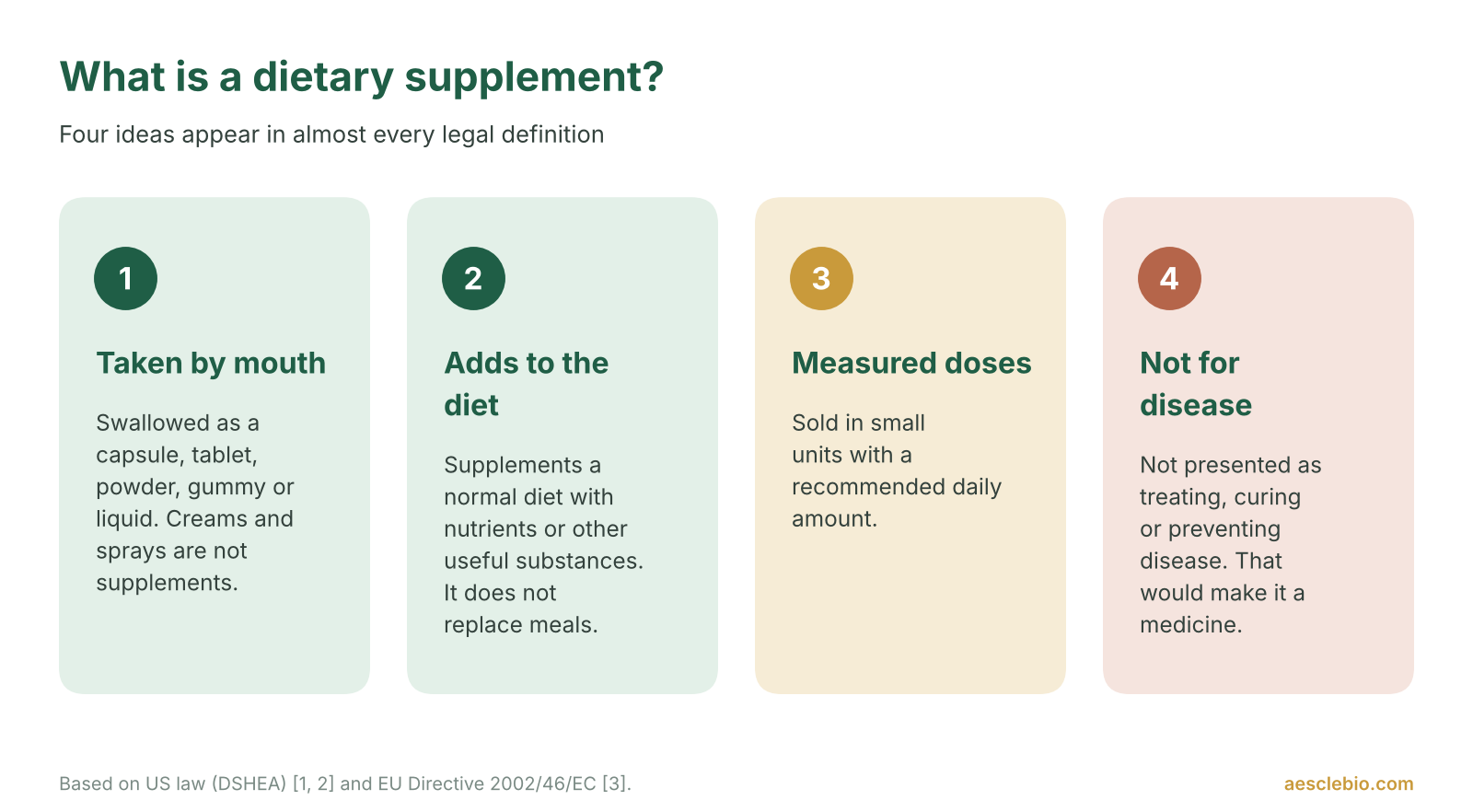
So, what does a dietary supplement mean in practice? It means a product that sits between ordinary food and medicine. It looks like a medicine (a capsule or tablet), but it is regulated, in most big markets, more like a food. That in-between position is exactly why countries draw the line in different places.
Food supplement and dietary supplement: two names, one idea
People often ask about the food supplement and dietary supplement difference. In everyday use, there is very little. "Dietary supplement" is the American legal term; "food supplement" is the European one. Food supplementation, meaning adding concentrated nutrients to what you eat, is the shared idea behind both. What really differs is the legal text behind each name, so let us read it.
USA: the dietary supplement under DSHEA
In the United States, the Dietary Supplement Health and Education Act of 1994 (DSHEA) added a definition to the main food and drug law. A dietary supplement is "a product (other than tobacco) intended to supplement the diet" that "bears or contains one or more of the following dietary ingredients": a vitamin, a mineral, a herb or other botanical, an amino acid, a dietary substance, or a concentrate, extract or combination of these [2]. It must also be taken by mouth, must not be "represented for use as a conventional food or as a sole item of a meal or the diet", and must be "labeled as a dietary supplement" [2]. The same law says a dietary supplement is "deemed to be a food" [2].
The US Food and Drug Administration (FDA), the national regulator, says dietary substances include enzymes and "live microbials", commonly called probiotics [1]. Importantly, the FDA "does not have the authority to approve dietary supplements before they are marketed" [1]. The company is responsible for safety and truthful labels.
European Union: the food supplement
The EU's Directive 2002/46/EC is the shared law for its member countries. It defines food supplements as "foodstuffs the purpose of which is to supplement the normal diet" and which are "concentrated sources of nutrients or other substances with a nutritional or physiological effect", sold in dose form such as capsules, pastilles, tablets, sachets of powder or drop bottles [3]. Here, "nutrients" means only vitamins and minerals; other substances are allowed, but until EU-wide rules are adopted, national rules may apply to them [3]. The product must be sold under the name "food supplement" [3], and countries may require a notification: when the product goes on sale, the seller sends a model of the label to the national authority [3, 4].
India: health supplements and nutraceuticals
India's food regulator, the Food Safety and Standards Authority of India (FSSAI), does not use either word as its main category. Under its 2016 regulations on health supplements, nutraceuticals and related foods (amended in 2021; according to Aesclebio's India regulatory guide, a 2022 draft replacement applied through regulator directions was still not final as of September 2026), health supplements are intended "to supplement the normal diet of a person above the age of five years" with concentrated nutrients [6, 7]. Nutraceuticals are natural ingredients "extracted, isolated and purified" that give a physiological benefit in measured amounts [6]. Probiotics usually go in a separate box called "probiotic food", with its own label words [7].
Brazil, Canada and Australia in brief
- Brazil. Brazil's health regulator, the National Health Surveillance Agency (ANVISA), has had one single category, the suplemento alimentar (food supplement), since 2018 [13]. It is a product "para ingestão oral, apresentado em formas farmacêuticas" (for oral intake, in pharmaceutical forms) to supplement the diet of healthy people with nutrients, bioactive substances, enzymes or probiotics [12].
- Canada. Supplements are mostly natural health products, a framework separate from both ordinary food and prescription drugs. Its list of included substances names vitamins, minerals, amino acids and, as its own item, "a probiotic" [9]. Health Canada assesses these products before sale, and approved ones carry an eight-digit Natural Product Number (NPN) on the label [8].
- Australia. Most vitamin and probiotic products are complementary medicines regulated by the Therapeutic Goods Administration (TGA). Many are "listed medicines" with an AUST L number on the label: they must use permitted ingredients and choose claims from a permitted list, but the TGA does not assess their effectiveness before listing [10, 11].
Why the definition decides claims, labels and the route to market
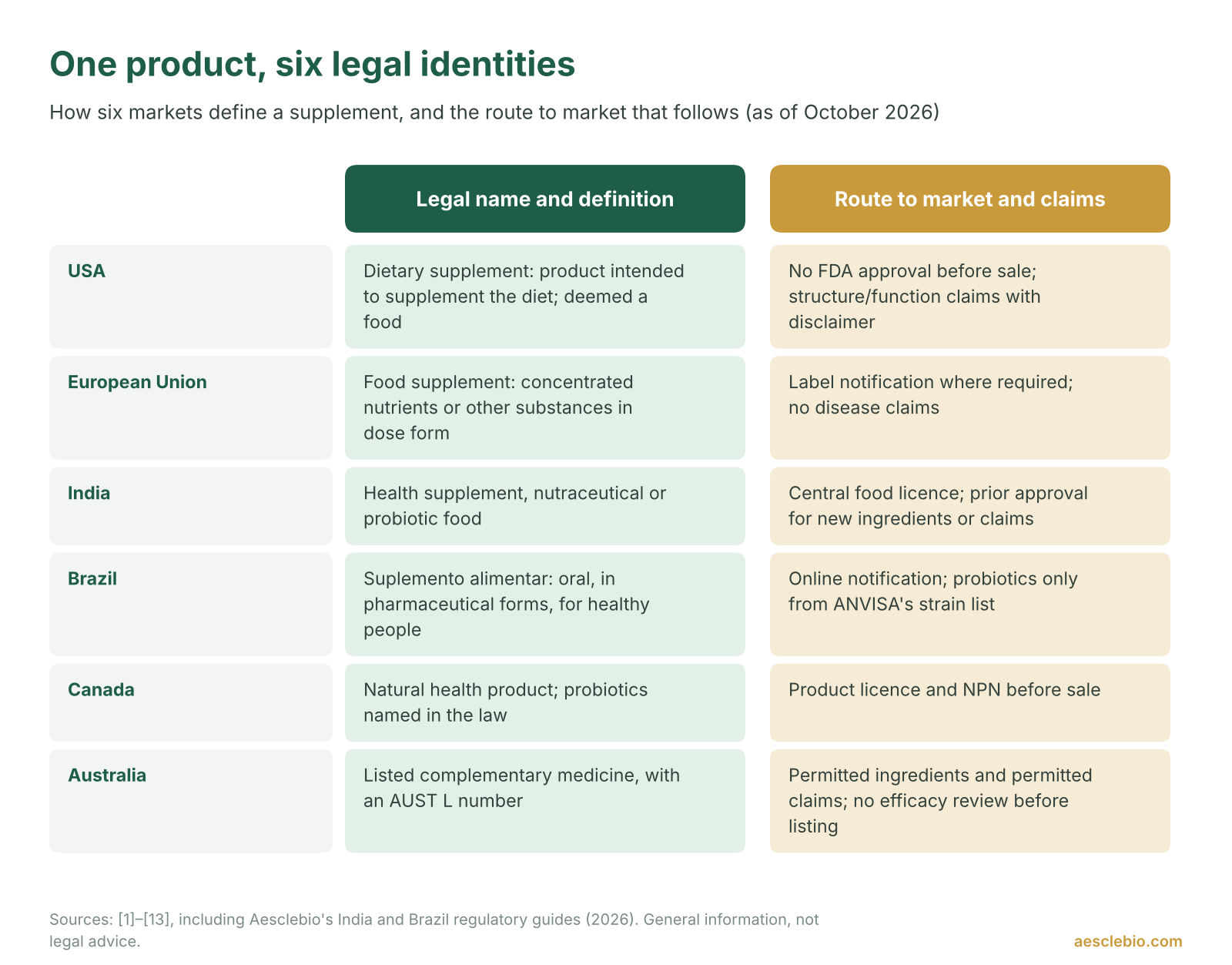
Once you know which box a product falls into, three practical things follow automatically.
- Claims. In the USA, a supplement may describe effects on a body structure or function, but must carry the statement "This statement has not been evaluated by the Food and Drug Administration" [1]. In the EU, labels must not suggest a food supplement prevents, treats or cures a disease [3]. In India, according to Aesclebio's India regulatory guide (status as of 2026), the only probiotic claim allowed without prior approval is "source of probiotics" [7]. In Brazil, according to Aesclebio's Brazil regulatory guide (status as of 2026), each entry on ANVISA's approved probiotic list comes with one claim sentence written by ANVISA, which must be printed word for word [13].
- Labels. The legal name changes: "dietary supplement" in the USA [2], "food supplement" in the EU [3], "HEALTH SUPPLEMENT", "NUTRACEUTICAL" or "PROBIOTIC FOOD" plus "NOT FOR MEDICINAL USE" in India [7], and "Este produto não é um medicamento" (this product is not a medicine) in Brazil [13].
- Route to market. It ranges from no product approval at all (USA) [1], through notification (EU countries that ask for it, and Brazil) [3, 4, 13], to licensing before sale (India for food businesses, Canada for each product) [7, 8].
| Market | Legal name | Before you sell | Where probiotics sit |
|---|---|---|---|
| USA | Dietary supplement (a type of food) | No FDA approval of the product | Dietary ingredient ("live microbials") |
| European Union | Food supplement | Label notification, where the country requires it | Allowed; the word "probiotic" counts as a health claim |
| India | Health supplement, nutraceutical or probiotic food | Central food licence; prior approval for new ingredients or claims | Own category: probiotic food, from a list of 30 species |
| Brazil | Suplemento alimentar (food supplement) | Online notification by a Brazilian company | Only strains on ANVISA's approved list |
| Canada | Natural health product | Product licence (NPN) before sale | Named as its own included substance |
| Australia | Listed complementary medicine | Listing on the national register (AUST L) | Microorganisms from the permitted ingredients list |
Dietary supplement vs vitamin vs drug vs functional food
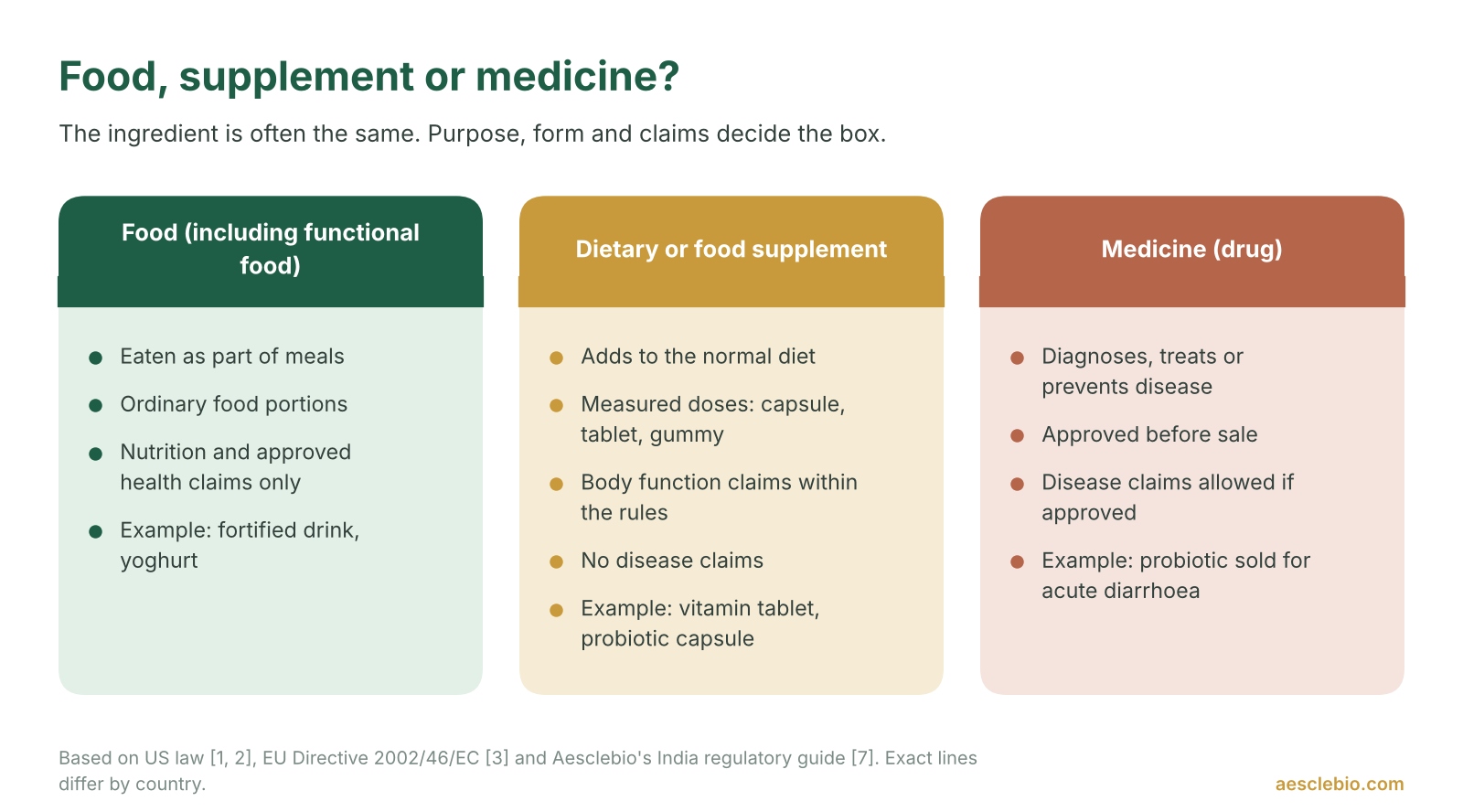
Four words get mixed up all the time. A vitamin is an ingredient; a dietary supplement is a finished product that may contain vitamins, and many contain none. That is the whole difference between food supplement and vitamins. A drug, in US law, is something "intended for use in the diagnosis, cure, mitigation, treatment, or prevention of disease" [2]. A functional food usually means an everyday food with an extra benefit, such as a fortified drink. The term is used loosely, and its legal weight depends on the market: in the EU, any health claim on such a food still follows the same claims rules as every other food [5], while India's 2016 regulations name functional foods in their title alongside health supplements and nutraceuticals [6].
The line between supplement and drug is usually drawn by purpose and words, not by the ingredient. Aesclebio's India regulatory guide (status as of September 2026) puts it plainly: "The ingredient is neutral. The presentation decides: label words, brand name, pictures, dose and advertising" [7]. A probiotic sold "for acute diarrhoea" is on the medicine route in India; the same organism sold to support general well-being can stay a food [7].
Where do probiotics sit?
Probiotics are, in the words of experts convened by the Food and Agriculture Organization (FAO) and the World Health Organization (WHO), "live microorganisms which when administered in adequate amounts confer a health benefit on the host" [14]. Every market above allows them, but each puts them in a different place, and the details matter.
- In the USA, live microbials count as dietary substances, so a probiotic capsule is a dietary supplement [1].
- In the EU, the European Commission's 2007 guidance says "the reference to probiotic/prebiotic implies a health benefit", so "contains probiotics" is treated as a health claim, which must be authorised [5]. Many brands therefore avoid the word on EU labels.
- In India, Aesclebio's India regulatory guide (status as of 2026) counts 30 organisms allowed in probiotic food, listed at the species level, with at least 100 million live cells per day's serving [6, 7].
- In Brazil, approval is strain by strain. Aesclebio's Brazil regulatory guide (status as of 2026) counts 34 authorised probiotic entries, about 26 unique strains, added from 2020 to June 2026, and no general "immunity" claim on the list [13]. A strain that is not listed needs an ANVISA evaluation first, which ANVISA estimates at 270 to 360 days and which often takes longer [13].
- In Canada and Australia, probiotics follow the medicine-style routes described above [8, 9, 11].
What about fermented food supplements, such as powders made from fermented foods? If the label promises live microbes, the probiotic rules above usually apply. If the microbes are dead or not counted, the product cannot be sold as a probiotic, because these definitions require live microbes; it falls into whatever category its other ingredients and claims decide [7, 13, 14].
Myth or fact?
| Myth | What the evidence says |
|---|---|
| A supplement is a supplement everywhere. | The same product is a food in the USA, the EU, India and Brazil, but a natural health product in Canada and a listed medicine in Australia [2, 3, 7, 8, 10]. |
| FDA approval is needed before selling a dietary supplement in the USA. | The FDA does not approve dietary supplements before they are marketed; companies are responsible for safety and labels [1]. |
| If the ingredients are allowed, any claim is fine. | Claims are controlled separately. Disease claims are banned on EU food supplements [3], and Aesclebio's India guide (2026) finds only "source of probiotics" allowed without prior approval [7]. |
| "Probiotic" is a neutral word you can always print. | Under EU guidance, the word itself implies a health benefit and is treated as a health claim [5]. |
What brand owners and exporters should do
The definition also reaches upstream. The same tests apply to bulk raw materials for dietary supplements: an ingredient that is permitted in one market may need approval in the next. Whether you build your own range or work with a dietary supplement and nutraceutical manufacturer or a contract R&D (research and development) partner, settle the category before you design the formula.
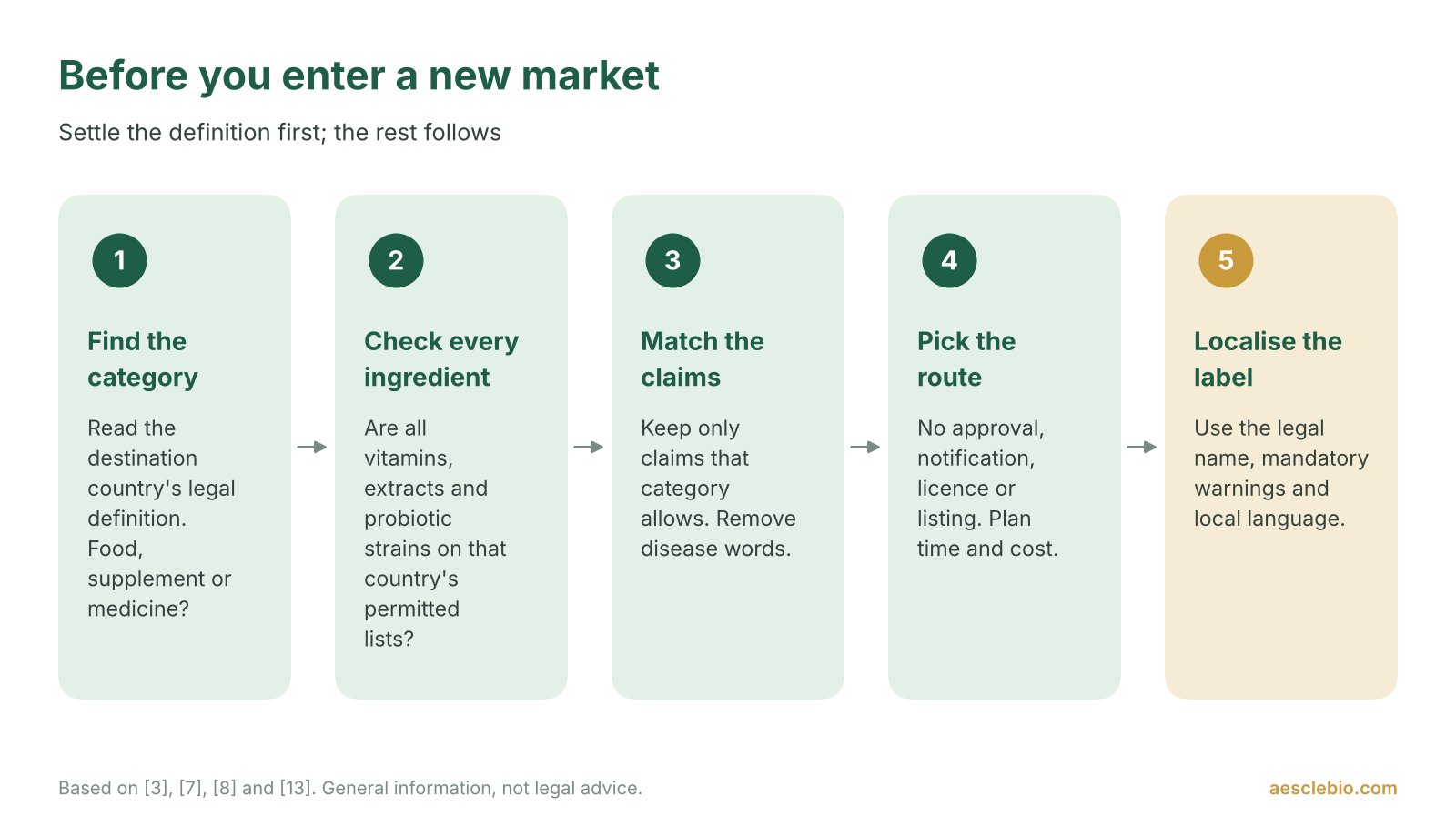
- Write a one-page classification note for each product and each country: why it is a supplement, food or medicine there [7].
- Design formulas around ingredients and probiotic strains already on the target country's lists [7, 13].
- Write claims for the strictest market first, then add where rules allow.
- Translate the legal name and mandatory warnings, not just the brand story.
Good dietary supplement B2B solutions, from formulation to labelling, start from the definition, not from the capsule.
The bottom line
A dietary supplement, in plain words, is a measured dose of something extra for your diet. "Food supplement" means nearly the same thing in Europe. But at a border, definitions stop being words and become routes: no product approval in the USA, notification in much of Europe and Brazil, licensing in India and Canada, and a medicine-style register in Australia. Read the destination country's definition first. It will tell you what you can say, what you must print and how long it will take to reach the shelf.
Frequently asked questions
What is a dietary supplement, in simple words?
A dietary supplement is a product you swallow in measured doses, such as a capsule, tablet, powder, gummy or liquid, to add nutrients or other useful substances to your normal diet. It does not replace meals and is not sold to treat disease. In US law it must also be labelled as a dietary supplement and is treated as a type of food [1, 2].
How does US law define dietary supplement products?
Under the 1994 Dietary Supplement Health and Education Act, a dietary supplement is "a product (other than tobacco) intended to supplement the diet" that contains dietary ingredients such as vitamins, minerals, herbs, amino acids or other dietary substances [2]. It is taken by mouth, is not presented as ordinary food or a meal replacement, and is labelled as a dietary supplement [2].
What is the difference between a food supplement and dietary supplement?
In meaning, very little: "dietary supplement" is the US legal term and "food supplement" the EU one [2, 3]. Both describe concentrated nutrients or other substances in dose form. The real differences lie in the rules behind each name, such as notification in many EU countries [4] versus no FDA approval of products before sale in the USA [1].
What is a food supplement under EU law?
The EU's food supplement definition (Directive 2002/46/EC) covers "foodstuffs the purpose of which is to supplement the normal diet" that are concentrated sources of nutrients or other substances, sold in doses such as capsules, tablets or sachets [3]. The label must use the name "food supplement" and give the daily dose and warnings [3].
Dietary supplement vs vitamin: what is the difference?
A vitamin is a single nutrient, an ingredient. A dietary supplement is the finished product, which may contain vitamins, minerals, plant extracts, amino acids or probiotics, alone or mixed [1, 2]. So every vitamin tablet is a supplement, but not every supplement contains a vitamin.
Dietary supplement vs drug: where is the line?
Mostly in purpose and wording. US law defines a drug as something intended for the "diagnosis, cure, mitigation, treatment, or prevention of disease" [2]. A supplement may describe effects on body structure or function, with a required FDA disclaimer [1]. In India, a probiotic sold for a named disease is on the medicine route [7].
Health supplement vs nutraceutical: what is the difference in India?
In FSSAI rules, health supplements supplement the normal diet of people over five years old with concentrated nutrients, such as vitamins and minerals [6]. Nutraceuticals are natural ingredients that are extracted, isolated and purified and give a physiological benefit in measured amounts [6]. Probiotics usually sit in a third box, "probiotic food" [7].
Are probiotics dietary supplements?
In the USA, yes: the FDA counts "live microbials" as dietary substances [1]. In Brazil, probiotics are one of the named contents of a food supplement [12]. In India they are usually "probiotic food" [7], in Canada natural health products [9], and in Australia complementary medicines [11]. Always check the destination market.
Related reading
- What Probiotics Are, and the Five Myths That Survive Every Explainer
- Prebiotics, Probiotics, Postbiotics, Synbiotics: A Field Guide Beyond the Buzzwords
- Probiotic Foods vs Probiotic Supplements: Why a Probiotic Foods List Is Not a Dose
- Choosing a Probiotic Contract Manufacturer (Aesclebio blog)
- Gummies vs Capsules vs Sachets vs Drops (Aesclebio blog)
References
- US Food and Drug Administration. Questions and answers on dietary supplements. Silver Spring, MD: FDA; accessed October 2026. Free to read. Link
- United States Code, Title 21, Section 321: definitions, including paragraph (ff) "dietary supplement" (added by the Dietary Supplement Health and Education Act of 1994) and paragraph (g) "drug". Free text: Legal Information Institute, Cornell Law School; accessed October 2026. Link
- European Parliament and Council. Directive 2002/46/EC of 10 June 2002 on the approximation of the laws of the Member States relating to food supplements. Official Journal of the European Communities. 2002;L183:51–57. Free text: EUR-Lex. Link
- European Commission. Food supplements. Brussels: European Commission, Directorate-General for Health and Food Safety; accessed October 2026. Link
- European Commission, Standing Committee on the Food Chain and Animal Health. Guidance on the implementation of Regulation No 1924/2006 on nutrition and health claims made on foods: conclusions of the Standing Committee. Brussels; 14 December 2007. Link
- Food Safety and Standards Authority of India. Frequently asked questions on the Food Safety and Standards (Health Supplements, Nutraceuticals, Food for Special Dietary Use, Food for Special Medical Purpose, Functional Food and Novel Food) Regulations, 2016. New Delhi: FSSAI; 2021. Link
- Aesclebio Technologies. Probiotic regulation in India: a plain-language guide. Status as of 21 September 2026. Hyderabad: Aesclebio Technologies Pvt. Ltd.; 2026. Link
- Health Canada. About natural health products. Ottawa: Government of Canada; accessed October 2026. Link
- Government of Canada. Natural Health Products Regulations (SOR/2003-196), Schedule 1: included natural health product substances. Justice Laws Website; accessed October 2026. Link
- Therapeutic Goods Administration. The three-tiered risk-based framework for complementary medicines (fact sheet). Canberra: Australian Government Department of Health; accessed October 2026. Link
- Therapeutic Goods Administration. Understanding the application requirements for microorganisms in listed or registered complementary medicine. Canberra: Australian Government; accessed October 2026. Link
- Agência Nacional de Vigilância Sanitária (ANVISA). Suplementos alimentares (webinar presentation on the 2018 regulatory framework, RDC 243/2018 and RDC 241/2018). Brasília: ANVISA; 2020. Link
- Aesclebio Technologies. Probiotic supplements in Brazil: a plain-language regulatory guide. Status as of 28 September 2026. Hyderabad: Aesclebio Technologies Pvt. Ltd.; 2026. Link
- Food and Agriculture Organization of the United Nations and World Health Organization. Probiotics in food: health and nutritional properties and guidelines for evaluation. FAO Food and Nutrition Paper 85. Rome: FAO; 2006. Link
Disclaimer
This article is for general education only. It is not medical advice and is not intended to diagnose, treat, cure or prevent any disease. It does not promote any specific product or brand, and it makes no claims about any product.
Statements about research describe the findings of published studies. They do not mean that any particular food or supplement will have the same effect for you. Always speak to a qualified healthcare professional before changing your diet or starting a supplement, especially if you are pregnant, breastfeeding, giving products to a baby or child, or living with a health condition.
Rules on how probiotics and supplements may be described differ from country to country. Nothing in this article should be read as a health claim for any product.
All graphics are original works of Aesclebio Technologies. Figures from other studies are credited to their sources. Quotations are limited to short passages with full attribution. Any clinical-trial figures from Aesclebio's own analysis come from public registry records and do not imply that any product is effective or safe.
Prepared by the Aesclebio Research Team with the help of AI tools, under the team's direction. © 2026 Aesclebio Technologies Pvt. Ltd. All rights reserved. Short extracts may be quoted with a link to the original article.