
Nutraceuticals · Zinc and Copper
The mineral your zinc supplement quietly takes away
Zinc and copper are not rivals at the same door. What actually happens inside the wall of the gut is stranger than the usual explanation, and it decides how a zinc product should be built.
Zinc is one of the few supplement ingredients where almost everyone involved is right about something. It really is needed in large amounts in India. It really does something useful. And it really can work against copper: just not by the mechanism, or at the dose, that most product literature claims.
Why India's zinc numbers look high
India asks an adult man for 17 milligrams of zinc a day and an adult woman for 13.2. The United States asks for 11 and 8. That looks like a large gap until you read why it exists.
Indian diets are built on cereals, pulses and millets, which are rich in phytate: a storage compound in seeds that grips minerals tightly enough to carry them straight through the gut unabsorbed. The Indian figures assume only 23 per cent of the zinc eaten actually gets in, and raise the requirement to compensate. Europe does the same thing differently, publishing a sliding scale that runs from 9.4 to 16.3 milligrams for men depending on the diet's phytate. At the high-phytate end Europe lands at 16.3, against India's 17. The two systems are solving the same problem.
What zinc is for
More than three hundred enzymes need a zinc atom to work, and over a thousand of the proteins that switch genes on and off use zinc to hold their shape. Shortage shows up as poor growth in children, weakened immunity and a disturbed sense of taste and smell. It is one of the clearest and best-characterised nutritional deficiencies there is.
A caution on a figure that circulates widely: the often-quoted 2,800 to 3,000 is the number of human proteins that bind zinc, most of them gene-switching proteins rather than enzymes. For enzymes, 'more than three hundred' is the defensible claim.
The thing that is not a competition
Almost every article on this subject says that zinc and copper compete for the same transporter. It is a tidy explanation and it is probably not what happens.
Zinc and copper enter the cells lining the gut through two different proteins, from two different families. They are separate doors. When researchers measured the copper-carrying machinery directly in animals given high doses of zinc, its capacity and its grip on copper were both unchanged, which is to say, in those animals, zinc did not block the door.
The protein is called metallothionein. The cells lining the gut are replaced every few days, and when a cell is shed, whatever it is still holding goes with it. So copper that has entered the cell but been captured on the way through is simply lost. It is a hold-up rather than a blockade, and the distinction matters because it explains why the effect depends on how much zinc arrives rather than on which copper salt you chose.
Two honest footnotes. Some researchers have produced copper depletion in animals without seeing much rise in this gripping protein, so the picture may not be complete. And a 2024 study did find zinc and copper genuinely competing for one shared binding site, but on a protein whose usual job is pumping zinc back out of cells, not at the uptake step the standard story blames. The simple 'same door' explanation still looks like the wrong one.
What the evidence actually shows, and what it does not
Here is the study that sits underneath almost every claim made about zinc and copper. In 1989, eighteen healthy women took 50 milligrams of supplemental zinc a day for ten weeks. The researchers measured a copper-dependent enzyme in their red blood cells and found its activity fell significantly. Two other markers of copper status did not change, and nobody developed copper deficiency.
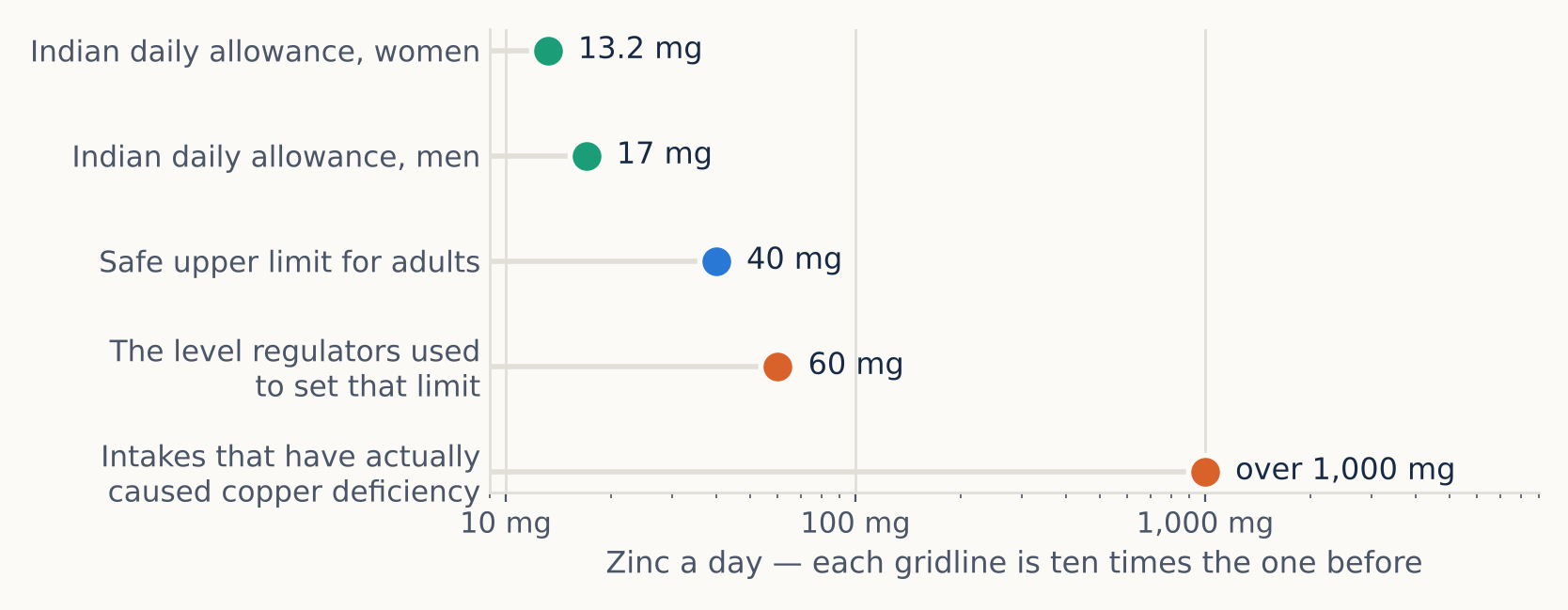
So where does the widely quoted figure of 60 milligrams come from? Not from anyone's bottle. When the United States Institute of Medicine used that study to set a safety limit, it added an assumed 10 milligrams of dietary zinc to the 50 milligram supplement. It called the resulting 60 milligrams the lowest total intake at which an effect had been seen, then divided by a safety factor of 1.5 to arrive at the 40 milligram upper limit that appears on labels today. The 60 milligrams is a regulator's arithmetic, not a dose.
It is also worth knowing that when someone later ran the experiment the arithmetic implies (60 milligrams a day for six weeks, with a comparison group taking a dummy tablet) the same enzyme did not budge in any group.
Where real copper deficiency comes from
Copper deficiency caused by zinc is a documented and serious condition. It causes anaemia, a fall in white blood cells and damage to the spinal cord and nerves, and recovery is often incomplete even after the zinc is removed. But the doses behind it are in a different league.
The best-described cases came from denture adhesive creams sold in the United States in the 2000s, which were found to contain 17,000 to 34,000 micrograms of zinc per gram. Patients who used very large amounts daily for years were swallowing well over a gram of zinc a day: something in the order of twenty times the dose in the 1989 study, sustained for far longer. In one series, eleven of eleven patients with progressive nerve damage turned out to be using such a product. Manufacturers subsequently reformulated.
The responsible way to state this is that a zinc product should be built so copper status is maintained over months of use, and that an ordinary zinc tablet is nowhere near the territory where clinical disease has been described.
The ratio worth formulating to
The most specific published guidance comes from an unexpected place. People who have had weight-loss surgery absorb minerals poorly and are routinely given high-dose zinc, so the nutritional guidelines for that group had to confront the problem directly. The American Society for Metabolic and Bariatric Surgery recommends one milligram of copper for every 8 to 15 milligrams of zinc supplied, specifically so that copper status is maintained.
Two things should be said about using it. It was written for a group whose absorption is impaired, taking doses well above anything a healthy person needs, and the guideline itself marks it as one of its weaker-evidenced recommendations. It is still the only concrete, published, numerical rule in existence, and it is a sensible specification for any product carrying a meaningful zinc dose.
The copper you add has to be copper the body can use
Adding copper to the formula is only half the job. India's permitted-sources list includes copper oxide, more precisely cupric oxide, which was added by a direction dated 29 December 2017 with a ceiling of 2 milligrams a day. On paper it is the most attractive copper ingredient available: nearly 80 per cent copper by weight, stable, and cheap. It is also the one copper source whose usability nutrition researchers have questioned for a quarter of a century, on the basis of animal evidence.
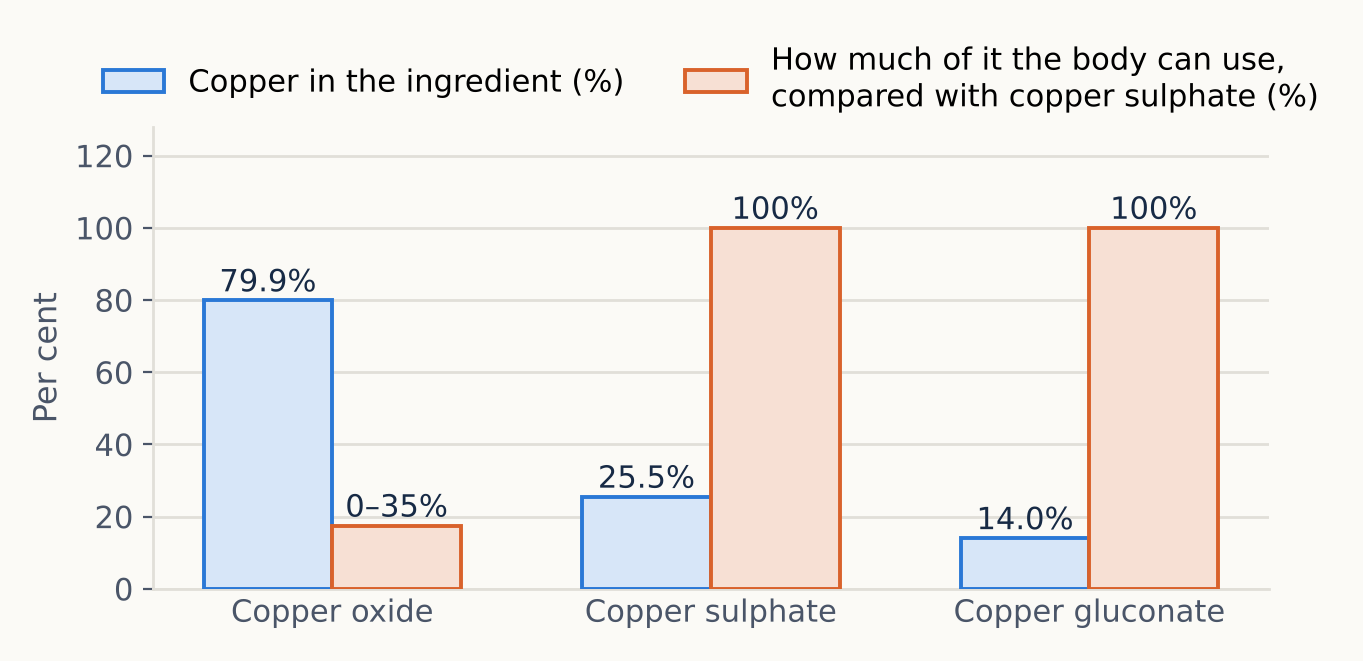
Note what this does not mean. Cuprous oxide (a closely related compound with one less unit of oxygen, and barely soluble in anything) delivered copper as well as copper sulphate did in the same animal studies. So solubility is not the test. The question mark hangs over cupric oxide specifically, and it comes from measurement in livestock rather than from theory. Copper gluconate is the straightforward default for a human product: permitted, well absorbed, and adequate in the amount of copper it carries, since copper doses are tiny in any case.
Which zinc, and which ones India does not name
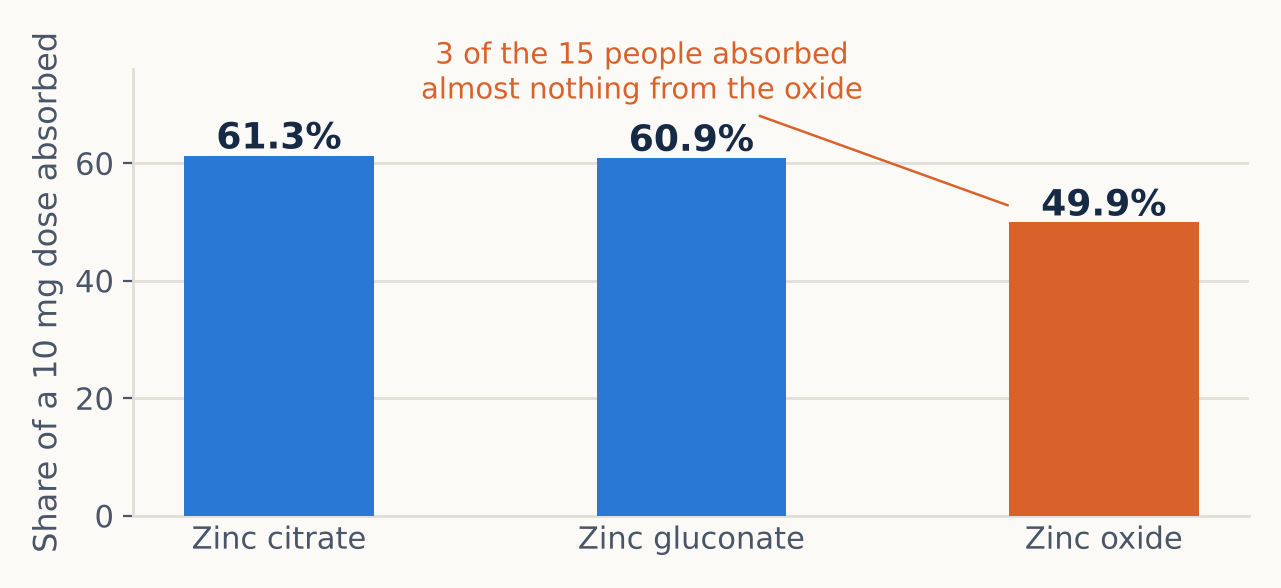
Zinc citrate and zinc gluconate are absorbed equally well and both beat zinc oxide, and the averages understate it, because three of the fifteen people absorbed almost nothing at all from the oxide. Oxide is cheap, carries 80 per cent zinc by weight, and works for most people. Citrate carries 31 per cent, tastes better and worked for everyone in that study.
Eight zinc ingredients are named in India's permitted-sources list: acetate, carbonate, chloride, citrate, gluconate, lactate, oxide and sulphate. Zinc picolinate and zinc bisglycinate, both common internationally, are not among them. The list does carry a general note allowing suitable salts and chelates of minerals, subject to written notification to the Food Authority, which is what manufacturers using those forms rely on. It is not the same as being named.
There is an irony in that pairing worth noticing. Cupric oxide is named. Zinc bisglycinate is not.
An interaction you can stop worrying about
Folic acid does not block zinc. In a controlled study, twelve volunteers took 800 micrograms of folic acid a day for twenty-five days while eating a diet supplying only 3.5 milligrams of zinc: a deliberately difficult test. Nothing changed: not blood zinc, not the zinc leaving in urine, not the gripping protein discussed earlier. The calcium-and-zinc question is a real one but it turns out to have a simple answer, and it is dealt with in the companion article on calcium and magnesium.
Therapeutic zinc is a different product entirely
One last distinction that gets blurred. The World Health Organization and the United Nations Children's Fund recommend 20 milligrams of zinc a day for ten to fourteen days for childhood diarrhoea, and 10 milligrams for infants under six months. That is a treatment, and in India it sits above one day's allowance for every childhood age band, which is why it falls outside the health-supplement route and is handled as a medicine.
A large trial published in 2020 is worth knowing about anyway. Four and a half thousand children aged six to fifty-nine months in India and Tanzania received 5, 10 or 20 milligrams a day for fourteen days. The two lower doses did not perform measurably worse than the standard one on either measure of how the diarrhoea resolved, and both caused significantly less vomiting, falling from 19.3 per cent of children at 20 milligrams to 13.7 per cent at 5 milligrams. That is a question worth putting to the bodies that set the guideline, not a reason for anyone to change a child's prescribed treatment.
The short version
- Zinc at supplement doses works against copper, but by trapping it inside the gut wall rather than by competing for an entrance.
- The human evidence for harm is a shift in one laboratory marker at 50 milligrams a day, not deficiency. Clinical deficiency has needed well over a gram a day for years.
- Include copper at one milligram for every 8 to 15 milligrams of zinc. Copper gluconate is the safe default; the evidence against cupric oxide is from livestock, but it is the only evidence there is.
- Use zinc citrate unless cost forces oxide, and remember that a minority of people appear to get almost nothing from oxide.
- Stop separating zinc from folic acid. There is nothing there.
Sources
- Indian Council of Medical Research – National Institute of Nutrition. Nutrient Requirements for Indians: Recommended Dietary Allowances and Estimated Average Requirements. Hyderabad, 2020.
- European Food Safety Authority Panel on Dietetic Products, Nutrition and Allergies. Scientific opinion on dietary reference values for zinc. EFSA Journal 2014;12(10):3844.
- Prasad AS. Discovery of human zinc deficiency: its impact on human health and disease. Advances in Nutrition 2013;4(2):176–90.
- Andreini C, Banci L, Bertini I, Rosato A. Counting the zinc-proteins encoded in the human genome. Journal of Proteome Research 2006;5(1):196–201.
- Fischer PWF, Giroux A, L'Abbé MR. The effect of dietary zinc on intestinal copper absorption. American Journal of Clinical Nutrition 1981;34(9):1670–5.
- Fischer PWF, Giroux A, L'Abbé MR. Effects of zinc on mucosal copper binding and on the kinetics of copper absorption. Journal of Nutrition 1983;113(2):462–9.
- Li Y, Ma J, Wang R, et al. Zinc transporter 1 functions in copper uptake and cuproptosis. Cell Metabolism 2024;36(9):2118–2129.e6.
- Yadrick MK, Kenney MA, Winterfeldt EA. Iron, copper, and zinc status: response to supplementation with zinc or zinc and iron in adult females. American Journal of Clinical Nutrition 1989;49(1):145–50.
- Institute of Medicine, Food and Nutrition Board. Dietary Reference Intakes for Vitamin A, Vitamin K, Arsenic, Boron, Chromium, Copper, Iodine, Iron, Manganese, Molybdenum, Nickel, Silicon, Vanadium and Zinc. Washington DC: National Academy Press, 2001.
- DiSilvestro RA, Koch E, Rakes L. Moderately high dose zinc gluconate or zinc glycinate: effects on plasma zinc and erythrocyte superoxide dismutase activities in young adult women. Biological Trace Element Research 2015;168(1):11–4.
- Nations SP, Boyer PJ, Love LA, et al. Denture cream: an unusual source of excess zinc, leading to hypocupremia and neurologic disease. Neurology 2008;71(9):639–43.
- Hedera P, Peltier A, Fink JK, et al. Myelopolyneuropathy and pancytopenia due to copper deficiency and high zinc levels of unknown origin II. The denture cream is a primary source of excessive zinc. Neurotoxicology 2009;30(6):996–9.
- Parrott J, Frank L, Rabena R, et al. American Society for Metabolic and Bariatric Surgery integrated health nutritional guidelines for the surgical weight loss patient 2016 update: micronutrients. Surgery for Obesity and Related Diseases 2017;13(5):727–41.
- Baker DH. Cupric oxide should not be used as a copper supplement for either animals or humans. Journal of Nutrition 1999;129(12):2278–9.
- Ledoux DR and colleagues. Estimation of the relative bioavailability of inorganic copper sources for sheep. Nutrition Research 1995.
- Wegmüller R, Tay F, Zeder C, Brnic M, Hurrell RF. Zinc absorption by young adults from supplemental zinc citrate is comparable with that from zinc gluconate and higher than from zinc oxide. Journal of Nutrition 2014;144(2):132–6.
- Food Safety and Standards Authority of India. Food Safety and Standards (Health Supplements, Nutraceuticals, Food for Special Dietary Use, Food for Special Medical Purpose, Functional Food and Novel Food) Regulations, 2016, Schedule I, with the direction dated 29 December 2017 and subsequent amendments.
- Kauwell GP, Bailey LB, Gregory JF, Bowling DW, Cousins RJ. Zinc status is not adversely affected by folic acid supplementation and zinc intake does not impair folate utilization in human subjects. Journal of Nutrition 1995;125(1):66–72.
- World Health Organization and UNICEF. Clinical Management of Acute Diarrhoea: WHO/UNICEF Joint Statement. Geneva and New York, 2004.
- Dhingra U, Kisenge R, Sudfeld CR, et al. Lower-dose zinc for childhood diarrhea: a randomized, multicenter trial. New England Journal of Medicine 2020;383(13):1231–41.
Disclaimer
This article is written for formulators, manufacturers and informed readers. It is a summary of published research and is not medical advice, a diagnosis or a treatment recommendation. Treatment doses of zinc, including those used for childhood diarrhoea, should be given only under qualified medical supervision, and no one should change a prescribed treatment on the basis of this article. Nothing here is a claim for any product. Product composition and labelling must comply with the Food Safety and Standards Authority of India regulations applicable at the time of manufacture, and the permitted-sources position should be verified against the current gazetted text before it is relied on.