Nutraceuticals · Iron
Your iron tablet's schedule matters more than its dose
India carries the heaviest anaemia burden in the world and some of the highest iron doses on any label. The reason those two facts sit together has very little to do with the number of milligrams on the pack.
The National Family Health Survey is the Government of India's large household health survey. Its fifth round, carried out between 2019 and 2021, found that 67.1 per cent of children aged six to fifty-nine months and 57 per cent of women aged fifteen to forty-nine were anaemic. Among men of the same ages the figure was 25 per cent. No other large country reports numbers like these.
Set against that, nobody could accuse India of being shy with iron. The country's official nutrient requirements, revised in 2020, ask an adult woman for 29 milligrams of iron a day. That is higher than the 27 milligrams set for pregnancy, and higher than any other adult figure in the table. Only adolescent girls are asked for more: 30 milligrams at thirteen to fifteen years, and 32 at sixteen to eighteen, the highest figure in the whole document. (Those requirements are set jointly by the Indian Council of Medical Research and the National Institute of Nutrition.)
So the requirement is high, the supply of tablets is plentiful, and the anaemia persists. Part of the answer is that an iron tablet has to compete with the meal around it. But the larger part is something simpler and stranger: the body puts a limit on how much iron it will let in on any given day, and a big dose makes that limit tighter, not looser.
The body has a gate, and a large dose closes it for a day
Iron is the one mineral the body cannot get rid of in any meaningful quantity. Once it is in, it stays in. Evolution's answer to that problem was to control it at the entrance rather than the exit, using a hormone called hepcidin. When hepcidin rises, the cells lining the gut stop passing iron into the bloodstream. Think of it as a gate on the inside of the gut wall rather than a filter on what you swallow.
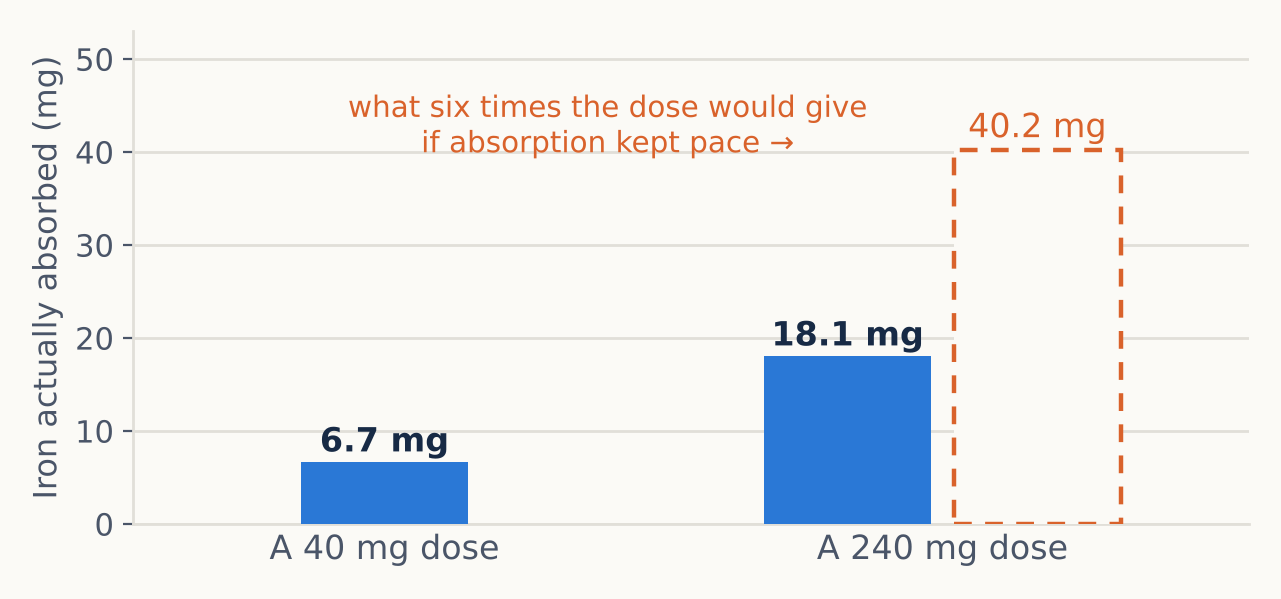
In 2015 a research group in Zurich gave 54 iron-depleted young women single morning doses of iron that had been chemically tagged so it could be traced through the body. The doses came in five sizes: 40, 60, 80, 160 and 240 milligrams. At 60 milligrams and above, hepcidin rose and stayed raised, and twenty-four hours later the women were absorbing between a third and a half less iron than they otherwise would have. At 40 milligrams no such rise was detected. The threshold sits somewhere between the two.
The consequence shows up most clearly when you compare the smallest dose with the largest. Six times the iron did not deliver six times the benefit. It did not even deliver three times.
The experiment that changed the schedule
If a large dose shuts the gate for about a day, the obvious question is what happens if you simply wait for it to reopen. The same group tested exactly that in 2017. Forty iron-depleted women received fourteen doses of 60 milligrams of iron each. One group took them on consecutive days, finishing in a fortnight. The other took them on alternate days, finishing in four weeks. Same tablets, same total iron, different spacing.
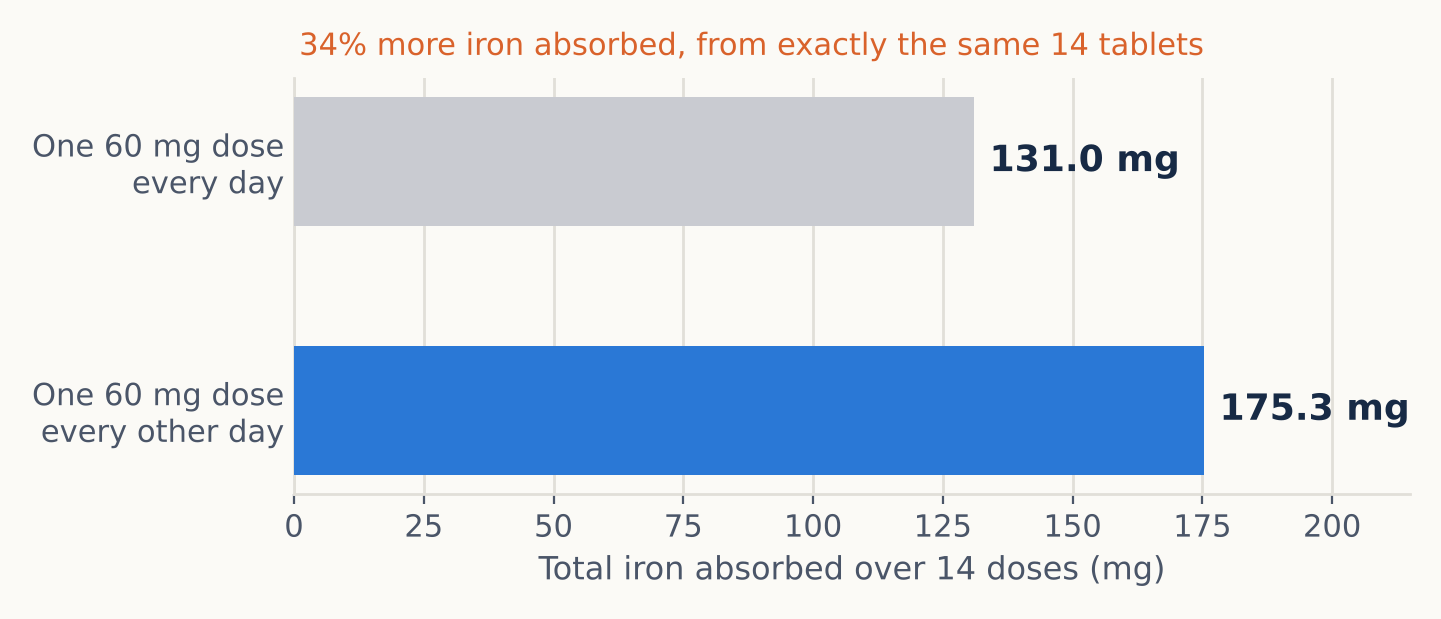
The second half of that study is just as useful and much less quoted. The same researchers compared a single 120 milligram dose against 60 milligrams taken twice in the same day. Over three days the single dose delivered 44.3 milligrams of absorbed iron and the two split doses 49.4: a gap too small to be sure it was real, and the split schedule pushed hepcidin higher while producing it. So spreading iron across days helps. Spreading it across a single day does not. Twice-daily is nonetheless what many Indian iron labels instruct.
The honest part, which most articles leave out
Absorption is not the thing patients care about. Haemoglobin is. And on that measure the alternate-day story becomes much more modest.
A trial in Puducherry gave 200 adults with low haemoglobin either 120 milligrams every other day or 60 milligrams daily for eight weeks, with neither the patients nor the doctors knowing who was on which schedule. Haemoglobin rose by 1.05 and 1.36 grams per decilitre respectively: a gap too small to be sure it was real, and pointing, if anything, the other way. When all eleven randomised trials of the question are analysed together, the small difference that emerges also leans very slightly towards daily dosing, and it too falls short of being a real one.
So the defensible claim is not that alternate-day dosing works better. It is this: it reaches the same destination using the body's own machinery more efficiently, and it is distinctly easier to live with. A Swiss trial followed 150 iron-depleted women for six months and found their average iron stores ended up the same on both schedules, but stomach complaints were about a third less common on the alternate-day one, and fewer women were still short of iron at the end of it, 3.0 per cent against 11.4. The averages matched; the number of people left behind did not. Since the commonest reason iron supplementation fails in the real world is that people stop taking it, that is not a small finding.
What the meal does, which is more than what the tablet does
Very little of iron absorption is under a formulator's control, and this is the part worth being blunt about. In a meal of cereal, pulses and tea, the things working against the iron are far stronger than anything the tablet itself can offer. The chief culprit is phytate: a storage compound in seeds, grains and pulses that grips minerals and carries them out of the body unabsorbed. The second is the tannins in tea, the compounds that give it its astringency.
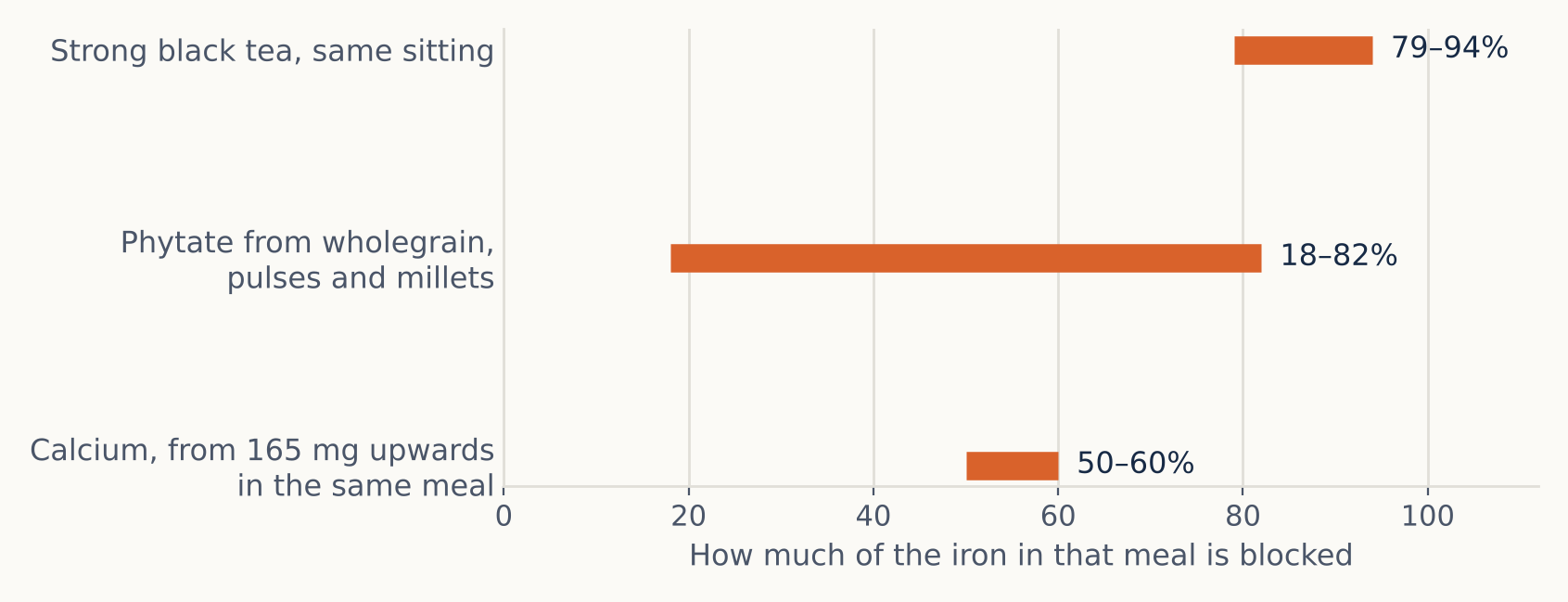
Tea is the one that should give an Indian brand pause. Strong black tea taken with a meal has been measured blocking 79 to 94 per cent of the iron in it. Adding milk made little difference. No premium ingredient will out-argue that. A line on the label telling people to take the tablet an hour before tea, or two hours after, costs nothing and addresses the actual obstacle.
Calcium is the second. As little as 165 milligrams of calcium in the same meal, roughly a glass of milk, cuts iron absorption by half to three-fifths. One caution against over-selling this, though: when researchers have given people calcium supplements for twelve weeks and for a full year and then measured their iron status, they have found no difference. The single-meal effect is real and well replicated. The long-term consequence is not established. Separate calcium and iron in the formulation because it is free to do so, not because the alternative is dangerous.
The vitamin C sentence that is wrong on most labels
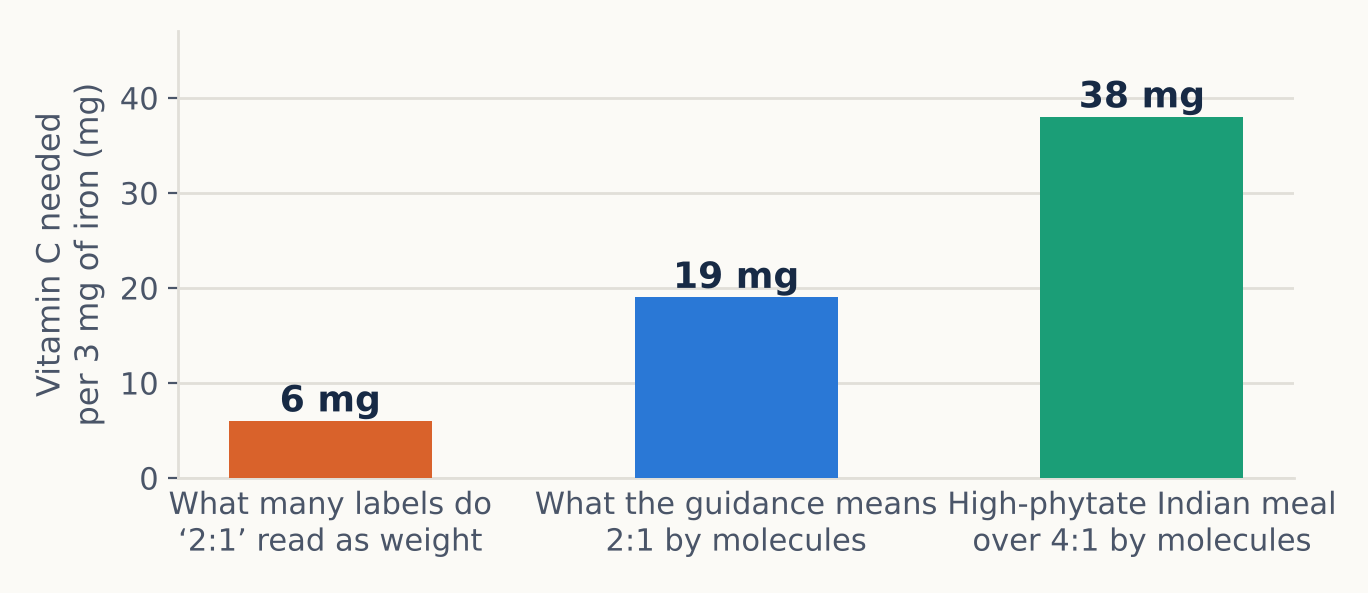
Vitamin C genuinely helps iron absorption from a meal. It converts iron into a form the gut takes up more readily and holds on to it so that phytate cannot. The guidance from the World Health Organization, and the research behind it, puts the useful amount at a ratio of two to one.
The trouble is what that ratio counts. It counts molecules, not milligrams. On the chemist's scale an atom of iron weighs 55.85 and a molecule of vitamin C weighs 176.12: vitamin C molecules are simply much heavier. So two vitamin C molecules for every one iron atom works out at about six and a third times as much vitamin C by weight, not twice as much. A label offering 6 milligrams of vitamin C alongside 3 milligrams of iron is delivering roughly a third of what the guidance intends.
And the vitamin C sentence that is wrong in the other direction
Having established that, here is the correction that runs the opposite way. A trial in Shanghai gave 440 adults with iron-deficiency anaemia a full treatment course of iron (100 milligrams three times a day, a therapeutic protocol rather than a supplement schedule) either with or without 200 milligrams of vitamin C alongside each dose. After two weeks, haemoglobin had risen by 2.00 grams per decilitre with the vitamin C and 1.84 without it. The trial found no advantage from adding it.
There is no contradiction between the two findings once you notice what each was testing. Vitamin C helps iron get out of a meal, where phytate and tannins are the obstacle. It showed no benefit on top of a large treatment dose. Price the vitamin C into a nutritional product taken with food. Do not price a premium on it for a treatment product.
A short word on which iron
Ferrous fumarate is a sensible workhorse: about 33 per cent iron by weight, cheap, and well absorbed. One widely repeated claim about it does not hold up, though. Two randomised studies in 482 pregnant women compared the common iron salts head to head and concluded that none of them caused clinically significant stomach complaints, with ferrous fumarate and ferrous sulphate behaving similarly to each other. Where they did differ was in black stools, a harmless but off-putting effect: 8 per cent of women on ferrous bisglycinate, against 22 per cent on fumarate and 31 per cent on sulphate.
Ferrous bisglycinate is also the one premium iron with a genuine argument in an Indian diet. It is a chelate: the iron is wrapped inside an organic molecule, which partly shields it from phytate. In a high-phytate maize porridge, 6.0 per cent of the iron from bisglycinate was absorbed against 1.7 per cent from ferrous sulphate. Two honest limits on that. The shielding does not work against tea or coffee, which still halve its absorption. And it does not license a smaller dose: a twelve-week trial in Cambodia found 18 milligrams of bisglycinate did not match 60 milligrams of ferrous sulphate.
What a label could usefully say
- Give the dose once, in the morning. Splitting it across the day raises the gate hormone without raising absorption.
- Tell people to keep it an hour away from tea and coffee, and two hours after. This is worth more than any ingredient upgrade.
- Keep calcium in a different product, or at a different time of day.
- Offer an alternate-day option, on medical advice, for people who cannot tolerate a daily dose. The haemoglobin result was not measurably different and stomach complaints were about a third less common.
None of those four lines costs a manufacturer anything. Between them they probably do more for the person taking the tablet than the difference between the common iron salts.
Sources
- International Institute for Population Sciences and Ministry of Health and Family Welfare, Government of India. National Family Health Survey (NFHS-5), 2019–21: India Report. Mumbai, 2022.
- Indian Council of Medical Research – National Institute of Nutrition. Nutrient Requirements for Indians: Recommended Dietary Allowances and Estimated Average Requirements. Hyderabad, 2020.
- Moretti D, Goede JS, Zeder C, et al. Oral iron supplements increase hepcidin and decrease iron absorption from daily or twice-daily doses in iron-depleted young women. Blood 2015;126(17):1981–9.
- Stoffel NU, Cercamondi CI, Brittenham G, et al. Iron absorption from oral iron supplements given on consecutive versus alternate days and as single morning doses versus twice-daily split dosing in iron-depleted women. The Lancet Haematology 2017;4(11):e524–e533.
- Pasupathy E, Kandasamy R, Thomas K, Basheer A. Alternate day versus daily oral iron for treatment of iron deficiency anemia: a randomized controlled trial. Scientific Reports 2023;13:1818 (see also the published author correction, Scientific Reports 2023).
- von Siebenthal HK and colleagues. Alternating-day versus consecutive-day oral iron supplementation in iron-depleted women: a randomised controlled trial. eClinicalMedicine 2023;65:102286.
- Dhanvijay A and colleagues. Alternate-day versus daily oral iron supplementation: a systematic review and meta-analysis of randomised controlled trials. BMC Pharmacology and Toxicology 2025.
- Hurrell RF, Reddy M, Cook JD. Inhibition of non-haem iron absorption in man by polyphenolic-containing beverages. British Journal of Nutrition 1999;81(4):289–95.
- Hallberg L, Brune M, Rossander L. Iron absorption in man: ascorbic acid and dose-dependent inhibition by phytate. American Journal of Clinical Nutrition 1989;49(1):140–4.
- Hallberg L, Brune M, Erlandsson M, Sandberg AS, Rossander-Hultén L. Calcium: effect of different amounts on nonheme- and heme-iron absorption in humans. American Journal of Clinical Nutrition 1991;53(1):112–9.
- Sokoll LJ, Dawson-Hughes B. Calcium supplementation and plasma ferritin concentrations in premenopausal women. American Journal of Clinical Nutrition 1992;56(6):1045–8.
- Yan L, Prentice A, Dibba B, et al. The effect of long-term calcium supplementation on indices of iron, zinc and magnesium status in lactating Gambian women. British Journal of Nutrition 1996;76(6):821–31.
- World Health Organization and Food and Agriculture Organization. Guidelines on Food Fortification with Micronutrients. Geneva, 2006.
- Teucher B, Olivares M, Cori H. Enhancers of iron absorption: ascorbic acid and other organic acids. International Journal for Vitamin and Nutrition Research 2004;74(6):403–19.
- Li N, Zhao G, Wu W, et al. The efficacy and safety of vitamin C for iron supplementation in adult patients with iron deficiency anemia: a randomized clinical trial. JAMA Network Open 2020;3(11):e2023644.
- Milman NT, Bergholt T. Low-dose prophylactic oral iron supplementation (ferrous fumarate, ferrous bisglycinate, and ferrous sulphate) in pregnancy is not associated with clinically significant gastrointestinal complaints. Journal of Pregnancy 2024;2024:1716798.
- Bovell-Benjamin AC, Viteri FE, Allen LH. Iron absorption from ferrous bisglycinate and ferric trisglycinate in whole maize is regulated by iron status. American Journal of Clinical Nutrition 2000;71(6):1563–9.
- Layrisse M, García-Casal MN, Solano L, et al. Iron bioavailability in humans from breakfasts enriched with iron bis-glycine chelate, phytates and polyphenols. Journal of Nutrition 2000;130(9):2195–9.
- Fischer JAJ and colleagues. The effects of oral ferrous bisglycinate supplementation on haemoglobin and ferritin concentrations in adults and children: a systematic review and meta-analysis of randomised controlled trials. Nutrition Reviews 2023.
Disclaimer
This article is written for formulators, manufacturers and informed readers. It is a summary of published research and is not medical advice, a diagnosis or a treatment recommendation. Anaemia has many causes and iron supplements are not appropriate for everyone. No one should start, stop or change an iron regimen that has been prescribed to them without speaking to their doctor. Nothing here is a claim for any product. Product composition and labelling must comply with the Food Safety and Standards Authority of India regulations applicable at the time of manufacture, and the permitted-sources position should be verified against the current gazetted text before it is relied on.