
Nutraceuticals · Omega-3
Omega-3 is one ingredient sold as two completely different products
The dose that supports general heart health and the dose that lowers blood fats are sixteen times apart. Evidence from one does not carry across to the other, and at the higher dose, one safety signal roughly quadruples.
Start with why this matters in India, because the rest of the article is about getting the dose and the claim right, and none of that is worth doing if there is no gap to close.
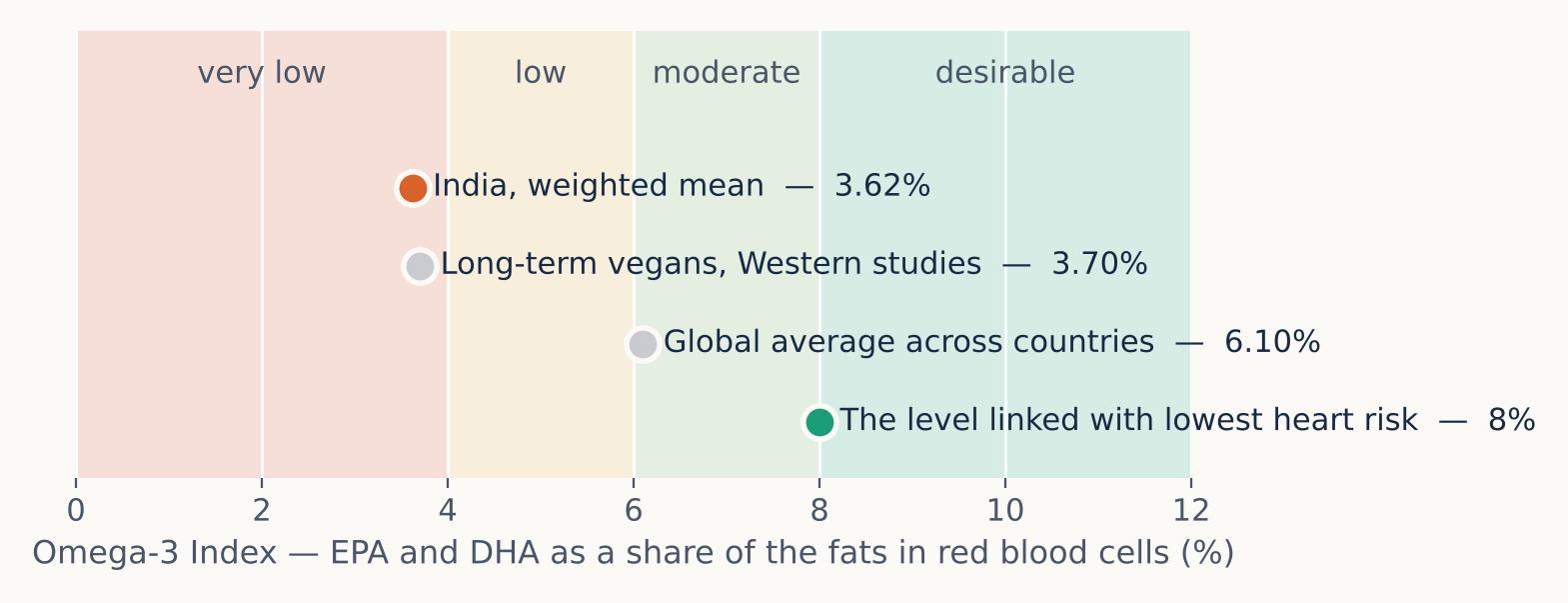
India sits in the lowest of the four categories that measure defines. Across ten long-term population studies, moving from 4 per cent to 8 per cent was associated with roughly a 30 per cent lower risk of dying from coronary heart disease.
And the shortfall is not confined to vegetarians. In a Bengaluru study of over a thousand pregnant women, measuring total omega-3 as a share of blood fats (a different measure from the one in the chart above, so the numbers are not directly comparable) vegetarians averaged 2.01 per cent and non-vegetarians 2.36, against 4.75 per cent in a comparable Australian group. Both Indian groups came out at around half the Australian level. In that population, eating fish and meat did not confer good omega-3 status.
A separate study measured Indian schoolchildren taking about 40 milligrams a day of EPA and DHA between them: roughly a sixth of the 250 milligram reference intake. (EPA and DHA are eicosapentaenoic acid and docosahexaenoic acid, the two long-chain fats found in oily fish and in certain marine algae. They are what 'omega-3' on a label usually means.)
So there is a real gap. Now the part brands get wrong
There are two separate dose regimes for this ingredient, they are a long way apart, and the research behind each one does not transfer to the other.
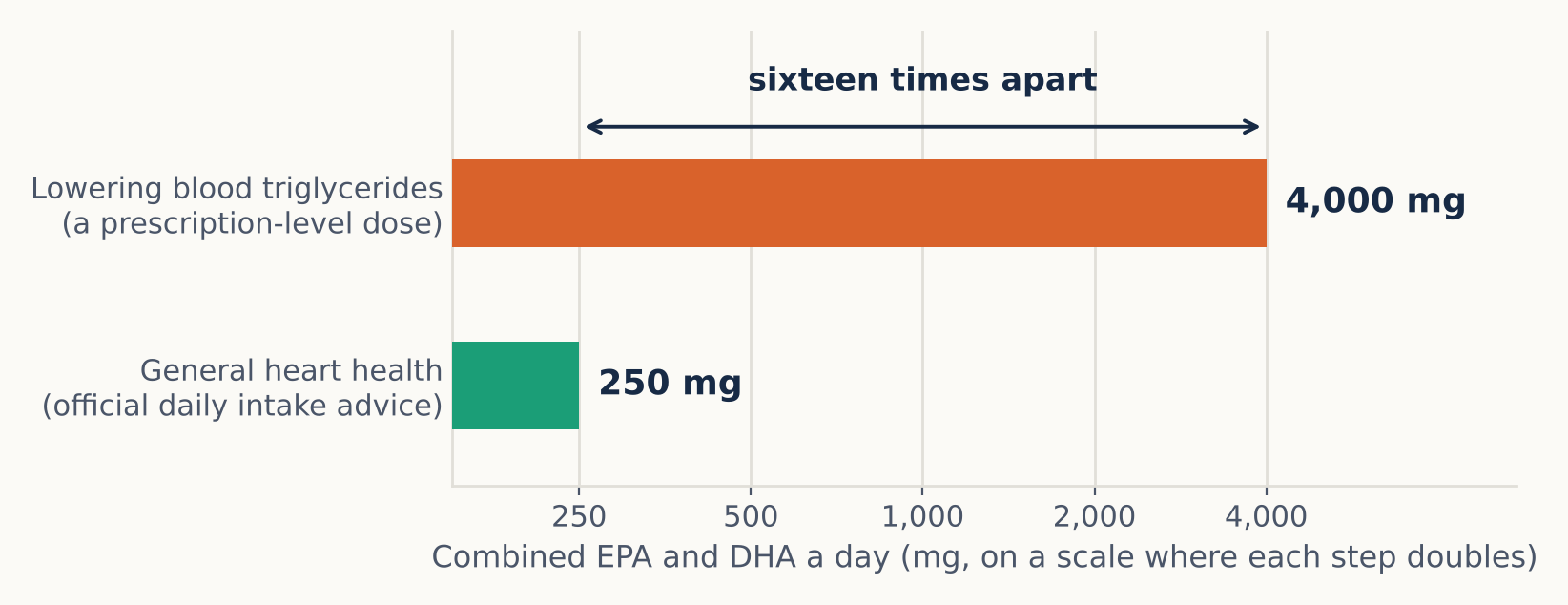
Europe's food safety authority and the joint United Nations expert consultation both set 250 milligrams a day of EPA and DHA combined for general cardiovascular health. That is a food-level intake, reachable with two portions of oily fish a week.
What should a brand claim for it? Less than most brands do, and the honest claim is still a good one. The largest assessment of the question (a Cochrane review combining the results of 86 separate randomised trials, in which neither the participants nor the researchers chose who got the supplement, covering 162,796 people) found little or no effect on deaths from any cause or on cardiovascular events, and rated that conclusion as resting on strong evidence. It did find a small reduction in coronary heart disease events and deaths, on weaker evidence, and a consistent fall of about 15 per cent in triglycerides, the main fat carried in the blood. The largest single prevention trial, which followed 25,871 American adults on a gram a day for over five years, found nothing on either of its two main questions.
What the high dose does, and why it is not a supplement
Four grams a day is a different proposition. The American Heart Association reports falls of 30 per cent or more in people with very high triglycerides at that dose, and describes it as effective and well tolerated, alone or alongside a statin: the class of cholesterol-lowering medicines.
Say the regulatory consequence plainly before anything else: lowering a blood marker of disease is a medicinal purpose. In India that is the medicines route, not the health-supplement route, and the four-gram preparations are prescription products in many countries. This article is not a design brief for one.
The outcome evidence at that dose is also genuinely contested. REDUCE-IT (one of two large trials, both known by their acronyms) gave 8,179 patients already on a statin four grams a day of a purified EPA preparation and reported a 25 per cent reduction in major cardiovascular events. STRENGTH gave 13,078 patients a similar dose of a combined EPA and DHA preparation and found nothing; it was stopped early because it was clearly not going to show a benefit.
The most likely explanation is not the oil. It is the dummy capsule each trial used for comparison. REDUCE-IT used mineral oil, and in that comparison group LDL cholesterol (low-density lipoprotein, the kind usually called 'bad' cholesterol) rose 10.9 per cent over twelve months, and C-reactive protein, a blood marker of inflammation, rose 21.9 per cent. STRENGTH used corn oil and nothing moved. Combining seventeen trials and 141,009 patients, EPA reduced cardiovascular events only where the comparison was against mineral oil. There is a counter-argument, and it comes largely from analyses funded by the manufacturer. The question is open.
The safety signal that separates the two regimes
If you want one piece of evidence that these are two different products, this is it. Combining seven trials and 81,210 patients, omega-3 supplementation raised the risk of atrial fibrillation, an irregular heartbeat, by 25 per cent overall. But the risk tracked the dose closely.
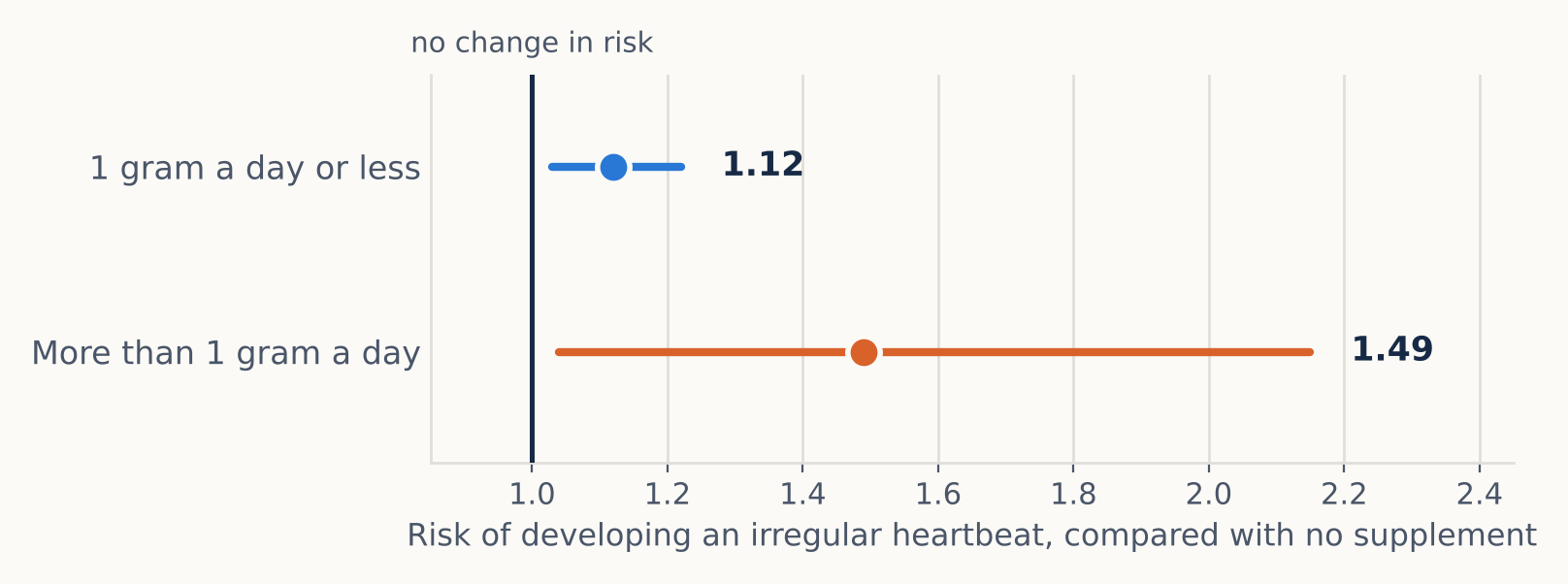
A dose at or below a gram a day carried a small increase. Above a gram, the increase was roughly four times larger. A product sold at a food-level dose and a product sold at a therapeutic dose are not the same thing with a different number on the front, and they should not carry the same claims or the same cautions.
Flaxseed is not a substitute, and the reason is more interesting than usual
Plant omega-3 is ALA, or alpha-linolenic acid, found in flaxseed, chia and walnuts. The body can convert it into EPA and DHA. The question is how much.
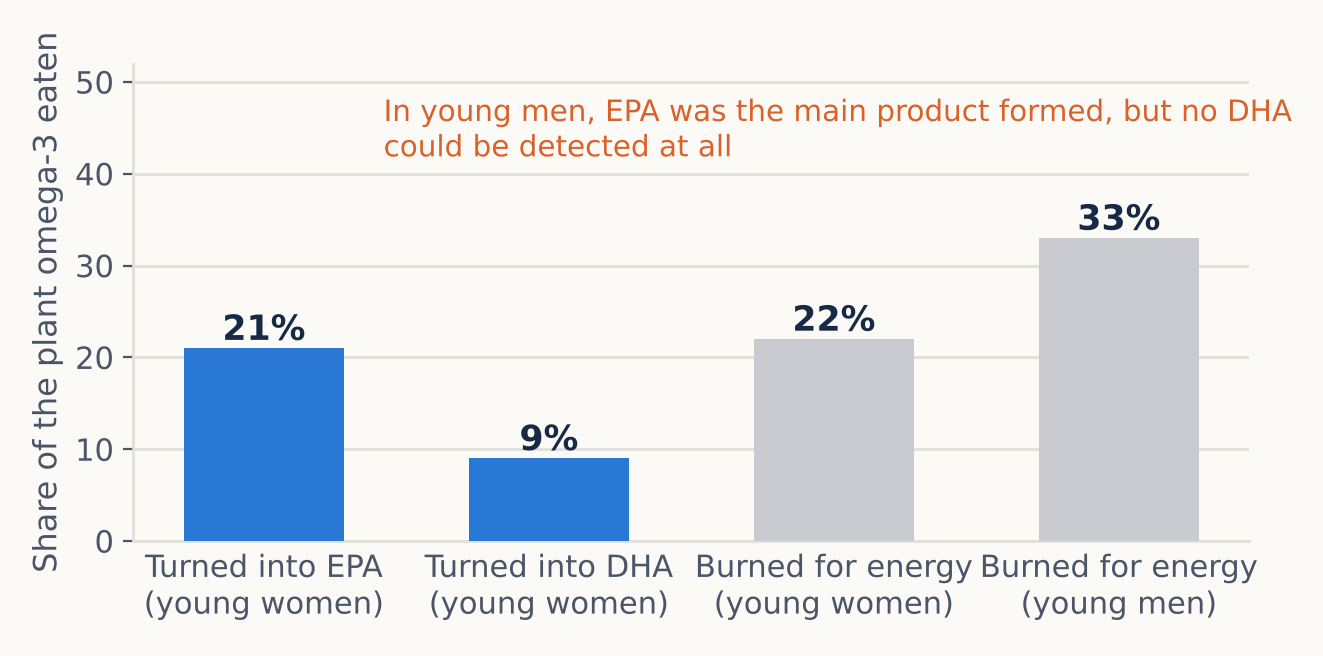
A fifth to a third of the plant omega-3 eaten is simply burned for energy within a day. And the conversion differs sharply between the sexes: in young women 21 per cent became EPA and 9 per cent became DHA, while in young men the researchers could not detect any DHA at all, concluding that the capacity was either very low or absent. A different modelling study put the EPA figure as low as 0.2 per cent, so the honest range is wide.
Those conversion figures look encouraging until you ask what they do to blood status. Tracing a single labelled dose is not the same as shifting the fat composition of a cell membrane at habitual intakes. Across the thirteen randomised trials in one review, high doses of flaxseed and similar plant oils produced no rise in the Omega-3 Index, and in some a fall. Algal oil raised it in every study that review identified.
Algal oil, and the question to ask your supplier
Oil from marine microalgae is the one genuinely important vegetarian development in this ingredient. In a head-to-head study, algal-oil capsules and cooked salmon produced no measurable difference in blood DHA. In 104 vegetarians, algal oil moved the Omega-3 Index from 4.8 to 8.4 per cent over eight weeks: from the 'low' band into the desirable one.
This is also the one place in this series where paying for the better ingredient is clearly right rather than clearly optional. Earlier articles argued that for iron and calcium the schedule and the dose size matter more than the salt you buy. Omega-3 is the exception: there is no technique that turns flaxseed into fish oil.
One caution most vegetarian positioning skips. The organism matters. The species used in most commercial algal oil produces mainly DHA, with EPA as a minor component; a different organism is used for EPA. A vegetarian product described as equivalent to fish oil should state its EPA content separately, not just its total omega-3. Many do not, and are in practice DHA supplements.
Two practical specifications
Give the product time, and say so. EPA takes about 28 days to reach half its eventual level in red blood cell membranes and about 180 days to plateau. A consumer expecting to feel something in a fortnight will stop before the blood level has finished moving. Six months is the honest expectation, and the window for substantiating a blood-status claim is the same.
Control oxidation, and know what it does and does not buy you. Fish oil goes rancid, and the trade measures that with two laboratory tests: the peroxide value, which counts the first products of rancidity, and the anisidine value, which counts the later ones. The industry's voluntary specification, adopted here for want of an independent one, sets a peroxide value of 5 or less, an anisidine value of 20 or less and a combined figure of 26 or less, and requires these to hold throughout the stated shelf life rather than only on arrival at the factory. Two things most specifications miss: the anisidine and combined figures are not valid tests on a flavoured oil, which is why the specification exempts them; and flavouring is by far the strongest predictor of a failing result, with 68 per cent of flavoured products failing in one American survey against 13 per cent of unflavoured ones.
Be careful what you claim for freshness, though. Two randomised human trials fed people deliberately oxidised fish oil and found no measurable difference in markers of oxidative stress or inflammation, or in which genes the body switched on, and no measurable difference in how far blood EPA and DHA rose. One trial did find a more favourable pattern of cholesterol-carrying particles on the fresher oil. Oxidation is a quality and palatability specification with a plausible but unproven effect on performance. It is not the thing that decides whether the product works.
Where Indian law leaves this
Fish oil is named in Schedule VI, Part B of India's nutraceutical rules: the part of the list that gives ingredient names without permitted daily quantities. There is therefore no stated Indian ceiling for EPA and DHA, which puts the responsibility for a defensible dose on the formulator rather than on the schedule. India's own nutrient requirements set a figure for total omega-3 of 2.2 grams a day and give no separate figure for EPA and DHA at all.
Absent a legal ceiling, the two-regime structure is the discipline. Build the everyday product at a food-level dose, against a national blood level that is among the lowest measured anywhere, and claim what the evidence supports. Leave the four-gram proposition to the medicines route. And do not let the evidence from one wander onto the label of the other.
Sources
- European Food Safety Authority Panel on Dietetic Products, Nutrition and Allergies. Scientific opinion on dietary reference values for fats. EFSA Journal 2010;8(3):1461.
- Food and Agriculture Organization and World Health Organization. Fats and Fatty Acids in Human Nutrition: Report of an Expert Consultation. Rome, 2010.
- Skulas-Ray AC, Wilson PWF, Harris WS, et al. Omega-3 fatty acids for the management of hypertriglyceridemia: a science advisory from the American Heart Association. Circulation 2019;140(12):e673–e691.
- Abdelhamid AS, Brown TJ, Brainard JS, et al. Omega-3 fatty acids for the primary and secondary prevention of cardiovascular disease. Cochrane Database of Systematic Reviews 2020;3:CD003177.
- Manson JE, Cook NR, Lee I-M, et al. Marine n-3 fatty acids and prevention of cardiovascular disease and cancer. New England Journal of Medicine 2019;380(1):23–32.
- Bhatt DL, Steg PG, Miller M, et al. Cardiovascular risk reduction with icosapent ethyl for hypertriglyceridemia. New England Journal of Medicine 2019;380(1):11–22.
- Nicholls SJ, Lincoff AM, Garcia M, et al. Effect of high-dose omega-3 fatty acids vs corn oil on major adverse cardiovascular events in patients at high cardiovascular risk: the STRENGTH randomized clinical trial. JAMA 2020;324(22):2268–2280.
- Ridker PM and colleagues. REDUCE-IT biomarker substudy: effects of randomized treatment with icosapent ethyl and a mineral oil comparator on inflammatory and lipid biomarkers. Circulation 2022.
- Yokoyama Y and colleagues. Association of eicosapentaenoic acid with cardiovascular outcomes: a network meta-analysis. Journal of Cardiology 2022.
- Gencer B, Djoussé L, Al-Ramady OT, Cook NR, Manson JE, Albert CM. Effect of long-term marine omega-3 fatty acids supplementation on the risk of atrial fibrillation in randomized controlled trials of cardiovascular outcomes: a systematic review and meta-analysis. Circulation 2021;144(25):1981–1990.
- Burdge GC, Wootton SA. Conversion of alpha-linolenic acid to eicosapentaenoic, docosapentaenoic and docosahexaenoic acids in young women. British Journal of Nutrition 2002;88(4):411–20.
- Burdge GC, Jones AE, Wootton SA. Eicosapentaenoic and docosapentaenoic acids are the principal products of alpha-linolenic acid metabolism in young men. British Journal of Nutrition 2002;88(4):355–63.
- Pawlosky RJ, Hibbeln JR, Novotny JA, Salem N. Physiological compartmental analysis of alpha-linolenic acid metabolism in adult humans. Journal of Lipid Research 2001;42(8):1257–65.
- Lane K and colleagues. Bioavailability and conversion of plant-based sources of omega-3 fatty acids: a scoping review to update supplementation options for vegetarians and vegans. Critical Reviews in Food Science and Nutrition 2021.
- Arterburn LM, Oken HA, Bailey Hall E, Hamersley J, Kuratko CN, Hoffman JP. Algal-oil capsules and cooked salmon: nutritionally equivalent sources of docosahexaenoic acid. Journal of the American Dietetic Association 2008;108(7):1204–9.
- Geppert J and colleagues. Docosahexaenoic acid supplementation in vegetarians effectively increases omega-3 index. Lipids 2005.
- Harris WS, von Schacky C. The Omega-3 Index: a new risk factor for death from coronary heart disease? Preventive Medicine 2004;39(1):212–20.
- Schuchardt JP, Beinhorn P, Hu XF, et al. Omega-3 world map: 2024 update. Progress in Lipid Research 2024;95:101286.
- Katan MB, Deslypere JP, van Birgelen AP, Penders M, Zegwaard M. Kinetics of the incorporation of dietary fatty acids into serum cholesteryl esters, erythrocyte membranes and adipose tissue: an 18-month controlled study. Journal of Lipid Research 1997;38(10):2012–22.
- Parasannanavar D, Gaddam I, Bukya T, et al. Omega-3 polyunsaturated fatty acid intake and plasma fatty acids of school going Indian children. Prostaglandins, Leukotrienes and Essential Fatty Acids 2021;170:102294.
- Mugford M and colleagues. Omega-3 fatty acid status of pregnant women in India and Australia. Prostaglandins, Leukotrienes and Essential Fatty Acids 2025.
- Global Organization for EPA and DHA Omega-3s. GOED Voluntary Monograph, version of 6 January 2022. (An industry body's specification, cited here because no independent equivalent exists.)
- Hands JM and colleagues. Oxidative quality of marine oil supplements in the United States, 2014–2020. Journal of Dietary Supplements 2023.
- Albert BB, Derraik JGB, Cameron-Smith D, et al. Fish oil supplements in New Zealand are highly oxidised and do not meet label content of n-3 PUFA. Scientific Reports 2015;5:7928.
- Bannenberg G, Mallon C, Edwards H, et al. Omega-3 long-chain polyunsaturated fatty acid content and oxidation state of fish oil supplements in New Zealand. Scientific Reports 2017;7(1):1488. (Authored by staff of the industry body that publishes the specification cited above.)
- Ottestad I, Vogt G, Retterstøl K, et al. Oxidised fish oil does not influence established markers of oxidative stress in healthy human subjects: a randomised controlled trial. British Journal of Nutrition 2012;108(2):315–26.
- Myhrstad M and colleagues. Effect of the fat composition of a single high-fat meal on inflammatory markers in healthy young women. Genes and Nutrition 2016.
- Rundblad A and colleagues. High-quality fish oil has a more favourable effect than oxidised fish oil on intermediate-density lipoprotein and LDL subclasses: a randomised controlled trial. British Journal of Nutrition 2017.
- Food Safety and Standards Authority of India. Food Safety and Standards (Health Supplements, Nutraceuticals, Food for Special Dietary Use, Food for Special Medical Purpose, Functional Food and Novel Food) Regulations, 2016, Schedule VI as substituted by the direction dated 29 December 2017.
- Indian Council of Medical Research and National Institute of Nutrition. Nutrient Requirements for Indians. Hyderabad, 2020.
Disclaimer
This article is written for formulators, manufacturers and informed readers. It is a summary of published research and is not medical advice, a diagnosis or a treatment recommendation. High-dose omega-3 preparations for raised blood fats are prescription medicines in many countries, including under India's medicines route, and should be taken only under medical supervision; no one should start, stop or change a prescribed treatment on the basis of this article. Nothing here is a claim for any product. Product composition and labelling must comply with the Food Safety and Standards Authority of India regulations applicable at the time of manufacture, and every schedule entry referred to here should be verified against the current gazetted text before it is relied on.