
Nutraceuticals · Calcium
With calcium, how you take it beats what you paid for
Two 500 milligram doses deliver more absorbed calcium than one 1,000 milligram dose, and the gain is at least as large as anything the premium calcium salt can offer, at no cost at all.
Calcium is the nutrient where the Indian shortfall is least arguable. The adult allowance was raised from 600 to 1,000 milligrams a day in the 2020 revision of the country's nutrient requirements. Measured intakes are nowhere close. National survey data put rural adult men and women at a middling 290 to 370 milligrams a day, and tribal women at around 214: somewhere between a fifth and a third of what is now asked for. Between 70 and 85 per cent of children and adolescents across the states take less than half the recommended amount.
So this is one of the few nutrients where a substantial dose is genuinely justified. Which makes it all the more worth getting the easy part right.
The curve that decides everything
Calcium is absorbed partly through a controlled route that can only handle so much at a time, and partly by simple leakage between cells. The controlled route is the efficient one, and it fills up. The practical result is that the more calcium arrives at once, the smaller the share of it that gets through.
This has been measured repeatedly since the 1980s, and the pattern is remarkably consistent: each time you double the dose, you lose roughly the same fixed number of percentage points of absorption. In one study of 37 adults, a 300 milligram dose was 36 per cent absorbed and a 1,000 milligram dose only 28.4 per cent. Work at much smaller doses found 77 per cent absorption from 20 milligrams.
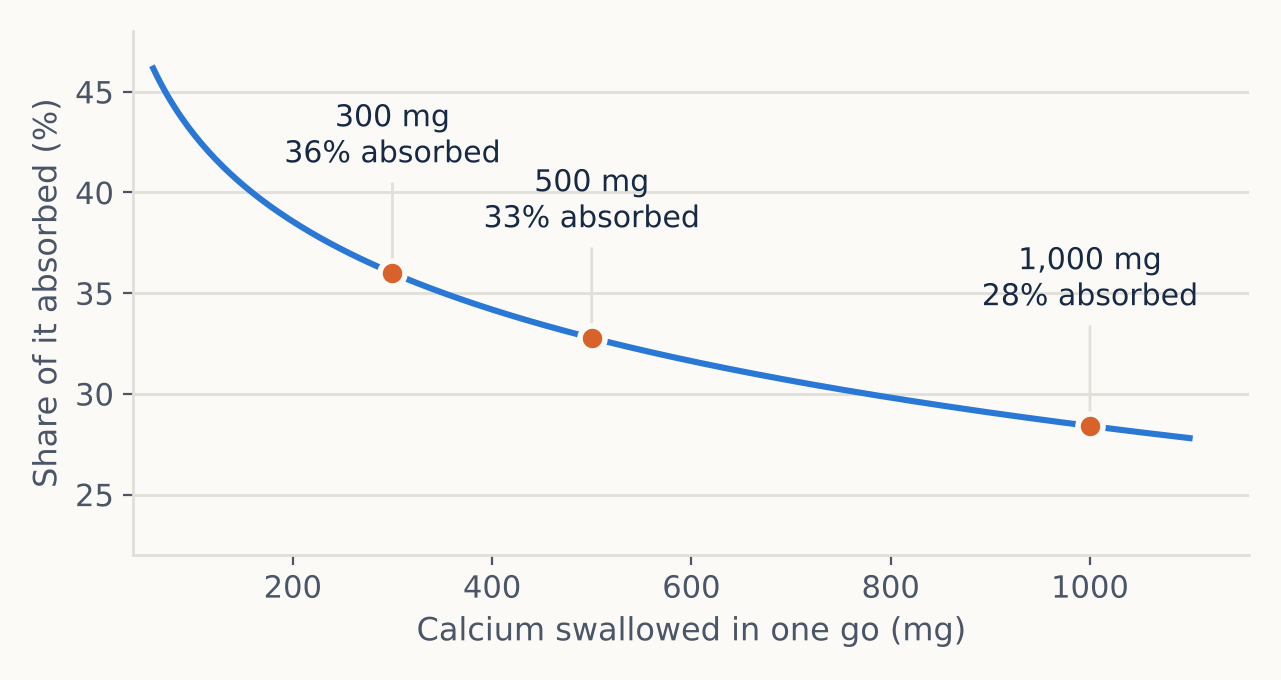
A separate group, using a different method, tested 200, 500, 1,000 and 2,000 milligram doses and concluded that 500 milligrams was the optimum single dose: below it you are leaving the efficient route underused, above it the returns flatten out sharply.
Splitting beats upgrading
Put those two facts together and the arithmetic is uncomfortable for the single large tablet.
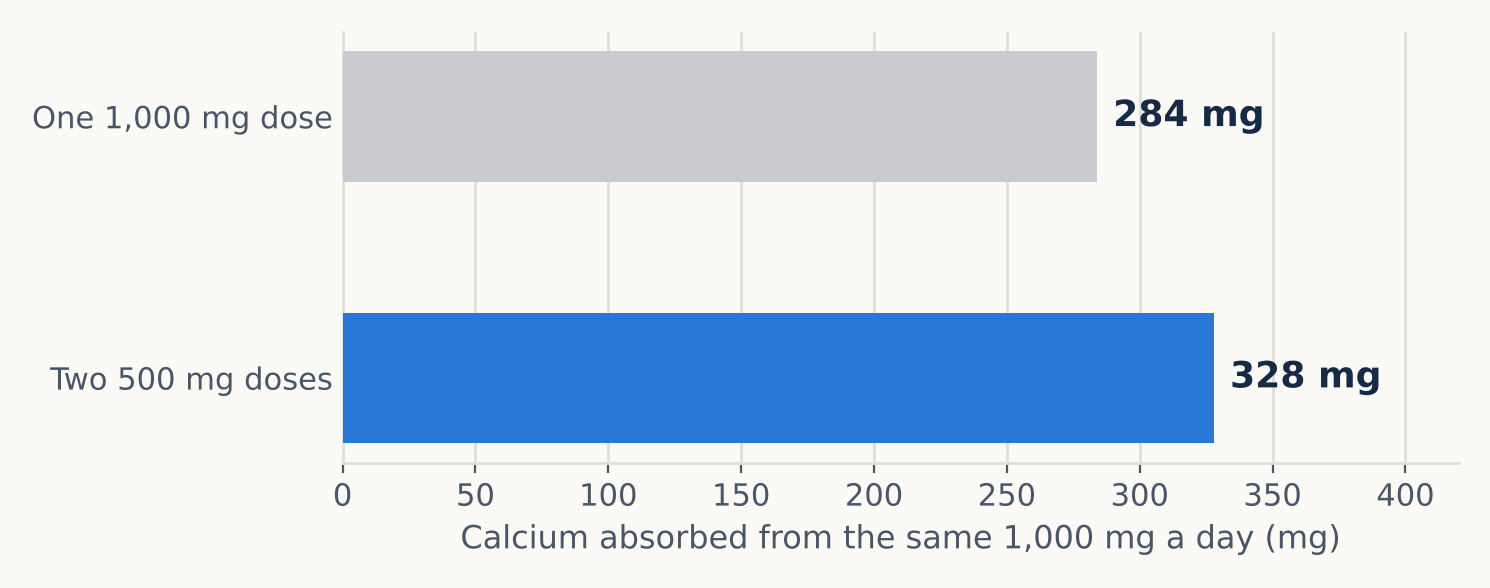
Two caveats, stated plainly. Nobody has run a trial giving one group 1,000 milligrams once a day and another 500 milligrams twice, and measuring the difference; the estimate above is read off a well-replicated absorption curve. The direction follows from that curve with some confidence. The size is an estimate, which is why the figure gives a range.
There is an awkward commercial truth attached. Split dosing is better nutrition and worse compliance. People forget the second tablet. That is an argument for designing the product and the instruction around it, not for pretending the curve does not exist.
Readers of the companion article on iron will notice this is the opposite advice. Iron should be given in one dose and spaced across days, because a large iron dose triggers a hormone that shuts absorption down for about a day. Calcium has no such hormone; it simply has a transport route that saturates. Different mechanism, opposite instruction.
So what about calcium citrate?
Calcium citrate commands a premium on the argument that it dissolves more readily. The researcher who did most of the underlying measurement, Robert Heaney, tested seven calcium sources whose solubility spanned a range of nearly forty thousand to one, and reported that across the narrow range in which actual supplement ingredients sit, there was no detectable effect of solubility on absorption at all.
His direct head-to-head went further. Testing both salts in the same 37 people, calcium carbonate came out marginally ahead at the 1,000 milligram dose, and combining both experiments gave zero difference between them. His conclusion was that when taken with food, calcium from the carbonate salt is fully as absorbable as from the citrate.
Against that sits a review pooling fifteen studies in 184 subjects, which reported calcium citrate absorbed 22 to 27 per cent better. Both bodies of work are real, and they reconcile in three ways. The first is how absorption was measured: tracking a traceable tagged dose through the body is about three times more sensitive than measuring the rise in calcium leaving in urine, which is the method most of the pooled studies used. The second is in the pooled review's own numbers: the citrate advantage was 27 per cent on an empty stomach and 22 per cent with meals, and the head-to-head trials were run with breakfast, the condition where the gap narrows. The third is that most of the pooled work comes from the research centre where calcium citrate was developed, which is worth stating plainly rather than ignoring.
Calcium carbonate also carries 40 per cent calcium by weight against 21 per cent for the usual grade of calcium citrate, which is why a citrate product is either a bigger tablet or a smaller dose. For most consumers, carbonate taken with a meal is the honest default.
Where citrate genuinely earns its price
There is one group for whom the citrate argument is not marketing. In a study of patients who produced no stomach acid at all, calcium citrate was absorbed roughly ten times better than carbonate when both were taken on an empty stomach. A separate trial found that a week of a proton pump inhibitor, the common class of acid-suppressing medicines, measurably reduced calcium carbonate absorption in women over 65, again on an empty stomach.
The first study also contains the fix. When those same patients took calcium carbonate as part of a normal breakfast, their absorption was completely normal. So the useful advice is narrower than 'buy citrate': take carbonate with food. Prefer citrate where the tablet will be taken away from meals, or for a consumer on long-term acid suppression who is unlikely to follow the instruction.
The lead question, answered properly
A claim circulates in the trade that calcium from oyster shell, coral and similar natural sources carries more lead than refined calcium. India explicitly permits those sources, so the question matters. The published measurements do not support the claim.
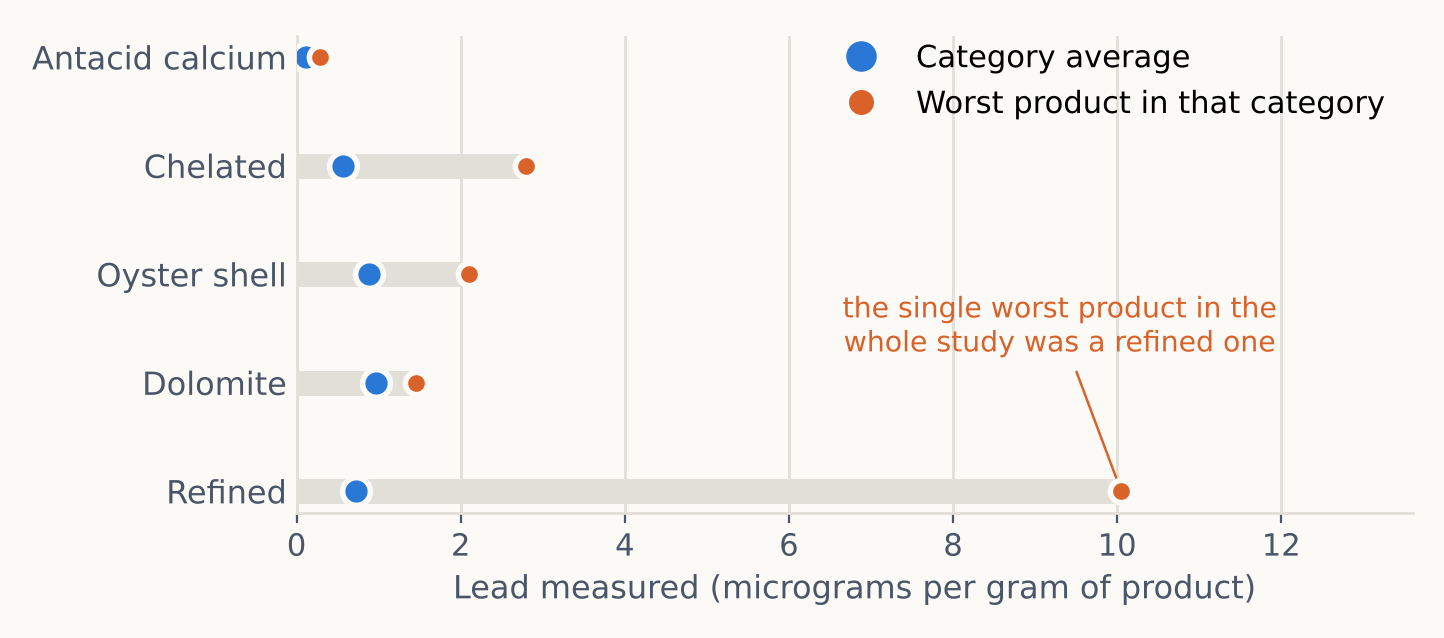
Historically the worst categories were bone meal and dolomite, not shell. In the last systematic survey of the question, published in 2000, no category differed convincingly from any other, and the single worst product measured was a refined one. An independent analysis published the same year found measurable lead in four of fourteen refined products, at levels similar to or higher than the natural-source ones. No comparable survey has been published since, so these figures describe the market of the 1990s rather than today's.
Two things follow. Lead levels in supplements fell after leaded petrol was withdrawn, so those old surveys overstate today's risk, which is another way of saying nobody has measured the current position. And the only way to know what is in a batch is to test the batch. 'Refined' is not a lead specification; a certificate of analysis from the supplier is. Worth keeping in proportion as well: the authors of that survey put the median daily lead from a calcium supplement at about 2.4 micrograms, against 5 to 11 micrograms from ordinary food, and noted that calcium itself reduces how much lead the gut absorbs.
Magnesium: the same lesson, smaller numbers
Magnesium carries its own confusion, starting with an apparent contradiction in the Indian figures. The allowance is 440 milligrams a day for men and 370 for women, while the upper limit is 350: lower than the allowance itself. This is not an error. The limit applies only to magnesium from supplements and medicines, not from food, and the Indian tables say so in a footnote. The convention comes from the United States Institute of Medicine and exists because supplemental magnesium causes diarrhoea long before dietary magnesium causes anything.
The form argument for magnesium is weaker than the market believes. The best-known trial gave twenty healthy men 300 milligrams of magnesium as either citrate or oxide and measured what came out in the urine over the following day. Citrate won by a margin the statisticians were comfortable with. Converted out of laboratory units into milligrams, that margin is 13.7 milligrams of magnesium: roughly the amount in a handful of spinach. A review of the field calls it physiologically irrelevant. The trial also had no dummy tablet and no blinding, and was funded by the maker of the citrate product.
The figure usually quoted against magnesium oxide, that only 4 per cent of it is absorbed, comes from a single small study using an indirect method, and sits far below every other published estimate of magnesium absorption. Magnesium oxide in an effervescent form has been measured performing like the organic salts. No trial has shown a difference between magnesium forms large enough to matter physiologically, and oxide carries 60 per cent magnesium by weight, more than any alternative.
What India's list actually allows
Eight magnesium ingredients are named in India's permitted-sources list: aspartate, carbonate, chloride, gluconate, two phosphates, oxide and sulphate. Magnesium citrate, glycinate, malate, lactate and threonate are not named, which covers most of what the global market has standardised on. The list does carry a general note permitting suitable salts and chelates of minerals, subject to written notification to the Food Authority, so 'not named' is not the same as 'prohibited'. It is still a different conversation with a regulator than pointing at a line in a schedule.
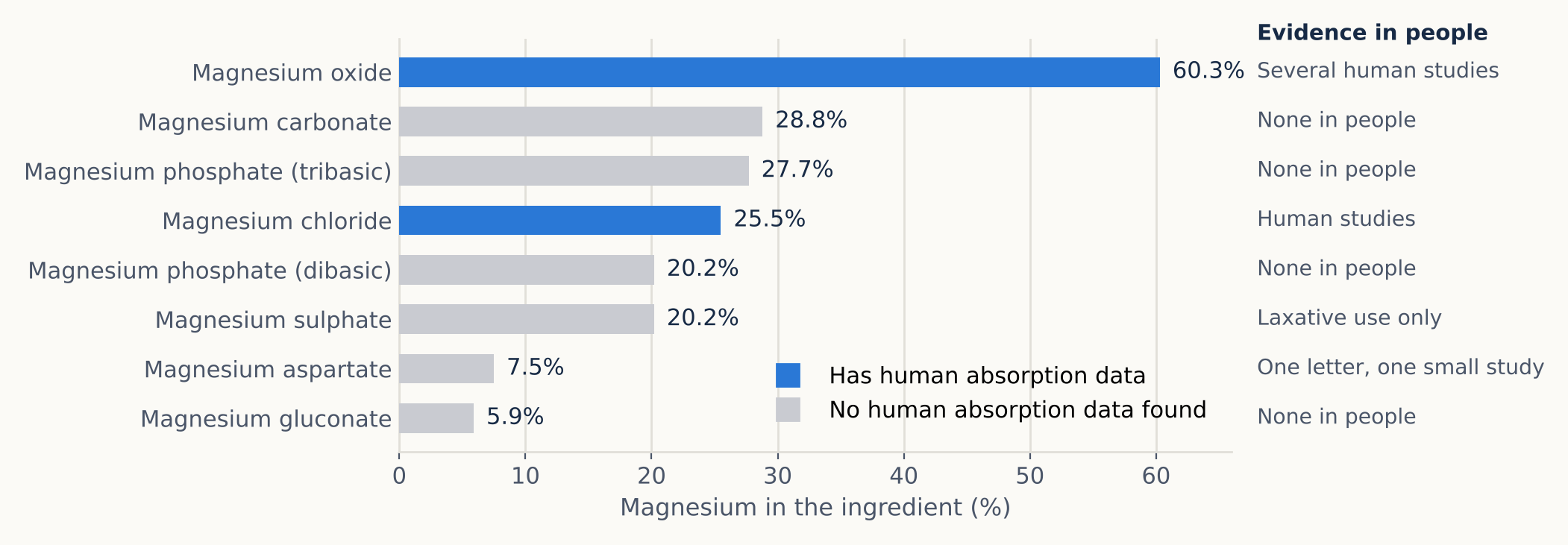
The chart carries an uncomfortable message. Of the eight, only magnesium oxide and magnesium chloride have meaningful human absorption data behind them. Magnesium aspartate is sometimes proposed as the answer for India, and it has two supporting studies, one of which is a two-page letter from 1991. It also contains only 7.5 per cent magnesium, so delivering 100 milligrams needs more than 1.3 grams of the salt, which is not a tablet anyone wants to swallow.
On the evidence available there is no reason to abandon magnesium oxide, which has the human data and much the highest magnesium content. Where its laxative effect is a problem, magnesium chloride is the better-supported alternative on the permitted list, with the caveat that the 25.5 per cent figure is for the dry salt, and the grade most suppliers ship carries water in the crystal and about 12 per cent magnesium.
And the calcium-magnesium-zinc question
The popular three-mineral combination is often dismissed on the grounds that the minerals fight each other. They largely do not. Magnesium absorption is unaffected by calcium at doses well above 1,000 milligrams a day. Calcium can reduce zinc absorption when the two are swallowed together, but the study that showed it also showed that adding a little extra zinc alongside the calcium cancels the effect, which is exactly what a three-mineral product does.
The real criticism is the one this article started with. Most three-mineral products on the market deliver their full 1,000 milligrams of calcium in a single serving. By the absorption curve, that is the inefficient way to take it. The problem is not the company the calcium keeps. It is the size of the helping.
Sources
- Indian Council of Medical Research – National Institute of Nutrition. Nutrient Requirements for Indians: Recommended Dietary Allowances and Estimated Average Requirements. Hyderabad, 2020.
- Harinarayan CV, Akhila H, Shanthisree E. Modern India and dietary calcium deficiency: half a century nutrition data, retrospect, introspect and the road ahead. Frontiers in Endocrinology 2021;12:583654. (Compiles the National Nutrition Monitoring Bureau rural and tribal survey intakes.)
- Heaney RP, Dowell MS, Barger-Lux MJ. Absorption of calcium as the carbonate and citrate salts, with some observations on method. Osteoporosis International 1999;9(1):19–23.
- Heaney RP, Weaver CM, Fitzsimmons ML. Influence of calcium load on absorption fraction. Journal of Bone and Mineral Research 1990;5(11):1135–8.
- Weaver CM, Heaney RP, Teegarden D, Hinders SM. Journal of Nutrition 1996;126(1):303–7.
- Harvey JA, Zobitz MM, Pak CY. Dose dependency of calcium absorption: a comparison of calcium carbonate and calcium citrate. Journal of Bone and Mineral Research 1988;3(3):253–8.
- Heaney RP, Recker RR, Weaver CM. Absorbability of calcium sources: the limited role of solubility. Calcified Tissue International 1990;46(5):300–4.
- Sakhaee K, Bhuket T, Adams-Huet B, Rao DS. Meta-analysis of calcium bioavailability: a comparison of calcium citrate with calcium carbonate. American Journal of Therapeutics 1999;6(6):313–21.
- Recker RR. Calcium absorption and achlorhydria. New England Journal of Medicine 1985;313(2):70–3.
- O'Connell MB, Madden DM, Murray AM, Heaney RP, Kerzner LJ. Effects of proton pump inhibitors on calcium carbonate absorption in women: a randomized crossover trial. American Journal of Medicine 2005;118(7):778–81.
- Scelfo GM, Flegal AR. Lead in calcium supplements. Environmental Health Perspectives 2000;108(4):309–13.
- Ross EA, Szabo NJ, Tebbett IR. Lead content of calcium supplements. Journal of the American Medical Association 2000;284(11):1425–9.
- Institute of Medicine, Food and Nutrition Board. Dietary Reference Intakes for Calcium, Phosphorus, Magnesium, Vitamin D and Fluoride. Washington DC: National Academy Press, 1997.
- Kappeler D, Heimbeck I, Herpich C, et al. Higher bioavailability of magnesium citrate as compared to magnesium oxide shown by evaluation of urinary excretion and serum levels after single-dose administration in a randomized cross-over study. BMC Nutrition 2017;3:7.
- Schuchardt JP, Hahn A. Intestinal absorption and factors influencing bioavailability of magnesium: an update. Current Nutrition and Food Science 2017;13(4):260–78.
- Firoz M, Graber M. Bioavailability of US commercial magnesium preparations. Magnesium Research 2001;14(4):257–62.
- Food Safety and Standards Authority of India. Food Safety and Standards (Health Supplements, Nutraceuticals, Food for Special Dietary Use, Food for Special Medical Purpose, Functional Food and Novel Food) Regulations, 2016, Schedule I, with the direction dated 29 December 2017 and subsequent amendments.
- Andon MB and colleagues. Magnesium balance in adolescent females consuming a low- or high-calcium diet. American Journal of Clinical Nutrition 1996.
- Wood RJ, Zheng JJ. High dietary calcium intakes reduce zinc absorption and balance in humans. American Journal of Clinical Nutrition 1997;65(6):1803–9.
- McKenna AA, Ilich JZ, Andon MB, Wang C, Matkovic V. Zinc balance in adolescent females consuming a low- or high-calcium diet. American Journal of Clinical Nutrition 1997;65(5):1460–4.
Disclaimer
This article is written for formulators, manufacturers and informed readers. It is a summary of published research and is not medical advice, a diagnosis or a treatment recommendation. Anyone taking prescribed medicines, including acid-suppressing medicines, or with kidney disease should consult a qualified medical practitioner before taking calcium or magnesium supplements, and no one should change a prescribed treatment on the basis of this article. Nothing here is a claim for any product. Product composition and labelling must comply with the Food Safety and Standards Authority of India regulations applicable at the time of manufacture, and the permitted-sources position should be verified against the current gazetted text before it is relied on.