Nutraceuticals · Vitamin D
The free performance tip that does not survive a randomised trial
‘Take your vitamin D with your largest meal’ is one of the most repeated pieces of advice in this industry. It rests on seventeen patients and no control group. When somebody tested it properly, it disappeared, and something more useful took its place.
Timing instructions are the cheapest thing a brand can put on a pack. They require no reformulation, no new raw material and no extra cost per unit. That is exactly why they should be held to the same standard as everything else, and most of them are not.
This article works through which of the common timing rules survive scrutiny and which do not, starting with the one that is quoted most often.
Where the fifty-seven per cent came from
The figure traces to a study published in 2010. Seventeen patients at a bone clinic, all of whom were already failing to respond to vitamin D treatment, were told to take their usual supplement with the largest meal of the day. Two to three months later their blood levels had risen by an average of 56.7 per cent.
Four things about that study deserve to be said together, because quoting the number without them is how it became an industry fact.
- There was no control group. Nobody was left taking it the old way for comparison.
- The patients were selected because they were not responding: the group most likely to drift upward on a second measurement for reasons that have nothing to do with the intervention.
- The doses ranged from 1,000 to 50,000 international units a day, which is not one intervention but many.
- The standard deviation on that 56.7 per cent was 36.7: nearly as large as the effect. The authors themselves wrote ‘about a 50 per cent increase’.
None of this makes the finding wrong. It makes it a hypothesis worth testing. Three years later, somebody tested it.
What the randomised trial found
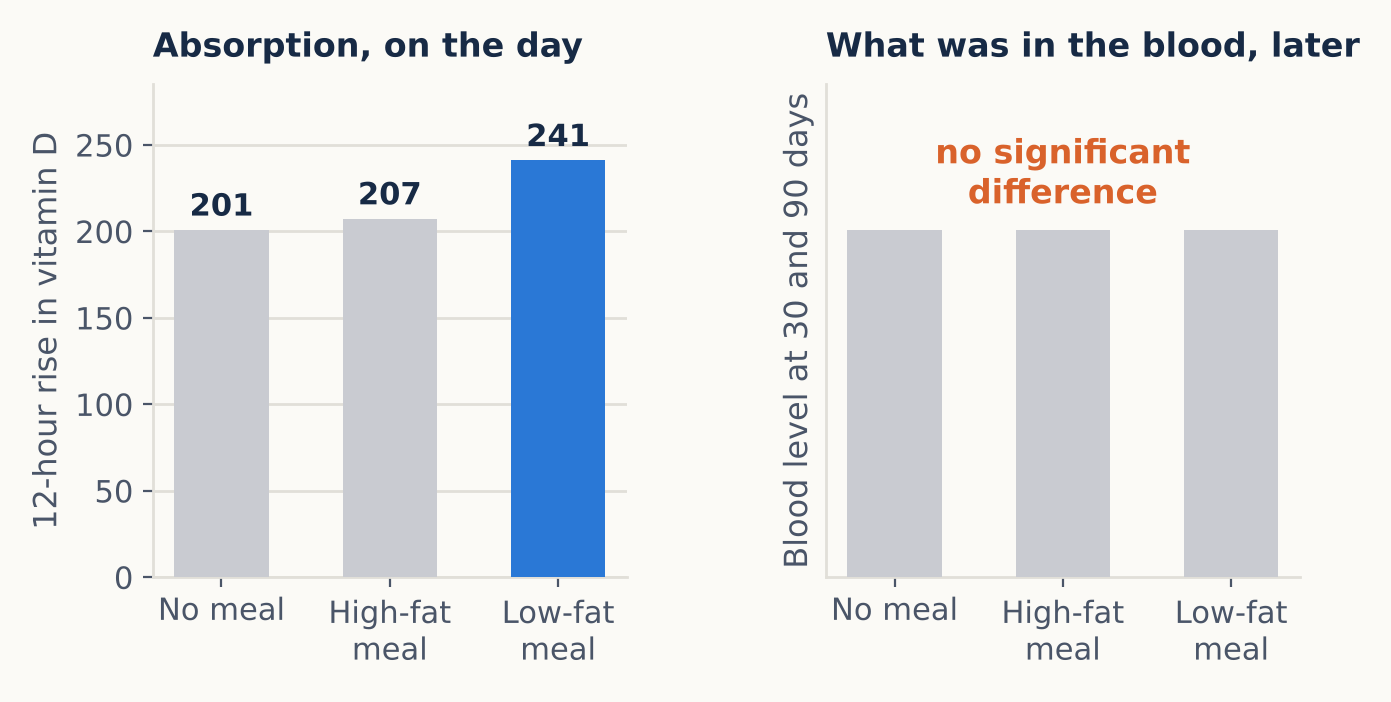
Sixty-two healthy older men and women were randomly assigned to one of three groups: no meal, a high-fat meal, or a low-fat meal. Each took 50,000 international units of vitamin D monthly with their assigned breakfast, or fasting, and were followed for ninety days.
Two results, and both of them are awkward for the received wisdom.
The low-fat meal won. Twelve-hour absorption was highest with the low-fat breakfast, significantly ahead of both the high-fat breakfast and no meal at all. And the high-fat meal did not beat taking it on an empty stomach. Whatever is happening, it is not simply that more fat dissolves more vitamin D.
And it did not reach the blood. At thirty days and at ninety days, the three groups' blood levels did not differ significantly. The paper's title says it plainly: meal conditions affect the absorption of supplemental vitamin D3, but not the blood level response to supplementation.
So the claim does not survive. There is no randomised evidence that taking vitamin D with a large or fatty meal raises what ends up in the blood, and the one trial that looked found the opposite of the mechanism everyone assumes.
What does survive, and it is dramatic
The fat rule is not dead. It was tested on the wrong nutrient.
Seven volunteers ate identical salads (spinach, romaine, cherry tomatoes, carrots) three times, in random order, with dressings containing zero, six or twenty-eight grams of oil. Their blood was sampled hourly for twelve hours and the carotenoids were measured directly in the fat-carrying particles that transport them.
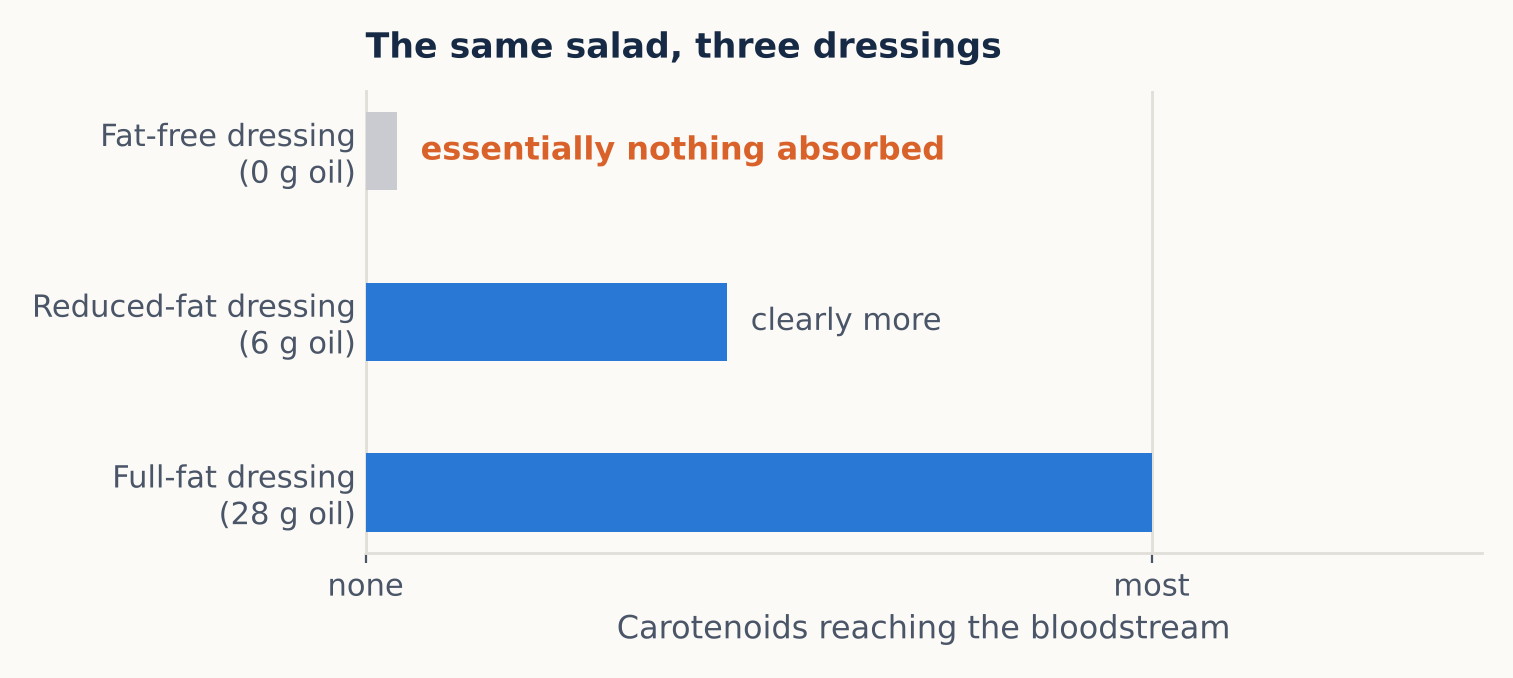
With the fat-free dressing, the appearance of alpha-carotene, beta-carotene and lycopene was negligible. Not reduced: negligible. Six grams of oil produced a clear increase over zero, and twenty-eight grams produced a further clear increase over six.
It is a tiny study, and the precise multiples should not be quoted. But the contrast between essentially nothing and something is not the kind of result that a larger sample reverses, and the mechanism is not in dispute: carotenoids are carried in fat and nothing else carries them.
The instruction this justifies is specific. A lutein, lycopene or mixed-carotenoid product should say to take it with a meal containing fat, and should mean it. A consumer taking a carotenoid capsule with black tea on an empty stomach is, on this evidence, absorbing almost none of it.
Why absorption and blood level are not the same question
The vitamin D trial contains a general lesson that is worth separating from vitamin D itself, because it applies across this whole category.
Absorption measured over twelve hours answers the question: how much of this dose got in on this occasion. Blood level measured at ninety days answers a different one: what is the person's status after taking it for three months. Between those two measurements sit storage, turnover, and the body's own regulation, and all three can absorb a difference that looked decisive on the day.
This is why single-dose absorption studies are a weak foundation for a pack instruction. They are cheap to run, they produce large and quotable percentage differences, and they are measuring the thing that is easiest to measure rather than the thing the consumer cares about. Where a longer study exists and disagrees with them, the longer study is describing the customer's experience.
What a timing instruction is actually worth
There is an arithmetic here that almost nobody does, and it changes which instructions are worth printing.
Suppose an instruction genuinely improves absorption by twenty per cent, and suppose that adding it as a second, inconvenient dosing time means some proportion of consumers take the product less consistently. If adherence drops by more than about a sixth, the instruction has made the product worse, because a dose not taken is absorbed at zero per cent.
Nobody can estimate those numbers precisely for a given product. The point is the direction: absorption gains are bounded and usually modest, while adherence losses are unbounded and frequently large. An instruction has to clear a real bar, not merely be true.
Iron is the clearest case. Taking it on an empty stomach demonstrably improves absorption. It also causes the nausea that is the main reason people stop taking iron, and in a market where the course lasts months, a product taken with food for twelve weeks beats a better-absorbed product abandoned in week two. The instruction is right; whether to lead with it is a judgement about the specific product and the specific consumer.
The rules, sorted
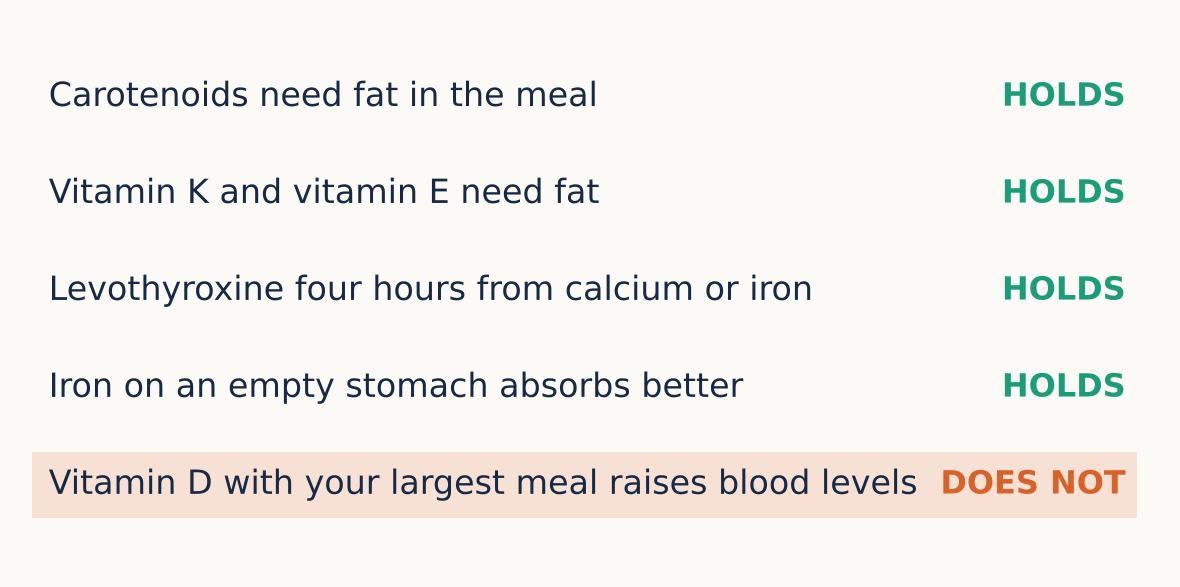
One row in that table deserves a caveat, because this article has just spent several hundred words warning against exactly the inference it rests on. The direct human evidence for the fat rule is strongest for carotenoids, where it was measured. For vitamins A, E and K it rests on the shared mechanism rather than on an equivalent trial, and vitamin D, which shares that same mechanism, is the nutrient where the rule did not translate into blood levels. So print the instruction for the fat-soluble vitamins by all means; the mechanism is sound and the instruction is harmless. Do not assume the size of the carotenoid effect carries across to them.
The levothyroxine rule is different in kind. It is not absorption theory: calcium and iron demonstrably reduce the absorption of thyroid medication, the four-hour separation is standard clinical practice, and it is a timing instruction rather than a reason to avoid either product.
Both rows point at the same underlying rule. A timing instruction only works if it is followed, so the test is never whether an instruction is true but whether it survives contact with a consumer who has a job, a family and four other things to remember.
Four slots that cover almost everything
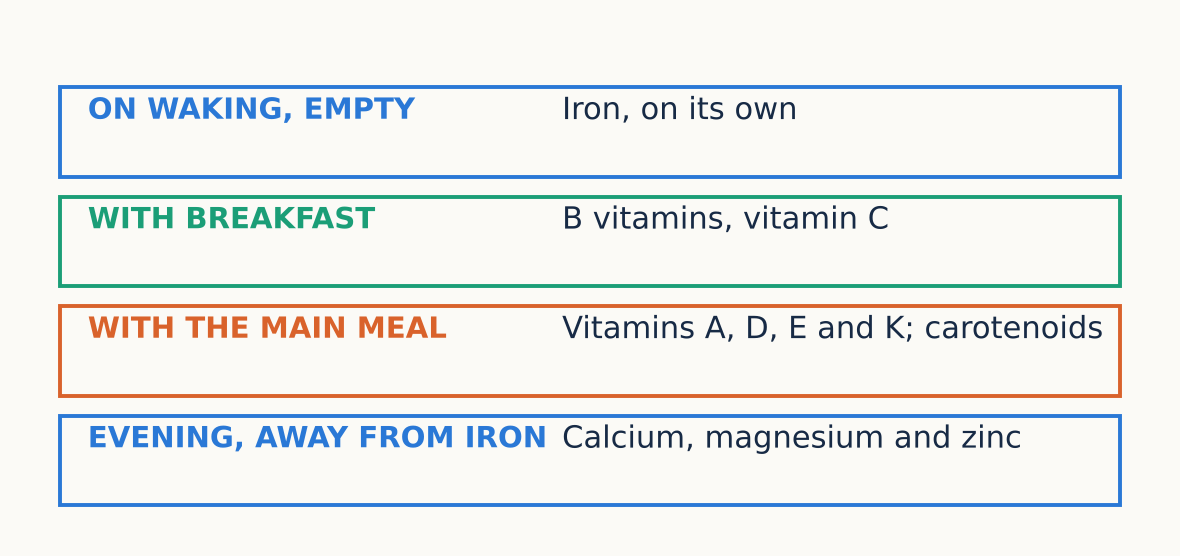
The virtue of a structure like this is that it is simple enough to print and simple enough to follow. Each slot exists for a reason that can be stated in one sentence on a pack, and none of the reasons is the vitamin D claim this article began with.
One more instruction is worth keeping, for a reason that has nothing to do with absorption. Telling a consumer when to take something gives them a place to put it in the day, and a supplement attached to an existing habit (breakfast, the evening meal) is taken far more reliably than one that floats. The timing slot may be doing more good as a memory aid than as a chemistry intervention, and that is a perfectly respectable reason to print it. It is just not the reason usually given.
What to take from this
- Do not print the vitamin D meal claim. It rests on an uncontrolled study of seventeen non-responders and the randomised trial did not confirm it.
- Do print the fat instruction for carotenoids, where it was measured directly and the difference was between something and almost nothing. Print it for vitamins A, E and K too, on the mechanism, but do not quote the carotenoid numbers for them.
- Separate levothyroxine from calcium and iron by four hours, as a timing instruction rather than a warning.
- Count the instructions before printing them. Three is a routine; six is a reason to stop taking the product.
The broader lesson is not about vitamin D. It is that the cheapness of a claim is not an argument for making it. A pack instruction is still a claim, and a company that prints only the ones it can defend ends up with fewer instructions and a better answer when somebody asks where they came from.
Sources
- Mulligan GB, Licata A. Taking vitamin D with the largest meal improves absorption and results in higher serum levels of 25-hydroxyvitamin D. Journal of Bone and Mineral Research 2010;25(4):928–930. (Prospective cohort, n=17, no control group.)
- Dawson-Hughes B, Harris SS, Palermo NJ, Ceglia L, Rasmussen H. Meal conditions affect the absorption of supplemental vitamin D3 but not the plasma 25-hydroxyvitamin D response to supplementation. Journal of Bone and Mineral Research 2013;28(8):1778–1783.
- Brown MJ, Ferruzzi MG, Nguyen ML, et al. Carotenoid bioavailability is higher from salads ingested with full-fat than with fat-reduced salad dressings as measured with electrochemical detection. American Journal of Clinical Nutrition 2004;80(2):396–403.
- Abioye AI, Okuneye TA, Odesanya AO, et al. Calcium intake and iron status in human studies: a systematic review and dose-response meta-analysis of randomized trials and crossover studies. Journal of Nutrition 2021;151(5):1084–1101.
- Product labelling for levothyroxine sodium, and standard clinical guidance on separating administration from calcium and iron preparations by approximately four hours.
Disclaimer
This article is written for formulators, manufacturers and informed readers. It is a summary of published research and is not medical advice, a diagnosis or a treatment recommendation. Thyroid disease and vitamin D deficiency require medical diagnosis and management, and no one should start, stop or change a prescribed treatment, including the timing of a prescribed medicine, on the basis of this article. Nothing here is a claim for any product, and no brand is named. Product composition and labelling must comply with the Food Safety and Standards Authority of India regulations applicable at the time of manufacture.