
Regulatory · Contamination
The contamination that will not appear on a certificate you did not ask for
Thirty per cent of turmeric sampled across five eastern states was over India's lead limit. The worst sample was six hundred times over it. None of this is accidental, all of it is testable, and one neighbouring country fixed the same problem in months.
India produces about eighty per cent of the world's turmeric. It is the country's most recognised functional ingredient and the one most likely to be on an export invoice. It is also, on the published evidence, the one most likely to be deliberately adulterated with a heavy metal.
This is uncomfortable to write and more uncomfortable to ignore, because the discipline that solves it is the same discipline that makes an export file defensible.
What the sampling found
A 2026 study collected 503 turmeric samples from 34 cities across five eastern Indian states, alongside 128 interviews with people along the supply chain. Thirty per cent of the samples exceeded India's permitted lead limit of 10 micrograms per gram. In Bihar, every city sampled showed evidence of adulteration.
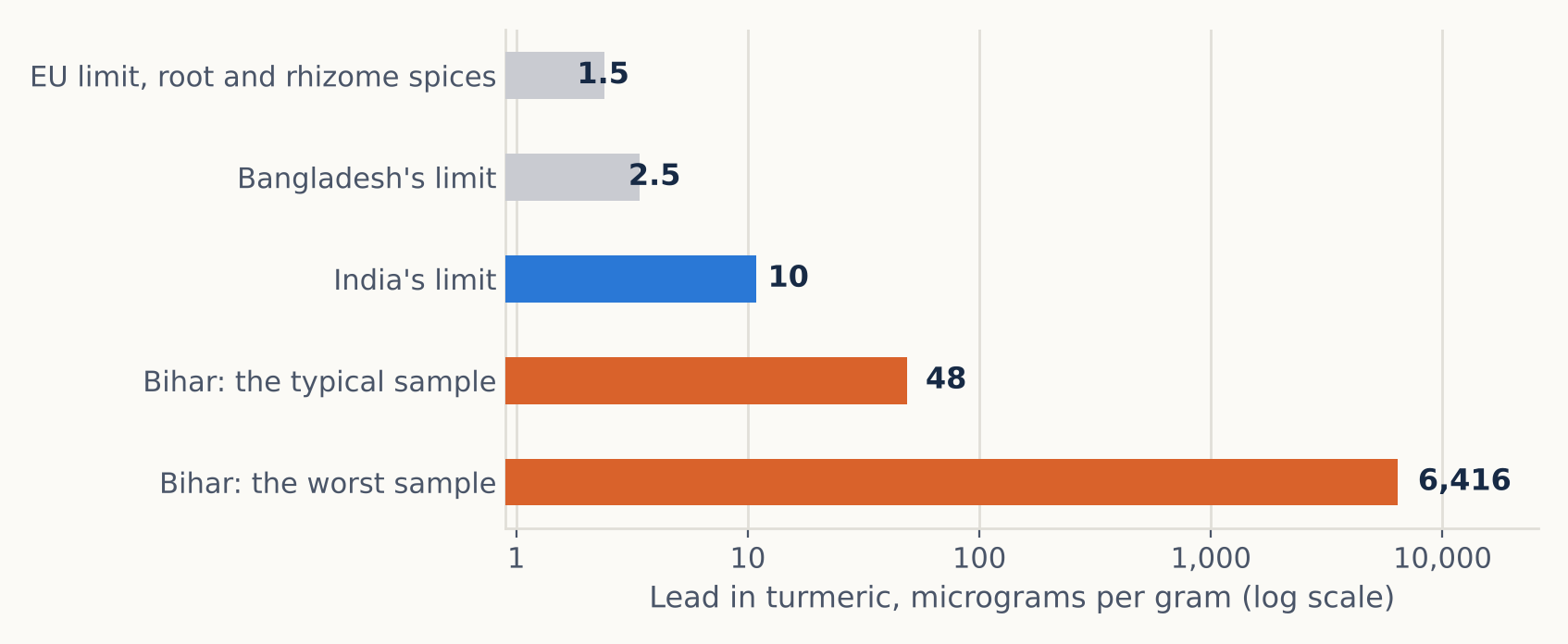
Two things in that chart deserve attention. The first is the distance between the typical Bihar sample and the worst one, which is why a single reassuring test result means very little. The second is the distance between India's limit and Europe's.
Turmeric that is perfectly legal in India can be nearly seven times over the European limit for root and rhizome spices. For anyone with an export ambition, the Indian limit is not the specification. It is the floor below the specification.
It is not environmental. It is added, and we know where
Every sample above the limit also contained chromium, at levels consistent with lead chromate: a bright yellow industrial pigment. This is not soil contamination or a processing residue. It is a colouring agent.
The interviews located the step. Lead chromate is added during polishing, when turmeric roots are tumbled in a spinning drum until the skin rubs away and the surface looks smooth and bright. It is not added during boiling or grinding. Sometimes roots are coloured again closer to the point of sale, by vendors correcting a colour discrepancy by hand.
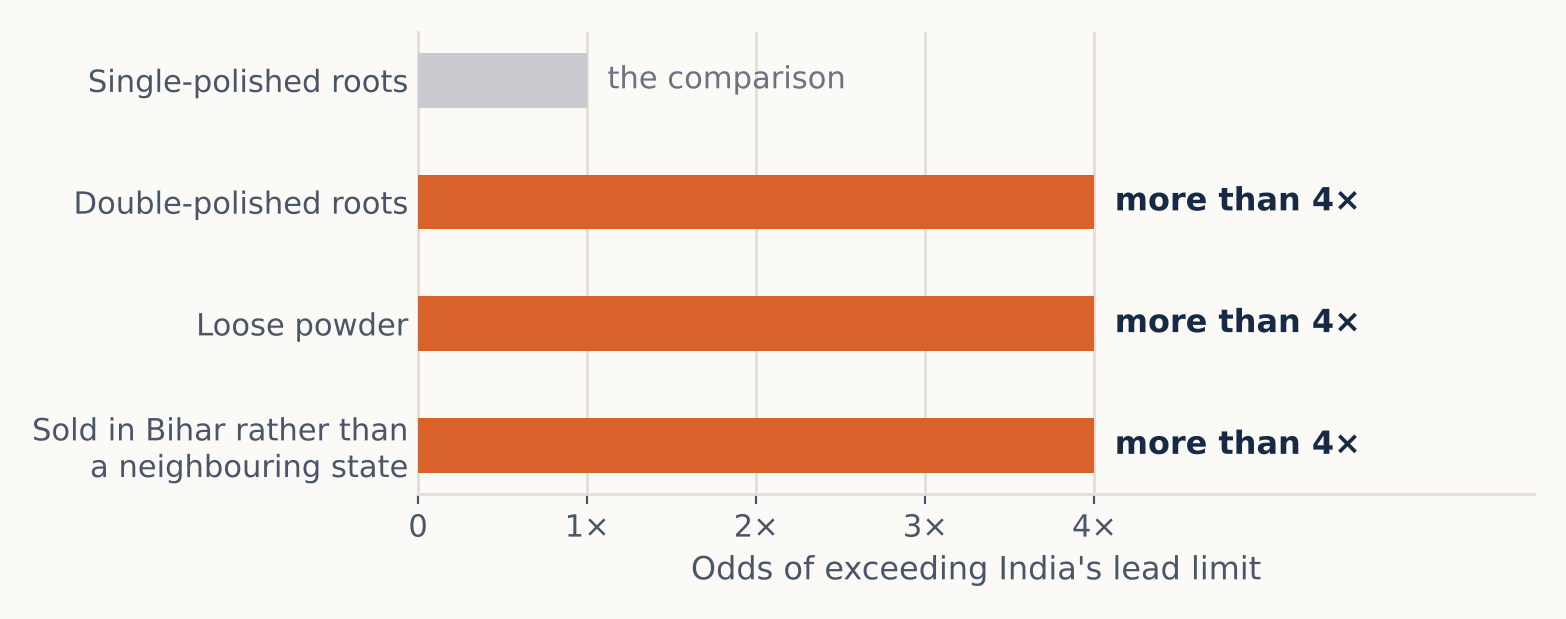
There were two stated reasons for doing it, and the second is the one that is rarely reported. The first is colour. The second is that the pigment fills the holes left by insect damage and makes stored roots look fresh, which is why adulteration is worse between January and March, when the roots have been in store longest.
The pigment itself is sold openly in hardware shops, in packets from a hundred grams to twenty-five kilograms, at between one and five and a half United States dollars a kilogram. The sellers describe it as a wood stain and a pigment for plastics and paint.
The finding that should change how you buy
Fifty-one samples were collected from two cities with no previous evidence of adulteration: Dhanbad in Jharkhand and Prayagraj in Uttar Pradesh. None of them contained detectable lead. They were predominantly the same middle grade, from the same producing states, as the lead-tainted turmeric sold a few hundred kilometres away.
That is the commercially useful finding in the whole study. It also sets the limits of what a formulator can do by specification alone: between 62 and 90 per cent of root samples arriving by truck from each major producing state already carried elevated lead when they reached the market.
Why the rule exists and the practice continues
India has prohibited lead in turmeric since 2011. The interviews in this study explain, without excusing, why that has not been enough.
Food safety officers have oversight of thousands of businesses each, from manufacturers to street carts, with limited staff and limited testing budgets. Their priorities are set by what is visible and what is acute: spoiled food, hygiene violations, customer complaints. Lead poisoning is neither. Its effects are silent and take years to appear, so it generates no complaints and therefore no inspections.
There is also a bottleneck that is purely practical. Confirming lead chromate adulteration requires laboratory analysis that costs money and takes about a fortnight. Several officers said they could often tell by looking at a root that it had been pigmented, but could not act without the lab result. Inspections concentrated on markets and grinding mills, not on the polishing facilities where the pigment is actually added.
None of that changes what a buyer should do. It changes what a buyer should expect: that the absence of enforcement action against a supplier is not evidence about that supplier, and that testing is a competitive advantage rather than a formality, for exactly as long as it remains unusual.
The interaction that makes this worse in exactly the wrong place
Lead exposure and iron deficiency compound one another. Anaemic people absorb lead more readily, because the gut transporter that takes up iron is not selective and takes up lead when iron is scarce.
In Bihar, where the adulteration is worst, more than sixty per cent of children are anaemic. The state with the most contaminated turmeric is also the state whose population is most efficient at absorbing what is in it. The study estimates that eliminating the practice could raise child IQ by up to 2.3 points, worth between 239 million and 1.6 billion US dollars a year in future earnings in that state alone.
For a company selling iron supplements in those markets, this is not a distant public-health statistic. It is a direct argument for testing the botanical ingredients in the same range, because the consumer most likely to need the iron is the one least protected against the lead.
Two more contamination problems worth assuming are present
Shilajit is a mineral-humic exudate and characteristically carries lead and arsenic. The arithmetic is unforgiving.
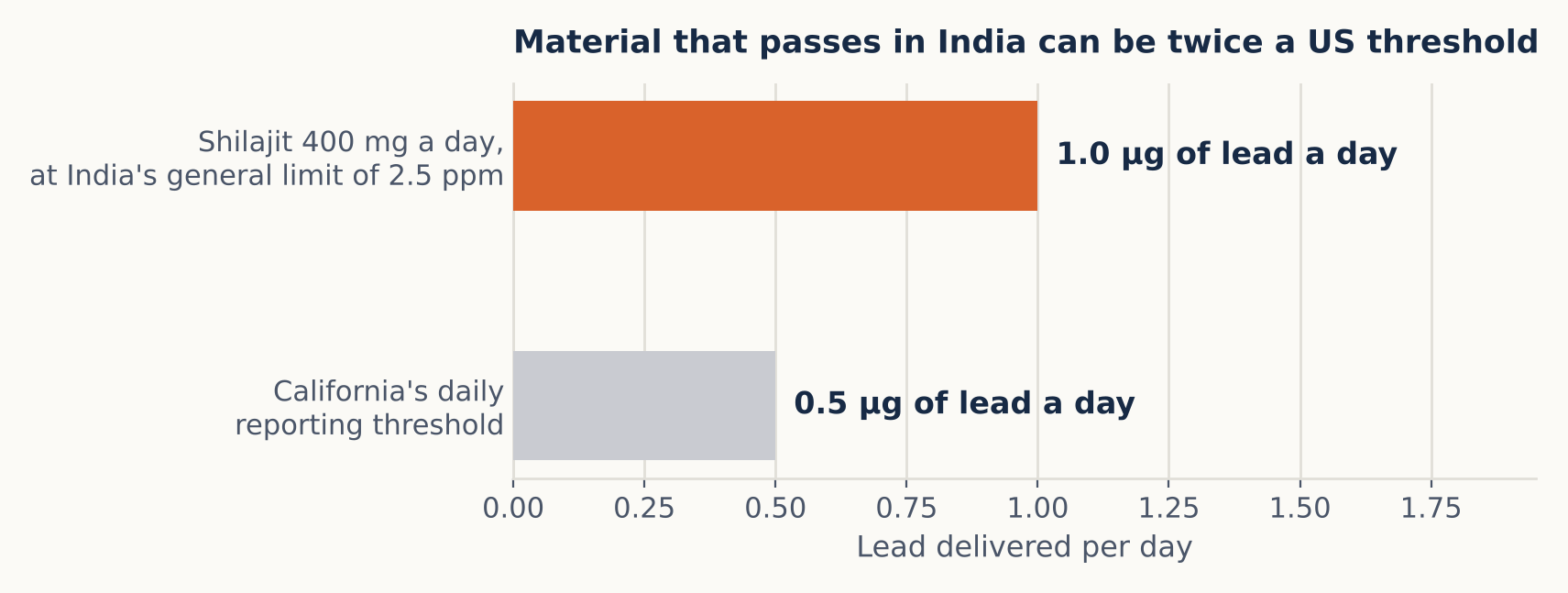
Material that meets the Indian limit comfortably can deliver twice the daily lead that triggers a labelling obligation in California. For any product with a United States ambition, specify below 1.25 parts per million and test it. The US import alert covering Ayurvedic supplements from India names this category explicitly, and detention is expensive in a way a test is not.
The second problem is quieter and shows up in the same study. Only one chilli sample and four coriander samples carried detectable lead, but grinding equipment is shared between spices, so residue on a mill is a plausible route into materials nobody is adulterating. If a supplier grinds turmeric and your botanical on the same equipment, that is a question worth asking in writing.
The third adulteration problem is a species, not a metal
The Schedule IV traps are not about contamination at all. They are about buying the wrong plant with the right common name.
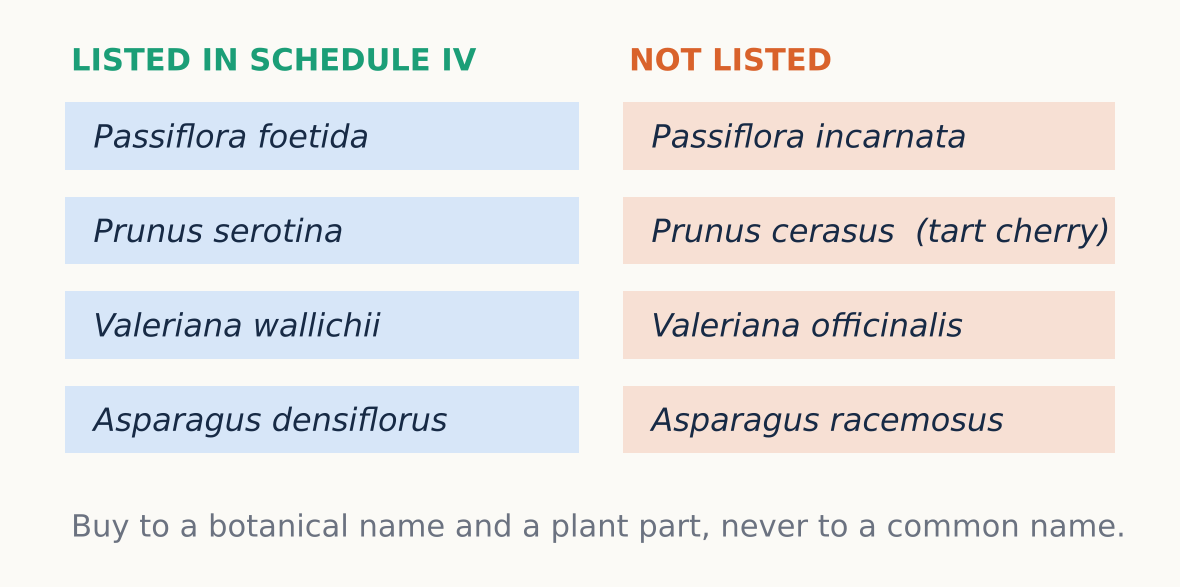
This is not a theoretical risk. When a widely used Indian botanical was linked to serious liver injury, the industry's principal defence was that the plants consumed were probably a related species traded under the same name. Whether or not that defence holds, it concedes the point that matters to a buyer: the common name did not identify the plant.
A last note on where the problem sits in the chain. Less than fifteen per cent of the turmeric traded in Bihar is grown there; most arrives from Tamil Nadu, Maharashtra, Telangana and Karnataka. Pigment was being added both at source and again near the point of sale. That means a supplier audit at one end of the chain does not settle the question, and it is the reason the answer has to be a test on the material you actually receive.
Five things that cost less than a recall
- Specify the European limit of 1.5 micrograms per gram for lead in turmeric, not India's 10, if the product may ever leave the country.
- Prefer a standardised extract over raw powder where the formulation allows it, and test the extract too: concentration concentrates everything.
- Avoid double-polished roots and loose powder, which carried more than four times the odds of exceeding the limit.
- Specify shilajit below 1.25 parts per million for lead, and ask for the arsenic figure in the same certificate.
- Buy to a botanical name and a plant part, never to a common name, and ask what else is ground on the same equipment.
A portable X-ray fluorescence analyser costs a few lakh rupees and screens a sample in a minute. Laboratory confirmation currently takes about two weeks, which is precisely why enforcement stalls, and precisely why a buyer who screens in-house has an advantage that is hard to copy.
One closing note, because this article should not end in resignation. Bangladesh had the same problem for four decades, with a policy in place and no enforcement behind it. A national intervention beginning in 2019 cut the prevalence of lead-tainted turmeric by about ninety per cent within months, and the improvement held for years. It cost under a million dollars. This is a solvable problem, and the companies that solve it first will be the ones holding the test data when someone finally asks.
Sources
- Forsyth JE, Sinha M, Bandekar A, Mistree D, Parida M, Nash E, Nambiar L, Elmera C, Luby SP. Systemic drivers of toxic food adulteration: lead chromate in turmeric across eastern India. npj Science of Food 2026;10(1). doi:10.1038/s41538-026-00867-8
- Commission Regulation (EU) 2023/915 on maximum levels for certain contaminants in food, for the 1.5 µg/g limit on lead in root and rhizome spices.
- Food Safety and Standards (Contaminants, Toxins and Residues) Regulations, 2011, for India's 10 µg/g limit on lead in turmeric, whole and powdered.
- United States Food and Drug Administration. Import Alert 99-42, detention without physical examination of certain products for heavy metal contamination, which names Ayurvedic supplements.
- California Office of Environmental Health Hazard Assessment. Proposition 65 maximum allowable dose level for lead (reproductive toxicity), 0.5 µg per day.
- Food Safety and Standards (Health Supplements, Nutraceuticals…) Regulations, 2016, Schedules IV and VI, for the listed species and plant parts.
- Kulkarni AV, Hanchanale P, Prakash V, et al. Tinospora cordifolia (Giloy)-induced liver injury during the COVID-19 pandemic: multicenter nationwide study from India. Hepatology Communications 2022;6(6):1289–1300.
- Panneer Selvam K, Payyappallimana U, Ravikumar K, Venkatasubramanian P. Can Guduchi (Tinospora cordifolia), a well-known ayurvedic hepato-protectant, cause liver damage? Journal of Ayurveda and Integrative Medicine 2023;14(1):100658. (The substitution argument.)
Disclaimer
This article is written for formulators, manufacturers and informed readers. It is a summary of published research and regulation and is not legal advice, medical advice, a diagnosis or a treatment recommendation. The contamination findings described here are those of the cited studies, relate to the samples those studies collected, and are not statements about any particular supplier, brand or batch. Nothing here is a claim for any product, and no brand is named. Product composition, contaminant testing and labelling must comply with the Food Safety and Standards Authority of India regulations applicable at the time of manufacture, and every limit and schedule entry referred to here should be verified against the current official text before it is relied on.