
Nutraceuticals · Evidence and Dose
What the trial did, and what the label does
Four of the most heavily marketed supplement ingredients share one problem. Either the dose in the pack is a fraction of the dose the research used, or the claim on the pack is not the result the research produced.
There is a particular kind of failure that runs through this category, and it is not fraud. The ingredient is real. The research is real. What goes wrong is in between. Four worked examples follow, each with the defensible version of the proposition set beside the problem, because all four of these ingredients sell extremely well in India and none of them deserves to be abandoned.
Collagen: an arithmetic problem and an evidence problem
Collagen peptides are genuinely absorbed. Collagen for supplements is sold as a hydrolysate, the long protein chopped into short fragments, and after an oral dose those fragments turn up in the blood within about two hours. That part is not in dispute.
The trials behind the skin claims use 2.5 to 10 grams a day, with most clustering around 3.5 to 4 grams. Then look at what is on sale.
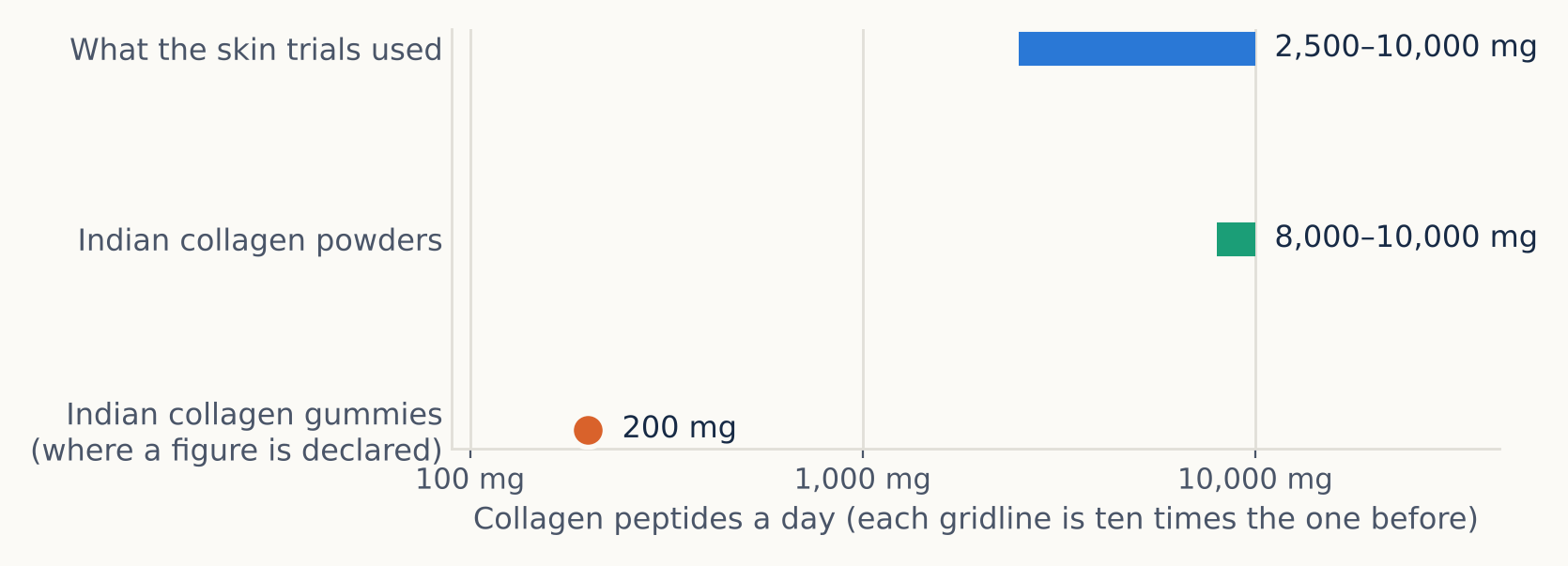
Indian collagen powders are dosed at or above the levels the trials used: 8 to 10 grams a serving is standard. Indian collagen gummies are a different story. Where a figure is declared at all it tends to be around 200 milligrams, somewhere between 2 and 8 per cent of the trial dose. Most listings declare no collagen quantity whatsoever. And some gummies sold in this market as collagen products contain no collagen at all: what they carry is a hundred-odd-milligram blend of plant extracts described as a collagen-boosting or collagen-building complex.
Before applying that arithmetic, though, ask the prior question: does the trial result survive scrutiny? For collagen, the best-designed analysis says no. A 2025 review of 23 randomised trials and 1,474 participants found that pooling everything gives a positive result for skin hydration, elasticity and wrinkles, but that separating the trials by who paid for them leaves the independently funded ones showing no effect on any of the three. The higher-quality studies showed no significant effect either. The authors concluded that there is currently no clinical evidence supporting collagen supplements for skin ageing. Other reviews disagree; nearly all of them flag the same funding and bias problems.
That ordering matters. The dose test only bites on ingredients whose effect survives the funding test. For collagen the honest position is that neither test is passed by the gummy format, and the powder format passes the dose test for an effect that is itself unsettled.
And one point of precision about the word
Collagen is, by definition, an animal protein. European Union Regulation 853/2004 defines it as a protein-based product derived from animal bones, hides, skins and tendons. So in the European Union a plant protein hydrolysate sold as collagen is not the food it is named after.
In India and the United States the position rests on general prohibitions rather than a definition. Section 3 of the Food Safety and Standards Act 2006 makes food misbranded if it is offered with false, misleading or deceptive claims, or sold by the name of another food. The equivalent American provision prohibits labelling that is false or misleading in any particular. We have found no published guidance from either the Indian food authority or the United States Food and Drug Administration dealing specifically with plant-based collagen claims as at November 2026, so this is an argument from first principles rather than a settled ruling.
The commercially stronger answer in India is also the cleaner one. Supply vitamin C, zinc and hyaluronic acid at doses that have actually been tested, describe the product as collagen support rather than collagen, and keep the vegetarian mark, accepting, as the next section sets out, that the hyaluronic acid evidence has limits of its own.
Hyaluronic acid: the gap is not where people think
This one deserves a correction to the received wisdom. Oral hyaluronic acid trials run at 60 to 200 milligrams a day, most often 120, over 4 to 12 weeks, and the trial quality is modest throughout: small groups, short durations, instrument measurements of skin rather than anything a person would notice unaided, and heavy manufacturer involvement.
Against that, standalone hyaluronic acid capsules are commonly sold at 100 milligrams a serving, which is close to trial dose. On this ingredient the standalone products are broadly honest, and a 100 to 120 milligram dose is a defensible specification. The gap opens somewhere else: in multi-ingredient beauty gummies, where hyaluronic acid appears on the front of pack and is listed with no quantity at all. A named ingredient without a number is a decoration.
Coenzyme Q10: the milligram figure is the least important number on the pack
Coenzyme Q10 is poorly absorbed, and how poorly depends almost entirely on how it is formulated rather than on how much is in it.
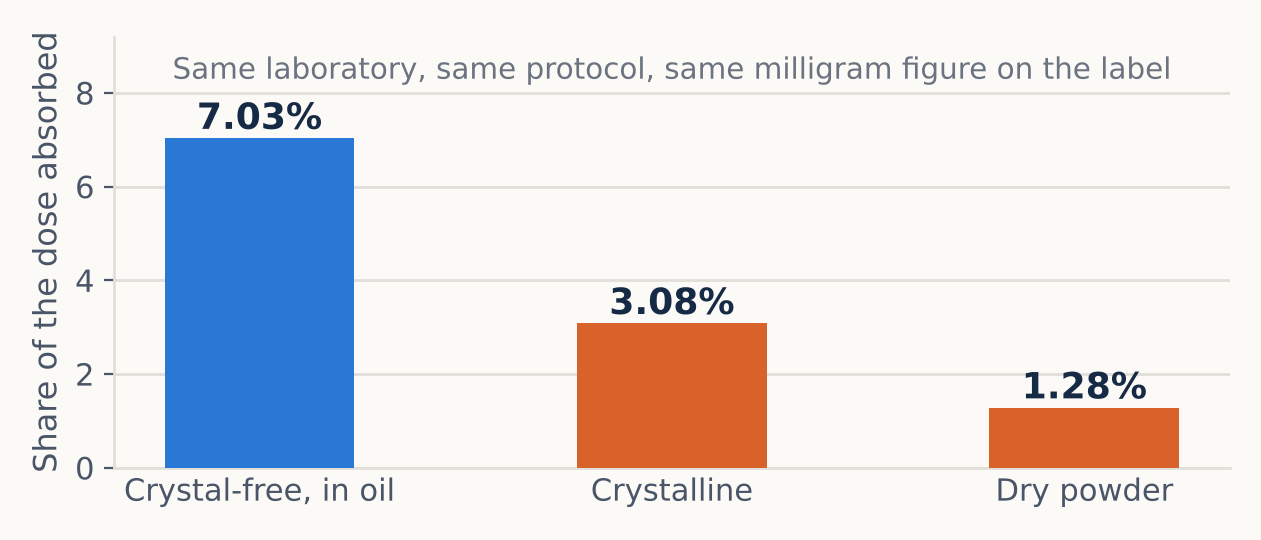
Changing the formulation changed absorption five-fold at the same label dose. That is a larger difference than most of the dose differences brands compete on, and it is the exception to an argument made earlier in this series: for iron and calcium the schedule and the dose size matter more than the ingredient grade, but for coenzyme Q10 the grade is the whole game.
Two further specifications worth having. Absorption plateaus near 200 milligrams in a single dose, and 100 milligrams taken twice raises blood levels more than 200 milligrams taken once. India permits 100 to 1,000 milligrams a day in the nutraceutical schedule: an unusually generous range that puts the burden of choosing sensibly on the formulator.
On evidence, the strongest result is a trial known as Q-SYMBIO: 420 patients with moderate to severe heart failure given 300 milligrams a day on top of their standard treatment. Major cardiovascular events over two years came in at 15 per cent against 26 per cent. That is a trial dose in a diagnosed disease, not a claim available to a supplement. Two things are rarely mentioned alongside it: the trial's own 16-week endpoints showed no significant change, and no second large trial has reproduced the two-year result.
The statin claim, which is what most coenzyme Q10 is actually sold on
Statins, the cholesterol-lowering medicines taken by a very large number of people, lower blood coenzyme Q10, and muscle aches are the commonest reason people stop taking them. Those two facts have built a large market. Nothing in this section should be used by anyone to stop or change a statin their doctor has prescribed; that is a conversation for the doctor.
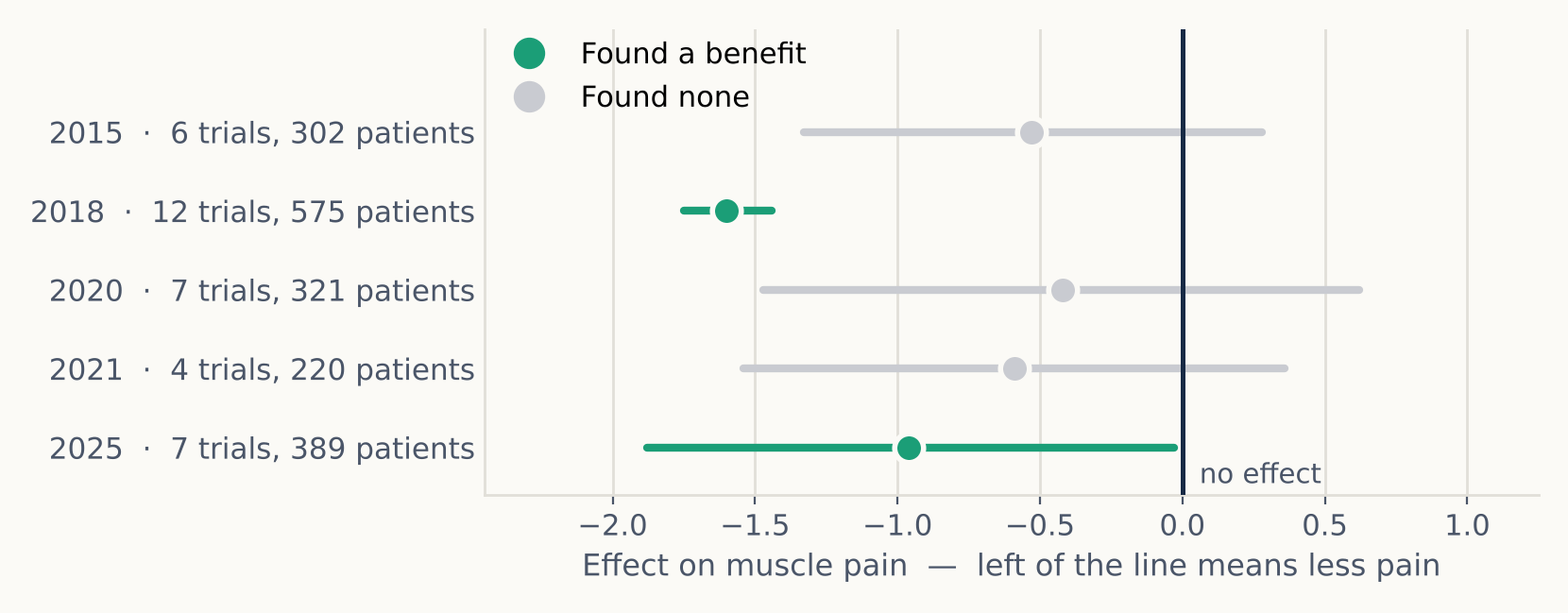
Three of the five found nothing. Two found a benefit, the 2025 one only narrowly. The trials underneath them are the same handful of small, short studies (roughly 35 to 76 patients each, 30 to 90 days) and which way an analysis lands depends heavily on which of them it includes. Anyone claiming the question is settled, in either direction, is overstating it.
One observation does hold across all five: none of them found a change in creatine kinase, the blood marker of actual muscle damage, though none was large enough to settle the point. The disagreement lives entirely in the subjective pain scores. If a brand wants to be in this space, comfort rather than repair is the only positioning the evidence reaches towards, and it rests on the minority of the analyses, which should be said rather than hidden.
On the fall in blood coenzyme Q10 itself, there is a tidy explanation worth knowing. Coenzyme Q10 travels through the bloodstream inside LDL particles: low-density lipoprotein, the carrier usually called 'bad' cholesterol. In a trial of 72 healthy men comparing a statin against a cholesterol-absorption blocker, the fall in coenzyme Q10 tracked the fall in LDL closely, while the amount carried per particle actually rose. So the fall probably reflects fewer delivery vehicles rather than less coenzyme Q10.
Lutein: a real measurable effect attached to a trial that missed
Lutein and zeaxanthin accumulate selectively in the macula, the central part of the retina, where they are thought to filter blue light and neutralise reactive oxygen. Supplementation at 5 to 20 milligrams a day raises the measured density of that pigment, repeatably and in proportion to the dose, though people who already have a lot of it respond least.
That is a genuine instrument-measured effect, and it is a weaker claim than a clinical outcome; this article has just criticised instrument endpoints in the hyaluronic acid trials, and the same discount applies here. It is still the most defensible thing a lutein product can say. What it should be careful about is the trial it is usually sold on.
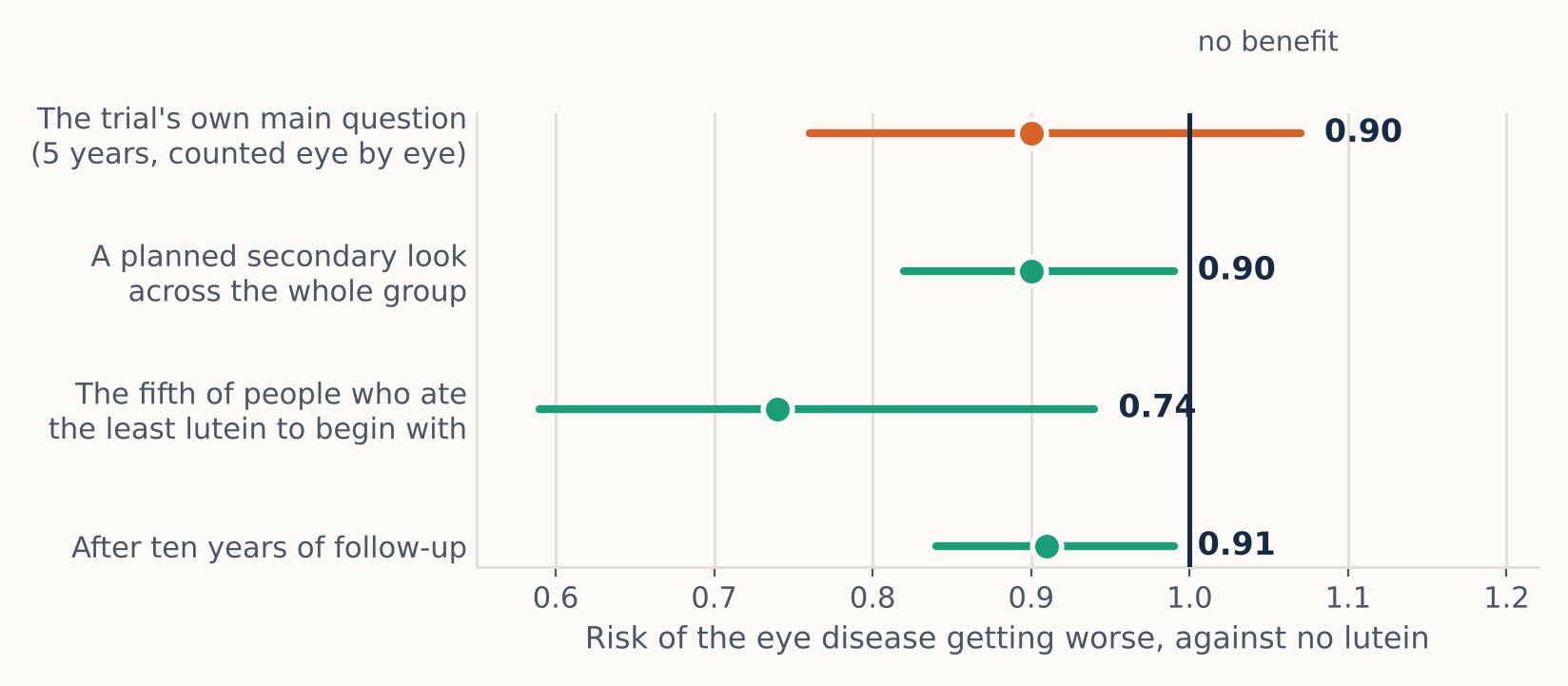
The trial's own main question did not reach significance. The same best estimate, a 10 per cent reduction, did reach it in a planned secondary analysis across the whole group, where the larger numbers made the estimate more precise rather than larger. A bigger effect appeared in the fifth of participants who ate the least lutein to begin with, and the ten-year follow-up found the same small benefit again. That is a reasonably consistent picture of a modest effect in people who were short of lutein in the first place.
The report containing those findings calls them exploratory in its own stated limitations, and notes that the analyses were run without the statistical correction normally applied when a study asks many questions at once. Visual acuity did not move in any analysis. Sell the pigment effect. Do not build the front of pack on this trial.
Briefly, the two neighbouring carotenoids. Lycopene for prostate claims is not disproved: it is unsupported, which is a different thing: the Cochrane review found three trials and 154 men between them and concluded there was not enough evidence either to support or to refute it. Astaxanthin is better placed, with reasonably consistent skin results at 3 to 6 milligrams a day, though applying this article's own funding test, those trials are small and largely manufacturer-funded, so the same discount applies as to collagen. Its antioxidant and metabolic claims need 12 to 20 milligrams and rest on low-certainty evidence.
The test to apply before a product goes to print
- Does the effect survive when the industry-funded trials are removed? Ask this first, because it decides whether the dose question is worth asking. For collagen, on the best current analysis, it does not.
- What dose did the trial use, and what percentage of it is in one serving? Under a quarter, and the trial is not evidence for this product.
- Is the claim built on the trial's main question, or on something found afterwards? Both can be legitimate. Only one of them is what a reader will assume.
- For a poorly absorbed ingredient, is the formulation specified, or only the milligram figure? Coenzyme Q10 varies five-fold on formulation alone.
None of this argues against selling these ingredients. Hyaluronic acid at 100 to 120 milligrams, lutein at 10 milligrams sold on the pigment effect, coenzyme Q10 in a specified oil-dispersed grade, and collagen at the dose the powders already use are all defensible propositions. They are narrower than the market currently makes them, and a good deal more durable.
Sources
- Ichikawa S, Morifuji M, Ohara H, Matsumoto H, Takeuchi Y, Sato K. Hydroxyproline-containing dipeptides and tripeptides quantified at high concentration in human blood after oral administration of gelatin hydrolysate. International Journal of Food Sciences and Nutrition 2010;61(1):52–60.
- Myung S-K, Park Y. Effects of collagen supplements on skin aging: a systematic review and meta-analysis of randomized controlled trials. American Journal of Medicine 2025;138(9):1264–1277.
- Pu S-Y, Huang Y-L, Pu C-M, et al. Effects of oral collagen for skin anti-aging: a systematic review and meta-analysis. Nutrients 2023;15(9):2080.
- Regulation (EC) No 853/2004 of the European Parliament and of the Council laying down specific hygiene rules for food of animal origin, Annex I, point 7.8.
- The Food Safety and Standards Act, 2006 (Act No. 34 of 2006), section 3.
- United States Code, Title 21, section 343(a)(1) and section 343(i).
- Dolečková I and colleagues. Oral hyaluronan supplementation and skin quality: a randomised, double-blind, placebo-controlled trial. Scientific Reports 2025. (Conducted and funded by a hyaluronic acid manufacturer.)
- Hsu T-F and colleagues. Oral hyaluronan relieves wrinkles and improves dry skin. Nutrients 2021;13(7):2220.
- Amin A and colleagues. Oral hyaluronic acid for skin hydration, elasticity and wrinkles: a systematic review and meta-analysis. Journal of Drugs in Dermatology 2025.
- Judy WV. Bioavailability of nine coenzyme Q10 formulations. Integrative Medicine (Encinitas) 2022.
- Barakat A, Shegokar R, Dittgen M, Müller RH. Coenzyme Q10 oral bioavailability: human studies. Journal of Pharmaceutical Investigation 2013;43:1–14.
- Singh RB and colleagues. Effect on absorption and oxidative stress of different oral coenzyme Q10 dosages and intake strategy in healthy men. BioFactors 2005;25(1–4):219–24.
- Molyneux S and colleagues. The bioavailability of coenzyme Q10 supplements available in New Zealand differs markedly. Nutrition Research 2007.
- Mortensen SA, Rosenfeldt F, Kumar A, et al. The effect of coenzyme Q10 on morbidity and mortality in chronic heart failure: results from Q-SYMBIO, a randomized double-blind trial. JACC: Heart Failure 2014;2(6):641–9.
- Banach M, Serban C, Sahebkar A, et al. Effects of coenzyme Q10 on statin-induced myopathy: a meta-analysis of randomized controlled trials. Mayo Clinic Proceedings 2015;90(1):24–34.
- Qu H, Guo M, Chai H, et al. Effects of coenzyme Q10 on statin-induced myopathy: an updated meta-analysis of randomized controlled trials. Journal of the American Heart Association 2018;7(19):e009835.
- Kennedy C, Köller Y, Surkova E. Effect of coenzyme Q10 on statin-associated myalgia and adherence to statin therapy: a systematic review and meta-analysis. Atherosclerosis 2020;299:1–8.
- Wei S and colleagues. Effects of coenzyme Q10 supplementation on statin-induced myopathy: a meta-analysis. Irish Journal of Medical Science 2021;191(2):719–725.
- Kovacic V and colleagues. Coenzyme Q10 supplementation for statin-associated muscle symptoms: a systematic review and meta-analysis. Journal of Nutritional Science 2025;14:e72.
- Berthold HK, Naini A, Di Mauro S, et al. Effect of ezetimibe and/or simvastatin on coenzyme Q10 levels in plasma: a randomised trial. Drug Safety 2006;29(8):703–12.
- Bone RA, Landrum JT. Dose-dependent response of serum lutein and macular pigment optical density to supplementation with lutein esters. Archives of Biochemistry and Biophysics 2010;504(1):50–5.
- Ma L and colleagues. Effect of lutein and zeaxanthin on macular pigment and visual function in patients with early age-related macular degeneration. Ophthalmology 2012;119(11):2290–7.
- Chew EY and the AREDS2 Research Group. Lutein + zeaxanthin and omega-3 fatty acids for age-related macular degeneration: the AREDS2 randomized clinical trial. JAMA 2013;309(19):2005–15.
- AREDS2 Research Group. Secondary analyses of the effects of lutein/zeaxanthin on age-related macular degeneration progression: AREDS2 Report No. 3. JAMA Ophthalmology 2014;132(2):142–9.
- Chew EY and colleagues. Long-term outcomes of adding lutein/zeaxanthin and omega-3 fatty acids to the AREDS supplements: AREDS2 Report 28. JAMA Ophthalmology 2022;140(7):692–698.
- Ilic D, Forbes KM, Hassed C. Lycopene for the prevention of prostate cancer. Cochrane Database of Systematic Reviews 2011;(11):CD008007.
- Zhou X and colleagues. Systematic review and meta-analysis of the clinical efficacy of oral astaxanthin supplementation on skin ageing. Nutrients 2021;13(9):2917.
- Food Safety and Standards Authority of India. Schedule VI, Part A, item 11, as substituted by the direction dated 29 December 2017.
Disclaimer
This article is written for formulators, manufacturers and informed readers. It is a summary of published research and is not medical advice, a diagnosis or a treatment recommendation. Nothing here should be used to start, stop or change any prescribed treatment, including statin therapy, or to delay seeking advice about eye or heart symptoms. Nothing here is a claim for any product, and no brand is named. Product composition and labelling must comply with the Food Safety and Standards Authority of India regulations applicable at the time of manufacture, and every schedule entry referred to here should be verified against the current gazetted text before it is relied on.