
Nutraceuticals · Drug Interactions
The three drug questions a pharmacist will actually ask you
One of them is the largest identifiable commercial opportunity in Indian supplements and requires no disease claim at all. One is a timing instruction that gets mistaken for a contraindication. And one is a story this industry should stop telling.
Drug and nutrient interactions come up in pharmacy conversations more often than any other technical question, and a sales team that can answer them accurately has an advantage that is difficult to copy. Three of them account for most of the conversations.
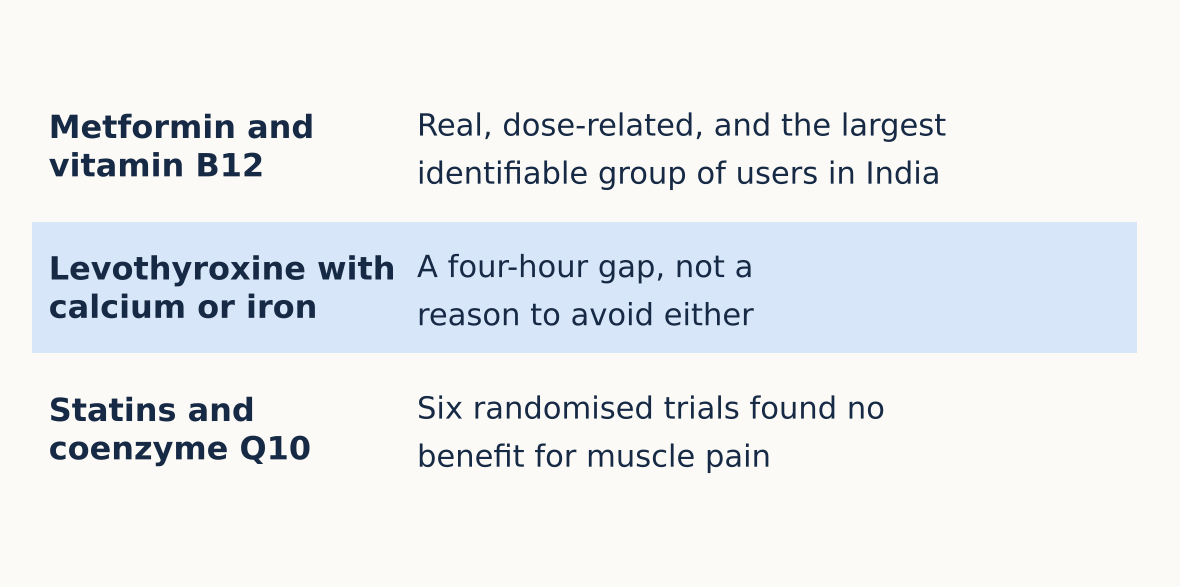
Metformin and vitamin B12
This is the best-established drug-nutrient depletion in common medicine and, given diabetes prevalence in India, the largest identifiable group of people it applies to anywhere.
Metformin interferes with the absorption of vitamin B12 in the lower small intestine. Indian clinic series consistently find around thirty per cent of patients on metformin have low B12, and the relationship with dose is consistent across them.
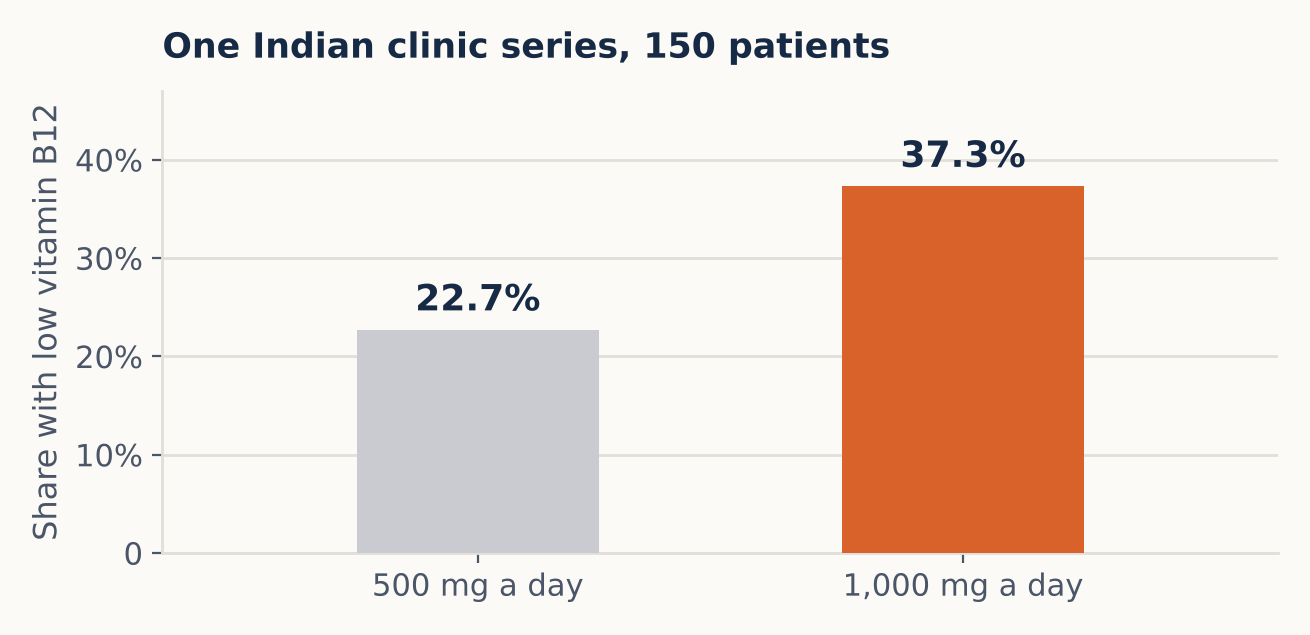
One widely repeated detail is worth correcting, because it changes who you would target.
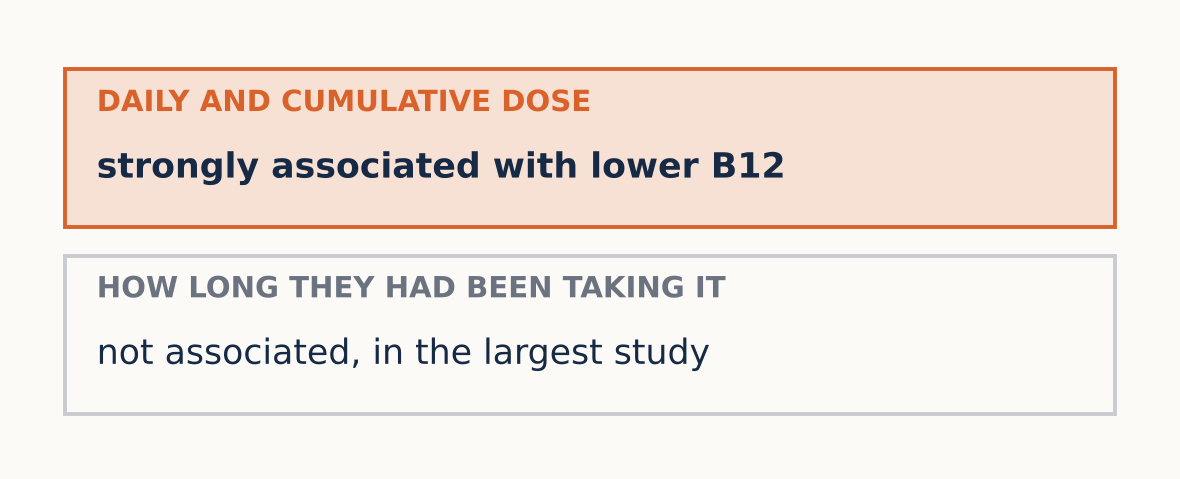
The depletion is usually described as dose- and duration-dependent. In the largest and best-measured study, which used a marker of cellular B12 status rather than total blood B12, daily and cumulative dose were strongly associated with lower levels, and duration of use was not. Several smaller Indian series do report a duration effect. The dose relationship is the one that holds up consistently.
There is a second reason this matters clinically, and it is the connection to folate. Folic acid can correct the anaemia of B12 deficiency while neurological damage continues underneath it: the blood count looks better while the nerves do not. In a market where a large share of the population is already B12 insufficient on dietary grounds alone, a folate-containing product without B12 is a formulation error rather than a cost saving.
Why this is an opportunity without being a claim
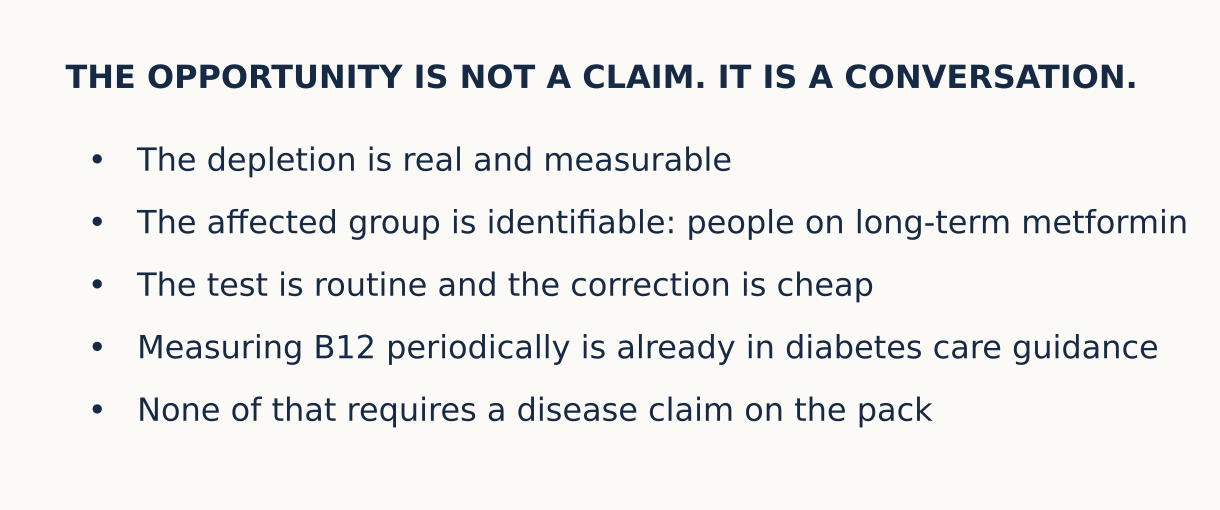
The reason this is unusual is that every element of the proposition is already established without the brand having to assert anything. The depletion is documented in the medical literature. The affected group identifies itself: people on long-term metformin know they are on it. Periodic measurement of B12 in metformin-treated patients already appears in diabetes care guidance. The test is routine and the correction costs very little.
What that means in practice: the pharmacist can have the conversation, and the pack does not have to make a claim at all. A B12 product correctly dosed, sitting beside a sales team who can explain the interaction accurately and who say ‘ask your doctor to check it’ rather than ‘take this instead’, is both compliant and more persuasive than any permitted wording would be.
What to actually put in the product
If the metformin conversation is the opportunity, the product has to be able to hold up its end of it. Three formulation points follow from how the depletion works.
- The interference is with absorption in the lower small intestine, which means an oral dose has to be large enough to get past it. The doses used in correction studies are well above the ordinary dietary requirement, and a token amount in a multivitamin is not an answer to this problem.
- Pair it with folate rather than relying on folate alone, for the masking reason above, and say on the pack that the two belong together.
- Vegetarian consumers start lower. India has a large population whose dietary B12 intake is marginal before any medicine is involved, so the metformin effect lands on top of an existing gap rather than creating one from a comfortable baseline.
That third point is the one that makes this an Indian proposition rather than an imported one. The same drug produces a much larger practical problem here than it does in a population with a high animal-food intake, and the argument for addressing it is correspondingly stronger.
And what not to say
The opportunity collapses if the conversation overreaches, so it is worth being explicit about the boundary.
- Do not suggest that anyone stop or reduce metformin. It is a safe, effective, inexpensive first-line medicine, and the depletion is a manageable side effect, not a reason to abandon treatment.
- Do not claim the supplement treats diabetes, neuropathy or anything else. The proposition is about correcting a documented depletion.
- Do not tell a customer they are deficient. That is a diagnosis, it requires a blood test, and saying it is both unlawful and wrong often enough to be embarrassing.
- Do point them at their doctor for the test. It is the honest answer, it is what the care guidance already says, and a customer who comes back with a result is a customer who stays.
The discipline is the proposition. Every one of those restraints is also what makes the conversation credible to a pharmacist, who has heard the overreaching version many times and discounts it automatically.
Levothyroxine, calcium and iron
This is the four-hour rule, and it is widely misunderstood in both directions.
Calcium and iron both reduce the absorption of thyroid hormone replacement. The standard clinical answer is to separate them by about four hours. That is it. It is not a contraindication, it does not mean a patient on levothyroxine cannot take calcium, and it does not require a different product.
What it does require is an instruction that the consumer can actually follow, which usually means putting the calcium in the evening. A pack that says ‘if you take thyroid medication, take this at least four hours apart from it’ answers the pharmacist's question before it is asked, and costs one line of print.
The error in the other direction is worth naming too. Some sales teams tell customers on thyroid medication to avoid calcium entirely. That is wrong, it is unhelpful to a population that often needs the calcium, and a pharmacist will correct it in front of the customer.
Statins and coenzyme Q10
This is the one to stop selling, and it is worth being precise about why, because the underlying biology is real.
Statins do lower blood coenzyme Q10. That part is not in dispute. The inference drawn from it, that supplementing coenzyme Q10 will relieve statin-associated muscle pain, is what the trials tested, and a meta-analysis of six randomised trials found no benefit for muscle symptoms.
There is also a straightforward explanation for the blood measurement that does not require any depletion at all. Coenzyme Q10 travels through the blood carried on LDL particles: low-density lipoprotein, the kind of cholesterol a statin is prescribed to lower. Statins lower LDL. So blood coenzyme Q10 falls largely because the vehicle carrying it has become less numerous, which says nothing about how much is inside muscle cells, where the symptom is.
Selling coenzyme Q10 on the statin story is not supportable. It is also unnecessary: this is an ingredient with better arguments available to it, and a sales team that concedes this one gains credibility for the rest of the conversation.
A note on the pattern these three share. In each case the underlying observation is real: metformin does lower B12, calcium does reduce thyroid hormone absorption, statins do lower blood coenzyme Q10. What differs is whether the obvious next step was ever tested. For B12 it was, and correction works. For levothyroxine it was, and separation works. For coenzyme Q10 it was, and supplementation did not relieve the symptom. Three true observations, three different answers, and the only way to know which is which was to look.
What to do with all three
- Train the team on metformin and B12 properly, including the dose relationship and the folate-masking problem. It is the single most useful technical conversation available in an Indian pharmacy.
- Put the four-hour levothyroxine instruction on calcium and iron packs, and make sure the team knows it is a separation, not an exclusion.
- Stop making the coenzyme Q10 statin argument, and say why if asked. Conceding one unsupportable claim is cheap and buys attention for everything else.
- None of these requires a new claim, a new approval or a new ingredient. They require a team that knows the answer.
That is the real pattern across all three. The commercial value is not in what the pack says. It is in whether the person being asked can answer accurately, and in a category where most of the answers given are wrong, being right is a position very few competitors are currently occupying.
Sources
- Beulens JWJ, Hart HE, Kuijs R, Kooijman-Buiting AMJ, Rutten GEHM. Influence of duration and dose of metformin on cobalamin deficiency in type 2 diabetes patients using metformin. Acta Diabetologica 2015;52(1):47–53.
- Vidhyavathi S, Suriya S. Prevalence of vitamin B12 deficiency among type 2 diabetes patients on metformin therapy. 2025. (Cross-sectional, n=150.)
- Huynh DT, Nguyen NT, Do MD, et al. Vitamin B12 deficiency in diabetic patients treated with metformin: a cross-sectional study. PLOS ONE 2024.
- Peixoto B, Gonçalves MC, Gonçalves EL. Metformin and vitamin B12 deficiency: what is the evidence? Scripta Medica 2024.
- Banach M, Serban C, Sahebkar A, et al. Effects of coenzyme Q10 on statin-induced myopathy: a meta-analysis of randomized controlled trials. Mayo Clinic Proceedings 2015;90(1):24–34.
- Product labelling for levothyroxine sodium, and standard clinical guidance on separating administration from calcium and iron preparations by approximately four hours.
Disclaimer
This article is written for formulators, manufacturers and informed readers. It is a summary of published research and is not medical advice, a diagnosis or a treatment recommendation. Diabetes, thyroid disease and raised cholesterol require medical diagnosis and management. No one should start, stop or change a prescribed medicine, or alter when they take it, on the basis of this article, and decisions about testing or correcting a vitamin B12 level belong with a doctor. Nothing here is a claim for any product, and no brand is named. Product composition and labelling must comply with the Food Safety and Standards Authority of India regulations applicable at the time of manufacture.