
Probiotics · Product Development
Spores Did Not Win on the Gut. They Won on the Shelf.
The Bacillus surge is usually told as a clinical story. Read the trial data and it is a packaging story: the advantage is in the formats and the supply chain, not in the outcomes.
The claim, and the awkward evidence
Ask why spore-forming probiotics are growing and you will be told they work better: they survive the stomach, they colonise, they do more with less. Some of that is defensible biology: the endospore is genuinely robust to heat and acid, which is why Bacillus has been a probiotic of interest for two decades [2, 3].
But if spores were winning on outcomes, the clinical record would show them taking over the indications where probiotics are used most. It does not.
In the registry-verified set of 3,070 interventional probiotic trials, 108 test a Bacillus-group organism [1]. Their centre of gravity is digestive health: 46 of the 108. Yet within the big digestive indications, spores remain a minority interest: 10% of trials in non-specific digestive comfort, 8% in constipation, 6% in irritable bowel syndrome [1]. In the two areas where probiotic evidence is strongest and most commercially valuable (obesity and metabolic health, and oncology supportive care), spores account for 2% and 1.8% of trials respectively [1].
Nor is the evidence better made. Spore-former trials are randomised just as often (92% vs 91%), but slightly less often fully blinded and placebo-controlled (56% vs 63%), less often registered before the first participant (42% vs 52%), and no more likely to report: three of 73 closed spore trials have posted results on the registry [1].
So the surge is real, but it is not an outcomes story. Look at how the products are built and the pattern is obvious.
Where spores are actually different
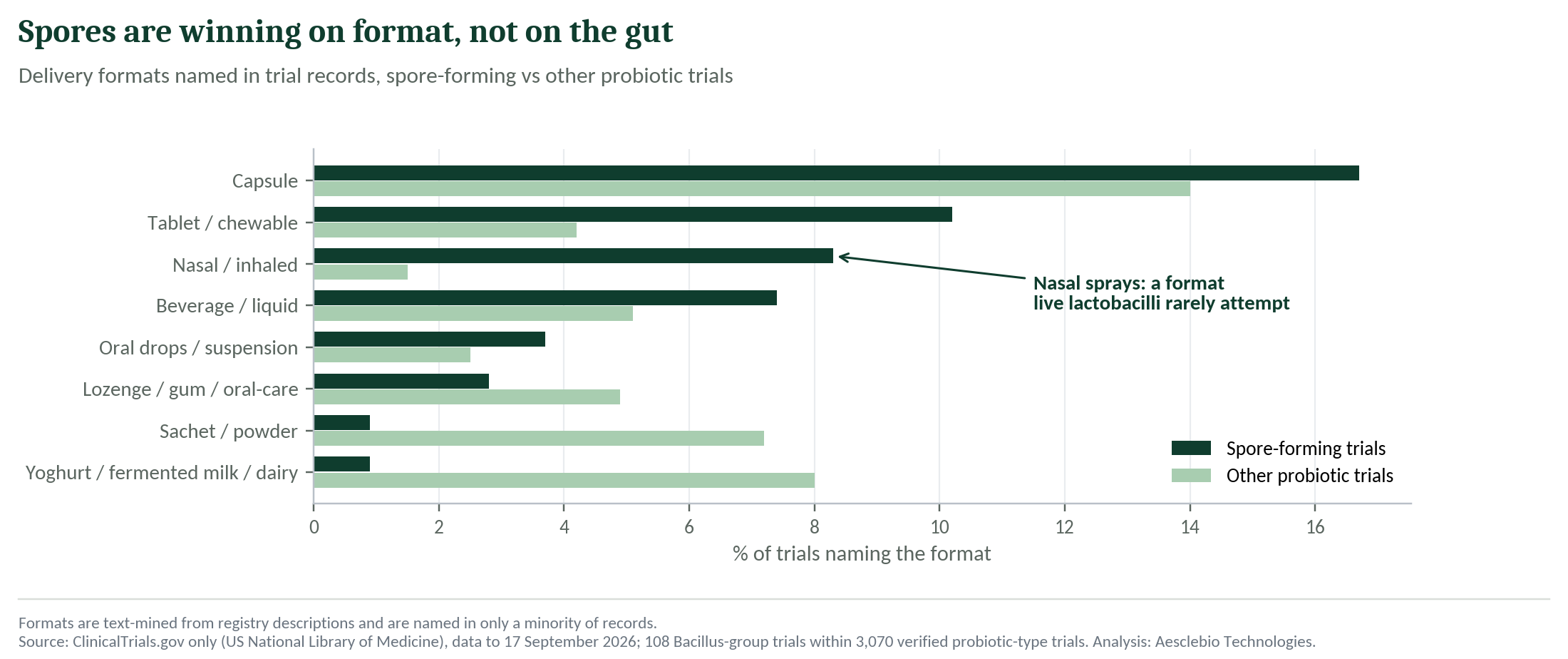
Spore trials over-index on exactly the formats that punish live lactobacilli: tablets and chewables (10% vs 4%) and nasal sprays (8% vs 1.5%). They under-index on the formats built around refrigeration and gentle processing: yoghurt and fermented milk (0.9% vs 8%), sachets (0.9% vs 7%), infant formula and enteral feeds (none at all) [1].
The nasal sprays deserve a paragraph of their own, because they are the clearest proof of the point. Nine trials in the set deliver Bacillus species into the nose, most of them in Vietnam, mostly in children with respiratory infection, and two of them using deliberately inactivated spores as a postbiotic [1, 5]. No one attempts that with a refrigerated lactobacillus. The organism was chosen because of what it tolerates, not because of a head-to-head clinical comparison.
The dose data point the same way. Where a daily dose is stated, spore trials sit at a median of about 2 billion CFU against 6 billion for other probiotics [1].
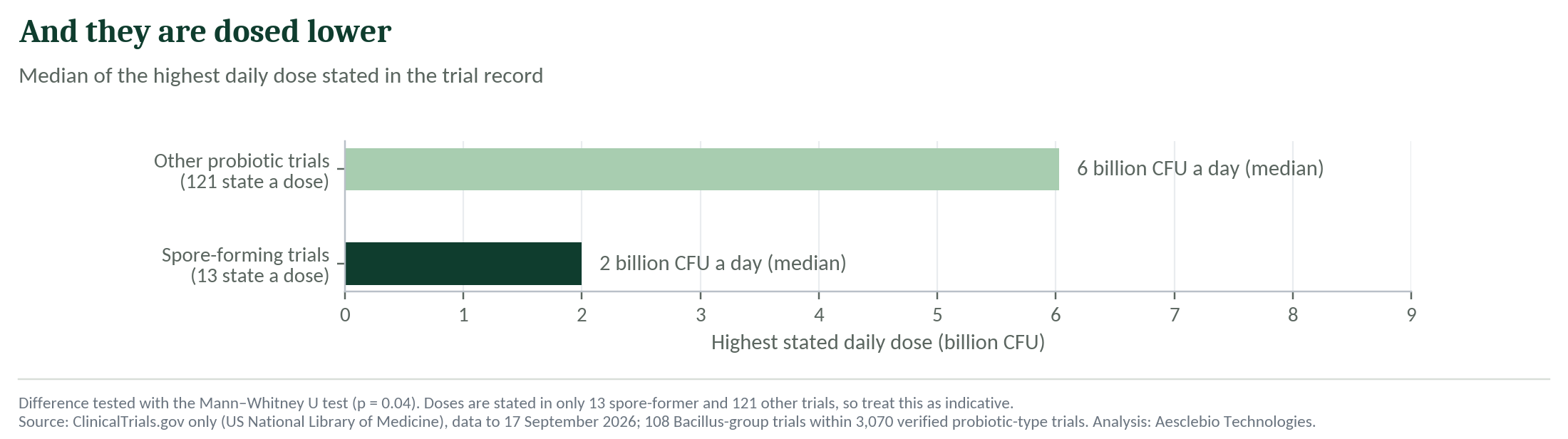
Spores are not a better answer to the gut. They are the only answer to the tablet, the ambient beverage and the nasal spray.
Why this reframing matters commercially
If you believe the outcomes story, you switch your existing product to a spore strain and expect better results. That is the expensive mistake. The trial record gives you no basis to expect a better clinical outcome, and you will have thrown away the strain-specific evidence your current organism already carries.
If you believe the format story, you use spores where the format problem is real and unsolved:
- ambient supply chains in hot and humid export markets, where a refrigerated claim is not credible;
- processed formats: tablets, chewables, bars, baked and heat-treated products, ambient drinks;
- routes of administration that live lactic-acid bacteria cannot survive, of which the nose is the current frontier;
- cost positions where a 2-billion CFU label is defensible and a 10-billion one is not.
That is a formulation brief, not a therapeutic claim, and it is a considerably safer one to defend in front of a regulator.
Two cautions before anyone rewrites a spec
Spore-forming is not a safety class. Bacillus is a large and varied genus; the B. cereus group has no place in food, and safety is assessed species by species and strain by strain through routes such as the EU's Qualified Presumption of Safety list [6]. "It is a Bacillus, so it is stable and safe" is two errors in one sentence.
Survival is not the same as benefit. Surviving manufacture and the stomach is a necessary condition, not a demonstration of effect. The strain still has to show the outcome you intend to claim, in the format you intend to sell, which brings the argument back to strain-specific evidence [4].
Five moves for an NPD team
- Write the format brief first. Define the temperature, moisture, processing step and shelf life you actually need to survive. Choose the organism against that, not against a category trend.
- Test in the final matrix. Stability in a capsule tells you nothing about the same strain in a chewable or a beverage. Run end-of-shelf-life counts in the pack you will sell.
- Set the label dose from the data you have. The spore trials cluster at 1–2 billion CFU. If your dossier is built on that, do not let marketing print 10 billion.
- Do not import claims across organisms. Evidence for a lactobacillus does not transfer to a Bacillus, or between Bacillus strains.
- Treat non-oral routes as a medicinal-borderline question. A nasal or topical probiotic will be read by many regulators as a medicine, not a supplement. Ask that question before the formulation work, not after.
The ask worth making
The industry would benefit from one head-to-head trial that the format story cannot answer: the same indication, the same dose, a well-characterised spore strain against a well-characterised lactobacillus, in an ambient format. Until someone runs it, "spores are better" remains a supply-chain observation with a clinical accent.
Working on this? If you are choosing between a spore and a conventional strain for an ambient or processed format, we are glad to compare notes on where the trial evidence actually helps.
A question for our readers: in your last spore-former project, was the deciding factor a clinical result, or a stability report?
Notes and sources
- The Bacillus Surge: clinical-trial trends for spore-forming probiotics. Aesclebio Technologies, 25 September 2026. Analysis of 3,070 verified interventional probiotic-type trials registered on ClinicalTrials.gov, data to 17 September 2026; 108 Bacillus-group trials. Formats and doses are text-mined from registry descriptions and are stated in a minority of records (dose: 13 spore and 121 other trials); dose difference tested by Mann–Whitney U (p = 0.04).
- Cutting SM. Bacillus probiotics. Food Microbiology 2011;28(2):214–20.
- Elshaghabee FMF, Rokana N, Gulhane RD, Sharma C, Panwar H. Bacillus as potential probiotics: status, concerns, and future perspectives. Frontiers in Microbiology 2017;8:1490.
- McFarland LV, Evans CT, Goldstein EJC. Strain-specificity and disease-specificity of probiotic efficacy: a systematic review and meta-analysis. Frontiers in Medicine 2018;5:124.
- Salminen S, Collado MC, Endo A, et al. ISAPP consensus statement on the definition and scope of postbiotics. Nature Reviews Gastroenterology & Hepatology 2021;18:649–67.
- European Food Safety Authority, Panel on Biological Hazards. Qualified Presumption of Safety: the list of QPS-recommended biological agents is reviewed and updated periodically. efsa.europa.eu, accessed 26 September 2026.