
Probiotics · Clinical Evidence
Fastest Growing, Least Documented: The Spore Probiotic Evidence Gap
Bacillus trials are multiplying three times faster than lactobacilli trials. Half of them never name the strain they tested, and a trial without a strain is evidence nobody can buy, sell or defend.
- Probiotics
- Bacillus
- Spore-forming probiotics
- Clinical trials
- ClinicalTrials.gov
- Strain designation
- ISAPP
- QPS
A category in a hurry
Spore-forming probiotics are the fastest-moving part of clinical research in this industry. In the registry-verified set of 3,070 interventional probiotic trials on ClinicalTrials.gov, 108 test a Bacillus-group organism: Heyndrickxia (Bacillus) coagulans, Bacillus subtilis, Shouchella (Bacillus) clausii or a relative [1].
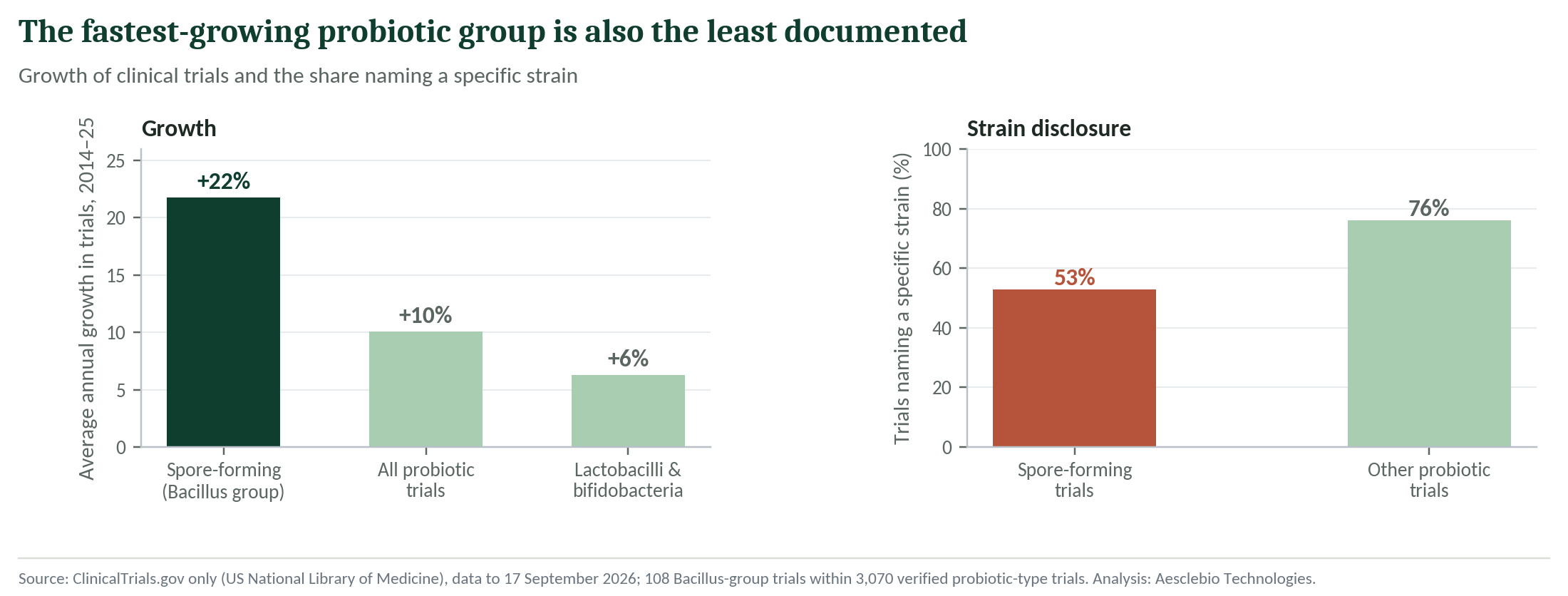
The growth rate is the headline. Spore-former trials have grown 22% a year since 2014 (95% confidence interval 15–29%), against 10% for probiotic trials as a whole and 6% for lactobacilli and bifidobacteria [1]. Twenty were registered in the first eight and a half months of 2026, more than in the whole of 2025. Two-thirds have an industry sponsor or collaborator, against 39% elsewhere [1]. This is the segment where ingredient companies, not universities, are setting the agenda.
Then you look for the strain, and it is not there.
A trial without a strain is not evidence about a product
Probiotic effects are strain-specific. That is not a marketing convention; it is the operating assumption of every serious body in the field. ISAPP's consensus definition is built on characterised strains [2]. The World Gastroenterology Organisation's global guidelines organise their evidence tables strain by strain and dose by dose [3]. Systematic reviews of strain- and disease-specificity have shown that pooling by species overstates what any individual product can claim [4].
Which makes the disclosure number in these trials uncomfortable. Only 53% of spore-former trials state any strain designation, against 76% of other probiotic trials, a 23-point gap that is not a rounding artefact (p < 0.001) [1].
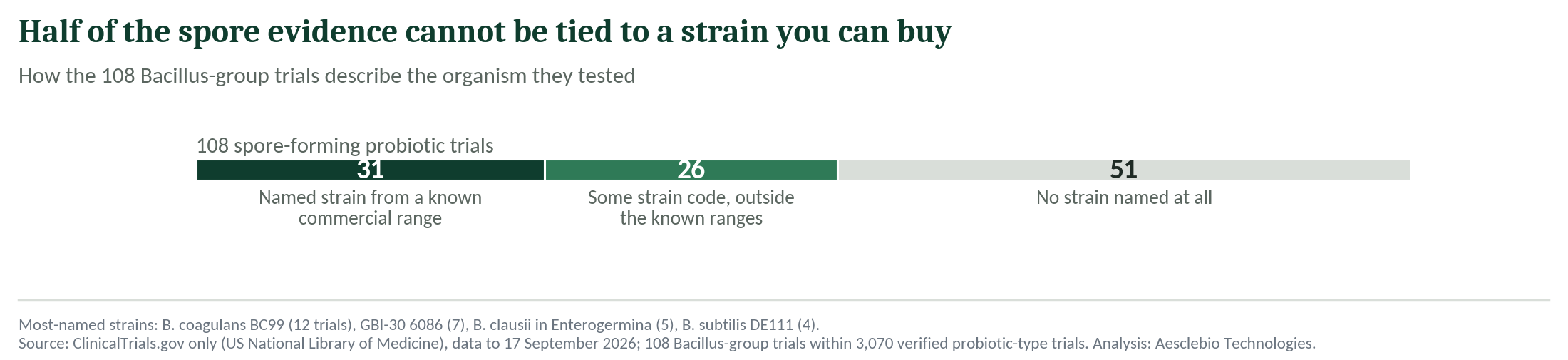
Break the 108 trials down and the picture sharpens. Thirty-one name a strain from a known commercial range. Twenty-six give a code of some sort that sits outside those ranges. Fifty-one, nearly half the evidence base, describe the organism only as a species, or as a "Bacillus probiotic" [1].
Who actually pays for the gap
The brand owner pays twice.
First, you cannot cite it. A regulator assessing a health claim, a paediatrician deciding what to recommend, a buyer building a private-label dossier: each of them is asking the same question: is this the same strain, at the same dose, as the one in the trial? If the trial does not say, the honest answer is that nobody knows, and the trial quietly drops out of your file.
Second, everyone else can use it. A trial that names only "Bacillus coagulans" is a public good. Any competitor selling any B. coagulans can gesture at it. If you paid for that trial, you have funded your category's marketing rather than your own.
The cheapest asset in probiotic research is a strain code. It is also the one most often left out.
There is a third cost, further downstream. Safety assessment in the European Union runs through the Qualified Presumption of Safety list, which is decided at species level with strain-level qualifications, and national positive lists work the same way [5]. When quality surveys of commercial Bacillus products find mismatches between the label and the contents, the response from authorities is to tighten identity requirements, and identity means a strain, verified by sequencing, not a genus on a carton [6].
Why the gap exists, and why it is fixable
Three causes, all of them mundane.
Multi-strain products get tested under a brand name, and the registry record inherits the brand rather than the composition. Investigator-led trials use whatever the sponsor supplied, and the sponsor does not always volunteer the deposit number. And spore products are disproportionately tested in markets where the product is registered as a medicine rather than a supplement (31% of spore trials are entered on the registry as drugs, against 13% of the comparison group [1]), where the registry text tends to carry the product name only.
None of these is expensive to fix. A strain designation is one line in a protocol and one line in a registry field. The cost of adding it is essentially zero; the cost of leaving it out is an evidence base you cannot own.
Five moves that cost almost nothing
- Deposit the strain and use the deposit number everywhere. One designation, used identically in the protocol, the registry record, the label, the dossier and the sales deck. Inconsistent naming is the same problem in a different suit.
- Put the strain in the trial title. Not just the intervention field. Titles are what search engines, systematic reviewers and competitors' analysts read.
- Make it a supply condition. If you buy a strain, require the supplier's deposit number and sequencing certificate in the specification, and require that any trial they cite names it.
- Audit the trials you already cite. For each one on your product page, check whether the registry record names the strain you actually sell. Anything that does not is a claim you cannot defend if challenged.
- Check the species name too. Two of the three main spore probiotics have been renamed since 2020; a search on the old name and a search on the new one return different evidence [7].
The ask worth making
Industry normally lobbies for fewer fields to fill in. This is a case for one more. Trial registries capture the condition, the phase, the sponsor and the enrolment, but treat the intervention as free text. A mandatory structured field for microbial strain identity (genus, species, deposit collection and number) would cost sponsors a minute per record and would convert a decade of probiotic trials from a genus-level blur into a searchable, strain-level evidence base.
Until that exists, the discipline has to come from the buyers. Ask for the strain. If the answer is a genus, treat the evidence as belonging to the category, not to the product in front of you.
Working on this? If you are running or commissioning spore-former trials and want the registry record to work as a commercial asset, we are glad to compare notes on how the strain is described.
A question for our readers: if you audited every trial cited on your own product pages tomorrow, how many would name the strain you actually sell?
Notes and sources
- The Bacillus Surge: clinical-trial trends for spore-forming probiotics. Aesclebio Technologies, 25 September 2026. Analysis of 3,070 verified interventional probiotic-type trials registered on ClinicalTrials.gov, data to 17 September 2026; 108 Bacillus-group trials. Growth rates from Poisson log-linear models; strain-disclosure difference tested by chi-square.
- Hill C, Guarner F, Reid G, et al. ISAPP consensus statement on the scope and appropriate use of the term probiotic. Nature Reviews Gastroenterology & Hepatology 2014;11:506–14.
- Guarner F, Sanders ME, Szajewska H, et al. World Gastroenterology Organisation Global Guidelines: probiotics and prebiotics. Journal of Clinical Gastroenterology 2024;58(6):533–53.
- McFarland LV, Evans CT, Goldstein EJC. Strain-specificity and disease-specificity of probiotic efficacy: a systematic review and meta-analysis. Frontiers in Medicine 2018;5:124.
- European Food Safety Authority, Panel on Biological Hazards. Qualified Presumption of Safety: the list of QPS-recommended biological agents is reviewed and updated periodically. efsa.europa.eu, accessed 26 September 2026.
- Kolaček S, Hojsak I, Berni Canani R, et al. Commercial probiotic products: a call for improved quality control. ESPGHAN Working Group position paper. Journal of Pediatric Gastroenterology and Nutrition 2017;65(1):117–24.
- List of Prokaryotic names with Standing in Nomenclature (LPSN). Heyndrickxia coagulans and Shouchella clausii species pages, lpsn.dsmz.de, accessed 26 September 2026.