
Probiotics · Strain Evidence
With probiotics, the evidence belongs to the strain
India's permitted list names species. The United States treats every strain as a separate ingredient, and Europe works the same way for claims. That gap is where Indian probiotic exports stall, and it is entirely fixable.
Probiotics attract more scepticism than they deserve and more extravagant claims than they can carry. Both problems have the same root: the evidence is specific, and the marketing is general. So start with what is actually established, because it is a good deal stronger than the sceptics allow.
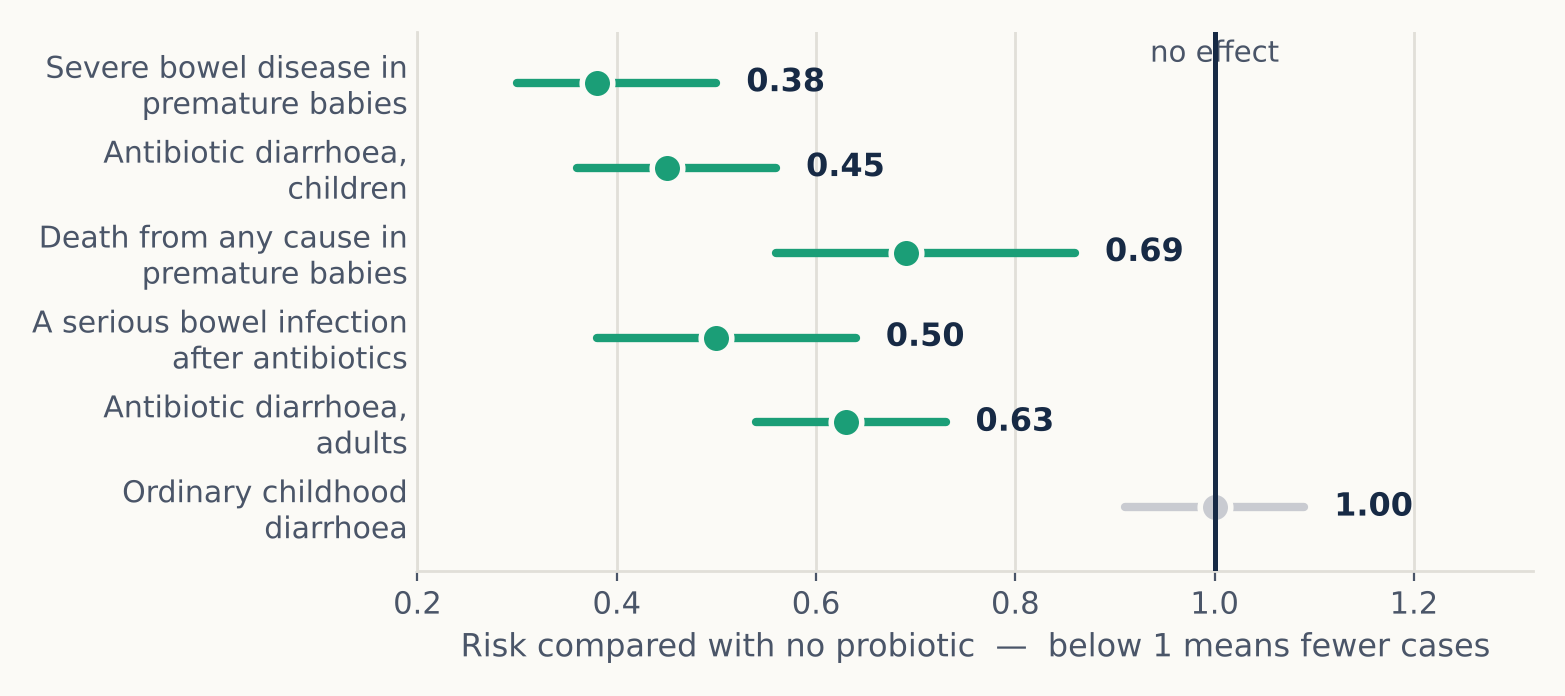
The strongest result in the whole supplement category is at the top of that chart. A network analysis of 106 trials and 25,840 premature infants found that multi-strain probiotics cut severe necrotising enterocolitis, a destructive bowel disease of newborns, by 62 per cent, and reduced death from any cause by 31 per cent. Very few nutritional ingredients of any kind have mortality evidence at all.
Antibiotic-associated diarrhoea is the other well-established use: 42 trials and 11,305 adults give a 37 per cent reduction, and a Cochrane review of 33 trials in 6,352 children found rates of 8 per cent against 19, with nine children needing treatment to prevent one case.
And the honest counterweight, because a field that will not state its own null results does not deserve to be believed on its positive ones. For ordinary childhood diarrhoea, the use the market most wants, a Cochrane review of 82 studies and 12,127 participants found no effect, and two large trials published in the New England Journal of Medicine in 2018 found nothing in nearly 1,900 children between them. The review also demonstrated publication bias in the earlier literature.
Dose: where it has been tested, more is better
Trials generally use somewhere between a hundred million and a hundred billion live organisms a day. A proper dose-response relationship has been demonstrated for exactly one indication.
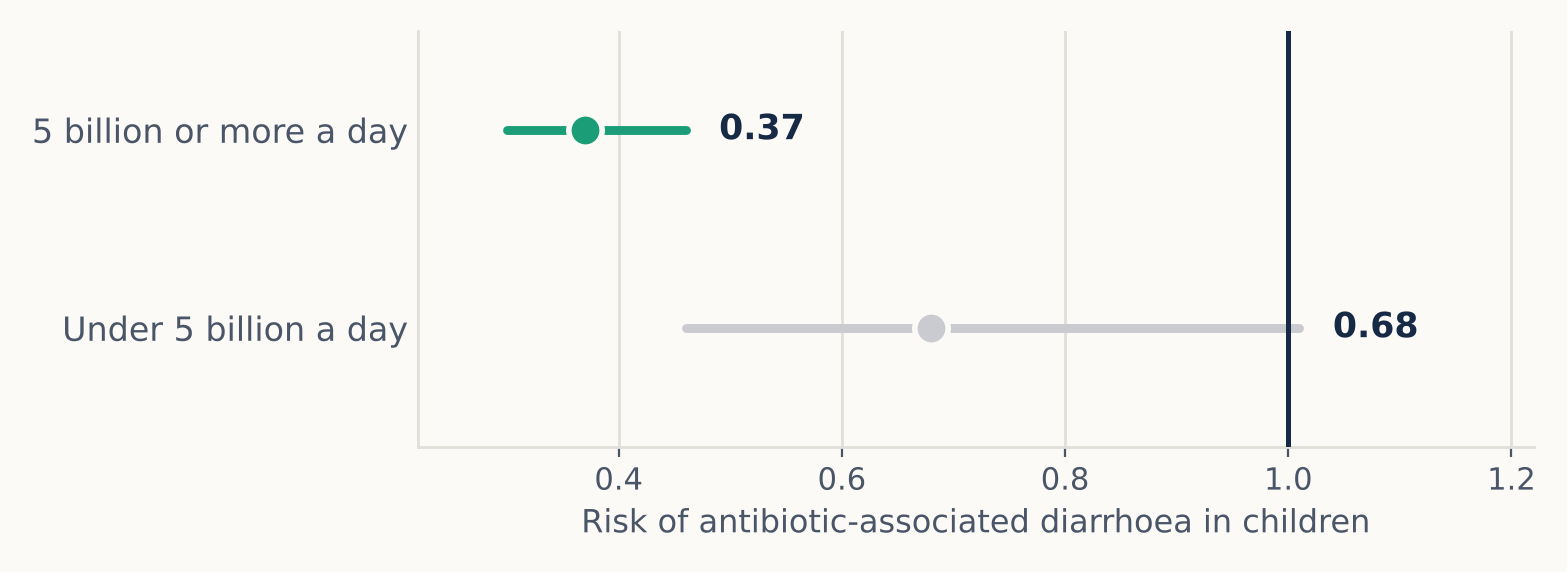
That is the only indication where dose-response is established, not for irritable bowel syndrome, not for necrotising enterocolitis, not for the serious bowel infection that follows antibiotics. It is worth knowing which of your claims can lean on dose and which cannot.
India's threshold for calling a product a source of probiotics is a hundred million live organisms in the recommended daily serving. That is the floor of the trial range, not the middle of it.
Why the strain is the unit that matters
The joint guidance from the Food and Agriculture Organization and the World Health Organization put it plainly in 2002: the evidence suggests probiotic effects are strain-specific. A review of 228 trials found exactly that pattern: for preventing antibiotic-associated diarrhoea in adults, certain named strains worked while other strains of related species showed nothing.
Be careful not to overstate it. A 2022 review of 23 paediatric trials found that, with one exception, no significant differences emerged between strains of the same species, and concluded there is not enough clinical evidence either to support or refute strain-specificity in children. Head-to-head trials of one strain against another are almost entirely absent.
Three markets, three answers
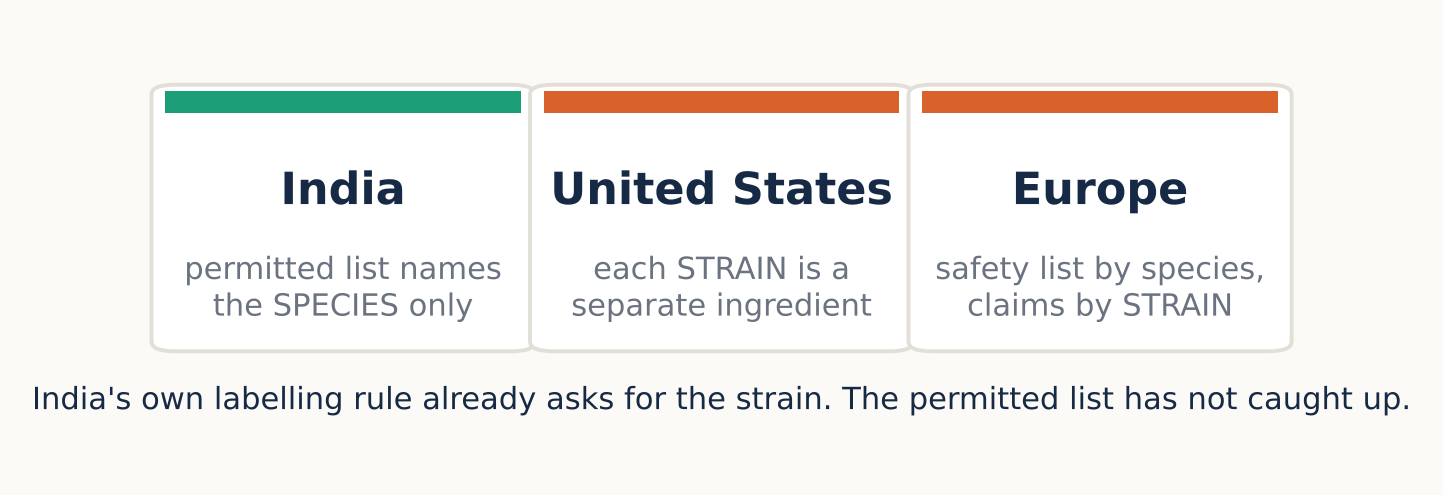
The American position is a single sentence, and it is the one an exporter should commit to memory: the Food and Drug Administration considers each strain of a bacterial or yeast species to be a separate ingredient. Its guidance asks for whole genome sequencing or identification by a recognised repository, and a named location where a reference strain is deposited.
Europe's safety list operates at species level, but the qualifications attached to it are assessed on the particular strain, and any health claim requires strain-level characterisation and the company's own human trial data. There is precisely one authorised European claim involving live microorganisms, and it is about yoghurt cultures and lactose digestion.
India's permitted list names around thirty organisms by genus and species with no deposit numbers at all, and in pre-2020 taxonomy, which matters because the genus Lactobacillus was formally split into 25 genera that year. At least two of the names on the list are no longer valid species names.
But here is the part that is usually missed, and it is good news. India's own labelling rule already requires genus, species and strain designation or a culture collection number on the pack, together with viable numbers at the end of shelf life, the words 'PROBIOTIC FOOD', and 'NOT FOR MEDICINAL USE'. The Indian Council of Medical Research and Department of Biotechnology guidelines go further still, asking for deposit in an internationally recognised culture collection, and for bridging efficacy studies in Indian subjects where a strain's evidence was generated abroad.
So the permitted list is species-level and the labelling rule is strain-level. An Indian manufacturer already has to do most of the work that an export file needs. The gap is smaller than it looks.
What may lawfully be claimed in India
One claim is pre-authorised: 'source of probiotics', where the product contains at least a hundred million colony-forming units, live organisms able to multiply, in the recommended daily serving. There is no probiotic entry in the list of permitted disease-risk-reduction claims, so no authorised gut-health or immunity claim exists.
It is often said that this is the end of the matter. It is not. Statements about what an ingredient does in the body, rather than what disease it prevents, are permitted where supported by generally accepted scientific data, provided they stop short of claiming to prevent, treat or cure anything. And a product-specific health claim based on the company's own human intervention studies may be made after notification to the Food Authority, with results from well-designed trials following good clinical practice and published in a peer-reviewed journal. That is a demanding standard. It is not a closed door.
The quality problem, and why it is an opportunity
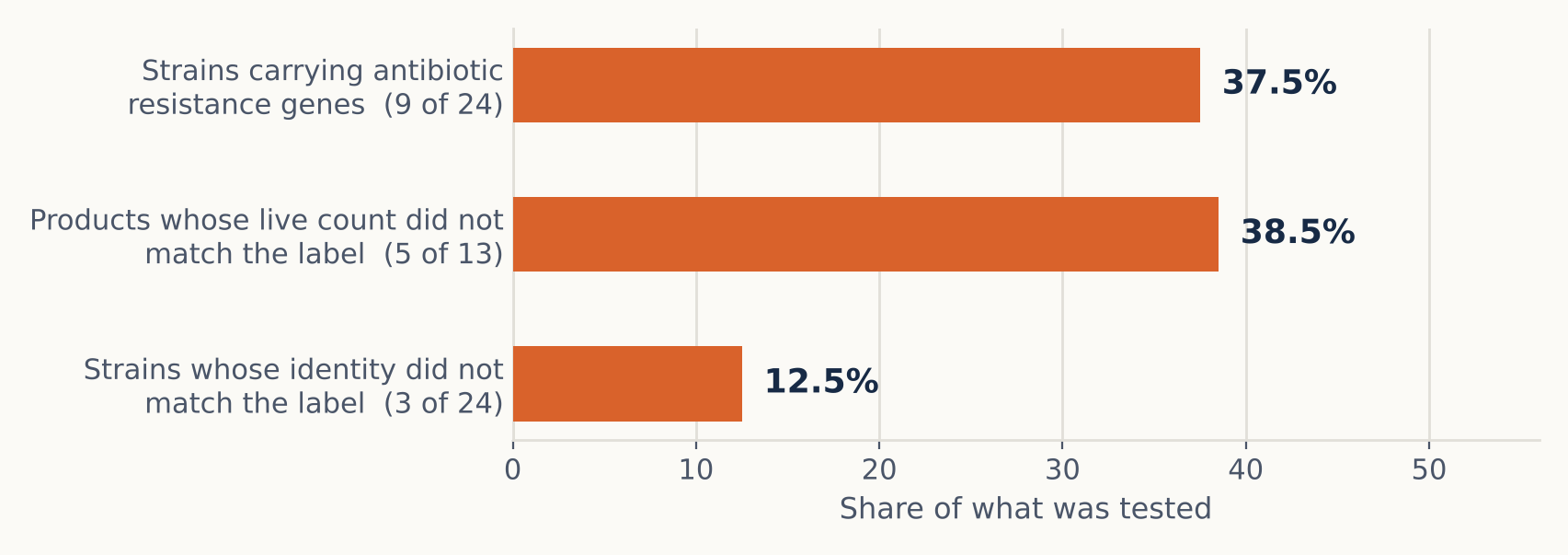
A study of twenty of the most-prescribed Indian probiotics reported very poor correlation between what the pack declared and what the laboratory found: in viable counts, in species identity, and in the presence of contaminants. A genomic assessment of twenty retail products sequenced 24 strains and found three whose identity did not match the label and nine carrying antibiotic-resistance genes, three of those on mobile genetic elements: stretches of DNA able to move across to other bacteria, including harmful ones.
This is not a uniquely Indian failing, and it would be dishonest to imply it is. A Slovenian pharmacy survey found 12 per cent of products had insufficient viable bacteria, and a Pakistani survey found almost none met their label claim. But in a market where the regulator already requires strain designation and end-of-shelf-life counts, a manufacturer who actually does both has a straightforward, documentable advantage: at home and at the border.
On viability, one practical note. India requires live numbers at the end of shelf life, which is stricter on paper than the American draft guidance, which sets no end-of-shelf-life rule at all. There is no published standard overage figure to work to; the honest position is that the formulator must overfill by whatever the strain's own stability data require, and that means generating stability data.
Prebiotics, briefly and accurately
Thirteen prebiotic ingredients are listed in Schedule VIII without individual maximums, which is often reported as meaning there is no limit. There is: the body of the regulation caps prebiotics at 40 grams per 2,000 kilocalories a day for adults.
Tolerance is the real constraint, and it depends on how the dose arrives. A single 10 gram serving of short-chain fructo-oligosaccharide already produces noticeably more wind than placebo; spread across the day, first symptoms appear above about 30 grams and diarrhoea around 50. One useful and counter-intuitive finding: starting low and building up did not improve tolerance. Set the dose where it belongs rather than hoping the consumer adapts.
And a genuine regulatory prize exists here. Chicory inulin carries an authorised European claim for maintaining normal bowel function by increasing stool frequency, at 12 grams a day: above the comfortable single-dose limit, which is exactly why the dosing instruction on the pack decides whether the product is used as intended.
Five specifications
- Deposit the strain in an internationally recognised culture collection and put the accession number on the label. India already asks for it; the United States treats the strain as the ingredient; Europe will not consider a claim without it.
- Sequence the genome. It is the accepted method of proving identity, and it will also tell you whether your strain carries transferable antibiotic-resistance genes before a regulator does.
- Set the dose from the trial your claim rests on, not from the legal floor. A hundred million organisms is where the law starts, not where the evidence sits.
- Generate stability data and declare the count at end of shelf life, not at manufacture.
- Claim what has been shown for your organism. 'Source of probiotics' is available immediately; anything more requires your own human data, and the notification route for that exists.
None of this is exotic. It is the difference between a product that is lawful in India and a product that is lawful in India and sellable abroad, and the work is largely the same work.
Sources
- Food and Agriculture Organization and World Health Organization. Guidelines for the Evaluation of Probiotics in Food: Report of a Joint FAO/WHO Working Group. London, Ontario, 2002.
- Hill C, Guarner F, Reid G, et al. The International Scientific Association for Probiotics and Prebiotics consensus statement on the scope and appropriate use of the term probiotic. Nature Reviews Gastroenterology and Hepatology 2014;11(8):506–514.
- Binda S, Hill C, Johansen E, et al. Criteria to qualify microorganisms as probiotic in foods and dietary supplements. Frontiers in Microbiology 2020;11:1662.
- McFarland LV, Evans CT, Goldstein EJC. Strain-specificity and disease-specificity of probiotic efficacy: a systematic review and meta-analysis. Frontiers in Medicine 2018;5:124.
- Jankiewicz M and colleagues. Strain-specificity of probiotics in paediatrics: a rapid review of the clinical evidence. Journal of Pediatric Gastroenterology and Nutrition 2022.
- Wang Y, Florez ID, Morgan RL, et al. Probiotics, prebiotics, lactoferrin and combination products for prevention of mortality and morbidity in preterm infants: a systematic review and network meta-analysis. JAMA Pediatrics 2023;177(11):1158–1167.
- van den Akker CHP, van Goudoever JB, Szajewska H, et al. Probiotics for preterm infants: a strain-specific systematic review and network meta-analysis. Journal of Pediatric Gastroenterology and Nutrition 2018;67(1):103–122.
- Goodman C, Keating G, Georgousopoulou E, Hespe C, Levett K. Probiotics for the prevention of antibiotic-associated diarrhoea: a systematic review and meta-analysis. BMJ Open 2021;11(8):e043054.
- Guo Q, Goldenberg JZ, Humphrey C, El Dib R, Johnston BC. Probiotics for the prevention of pediatric antibiotic-associated diarrhea. Cochrane Database of Systematic Reviews 2019;4:CD004827.
- Esmaeilinezhad Z, Ghosh NR, Walsh CM, et al. Probiotics for the prevention of Clostridioides difficile-associated diarrhea in adults and children. Cochrane Database of Systematic Reviews 2025;9:CD006095.
- Collinson S, Deans A, Padua-Zamora A, et al. Probiotics for treating acute infectious diarrhoea. Cochrane Database of Systematic Reviews 2020;12:CD003048.
- Schnadower D, Tarr PI, Casper TC, et al. Lactobacillus rhamnosus GG versus placebo for acute gastroenteritis in children. New England Journal of Medicine 2018;379(21):2002–2014.
- Freedman SB, Williamson-Urquhart S, Farion KJ, et al. Multicenter trial of a combination probiotic for children with gastroenteritis. New England Journal of Medicine 2018;379(21):2015–2026.
- Ouwehand AC. A review of dose-responses of probiotics in human studies. Beneficial Microbes 2017;8(2):143–151. (The author was employed by an ingredient supplier at the time of writing.)
- Zheng J, Wittouck S, Salvetti E, et al. A taxonomic note on the genus Lactobacillus: description of 23 novel genera. International Journal of Systematic and Evolutionary Microbiology 2020;70(4):2782–2858.
- United States Food and Drug Administration. New Dietary Ingredient Notifications and Related Issues: Identity and Safety Information About the New Dietary Ingredient. Guidance for industry, 2026.
- European Food Safety Authority BIOHAZ Panel. Statement on the update of the list of qualified presumption of safety recommended microbiological agents. EFSA Journal 2023;21(1):7746.
- Commission Regulation (EU) No 432/2012 establishing a list of permitted health claims made on foods, Annex.
- Indian Council of Medical Research and Department of Biotechnology. Guidelines for Evaluation of Probiotics in Food. New Delhi, 2011; Indian Journal of Medical Research 2011;134(1):22–25.
- Food Safety and Standards (Advertising and Claims) Regulations, 2018, Schedule I, serial number 15; and Food Safety and Standards (Health Supplements, Nutraceuticals…) Regulations, 2016, regulations 10 and 11, with Schedules VII and VIII.
- Kesavelu D, Rohit A, Karunasagar I, Karunasagar I. Composition and laboratory correlation of commercial probiotics in India. Cureus 2020;12(11):e11334.
- Madhumathi I, Ramesh V, Rathakrishnan B, et al. Safety and efficacy concerns in Indian probiotics: insights from whole-genome sequencing and in vitro assessment. Gut Microbes Reports 2026;3(1):2668863.
- Comprehensive genomic assessment of available probiotics in India: a framework for safety and functionality evaluation. Bioinformation 2025.
- Mohar Lorbeg P and colleagues. Evaluation of dietary supplements containing viable bacteria by cultivation and molecular analysis. Frontiers in Microbiology 2021;12:700138.
- Briet F, Achour L, Flourié B, et al. Symptomatic response to varying levels of fructo-oligosaccharides consumed occasionally or regularly. European Journal of Clinical Nutrition 1995;49(7):501–507.
- Bonnema AL, Kolberg LW, Thomas W, Slavin JL. Gastrointestinal tolerance of chicory inulin products. Journal of the American Dietetic Association 2010;110(6):865–868.
- European Food Safety Authority Panel on Dietetic Products, Nutrition and Allergies. Scientific opinion on the substantiation of a health claim related to native chicory inulin and maintenance of normal defecation. EFSA Journal 2015;13(1):3951.
Disclaimer
This article is written for formulators, manufacturers and informed readers. It is a summary of published research and is not medical advice, a diagnosis or a treatment recommendation. Probiotics are not appropriate for everyone: serious harm has been reported in specific clinical populations, including a randomised trial in severe acute pancreatitis, and they should not be given to critically ill or severely immunocompromised patients except under medical supervision. Nothing here should be used to start, stop or change a prescribed treatment. Nothing here is a claim for any product, and no brand is named. Product composition and labelling must comply with the Food Safety and Standards Authority of India regulations applicable at the time of manufacture, and every schedule entry referred to here should be verified against the current gazetted text before it is relied on.