
When packaging is bought, the comparison usually comes down to one number: the price per piece on the quotation. It is the wrong number. What matters is the delivered cost of each pack that passes inspection, including set-up charges, tools, waste, freight and the stock you have to throw away when artwork changes.
This is the third of three articles on medicine packaging in India. Here we look at what packaging really costs, why prices move so much with quantity, and the labelling rules that are reshaping Indian packs.
How much of a ₹100 strip is packaging?
Take a strip of ten tablets with an MRP (maximum retail price) of ₹100 and build up the cost of everything around the tablets: the blister or strip, a share of the carton, the leaflet and the shipping box.
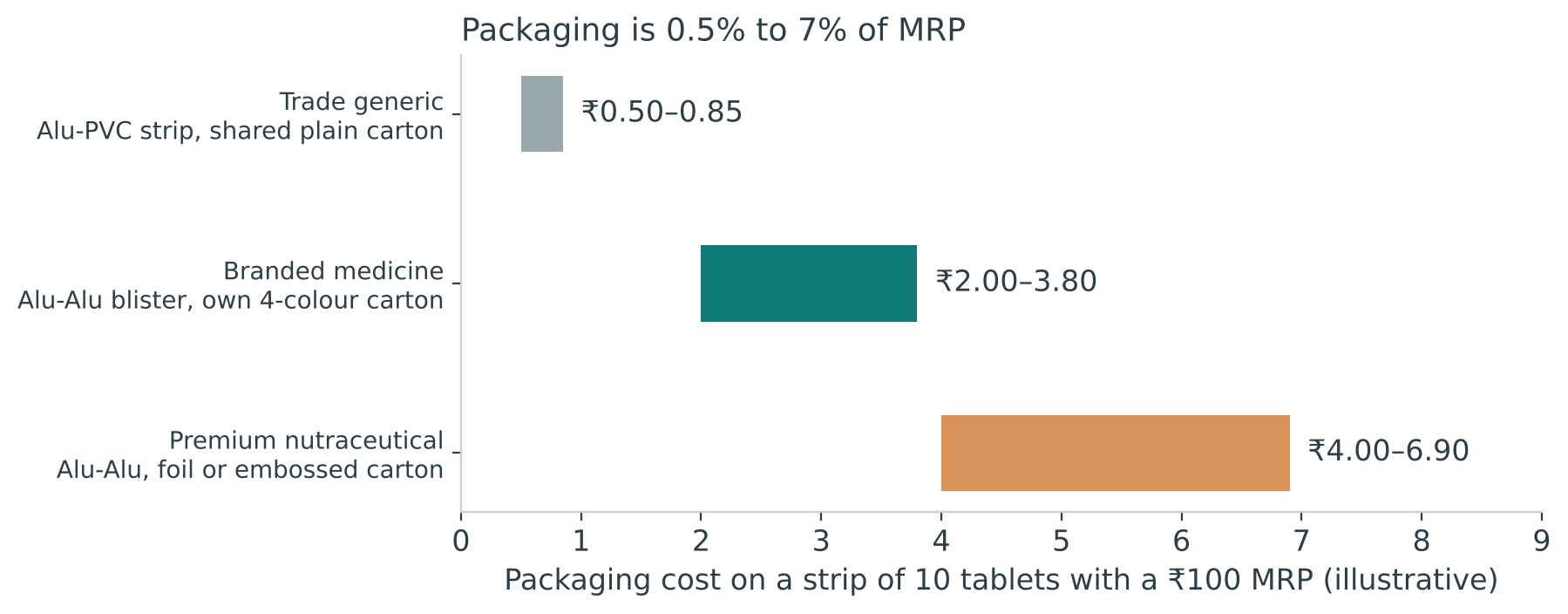
On these assumptions, packaging is about 0.5% to 7% of MRP. That looks small, but the manufacturer does not receive the MRP. If the company sells the strip to the trade at, say, ₹35–50, the same packaging is roughly 1–2% of revenue for a plain trade generic and 10% or more for a premium supplement pack. Packaging decisions are margin decisions.
Why the price per piece falls so fast
Every printing job has a fixed set-up cost: plates or cylinders, machine make-ready and the sheets wasted while colours are brought into line. That cost is the same whether you order 3,000 cartons or 50,000, so it is spread very differently.
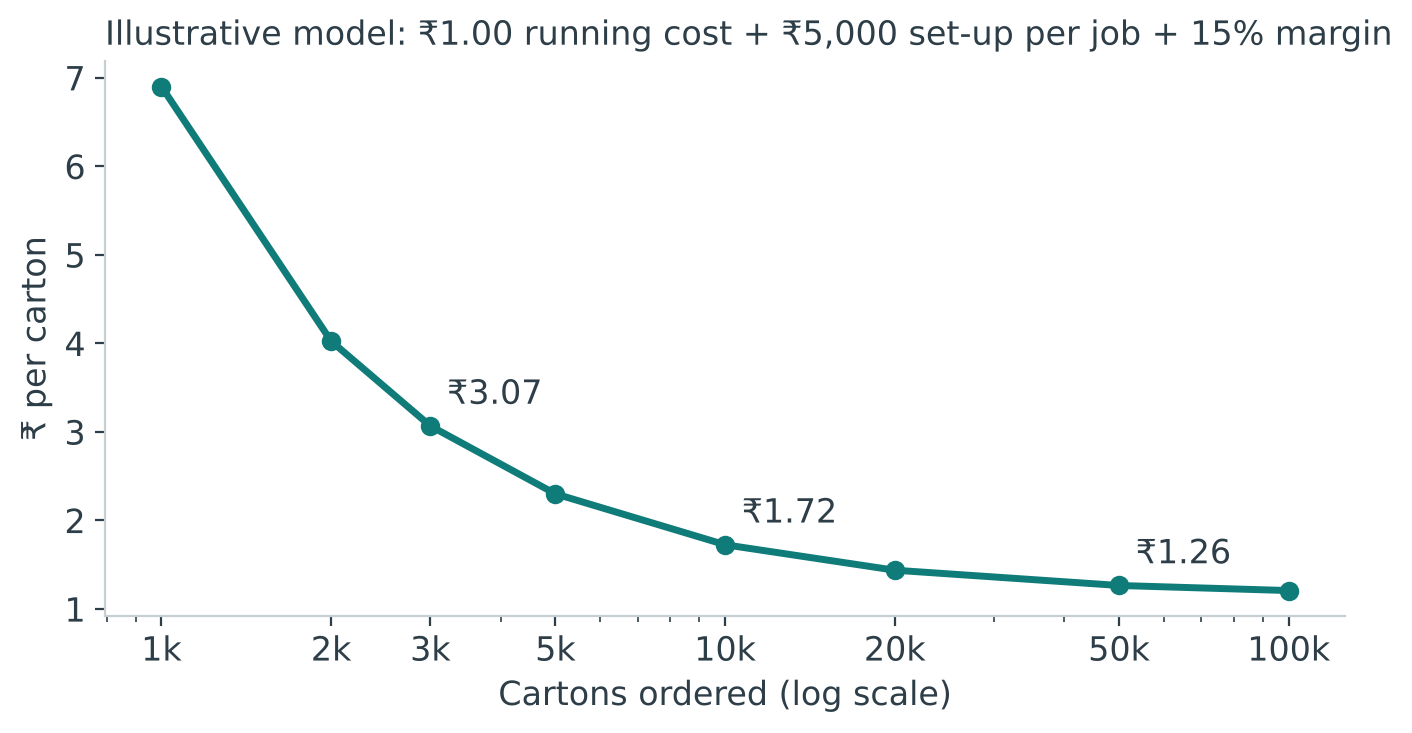
In this model the same carton costs about ₹3.07 at 3,000 pieces, ₹1.72 at 10,000 and ₹1.26 at 50,000. This is also why suppliers set minimum order quantities. Below a certain run, the set-up dominates the price and the job stops making sense for either side.
Three practical consequences follow:
- Fewer pack variants save money. Ten designs ordered at 2,000 each cost far more per carton than one design at 20,000. Standardising board, carton style and colours across products cuts set-ups.
- Ask for a shared print run. Several designs of the same size and board can often be printed together on one sheet to reach the minimum.
- Watch the sheet layout. Trimming a few millimetres from a carton blank can fit more cartons on each printing sheet: cutting board and press time for every carton ordered from then on.
The rules now printed on the pack
India is steadily moving medicines towards scannable codes that let anyone check whether a pack is genuine:
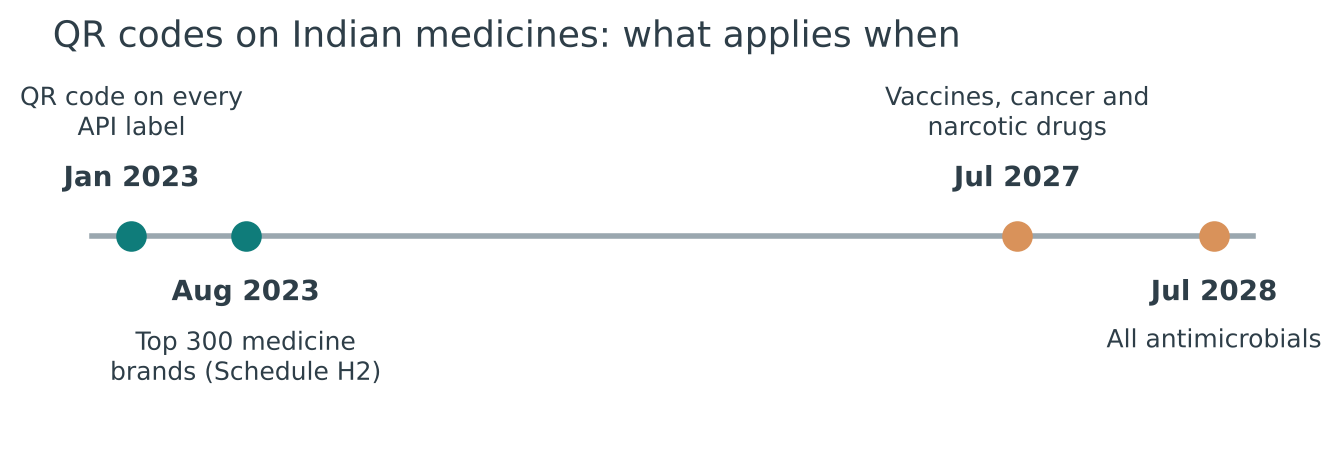
- Since 1 January 2023, every label of an active pharmaceutical ingredient must carry a QR code, at each level of packaging [3].
- Since 1 August 2023, the 300 medicine brands listed in Schedule H2 of the Drugs Rules must carry a barcode or QR code on the primary pack, or on the secondary pack if there is not enough space. The code must hold eight items, including a unique product code, generic and brand name, manufacturer, batch number, manufacturing and expiry dates, and licence number [1].
- A June 2026 amendment extends the requirement to whole categories: vaccines, cancer medicines and narcotic or psychotropic drugs from 1 July 2027, and all antimicrobials from 1 July 2028 [2].
For packaging teams this is not just a printing question. A code needs a clear, varnish-free space, enough contrast to scan, and a link to data systems behind it. Packs designed today for these product groups should already leave room for the code.
How to compare quotations fairly
- Lock the specification. Every supplier quotes the same size, board grade, GSM and thickness, colours, finish, tolerances and quantity.
- Separate one-time costs. Plates, cylinders, dies and foil blocks should be listed apart from the price per piece, along with who owns them.
- Ask how many cartons fit per sheet and how much waste is assumed.
- Request price breaks, for example at 3,000, 5,000, 10,000, 25,000 and 50,000 pieces.
- Compare delivered, accepted cost, including GST, freight, payment terms and who pays for printed stock made obsolete by an artwork change.
Watch for warning signs too: quotations based on GSM alone with no tolerances, a supplier who cannot show which artwork version was printed on a lot, or a price that is unexplainably low.
References
- Central Drugs Standard Control Organisation (CDSCO). FAQs on bar code / QR code under Schedule H2, 21 July 2023. (accessed 28 October 2026) Link
- Lexplosion. India expands Schedule H2 labelling: how pharma manufacturers must prepare (G.S.R. 506(E), 22 June 2026). (accessed 28 October 2026) Link
- SCC Online. QR codes on active pharmaceutical ingredients mandatory vide Drugs (Amendment) Rules, 2022. (accessed 28 October 2026) Link
Disclaimer
This article is for general information and education. It is not legal, regulatory or engineering advice. Figures marked “illustrative” come from simple planning models built by the Aesclebio Research Team, not from supplier quotations; prices change with raw-material costs, order size and specification. Always confirm material choices with your own stability data, and confirm rules against the current official text before acting.