
Nutraceuticals · Formulation
Four pairs that must not share a tablet, and why everything else is a label instruction
Most nutrient interactions can be solved by telling the consumer when to take something. Four cannot, because the two ingredients arrive in the stomach together whatever the label says. One of the four depends on a dose threshold that almost nobody specifies.
There is a useful distinction buried in the interaction literature that rarely gets drawn explicitly, and drawing it saves a great deal of argument.
Some interactions are solved by separation in time. Those are label problems: they cost a line of print and nothing else. Others cannot be separated in time, because the two substances are compressed into the same tablet and dissolve together. Those are formulation problems, and no instruction fixes them.
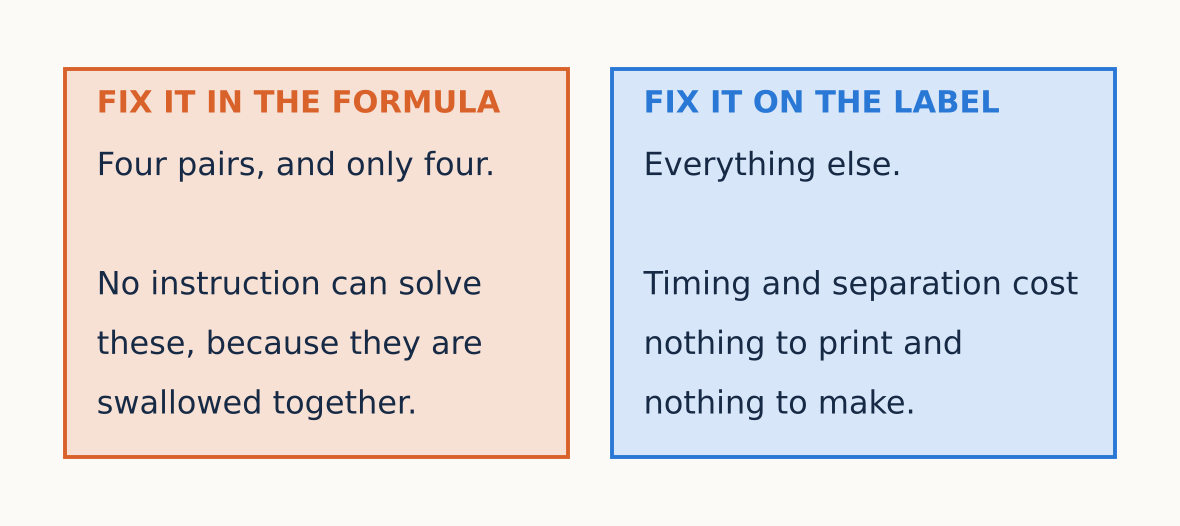
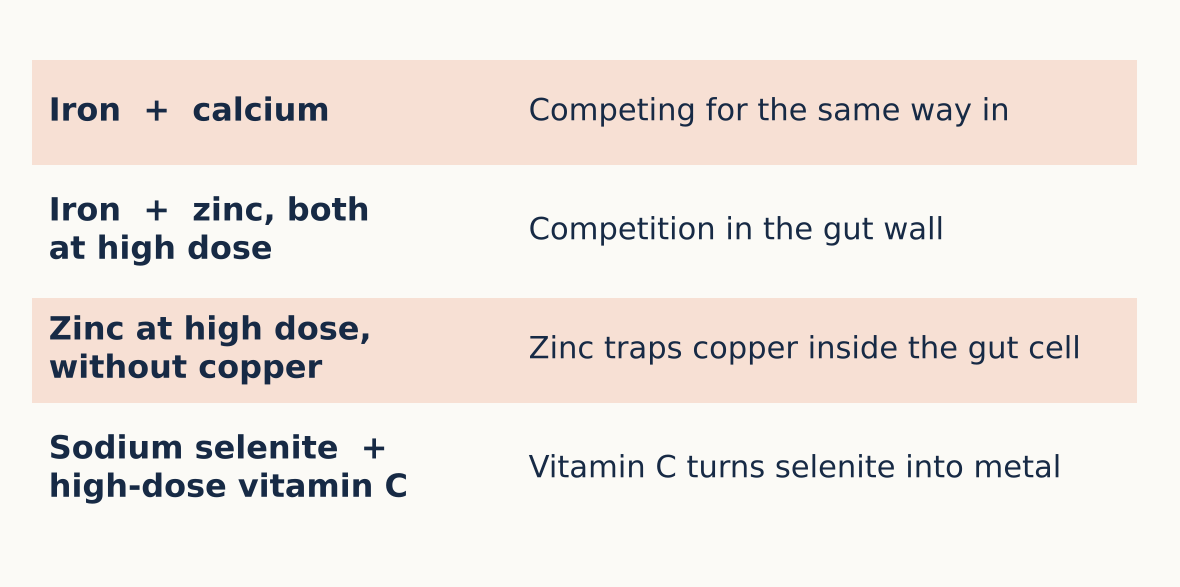
There are four in the second category. Here they are, with the mechanism in each case, because the mechanism is what tells you whether a lower dose solves it.
Iron and calcium
These compete for absorption, and the effect is real in a single meal. The long-term studies are a different matter: across trials running from one to four years, high calcium intakes did not lower haemoglobin, which is a strong argument against burdening a consumer with a timing instruction. It is not an argument for putting both into one tablet.
Inside a single tablet there is no instruction to give, no adherence cost to weigh, and nothing gained by combining them. Keep them in separate units simply because it is free to do so.
Iron and zinc, both at high dose
This one is better evidenced than it is observed. When zinc bioavailability was measured in adults before and after two weeks of oral iron supplements, it was markedly reduced, and the shape of the blood curves pointed at impaired absorption in the gut wall rather than anything happening in the tablet.
At the modest doses found in an ordinary multivitamin this is not a practical concern. At therapeutic iron doses combined with therapeutic zinc doses, it is, and those are exactly the two things an Indian formulator is most likely to want at therapeutic levels at the same time.
Zinc at high dose, without copper
This is the one with the clearest mechanism and the most serious consequence if ignored. High zinc intakes induce a binding protein in the cells lining the gut that holds copper fast, so the copper is shed with the cell rather than absorbed. Sustained high-dose zinc without copper therefore produces copper deficiency, slowly and silently.
The formulation answer is a ratio rather than an exclusion: where zinc is present at a high dose, copper should be present too, within India's own permitted limits. This is a design parameter, not a warning, and it costs almost nothing to get right.
Sodium selenite and vitamin C, and the threshold nobody specifies
This is the most interesting of the four, because it is usually stated as an absolute rule and it is not one. It depends on a dose, and the dose is exactly the one a lot of Indian multivitamins use.
The underlying chemistry is simple. Ascorbic acid is a reducing agent. Selenite is in a chemical state that ascorbic acid readily reduces, converting it to elemental selenium: a grey metallic powder the body cannot absorb. Selenate is in a different state and is almost untouched.
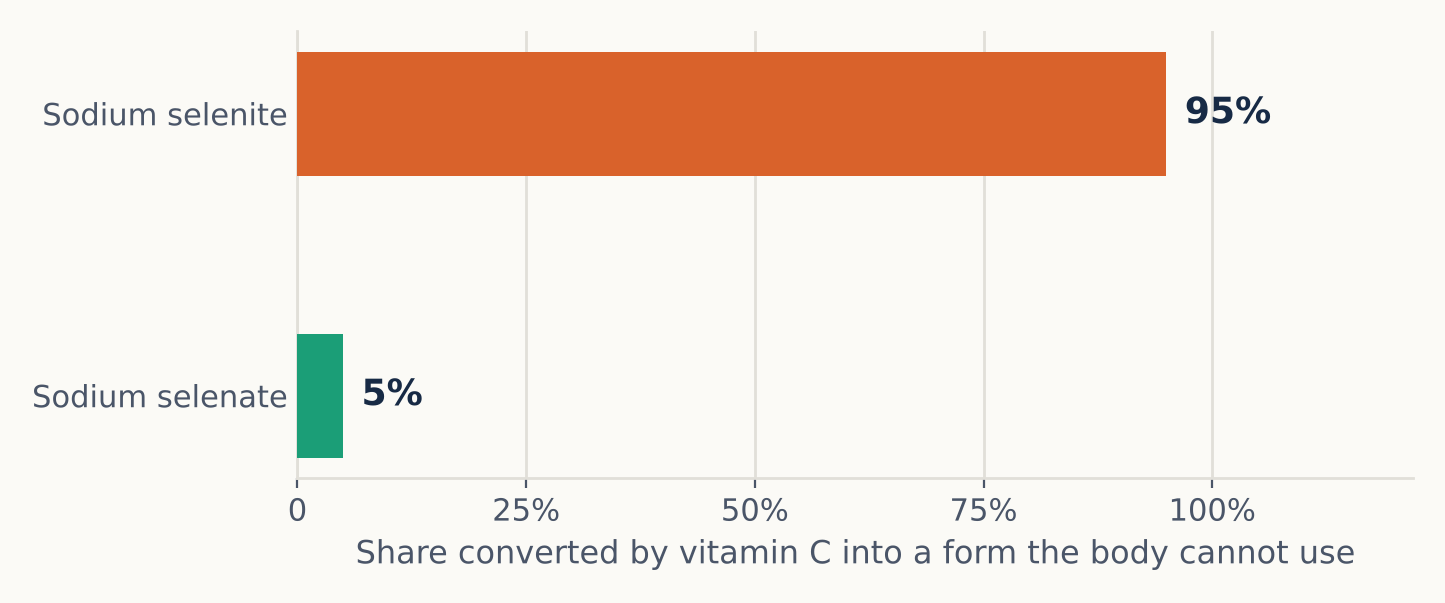
Now the human evidence, which is where the threshold appears.
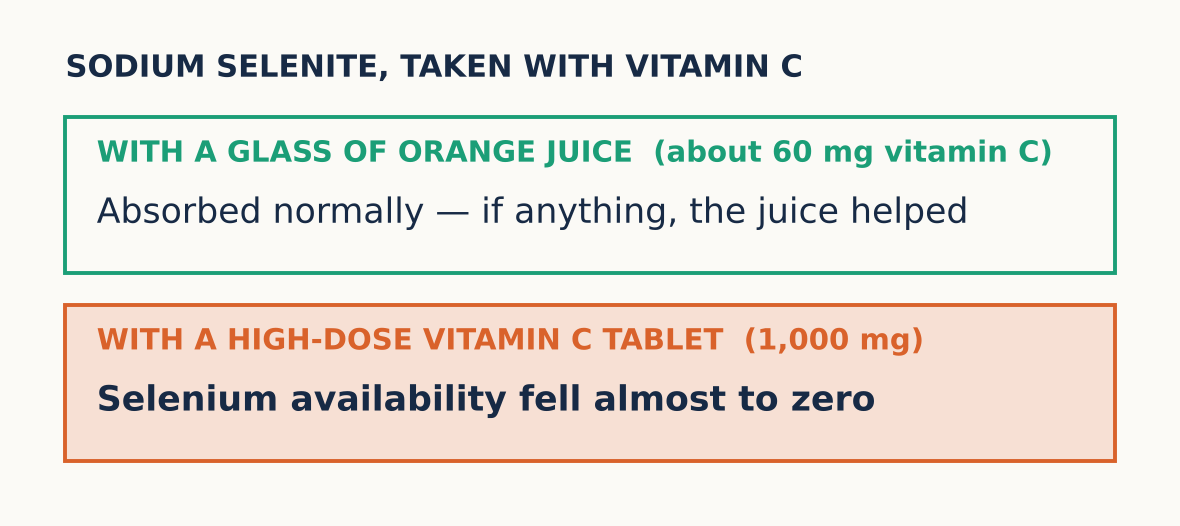
Read those two results together, because the contrast is the useful part. A gram of ascorbic acid taken with selenite reduced selenium availability almost to zero. Sixty milligrams of ascorbic acid, in a glass of orange juice, did not; if anything it appeared to help. A separate study found that selenate plus 200 milligrams of ascorbic acid raised blood selenium perfectly well.
So the rule is not ‘never combine selenium with vitamin C’. It is narrower and more actionable than that: at the 500 to 1,000 milligram vitamin C doses that are common in Indian multivitamins, specify selenate rather than selenite. At the vitamin C levels found in an ordinary multivitamin or a food, selenite is not obviously a problem.
Two further details for anyone making the product rather than designing it. The reduction is strongly pH-dependent, and in near-neutral solutions at practical concentrations very little of it happens, which is why this shows up as a problem in acidic formats and premixes rather than everywhere. And sodium selenite is more hygroscopic than selenate, so in a premix with any appreciable moisture it is more likely to dissolve and become available to react. The classic demonstration is a filter paper wetted with ascorbic acid suspended above the premix, which turns brown as selenium deposits on it.
Gummies make three of these harder
Everything above assumes a tablet or a capsule. A gummy changes the calculation in ways that are easy to discover too late.
A gummy is a wet, usually acidic matrix, and it stays that way for the whole of its shelf life. The selenite problem is a direct consequence: the reduction by ascorbic acid is strongly pH-dependent and needs the two substances in solution together, which is precisely the condition a gummy maintains for two years. In a dry tablet the same pair may sit side by side indefinitely without reacting. Specify selenate in any gummy carrying vitamin C, and treat it as a formulation rule rather than a preference.
The second difficulty is mineral load. Therapeutic doses of iron, calcium or zinc are bulky and they taste of metal, which is why gummies in this category are usually dosed well below the levels at which the interactions above would bite. That is a genuine advantage, provided nobody tries to close the gap by putting all three into one gummy to make the label look complete.
The third is legal rather than chemical. A gummy is confectionery in several export markets, which brings a different labelling regime with it: the European liquorice thresholds being the clearest example. A formulation that is unremarkable as a tablet can acquire obligations simply by being made chewable.
How to find these before a customer does
Each of the four has a test that costs very little at the development stage.
- For selenite, assay selenium at the start and end of accelerated stability. A fall without a matching rise in anything else is the signature, and the classic visual check (ascorbic acid on a filter paper above the premix, browning as selenium deposits) takes an afternoon.
- For zinc and copper, check the ratio in the finished product rather than in the formulation sheet. Overages applied independently to the two can move a designed ratio a long way.
- For iron with anything, run the dissolution and look at the colour. Visible darkening in a blend usually means something is being oxidised that you did not intend to oxidise.
- For premixes generally, measure water activity and not just moisture content. The selenite literature makes the point that availability to react tracks water activity, and premixes are where the surprises originate.
Everything else is a label instruction
That is the whole list. Four pairs, each with a mechanism that operates in the tablet or in the gut at the same moment, and none of which a consumer can route around by changing when they swallow something.
The rest of the interaction literature, and it is extensive, describes effects that separation in time resolves completely. Those belong on the label, where they cost nothing to print and nothing to manufacture.
That asymmetry is the argument for keeping the list of label instructions short. Every instruction added reduces the chance that any of them is followed. Three is a routine that a person can internalise. Six is a reason to stop taking the product, and a product nobody takes has an absorption rate of zero regardless of how elegantly it was formulated.
It is worth saying what is not on the list, because several well-known pairs are missing. Folate and zinc are not here; the controlled study designed to find that effect did not find it. Calcium and zinc are not here; a year of 1,000 milligrams a day did not move plasma zinc. Magnesium and calcium are not here either, despite how often they are sold as needing to be balanced against one another. A short list is only useful if things have genuinely been left off it.
A specification checklist
- Iron and calcium: separate units. No tablet should contain therapeutic doses of both.
- Iron and zinc: fine together at multivitamin levels; separate them when either is at a therapeutic dose.
- Zinc at a high dose: always with copper, within the permitted limits. Check the ratio, not just the presence.
- Selenium: specify selenate in any formula carrying 500 milligrams or more of vitamin C, in any acidic format, and in any premix where water activity is not tightly controlled.
- Everything else: put it on the label, and count the instructions before you print them.
None of these costs anything at the design stage. All of them cost something once the batch exists.
Sources
- Robinson MF, Thomson CD, Huemmer PK. Effect of a megadose of ascorbic acid, a meal and orange juice on the absorption of selenium as sodium selenite. New Zealand Medical Journal 1985;98(784):627–629.
- Mutanen M, Mykkänen HM. Effect of ascorbic acid supplementation on selenium bioavailability in humans. 1985.
- Zhang G, Gomez MA, Yao S, et al. Systematic study on the reduction efficiency of ascorbic acid and thiourea on selenate and selenite at high and trace concentrations. Environmental Science and Pollution Research 2019;26:20819–20833.
- Ganther HE, Kraus RJ. Chemical stability of selenious acid in total parenteral nutrition solutions containing ascorbic acid. Journal of Parenteral and Enteral Nutrition 1989;13(2):185–188.
- Eisenberg S. Relative stability of selenites and selenates in feed premixes as a function of water activity. Journal of AOAC International 2007;90(1):349–353.
- Meadows NJ, Grainger SL, Ruse W, Keeling PWN, Thompson RPH. Oral iron and the bioavailability of zinc. British Medical Journal 1983;287(6398):1013–1014.
- Abioye AI, Okuneye TA, Odesanya AO, et al. Calcium intake and iron status in human studies: a systematic review and dose-response meta-analysis. Journal of Nutrition 2021;151(5):1084–1101.
- Sandström B. Micronutrient interactions: effects on absorption and bioavailability. British Journal of Nutrition 2001;85(Suppl 2):S181–S185.
- Food Safety and Standards (Health Supplements, Nutraceuticals…) Regulations, 2016, Schedule I, for permitted limits on zinc, copper and selenium.
Disclaimer
This article is written for formulators, manufacturers and informed readers. It is a summary of published research and is not medical advice, a diagnosis or a treatment recommendation. Nutrient deficiencies require medical diagnosis and management, and no one should start, stop or change a prescribed treatment on the basis of this article. Nothing here is a claim for any product, and no brand is named. Product composition and labelling must comply with the Food Safety and Standards Authority of India regulations applicable at the time of manufacture, and every permitted limit referred to here should be verified against the current gazetted text before it is relied on.