
Ask a buyer to make a carton “stronger” and the usual answer is to raise the GSM: grams per square metre, the weight of the board. It feels logical: more board, more strength. But GSM measures weight, not thickness, and it is thickness that makes a carton stiff. A lighter board can be the stiffer one.
This is the second of three articles on medicine packaging in India. Here we look at the secondary pack: the printed carton, the leaflet and the finishes that make a brand stand out.
GSM is weight; stiffness comes from thickness
Two boards of exactly the same GSM can differ in thickness (printers call it caliper) because their fibres are packed differently. Board made with a bulky, springy middle layer is thicker for its weight than board made from dense fibres all the way through.
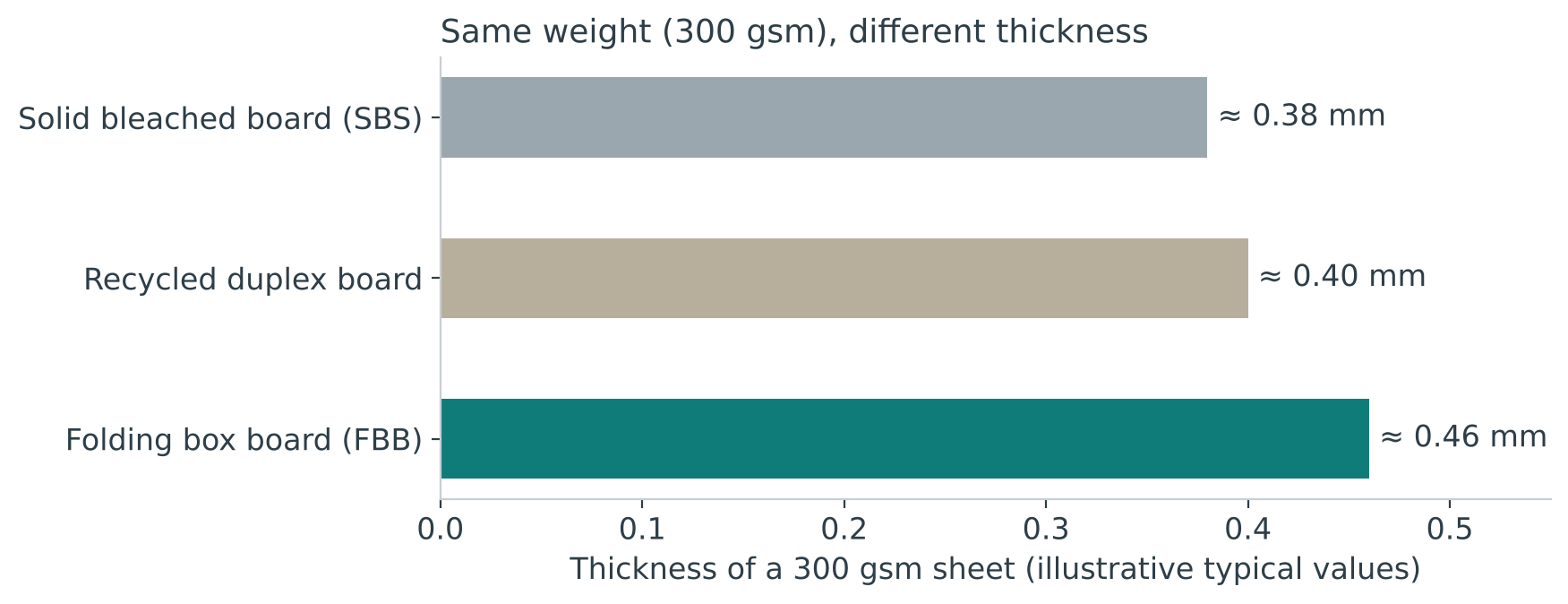
Why does that matter? For a sheet of a given material, resistance to bending rises with roughly the cube of its thickness: a basic result of engineering physics [1]. A board that is 15% thicker can therefore be about 50% stiffer. That is why a lighter, bulkier board can match a heavier, denser one on the packing line, and sometimes cost less per carton even when its price per kilogram is higher.
The practical lesson: specify a carton by board grade + GSM + thickness range + grain direction, and confirm stiffness on the real cartoning machine, rather than ordering “more GSM”.
The four board families
- Duplex board with a grey back: a white coated face on recycled fibre. The lowest-cost choice, common for trade generics.
- Duplex board with a white back: recycled middle, but a clean white inside face.
- Folding box board (FBB): virgin fibre with a bulky middle layer, stiff for its weight, and the usual choice for branded medicines.
- Solid bleached sulphate board (SBS): bleached fibre right through. The best surface for fine print and foil, used for premium and export packs.
The carton is sized from the blister stack
A carton’s size is not a design choice; it follows from what goes inside. Take three blister cards of 85 × 40 mm with 5-mm deep pockets, plus a folded leaflet. Allow about 1 mm each side for length and width, and add the stack, the leaflet and a little room for depth. The inside size comes to roughly 87 × 42 × 20 mm. Every millimetre added here is paid for in board on every carton, and can change how many cartons fit on one printing sheet.
Printing: each method has its job
- Sheet-fed offset prints most cartons and leaflets. Each colour needs its own printing plate.
- Rotogravure prints blister foils and sachet laminates from engraved cylinders: expensive to make but reused for years.
- Flexographic printing suits labels and corrugated boxes.
- Digital printing needs no plates, so it suits samples and very short runs, at a higher price per piece.
Every job carries a fixed set-up cost (plates or cylinders, machine make-ready and wasted sheets) that is spread over the quantity ordered. That single fact explains most of the price differences buyers see between suppliers and order sizes.
Finishes: drip-off, spot UV, foil and embossing
Finishes are where cartons look premium, and where costs creep in quietly. Two finishes that look similar on the shelf are made very differently:
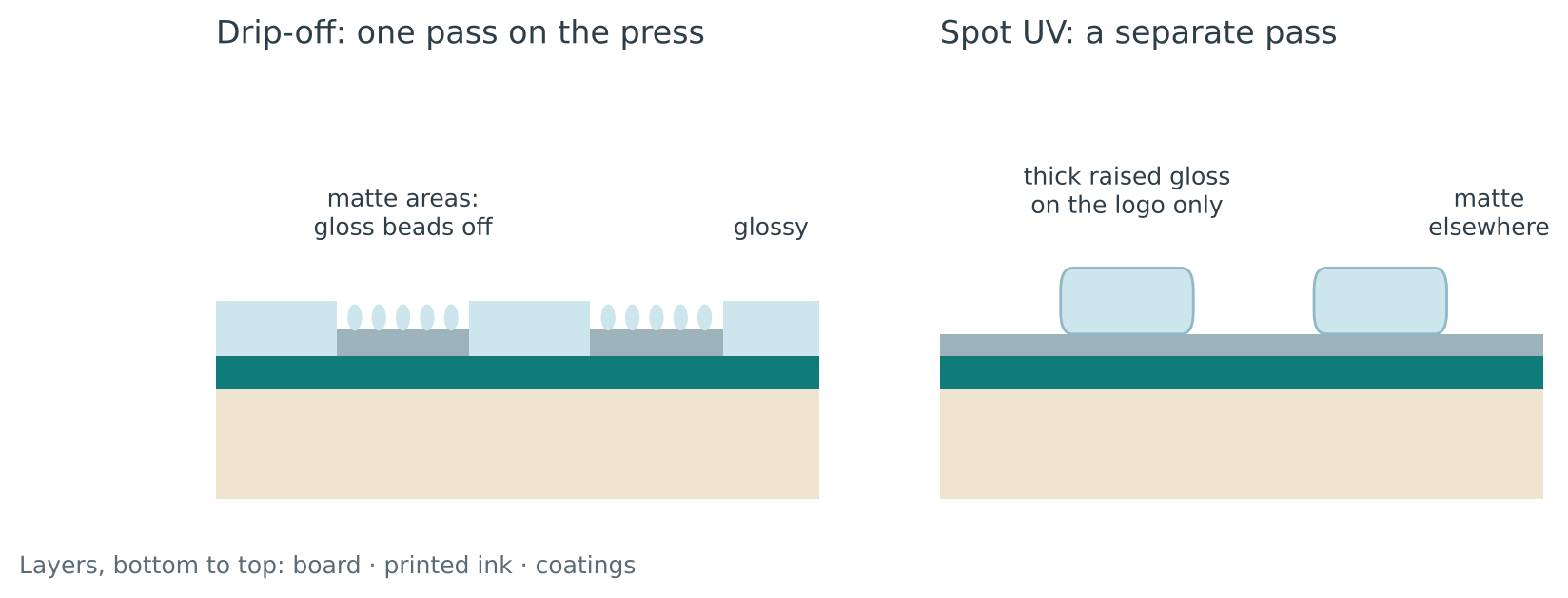
- Drip-off: the press lays a special matte varnish in chosen areas, then floods gloss over the sheet. The gloss runs off the matte areas, leaving a fine texture. Cheap and fast; edges are softer.
- Spot UV: thick gloss varnish is printed only on the logo and hardened under ultraviolet lamps. Crisp and raised, but it costs an extra pass and a screen.
- Hot-foil stamping and embossing need their own metal blocks or dies. On short runs, the one-time tool can cost more than the finish itself.
A good rule is to put the finish where the eye goes, the brand name or logo, and nowhere else. Keep the areas where batch numbers, expiry dates and QR codes are printed free of varnish, or the codes may smudge or fail to scan.
Braille: required for Europe, not for India
European Union rules require the name of the medicine to appear in Braille on the outer packaging [2]. India has no such requirement. Exporters therefore need an embossing step and a check of dot height and spacing: something to plan when a carton is first designed rather than after the dies are made.
References
- Wikipedia. Flexural rigidity (rigidity of a plate depends on the cube of its thickness). (accessed 28 October 2026) Link
- Directive 2001/83/EC, Article 56a (Braille on packaging), via legislation.gov.uk. (accessed 28 October 2026) Link
Disclaimer
This article is for general information and education. It is not legal, regulatory or engineering advice. Figures marked “illustrative” come from simple planning models built by the Aesclebio Research Team, not from supplier quotations; prices change with raw-material costs, order size and specification. Always confirm material choices with your own stability data, and confirm rules against the current official text before acting.