Iodine is the textbook case of a public health programme that worked. Since 1992 India has run universal salt iodisation under the National Iodine Deficiency Disorders Control Programme, and the rule behind it is unusually blunt: no person may sell common salt for direct human consumption unless it is iodised, subject to the exemptions in that sub-regulation. The fortification rules set 20 to 30 parts per million at the point of manufacture and 15 to 30 at retail (that is, 20 to 30 milligrams of iodine in every kilogram of salt) and permit only one iodine compound, potassium iodate.
That last detail is not an accident. Iodate is markedly more stable than iodide in warm, damp conditions, which is why the World Health Organization recommends it in preference for tropical climates. The salt rule does not bind a supplement, but it points the same way for any humid supply chain.
How well did it work? Better than the sceptics say, worse than the headline
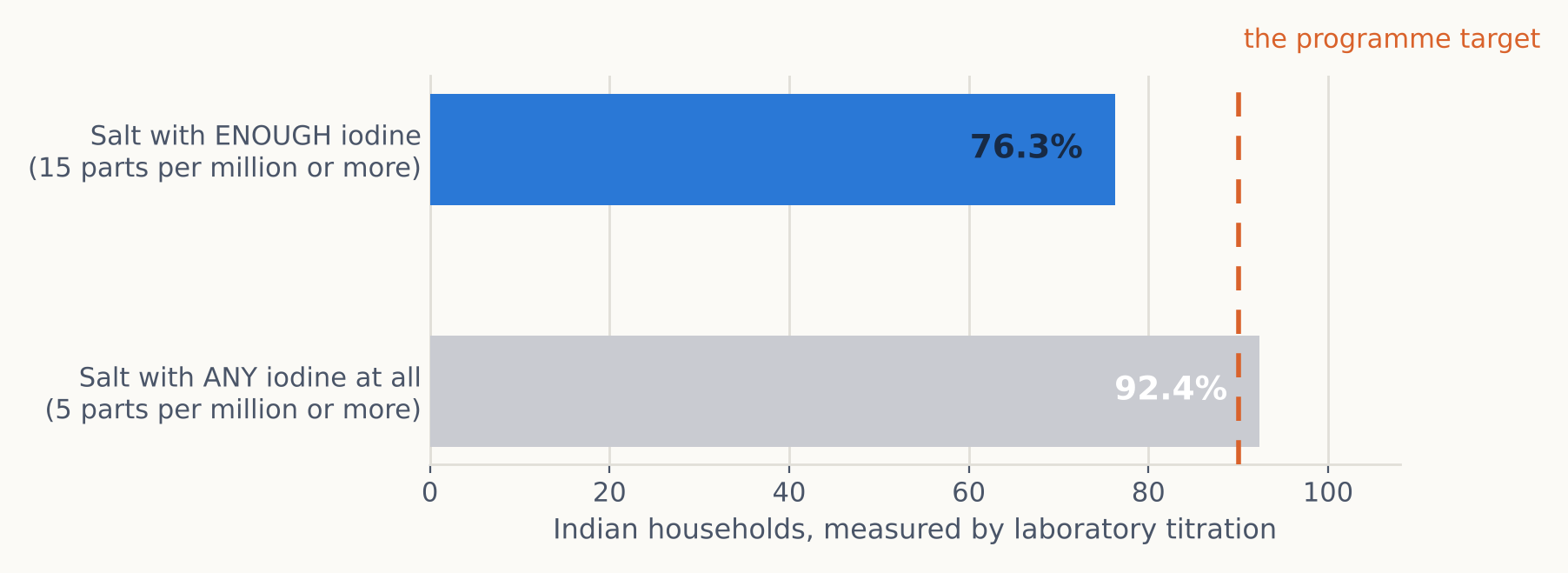
The difference between those two bars is the whole story, and it is a threshold difference, not a measurement one. Counting salt with any iodine in it at all, 5 parts per million or more, gives 92.4 per cent. Counting salt that meets the 15 parts per million standard that actually matters gives 76.3 per cent. Roughly one household in six is covered on paper and not in practice. A figure of 93 per cent also circulates widely; that one comes from a different national survey using a colour-change field kit, which detects presence rather than amount, and it should not be read against the 15 parts per million standard at all.
The shortfall is strongly geographic. Tamil Nadu sits at 61.9 per cent, Andhra Pradesh at 63.9, Rajasthan at 65.5, Odisha at 65.8 and Jharkhand at 68.8, while ten states and three union territories have reached full coverage.
Does that add up to a continuing national iodine deficiency? On the measure that counts, how much iodine is passing out in urine, no. The World Health Organization treats a population median below 100 micrograms per litre as insufficient, and below 150 in pregnancy. Indian women of reproductive age average 173 to 178, and pregnant women 173.
Who an iodine product is actually for
That is not an argument against the ingredient. It is an argument for aiming it, and the targets are well documented.
- Pregnancy and lactation. Adequate iodine in the general population does not imply adequate iodine in pregnant women: across 48 paired surveys worldwide, roughly half the time it did not.
- The under-covered states. Pregnant women in surveyed districts of Uttarakhand measured 110 to 124 micrograms per litre, in Kashmir 81, and in Delhi's urban slums half were below the pregnancy threshold.
- Not everywhere, though. In Ballabgarh in Haryana the figure was 260 and in Dakshina Kannada in Karnataka 352: both above requirements. One national product cannot be right for all of these.
A pregnancy-and-lactation iodine product, built on potassium iodate, aimed at the states where coverage is weakest, is a defensible proposition with a documented need behind it. A general adult multivitamin carrying iodine because multivitamins carry iodine is not.
Where iodine does belong: in company
Iodine is the raw material of thyroid hormone, but it is not sufficient on its own, because two separate steps depend on two other elements.
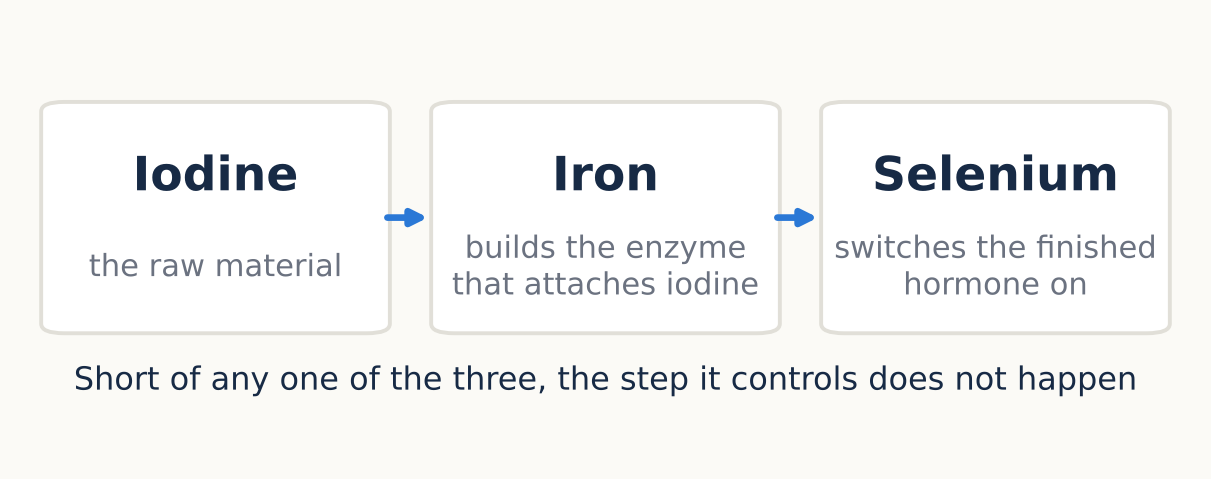
The enzyme that attaches iodine to the protein the hormone is built from is thyroid peroxidase, and it is built around a haem group: the same iron-containing structure that carries oxygen in blood. Without enough iron, that enzyme works poorly; in rats made iron-deficient its activity fell by a third to a half.
The thyroid then releases a storage form of the hormone, which has to be converted into the active form before it does anything. The enzymes that do that conversion are selenoproteins: they carry a selenium atom at the point where the chemistry happens. That was established in 1991, and it is why severe selenium deficiency impairs hormone activation.
What that is worth in practice, stated carefully
The iron half is the better supported of the two. In western Côte d'Ivoire, goitrous children given iodised oil were followed for 30 weeks: among those who were not anaemic, goitre fell to 12 per cent, while among those with iron-deficiency anaemia it was still 64 per cent. A later trial in 166 children already on iodised salt, in which neither the children nor the researchers knew who was getting iron, pointed the same way.
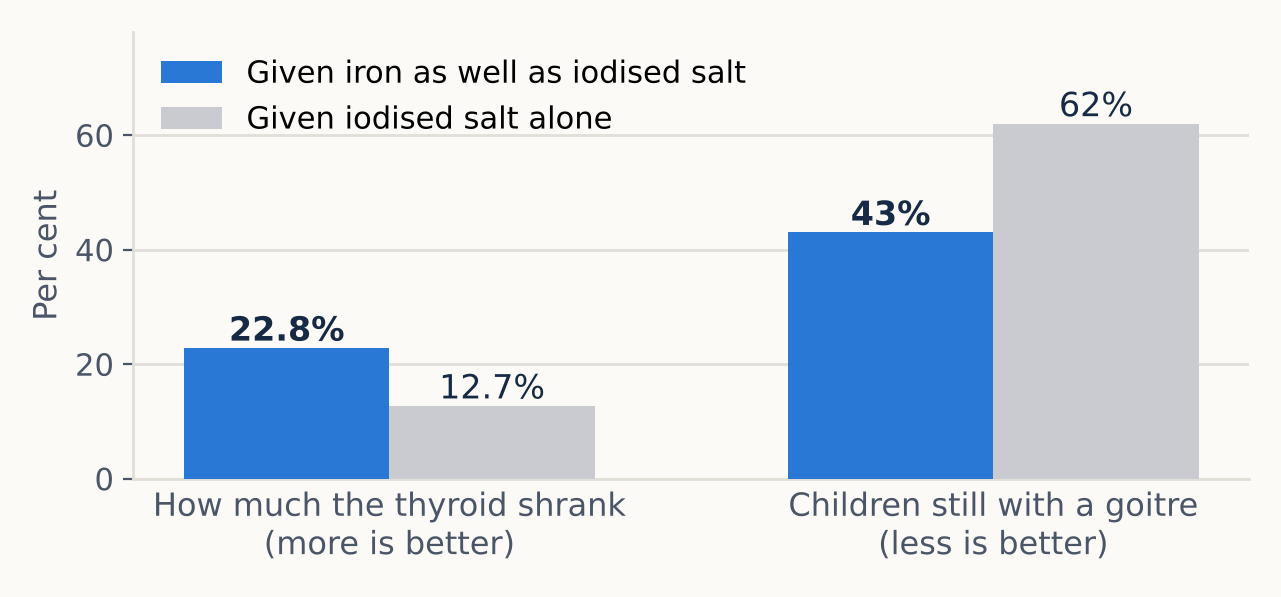
Now the limits, because this is exactly the kind of proposition that gets overstated. Those trials were in children who were iron-deficient, goitrous and iodine-deficient all at once; they are not a general-population finding. The related dual-fortified-salt trials, often lumped in with them, were run in Morocco rather than Côte d'Ivoire. And within India the picture is mixed: a Chandigarh study found iron depletion tracked with goitre in iodine-replete children, while a study in Udaipur found no such link and identified thyroid autoantibodies, the immune system attacking the gland, as the factor instead.
If iron does go into such a product, an earlier article in this series applies: in an Indian meal of cereal, pulses and tea, most of that iron will not be absorbed unless the dosing instruction keeps it away from tea and calcium.
The selenium half is weaker still, and a brand should know it before building a claim on it. In people who are not severely deficient, randomised trials have repeatedly failed to show that extra selenium improves hormone conversion. The largest, in 501 older British adults, found no effect at 100, 200 or 300 micrograms a day for six months, despite blood selenium rising. A five-year Danish trial found a change too small to matter clinically. And the one trial that paired selenium with iodine, in a population short of both, found no measurable synergy between them.
So the correct statement is this: the three-element combination is mechanistically coherent, each element doing a defined and separate job, and it has never been tested as a combination in any clinical trial. That is a legitimate formulation rationale and a legitimate thing to explain to a customer. It is not a proven intervention, and describing it as one would be a claim nobody can substantiate.
Selenium is the element to be careful with
Of all the trace elements, selenium has the narrowest comfortable margin between enough and too much. India's national nutrient tables set no tolerable upper intake for it (nor for manganese, copper or chromium) so the practical ceilings come from elsewhere. (The nutraceutical schedule does carry per-day ceilings for some of these ingredients; that is a different instrument serving a different purpose.)
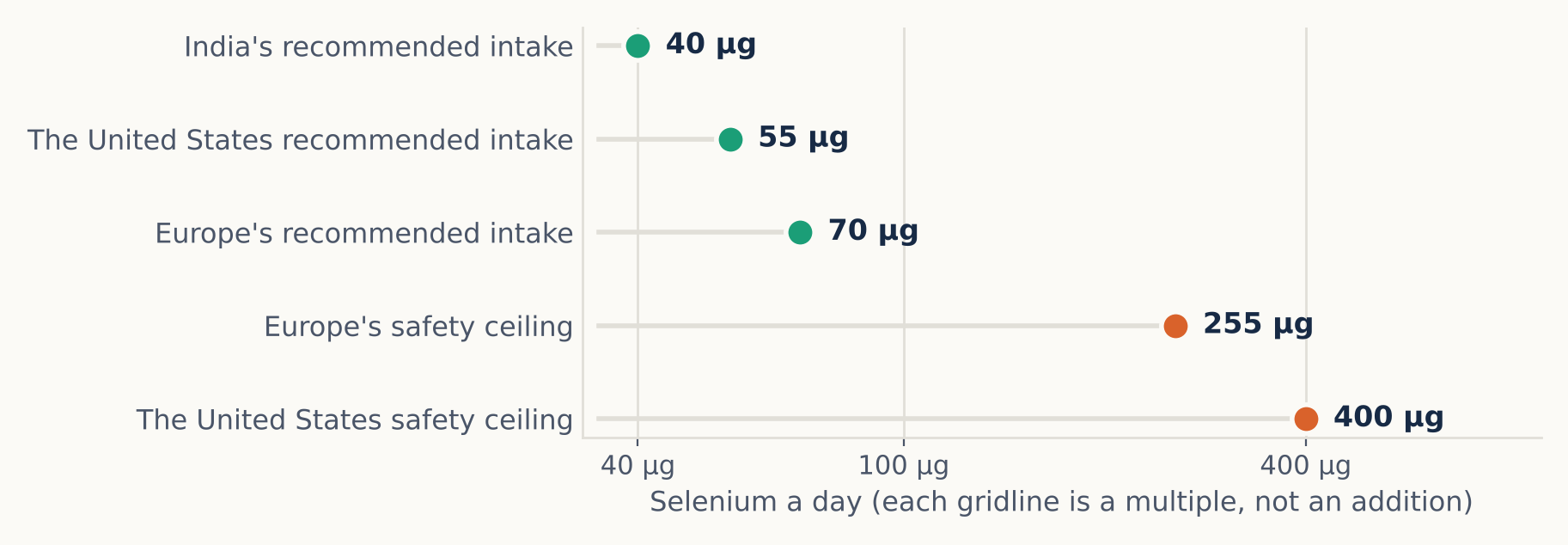
On American figures the gap between the 55 microgram recommended intake and the 400 microgram ceiling is about seven-fold. On European figures, 70 against 255, it is under four. For most nutrients that margin is far wider. And the Indian starting point is not uniform.
North-eastern Punjab has a seleniferous belt, ground naturally rich in selenium, in the Siwalik foothills: more than a thousand hectares across the Nawanshahr and Hoshiarpur districts, where soil selenium runs 2 to 6.5 milligrams per kilogram against under 0.5 nearby. Dietary intake there was measured at more than nine times the level in non-seleniferous Punjab, exceeding the tolerable limit in over 60 per cent of men, and a survey of 680 adults documented clinical selenium excess: hair and nail loss, garlic breath, altered thyroid markers. In 2025 a separate selenium-poisoning outbreak caused sudden hair loss across 18 villages in Buldhana district, Maharashtra, traced to ration wheat carrying 13 to 15 milligrams of selenium per kilogram against a normal 0.1 to 1.9.
The benefit case is narrow too. In the trial most often cited for selenium and cancer, benefit was confined to people in the lowest two thirds of baseline blood selenium; in the highest third, incidence was if anything raised. The much larger SELECT trial, 35,533 men at 200 micrograms a day, found no prostate cancer benefit. And a later analysis of the earlier trial found a 55 per cent higher rate of type 2 diabetes in the selenium group, concentrated in those who started with the most.
The practical conclusion is not to drop selenium. It is to treat it as a dose decision rather than an inclusion decision, and to keep it modest: at or near the 40 to 70 microgram recommended intakes, not at the ceiling.
Three specifications, and one regulatory trap
- Use potassium iodate, not potassium iodide. India's fortification rules permit only iodate for salt, and the stability argument applies to any humid supply chain.
- Keep the selenium dose near the recommended intake. Selenomethionine raises blood selenium more than the inorganic forms and is roughly twice as effective in people who are genuinely short of it, but in people who already have enough, no form raises the selenium-dependent enzymes any further.
- On the old advice that vitamin C destroys selenite, one of the inorganic forms: it holds only in the case actually tested. In a study of ten women, a full gram of vitamin C taken with selenite on an empty stomach cut absorption to near zero, while 60 milligrams from orange juice with a meal did not, and may have helped. The chemistry favours the other inorganic form, selenate, in a vitamin C-rich liquid formula, but no human study has tested that pairing.
And the trap. Chromium picolinate, the form the market wants, is not among India's permitted mineral sources; that list carries only chromium chloride and chromium sulphate. It does appear in the nutraceutical schedule at 200 to 400 micrograms a day. The consequence is that one ingredient choice moves the whole product from a health supplement into a nutraceutical, with a different licence. That decision is routinely made last, by a formulator, when it should be made first, by whoever owns the registration.
One further figure worth checking before anyone relies on it: the same nutraceutical schedule appears to permit selenium yeast at 2 milligrams of selenium a day. That would be about five times the American safety ceiling and nearly eight times the European one. Verify it against the current gazetted text before building anything on it.
Sources
- Directorate General of Health Services, Ministry of Health and Family Welfare, Government of India. National Iodine Deficiency Disorders Control Programme.
- Food Safety and Standards (Fortification of Foods) Regulations, 2018, Schedule I, item 1, notified 2 August 2018; and Food Safety and Standards (Prohibition and Restrictions on Sales) Regulations, 2011, sub-regulation 2.3.12.
- World Health Organization. Assessment of Iodine Deficiency Disorders and Monitoring their Elimination: A Guide for Programme Managers, 3rd edition. Geneva, 2007.
- Jha RK, Das S, Dey S, et al. National and sub-national estimates of household coverage of iodized salt and urinary iodine status among women of reproductive age in India: insights from the India Iodine Survey, 2018-19. Journal of Nutrition 2023;153(9):2717–2725.
- Nutrition International and the International Council for Control of Iodine Deficiency Disorders. India Iodine Survey 2018-19: National Report. September 2019.
- Wong EM and colleagues. Comparison of median urinary iodine concentration as an indicator of iodine status among pregnant women, school-age children and non-pregnant women. Food and Nutrition Bulletin 2011.
- Sareen N, Kapil U, Nambiar V, Pandey RM, Khenduja P. Iodine nutritional status in Uttarakhand State, India. Indian Journal of Endocrinology and Metabolism 2016;20(2):171–6.
- Kapil U, Pandey RM, Sareen N, Khenduja P, Bhadoria AS. Assessment of iodine deficiency disorders in Himachal Pradesh. Indian Journal of Endocrinology and Metabolism 2015;19(5):602–7.
- Köhrle J. Selenium, iodine and iron: essential trace elements for thyroid hormone synthesis and metabolism. International Journal of Molecular Sciences 2023;24(4):3393.
- Berry MJ, Banu L, Larsen PR. Type I iodothyronine deiodinase is a selenocysteine-containing enzyme. Nature 1991;349(6308):438–40.
- Hess SY, Zimmermann MB, Arnold M, Langhans W, Hurrell RF. Iron deficiency anemia reduces thyroid peroxidase activity in rats. Journal of Nutrition 2002;132(7):1951–5.
- Zimmermann M, Adou P, Torresani T, Zeder C, Hurrell R. Persistence of goiter despite oral iodine supplementation in goitrous children with iron deficiency anemia in Côte d'Ivoire. American Journal of Clinical Nutrition 2000;71(1):88–93.
- Hess SY, Zimmermann MB, Adou P, Torresani T, Hurrell RF. Treatment of iron deficiency in goitrous children improves the efficacy of iodized salt in Côte d'Ivoire. American Journal of Clinical Nutrition 2002;75(4):743–8.
- Zimmermann MB, Zeder C, Chaouki N, Saad A, Torresani T, Hurrell RF. Dual fortification of salt with iodine and microencapsulated iron: a randomized, double-blind, controlled trial in Moroccan schoolchildren. American Journal of Clinical Nutrition 2003;77(2):425–32.
- Das S, Bhansali A, Dutta P, et al. Persistence of goitre in the post-iodization phase: micronutrient deficiency or thyroid autoimmunity? Indian Journal of Medical Research 2011;133(1):103–9.
- Rayman MP, Thompson AJ, Bekaert B, et al. Randomized controlled trial of the effect of selenium supplementation on thyroid function in the elderly in the United Kingdom. American Journal of Clinical Nutrition 2008;87(2):370–8.
- Winther KH and colleagues. Does selenium supplementation affect thyroid function? Results from a randomized, controlled, double-blinded trial in a Danish population. European Journal of Endocrinology 2015;172(6):657–67.
- Thomson CD and colleagues. Selenium and iodine supplementation: effect on thyroid function of older New Zealanders. American Journal of Clinical Nutrition 2009.
- European Food Safety Authority Panel on Dietetic Products, Nutrition and Allergies. Scientific opinion on the tolerable upper intake level for selenium. EFSA Journal 2023;21(1):7704.
- Hira CK, Partal K, Dhillon KS. Dietary selenium intake by men and women in high and low selenium areas of Punjab. Public Health Nutrition 2004;7(1):39–43.
- Chawla R, Filippini T, Loomba R, Cilloni S, Dhillon KS, Vinceti M. Exposure to a high selenium environment in Punjab, India: biomarkers and health conditions. Science of the Total Environment 2019;719:134541.
- Sharma N and colleagues. Profile of selenium in soil and crops in seleniferous area of Punjab, India by neutron activation analysis. Journal of Radioanalytical and Nuclear Chemistry 2009.
- Bawaskar HS and colleagues. Selenium poisoning from consumption of contaminated wheat: a case series from rural Maharashtra, India. Clinical Toxicology 2025.
- Duffield-Lillico AJ, Reid ME, Turnbull BW, et al. Baseline characteristics and the effect of selenium supplementation on cancer incidence in a randomized clinical trial: a summary report of the Nutritional Prevention of Cancer Trial. Cancer Epidemiology, Biomarkers and Prevention 2002;11(7):630–9.
- Lippman SM, Klein EA, Goodman PJ, et al. Effect of selenium and vitamin E on risk of prostate cancer and other cancers: the Selenium and Vitamin E Cancer Prevention Trial (SELECT). JAMA 2009;301(1):39–51.
- Stranges S, Marshall JR, Natarajan R, et al. Effects of long-term selenium supplementation on the incidence of type 2 diabetes: a randomized trial. Annals of Internal Medicine 2007;147(4):217–23.
- Burk RF, Norsworthy BK, Hill KE, Motley AK, Byrne DW. Effects of chemical form of selenium on plasma biomarkers in a high-dose human supplementation trial. Cancer Epidemiology, Biomarkers and Prevention 2006;15(4):804–10.
- Xia Y, Hill KE, Byrne DW, Xu J, Burk RF. Effectiveness of selenium supplements in a low-selenium area of China. American Journal of Clinical Nutrition 2005;81(4):829–34.
- Robinson MF, Thomson CD, Huemmer PK. Effect of a megadose of ascorbic acid, a meal and orange juice on the absorption of selenium as sodium selenite. New Zealand Medical Journal 1985;98(784):627–9.
- Food Safety and Standards Authority of India. Food Safety and Standards (Health Supplements, Nutraceuticals, Food for Special Dietary Use, Food for Special Medical Purpose, Functional Food and Novel Food) Regulations, 2016, Schedule I; and Schedule VI as substituted by the direction dated 29 December 2017.
- Indian Council of Medical Research and National Institute of Nutrition. Nutrient Requirements for Indians. Hyderabad, 2020.
Disclaimer
This article is written for formulators, manufacturers and informed readers. It is a summary of published research and is not medical advice, a diagnosis or a treatment recommendation. Iodine and selenium both have narrow margins between adequacy and excess, and thyroid conditions require medical diagnosis and management; no one should start, stop or change a supplement or a prescribed treatment on the basis of this article. Nothing here is a claim for any product. Product composition and labelling must comply with the Food Safety and Standards Authority of India regulations applicable at the time of manufacture, and every schedule entry referred to here should be verified against the current gazetted text before it is relied on.