Nutraceuticals · Botanicals
The botanical with the largest effect size in the category, and almost nobody sells it
It is cheap, it is in every Indian kitchen, and across twelve randomised trials it lowered blood pressure by more than most people expect from a supplement. There is a catch, and it is worth understanding before building anything on it.
Fewer than one in six of the botanicals on the Indian market reaches a standard of evidence that would survive a serious technical review. That is the honest position, and it should shape a range rather than embarrass it. A brand carrying eight well-evidenced, properly dosed botanicals is in a far stronger position, commercially and legally, than one carrying thirty at decorative levels.
This article is about the top of that list, and about how to read the evidence for it without flattering it.
Garlic: the largest effect size here, from the cheapest material
A meta-analysis of twelve randomised trials in 553 adults with high blood pressure found an average fall in systolic blood pressure of 8.3 millimetres of mercury, and 5.5 in diastolic pressure across eight of those trials. For a food ingredient, that is a large number.
It is worth seeing it next to a botanical that moves the same measurement in the opposite direction, because the two are sold in the same shops.
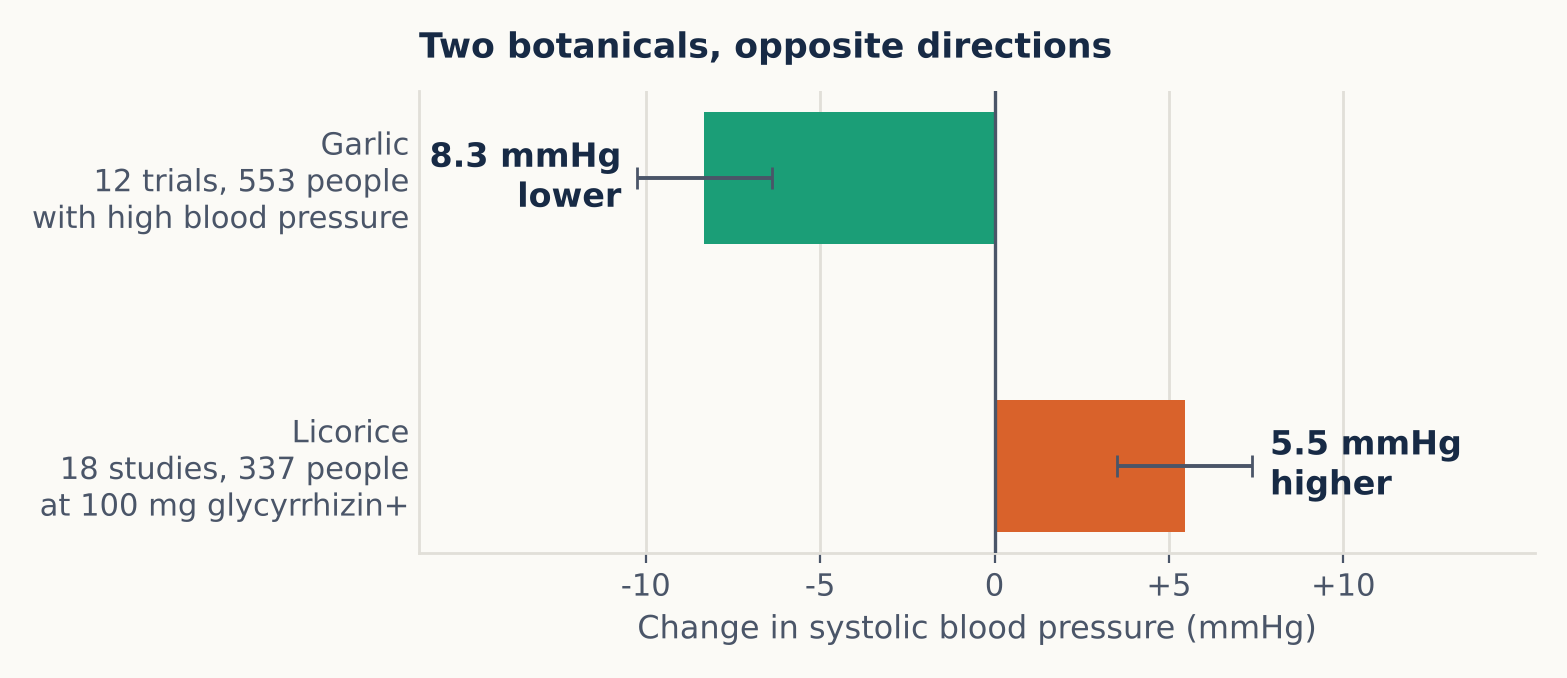
Now the catch, and it matters. That garlic meta-analysis is the work of a single author, four of the twelve trials in it come from that author's own research group, and it reads in places as advocacy for one particular form of the ingredient. The direction and the rough magnitude are supported by earlier independent reviews. The precision implied by a figure like 8.3 is not something to build a label around.
There is a second thing in that paper that should not be repeated. It states that the blood pressure reduction is associated with a 16 to 40 per cent reduction in cardiovascular events. That figure is not measured for garlic. It is inferred from trials of blood pressure medicines that produced a similar fall in pressure. The inference is reasonable. It is not a result, and it must not be presented as one.
The specification problem nobody mentions
Here is the part that decides whether a garlic product is a serious proposition or a decorative one. The twelve trials did not test one ingredient. They tested two, and the two are standardised to different markers.
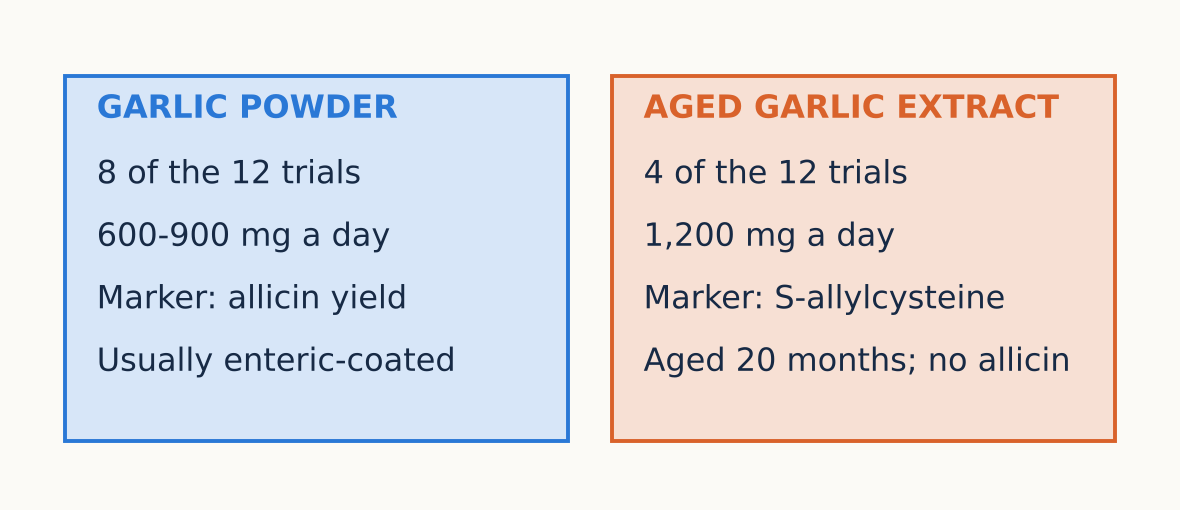
Aged garlic extract is matured for around twenty months, a process that converts the volatile sulphur compounds, allicin among them, into more stable ones. Its marker is S-allylcysteine, and the trials used about 600 micrograms of it per capsule. Garlic powder products are a different material, usually enteric-coated, and are specified by allicin yield.
One useful detail from the dose-response work: two capsules a day was sufficient, one was not, and four was no better than two. That is an unusually clean answer, and it points at a product rather than at a range.
The finding that nobody builds a product around, and should
In the garlic trials a proportion of participants did not respond at all: between a sixth and a third of them, depending on how response is defined. Their blood pressure barely moved while everyone else's fell.
The researchers proposed an explanation. Garlic lowers blood pressure through two signalling pathways that both depend on B vitamins (folate, riboflavin, B6 and B12) as cofactors. If those are marginal, the mechanism has nothing to work with, however much garlic is taken.
Treat that as a hypothesis, not a finding. It has not been tested by randomising people to garlic with and without B vitamins, which is the trial that would settle it. But it is a hypothesis with an unusual property for this market: it is cheap to act on, the cofactors are already permitted at ordinary doses, and the population it would matter most in is the Indian one, where B12 insufficiency is widespread. A combination product built on that reasoning is defensible as formulation logic even though it cannot yet be claimed as a result.
Boswellia: the second one, and the one with a cleaner regulatory position
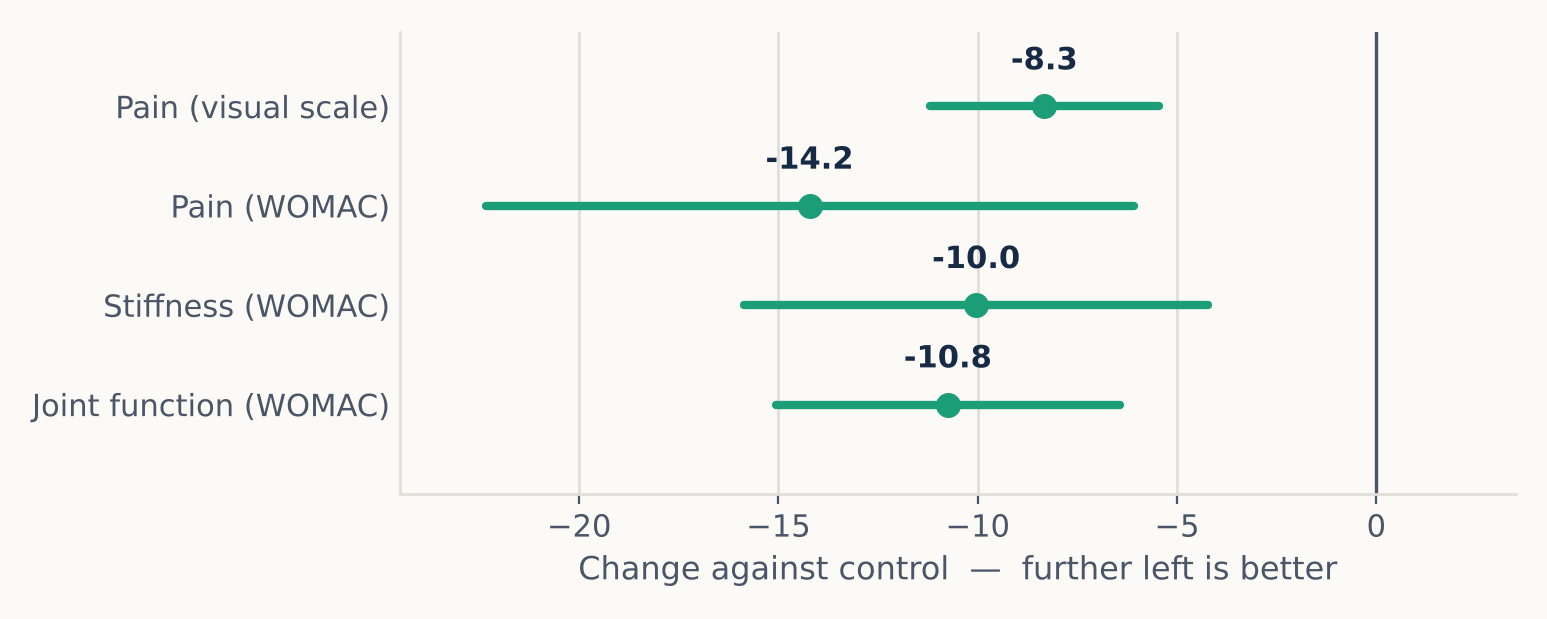
Boswellia serrata has multiple randomised trials for joint symptoms, a clean listing in Schedule VI Part A at 250 to 1,500 milligrams, and a standardisation marker that can be specified and tested. An independent meta-analysis of seven trials in 545 patients found consistent improvement across every measure used.
That same review says something a marketing team will not enjoy: the recommended duration of treatment is at least four weeks. Boswellia is frequently sold on the claim that it works within a week. That claim traces to trials of one branded extract, and those trials have the ingredient manufacturer among their authors or their funders.
One further detail from the independent review is useful at a bench. Every one of the four measures moved in the same direction, and the pooled ranges sit clear of zero on all of them. That consistency matters more than any single figure: an ingredient that improves pain but not stiffness, or one measure but not the others, is usually telling you that the result is fragile. Boswellia does not look fragile.
Who ran the trial is part of the specification
This is worth looking at directly, because it recurs across the whole category and it is not an accusation of dishonesty. It is a measurable pattern.
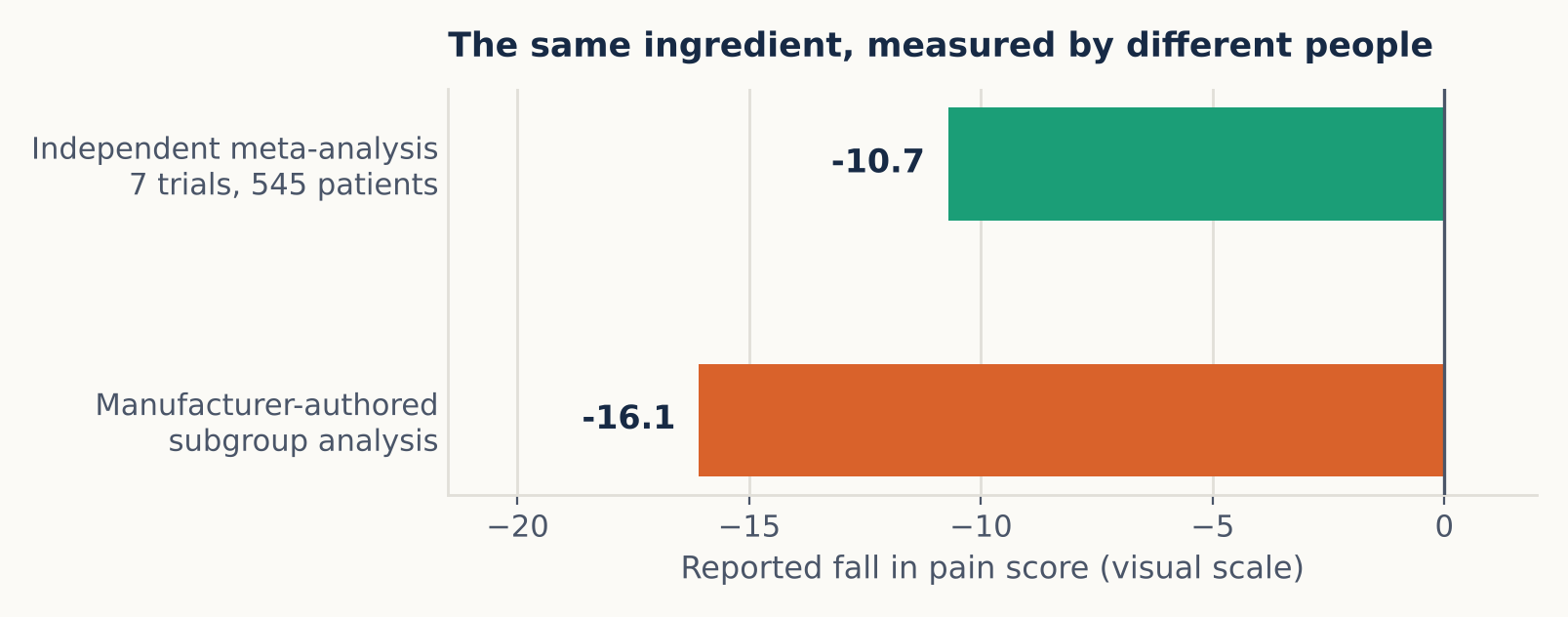
The manufacturer-authored analysis reports an effect about half as large again as the independent one. Both may be competently done. But when a buyer is choosing between a branded extract at a premium and a generic at a fraction of the price, the premium is being justified by the larger number, and the larger number comes from the people selling it.
The test is simple and worth applying to every ingredient dossier that arrives: find the trial that was not funded or authored by the supplier, and see what it found.
What the evidence supports, narrowly
Several botanicals in the second tier are legitimate, and the discipline they need is not a smaller dose but a narrower claim. The evidence usually supports something more specific than the market says:
- Tulsi for stress, rather than for immunity.
- Amla for blood lipids, rather than for hair.
- Grape seed for blood pressure, rather than for hair.
- Chamomile for anxiety, rather than for sleep.
- Ginkgo in people who already have cognitive impairment, rather than in healthy adults looking for an improvement.
In each case the narrower claim is the one with trials behind it, and in each case it is also the one a regulator is less likely to challenge. That is a rare alignment and it is worth taking.
What actually puts a botanical in the first tier
It is worth being explicit about the standard, because “clinically proven” is used so loosely that it has stopped carrying information.
- More than one randomised controlled trial, conducted by more than one group, in people rather than in cells or animals.
- A meta-analysis pooling those trials, or a regulatory monograph from a body that reviews evidence rather than registering products.
- A dose that the trials actually used, stated in the units the trials used, which for an extract means marker content, not milligrams of powder.
- A standardisation marker that a laboratory can measure in a delivered batch.
- At least one trial where the people who ran it were not the people selling the ingredient.
Fewer than one in six of the botanicals in common use clears all five. That is not a reason for despair; it is a competitive position. The ingredients that clear it are mostly old, cheap and out of patent, which means anyone can buy them, and almost nobody builds a serious product around them, because there is no supplier with a marketing budget pushing them forward.
What this means for a range
- Garlic is the most under-exploited ingredient in the Indian market: culturally unimpeachable, cheap, and better evidenced than most of what sits beside it. Choose one of the two materials and specify it to that material's own marker.
- Boswellia is the second, with the advantage of a clean schedule entry and a testable marker. Say four weeks, because that is what the independent evidence says.
- Never quote a cardiovascular-event reduction for a blood pressure ingredient. The trials measured pressure, not events.
- Ask who paid for the trial behind every premium you are being asked to pay. On present evidence, the premium is often the only thing the brand reliably delivers.
Eight ingredients, properly dosed, honestly claimed, and bought to a marker. It is a duller range than thirty, and a much harder one to compete with.
Sources
- Ried K. Garlic lowers blood pressure in hypertensive subjects, improves arterial stiffness and gut microbiota: a review and meta-analysis. Experimental and Therapeutic Medicine 2020;19(2):1472–1478. (Single-author review; four of the twelve included trials are from the author's own group.)
- Penninkilampi R, Eslick EM, Eslick GD. The association between consistent licorice ingestion, hypertension and hypokalaemia: a systematic review and meta-analysis. Journal of Human Hypertension 2017;31(11):699–707.
- Yu G, Xiang W, Zhang T, Zeng L, Yang K, Li J. Effectiveness of Boswellia and Boswellia extract for osteoarthritis patients: a systematic review and meta-analysis. BMC Complementary Medicine and Therapies 2020;20(1):225.
- Dubey V, Kheni D, Sureja V. Efficacy evaluation of standardized Boswellia serrata extract in osteoarthritis: a systematic review and sub-group meta-analysis. Explore 2024;20(5):102983. (All three authors were employees of an ingredient company.)
- Inprasit C, Bunyamahote S, Boonpattharatthiti K, et al. Evaluating the efficacy and safety of Curcuma longa, Boswellia serrata, and their mixed formulation in treating knee osteoarthritis: a systematic review and network meta-analysis. Complementary Therapies in Medicine 2025;96:103256.
- Food Safety and Standards (Health Supplements, Nutraceuticals…) Regulations, 2016, Schedule VI Part A.
Disclaimer
This article is written for formulators, manufacturers and informed readers. It is a summary of published research and is not medical advice, a diagnosis or a treatment recommendation. High blood pressure and joint disease require medical diagnosis and management, and no one should start, stop or change a prescribed treatment on the basis of this article. Garlic preparations can affect bleeding and interact with anticoagulant medicines. Nothing here is a claim for any product, and no brand is named. Product composition and labelling must comply with the Food Safety and Standards Authority of India regulations applicable at the time of manufacture, and every schedule entry referred to here should be verified against the current gazetted text before it is relied on.