Nutraceuticals · Evidence-Based Actives
Four supplements that work, and cost almost nothing
The best-evidenced actives in this category are mostly commodities. One is a by-product of cheese-making. None of them is the ingredient a brand would choose if it wanted something to talk about, which is precisely why they are worth talking about.
There is a pattern in this category that is easy to miss. The ingredients with the deepest evidence base tend to be old, cheap, chemically uninteresting and out of patent. The ingredients with the best stories tend to be new, proprietary and thinly evidenced. Four examples of the first kind follow, with the Indian regulatory position for each, because in two cases the law and the evidence do not sit comfortably together.
Creatine: the most-studied active in sports nutrition
Creatine monohydrate raises muscle creatine and phosphocreatine stores by 20 to 40 per cent, and the international position stand describes it as one of the few nutritional supplements for which research has consistently shown performance benefits. It is off-patent, made by many producers, and among the cheapest actives in the category.
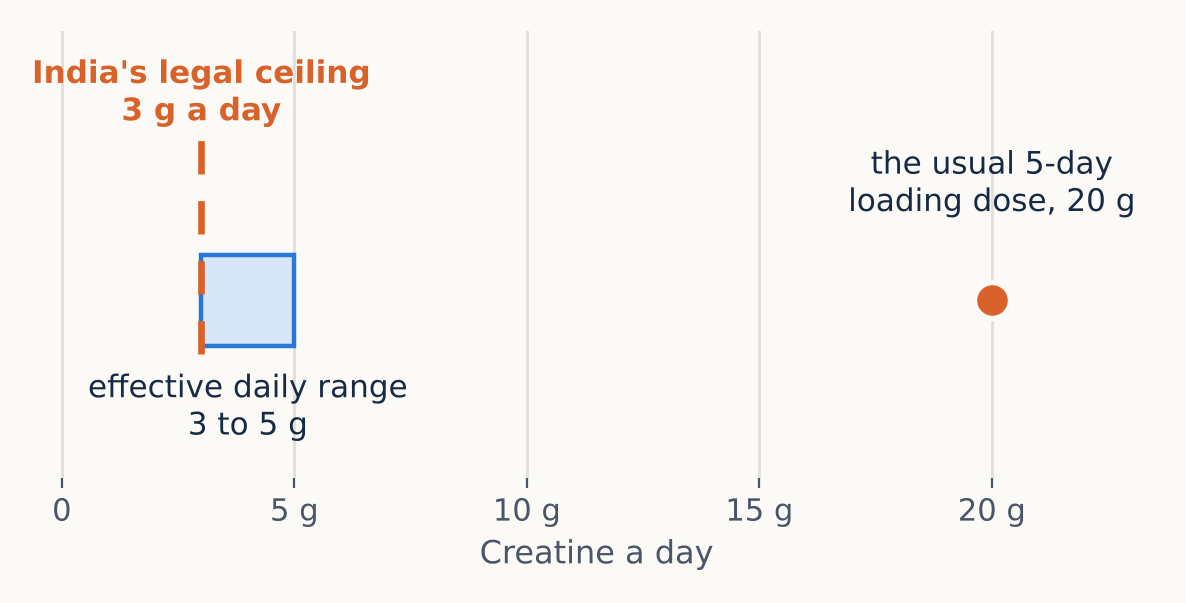
India permits 3 grams a day, for adults only. The conventional loading protocol, 20 grams a day for five to seven days, is therefore unavailable, and the cap sits at the very bottom of the 3 to 5 gram maintenance range. The position stand's own alternative is 3 grams a day for 28 days, which reaches the same muscle saturation more slowly. So Indian law forbids the shortcut, not the destination, and the label should say so rather than leaving the consumer to wonder why nothing has happened in week one.
Beyond sport, two things are worth stating accurately because they are usually stated backwards. Creatine appears to help memory in older adults: pooled across trials the effect is concentrated in people aged 66 to 76 and absent in those aged 11 to 31. And for muscle in older people it works only alongside resistance training: pooling 35 studies, creatine with training added 1.10 kilograms of lean mass, and creatine without training added 0.03 kilograms, which is to say nothing. Creatine is an amplifier of exercise, not a substitute for it.
The one objection creatine always attracts is kidneys, and it has an identifiable origin: a single case report from 1998, and a confusion between two very similar words. Creatine breaks down into creatinine, and blood creatinine is the marker laboratories use to estimate how well a kidney is filtering. So somebody taking creatine, or simply eating a lot of meat, can return a blood test that looks like declining kidney function while the kidney is working perfectly well. Reviewing the supplementation trials, twelve showed no rise in blood creatinine at all, eight showed a rise that stayed inside the normal range, and two showed a rise above it. After more than twenty years of research, no adverse effect on kidney function has been demonstrated in healthy people at recommended doses.
Two practical consequences. Anyone with existing kidney disease should use it only under medical supervision, and anyone else should mention creatine to whoever is reading their blood test, which is worth putting on the pack, because it costs nothing and prevents a needless scare.
And one formulation warning. Creatine monohydrate powder is remarkably stable, showing no degradation over years even in warm storage. Creatine in solution is not: it converts into creatinine, faster when warm and faster when acidic. A ready-to-drink creatine beverage is therefore a poor idea, however well it would sell. Powders, sachets, capsules and tablets are the honest formats.
Whey protein: a waste stream that turned out to work
Whey was the liquid left over from cheese-making, and for most of industrial history it was a disposal problem. It is now a globally traded commodity, priced per tonne, and it has the best evidence base of any protein supplement.
What that evidence shows is modest and has a hard ceiling.
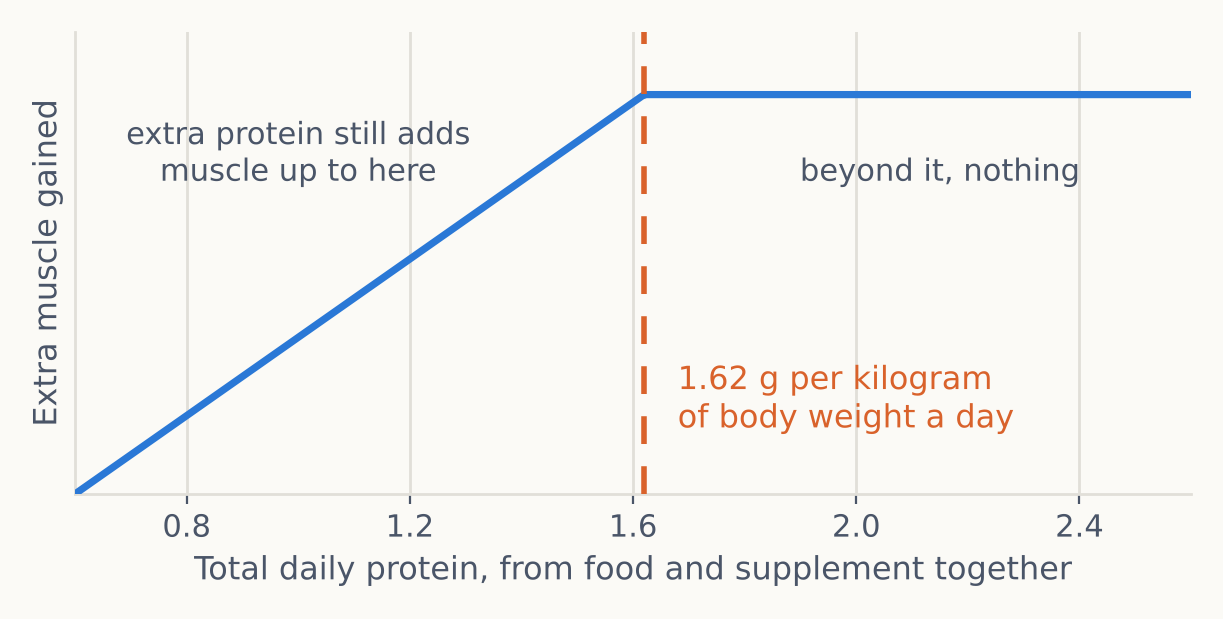
Beyond a total protein intake of 1.62 grams per kilogram of body weight a day, from food and supplement together, further protein produced no additional gains. Below it, supplementation added 0.30 kilograms of fat-free mass and 2.49 kilograms on a one-repetition maximum lift. Real, worth having, and small.
One claim to drop: whey is not superior to other proteins for the outcomes people care about. Pooling nine trials of at least six weeks, whey and soy produced no difference in strength or lean mass, and comparisons against beef, milk and dairy protein showed the same. Whey does stimulate muscle protein synthesis more sharply in the hours after a dose, which is where its reputation comes from, but that laboratory signal does not translate into a better result over six weeks. Whey's real advantages are practical: a complete amino acid profile, good digestibility, it dissolves, it tastes acceptable, and it is cheap per gram of protein. That is enough.
Beta-alanine: a narrow window, precisely located
Beta-alanine raises muscle carnosine, which buffers the acid that builds up during hard effort. Pooling 40 studies and 1,461 participants, the overall effect is small, and it is concentrated in a specific band of exercise duration.
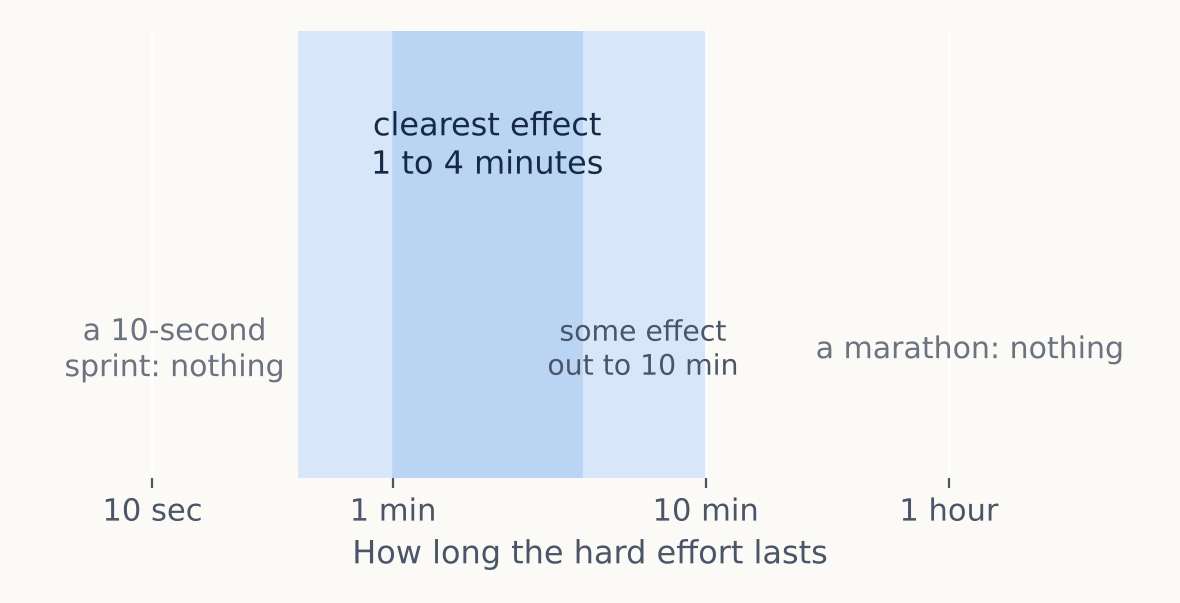
It does nothing for a ten-second sprint, because that effort does not last long enough to accumulate acid, and nothing for an hour-long event, because acid is not what limits it. Within the window, the effect is clearer for capacity tests, how long someone can hold an effort, than for timed performance.
The dose is 4 to 6 grams a day for four weeks, and unlike creatine the loading period is not optional: raising muscle carnosine is the mechanism, and it takes that long. The only reported side effect is tingling of the skin, which is harmless, roughly nine times more likely than on a dummy capsule, and avoidable by splitting the dose into portions of 1.6 grams or less.
India permits 4 to 6 grams a day, not more than four weeks at a stretch. The range matches the evidence exactly and the duration matches the loading period exactly, which means an Indian consumer may lawfully complete one full loading cycle and must then stop, while muscle carnosine slowly washes out. The regulation permits the effective protocol and forbids maintaining it. A product designed around four-week cycles, with the reason explained, is both compliant and honest.
One qualification to the cheapness argument: beta-alanine is a simple amino acid with generic suppliers, but the best-known branded form is patented and the patents have been litigated.
Alpha-lipoic acid: a symptom treatment with a real trial behind it
Alpha-lipoic acid is a bulk-synthesised commodity, and in Germany it is an approved medicine for diabetic nerve pain. The trial that matters was oral, randomised, double-blind and placebo-controlled, in 181 patients over five weeks.
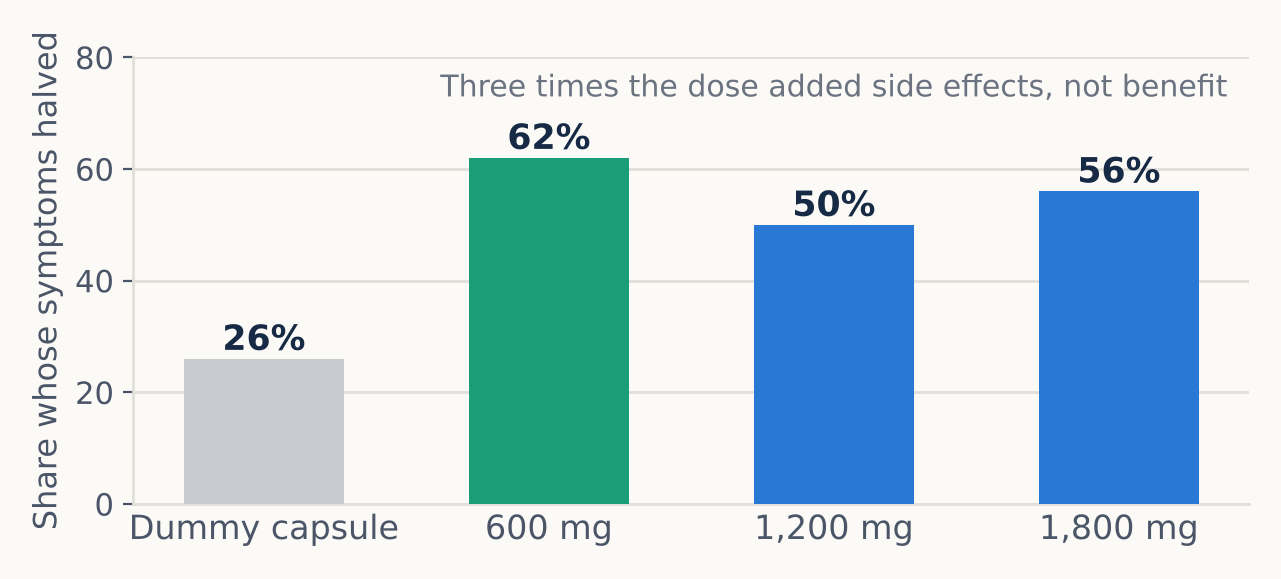
Six hundred milligrams a day did as well as 1,800, while nausea and dizziness rose with dose, so the trial's own conclusion was that 600 milligrams once daily gives the best balance of benefit and side effects. That is an unusually clean dosing answer.
Two honest limits. What improved was what patients reported: burning, stabbing, tingling, numbness. Objective measures of nerve damage were only numerically better. And a four-year trial in 460 patients, also oral, missed its primary endpoint, although several secondary measures favoured treatment. The striking nerve-conduction improvements that circulate in marketing material come from intravenous studies of generally poor methodological quality, and must not be quoted alongside an oral dose.
So: a genuine symptomatic treatment, not a disease-modifying one. In India it sits in Schedule VI Part B, which lists ingredients without numerical daily limits, so the evidence-based 600 milligram dose is unproblematic here: a useful contrast with the two ingredients above.
Why the two joint ingredients everyone asks about are not on this list
Glucosamine is the obvious omission. The large independent trial (1,583 patients, five arms) found a placebo response of 60.1 per cent and glucosamine 3.9 percentage points above it, which was not statistically distinguishable from placebo. The active comparator in the same trial, an anti-inflammatory drug, came in 10 points above placebo and was statistically significant, so the trial could detect a real effect when one was there. There is a further wrinkle that bites in India: the positive glucosamine trials all used 1,500 milligrams a day, while India's permitted range for glucosamine sulphate starts at 2,500. A product sold here at the only dose with supporting evidence would be non-compliant for being too weak.
Undenatured type II collagen is the more interesting omission, because mechanistically it is the most elegant thing in this whole field. It works, if it works, at 40 milligrams rather than the 10 grams used for ordinary collagen peptides, because it is not supplying building material at all. It is presented to the immune tissue of the gut as an intact folded protein, teaching the immune system not to attack the body's own joint cartilage. That is a 250-fold smaller dose doing a completely different job.
But it fails both of this article's tests. It is a single patented material with no commodity version. And every trial reporting that it beats glucosamine has had the manufacturer among its authors or its funders, while the first well-powered trial with no manufacturer involvement (216 patients, 24 weeks, published in 2026) found that no supplement tested, including this one, beat placebo. The mechanism remains worth understanding. The evidence does not yet support putting it on this list.
The pattern worth taking away
Across these six ingredients the relationship between price and evidence runs the wrong way round. The four that work are commodities. The two whose evidence depends on manufacturer-run trials are the two that are patented and single-source. That is not a coincidence: a commodity has no owner to fund a trial, so a commodity with a good evidence base usually has one because independent researchers kept finding the same thing.
Which suggests a simple test when an expensive new active is presented: ask who paid for the trials, and ask what happened the first time somebody independent ran one.
Sources
- Kreider RB, Kalman DS, Antonio J, et al. International Society of Sports Nutrition position stand: safety and efficacy of creatine supplementation in exercise, sport and medicine. Journal of the International Society of Sports Nutrition 2017;14:18.
- Antonio J, Candow DG, Forbes SC, et al. Common questions and misconceptions about creatine supplementation: what does the scientific evidence really show? Journal of the International Society of Sports Nutrition 2021;18:13.
- Xu C, Bi S, Zhang W, Luo L. The effects of creatine supplementation on cognitive function in adults: a systematic review and meta-analysis. Frontiers in Nutrition 2024;11:1424972.
- Prokopidis K, Giannos P, Triantafyllidis KK, et al. Effects of creatine supplementation on memory in healthy individuals: a systematic review and meta-analysis. Nutrition Reviews 2023;81(4):416–427.
- Chilibeck PD, Kaviani M, Candow DG, Zello GA. Effect of creatine supplementation during resistance training on lean tissue mass and muscular strength in older adults: a meta-analysis. Open Access Journal of Sports Medicine 2017;8:213–226.
- Delpino FM and colleagues. Influence of creatine supplementation on lean body mass: a systematic review and meta-analysis. Nutrition 2022.
- Kley RA, Tarnopolsky MA, Vorgerd M. Creatine for treating muscle disorders. Cochrane Database of Systematic Reviews 2013;(6):CD004760.
- Morton RW, Murphy KT, McKellar SR, et al. A systematic review, meta-analysis and meta-regression of the effect of protein supplementation on resistance training-induced gains in muscle mass and strength in healthy adults. British Journal of Sports Medicine 2018;52(6):376–384.
- Messina M, Lynch H, Dickinson JM, Reed KE. No difference between the effects of supplementing with soy protein versus animal protein on gains in muscle mass and strength in response to resistance exercise. International Journal of Sport Nutrition and Exercise Metabolism 2018;28(6):674–685.
- Saunders B, Elliott-Sale K, Artioli GG, et al. Beta-alanine supplementation to improve exercise capacity and performance: a systematic review and meta-analysis. British Journal of Sports Medicine 2017;51(8):658–669.
- Trexler ET, Smith-Ryan AE, Stout JR, et al. International Society of Sports Nutrition position stand: beta-alanine. Journal of the International Society of Sports Nutrition 2015;12:30.
- Dolan E, Swinton PA, Painelli VS, et al. A systematic risk assessment and meta-analysis on the use of oral beta-alanine supplementation. Advances in Nutrition 2019;10(3):452–463.
- Ziegler D, Ametov A, Barinov A, et al. Oral treatment with alpha-lipoic acid improves symptomatic diabetic polyneuropathy: the SYDNEY 2 trial. Diabetes Care 2006;29(11):2365–2370.
- Ziegler D, Low PA, Litchy WJ, et al. Efficacy and safety of antioxidant treatment with alpha-lipoic acid over 4 years in diabetic polyneuropathy: the NATHAN 1 trial. Diabetes Care 2011;34(9):2054–2060.
- Han T, Bai J, Liu W, Hu Y. A systematic review and meta-analysis of alpha-lipoic acid in the treatment of diabetic peripheral neuropathy. European Journal of Endocrinology 2012;167(4):465–471. (Intravenous administration only.)
- Cassanego G, Rodrigues P, De Freitas Bauermann L, Trevisan G. Evaluation of the analgesic effect of alpha-lipoic acid in treating pain disorders: a systematic review and meta-analysis of randomized controlled trials. Pharmacological Research 2022;177:106075.
- Clegg DO, Reda DJ, Harris CL, et al. Glucosamine, chondroitin sulfate, and the two in combination for painful knee osteoarthritis. New England Journal of Medicine 2006;354(8):795–808.
- Sawitzke AD, Shi H, Finco MF, et al. The effect of glucosamine and/or chondroitin sulfate on the progression of knee osteoarthritis. Arthritis and Rheumatism 2008;58(10):3183–3191.
- Liu X, Machado GC, Eyles JP, Ravi V, Hunter DJ. Dietary supplements for treating osteoarthritis: a systematic review and meta-analysis. British Journal of Sports Medicine 2018;52(3):167–175.
- Crowley DC, Lau FC, Sharma P, et al. Safety and efficacy of undenatured type II collagen in the treatment of osteoarthritis of the knee: a clinical trial. International Journal of Medical Sciences 2009;6(6):312–321. (Funded by the ingredient manufacturer.)
- Lugo JP, Saiyed ZM, Lane NE. Efficacy and tolerability of an undenatured type II collagen supplement in modulating knee osteoarthritis symptoms. Nutrition Journal 2016;15:14. (First two authors were employees of the ingredient manufacturer.)
- Narkbunnam R, Awirotananon K, Chareancholvanich K, et al. A comparison of clinical outcomes among undenatured collagen type II, glucosamine sulfate and diacerein on osteoarthritic knee treatment: a randomized clinical trial. JB and JS Open Access 2026;11(3).
- Food Safety and Standards (Health Supplements, Nutraceuticals, Food for Special Dietary Use, Food for Special Medical Purpose, Functional Food and Novel Food) Regulations, 2016, Schedule VI Parts A and B, as substituted by the direction dated 29 December 2017.
Disclaimer
This article is written for formulators, manufacturers and informed readers. It is a summary of published research and is not medical advice, a diagnosis or a treatment recommendation. Diabetic nerve pain and osteoarthritis require medical diagnosis and management, and no one should start, stop or change a prescribed treatment on the basis of this article. Nothing here is a claim for any product, and no brand is named. Product composition and labelling must comply with the Food Safety and Standards Authority of India regulations applicable at the time of manufacture, and every schedule entry referred to here should be verified against the current gazetted text before it is relied on.