
Aesclebio Insights · Pharmaceutical Packaging in India
Don’t Buy Barrier by Habit
How to choose the right primary pack for tablets, capsules and probiotics, and why “Alu-Alu to be safe” can cost more than it saves
Walk through almost any packing hall in India and you will hear the same instinct: if a product is sensitive, move it to Alu-Alu (aluminium on both sides of the blister) “to be safe”. It sounds prudent. Often it is not. The most protective pack is not automatically the right pack: the right pack is the cheapest one that passes your stability study. Everything above that is cost you pay for nothing.
This is the first of three articles on medicine packaging in India. Here we look at the primary pack: the layer that actually touches the tablet, capsule or powder.
What the primary pack is really for
The primary pack is the blister, strip, bottle, sachet or vial that holds the dose. It is the only layer that stands between the product and the air. Its main job is to keep out moisture, oxygen and light for the whole shelf life. The carton outside it carries information and looks good, but it does very little to stop water vapour.
Moisture is usually the biggest threat. Stability studies for hot and very humid markets are run at 30 °C and 75% relative humidity for the long-term test (the climate band known as Zone IVb) [4]. A pack that is fine in a dry, cool market can fail there. That is why the choice of film matters so much.
The barrier ladder: how much water each film lets through
Blister films are compared by their moisture vapour transmission rate: how many grams of water pass through one square metre of film in a day under hot, humid test conditions. Lower is better. The figures below are typical published values for flat film; formed cavities, which are stretched thinner, let through more.
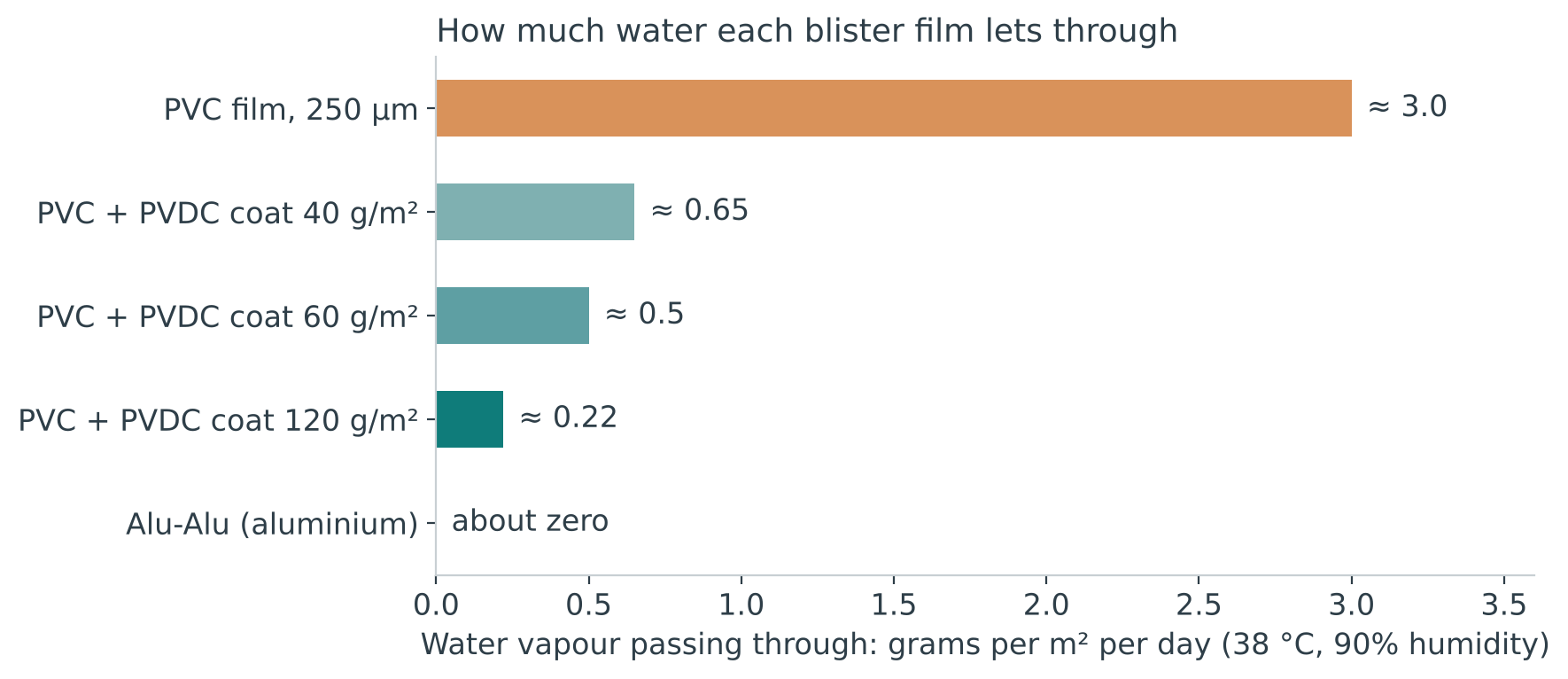
Read the chart from top to bottom and the logic is clear. Plain PVC film lets through roughly 3 grams a day. Adding a PVDC coating of 40 g/m² cuts that to about 0.65; heavier coatings of 60 and 120 g/m² bring it to about 0.5 and 0.22 [1, 2]. Cold-formed aluminium (Alu-Alu) lets through almost nothing [2].
There is a big step between plain PVC and the first PVDC coating, and many products sit comfortably on that middle rung. The question is not “which film is best?” but “which is the lowest rung my product survives on?” Only your stability data can answer that.
What Alu-Alu really costs
Alu-Alu packs are made by stretching a nylon–aluminium–plastic laminate in a cold press. Aluminium does not stretch like heated PVC, so the pockets have to be shallower with sloping walls, and they sit further apart [5]. The result is a bigger card for the same number of tablets.
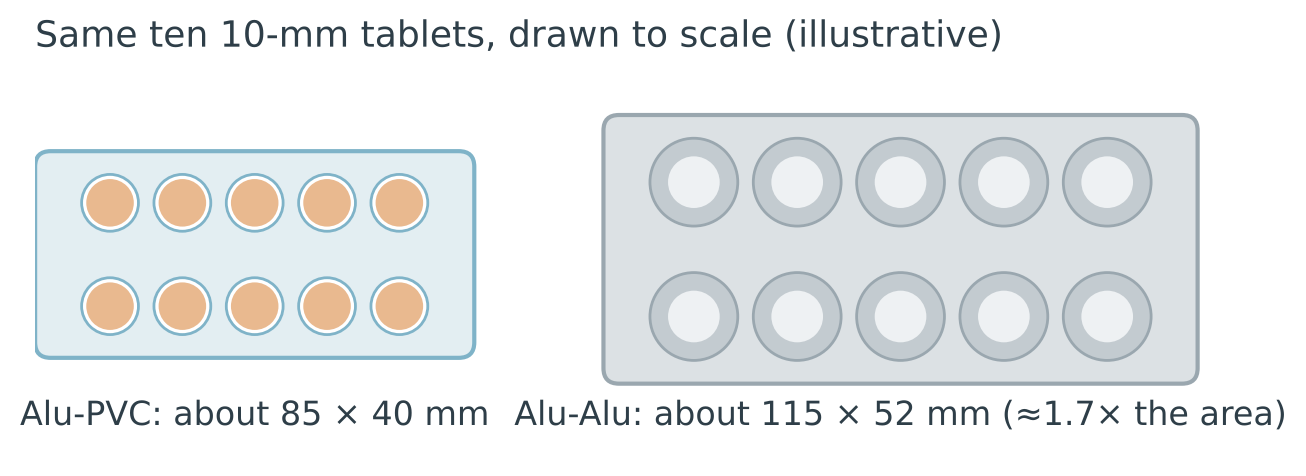
In our illustration the Alu-Alu card needs about 1.7 times the area. That knock-on effect runs through the whole pack: more laminate per tablet, a bigger carton, fewer cartons per shipper, new forming tools and often a slower line. The pack is also opaque, so patients and pharmacists can no longer see the tablet.
None of this makes Alu-Alu wrong. For a highly moisture-sensitive or light-sensitive product it is often the only sensible choice. The point is to choose it because the data demands it, not out of habit.
Size the cavity from the dose, not from the label
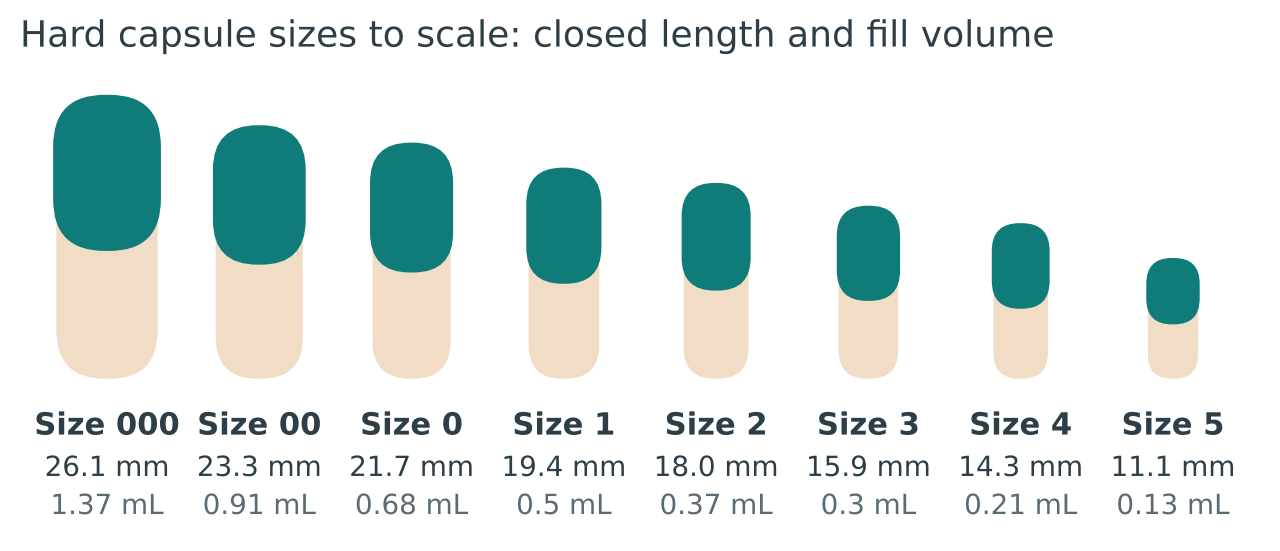
A blister pocket is designed around the real dimensions of the tablet or capsule (length, width and thickness measured across several batches) plus a small clearance agreed with the tooling maker. Too tight, and tablets chip; too loose, and they rattle and waste film. The milligram strength printed on the label tells you nothing about size.
Capsules make this easy to see. The standard sizes are fixed, so the pocket follows the size number.
Strips, bottles and sachets
- Strip packs seal each dose between two soft aluminium foils. They give a high barrier and are widely used in India, where medicines are often sold strip by strip.
- Bottles made of HDPE (high-density polyethylene) suit larger counts and export markets. The barrier comes from the whole system: bottle wall, induction-sealed foil liner, cap and, where needed, a desiccant (moisture-absorbing) canister.
- Sachets and stick packs for powders depend on the laminate. A layer of real aluminium foil gives a far better barrier than a thin metallised film. For probiotics, live bacteria that lose viability with moisture and oxygen, foil laminates, good seals and checks of live counts through shelf life matter more than any other choice.
A four-question rule for solid doses
- Is it a powder, granule or live culture? Consider a foil sachet or a bottle with desiccant.
- Does it stay stable at 30 °C and 75% humidity in plain PVC? Use Alu-PVC: the lowest-cost option.
- If not, does it pass in PVC with a PVDC coating? Choose the lightest coating that passes.
- If not, or if it is also sensitive to light or oxygen, move to Alu-Alu or a strip pack.
References
- Solvay. Diofan® PVDC for thermoformed and blister packaging (technical brochure). (accessed 28 October 2026) Link
- Jinlu Packing. PVC vs PVDC in pharmaceutical packaging. (accessed 28 October 2026) Link
- Medisca. Coni-Snap® capsule sizes chart. (accessed 28 October 2026) Link
- Pharmaguideline. Climatic zones for stability studies (ICH Q1A(R2) conditions). (accessed 28 October 2026) Link
- Jinlu Packing. What is Alu-Alu blister packaging? (accessed 28 October 2026) Link
Disclaimer
This article is for general information and education. It is not legal, regulatory or engineering advice. Figures marked “illustrative” come from simple planning models built by the Aesclebio Research Team, not from supplier quotations; prices change with raw-material costs, order size and specification. Always confirm material choices with your own stability data, and confirm rules against the current official text before acting.