
Nutraceuticals · Nutrient Interactions
Three nutrient interactions everybody designs around, and what the long studies found
The calcium-and-iron warning is the most repeated formulation rule in this industry. Across a one-year trial, a four-year study and a pooled analysis of randomised trials, haemoglobin did not fall. Here is what that does and does not mean.
Nutrient interactions are real, and two of them belong in a formulation specification. But a long tail of them have become received wisdom on the strength of single-meal absorption studies, and single-meal absorption studies answer a narrower question than the one a formulator is actually asking.
The question is not whether absorption from one meal falls. It is whether the person ends up worse off. Those are different questions and they do not always have the same answer.
Calcium and iron: real, small, and it does not reach the blood count
This is the best-studied of the three, and the evidence runs in two directions at once.
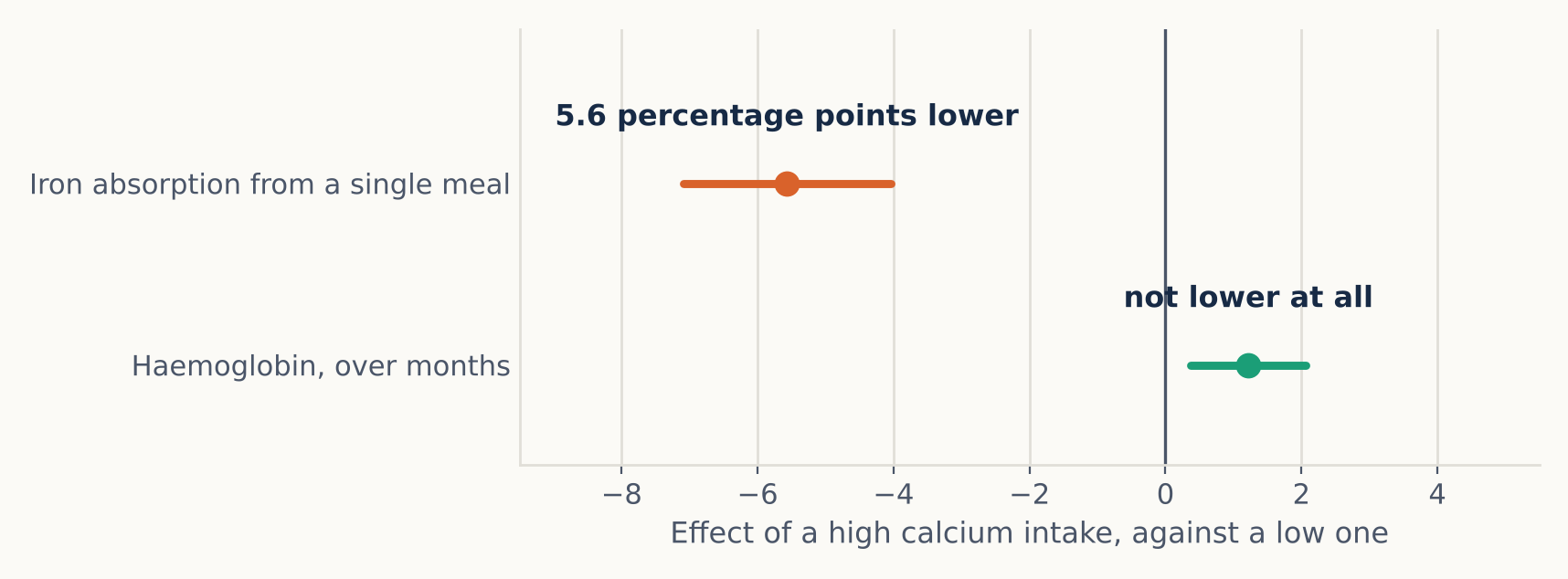
The acute effect is real. Comparing the highest calcium intakes against the lowest, iron absorption from a single meal fell by 5.57 percentage points. That is statistically solid and the analysis describes the magnitude as low.
The haemoglobin result is the one that matters commercially. Pooled across the same studies, haemoglobin was not lower on high calcium intakes. If anything it was fractionally higher, by 1.22 grams per litre, with a confidence interval that sits entirely above zero.
That is not a single surprising finding. It is what the long studies consistently show.
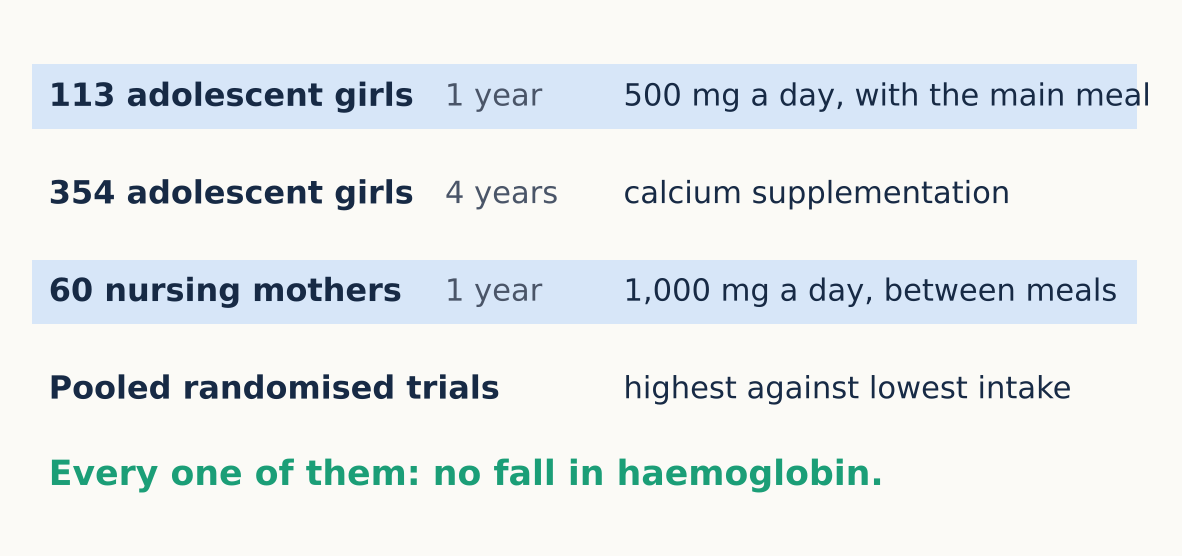
A one-year randomised, double-blind, placebo-controlled trial gave 113 adolescent girls 500 milligrams of calcium a day with their main meal (deliberately, at the worst possible moment) and found no effect on haemoglobin, ferritin or transferrin receptors. A four-year study in 354 adolescent girls found no effect on iron stores or anaemia indices. A twelve-month trial in sixty nursing mothers in rural Gambia, a population at real risk of both deficiencies, found no difference in ferritin.
The honest qualification
One result does not fit the clean story, and leaving it out would be the same sin this article is about.
In the pooled analysis, higher calcium intake was associated with lower serum ferritin, and that association was statistically strong. Ferritin is a measure of iron stores, so something is moving even though the blood count is not. The authors are careful about it: ferritin is also an inflammation marker, which makes it an unreliable iron biomarker, and they state that the existing body of studies is not sufficient for high-confidence recommendations.
Note the words ‘free-living’. That is the crux. In a trial, everyone takes what they are told, when they are told. In a shop, a consumer told to take two products at two different times of day often ends up taking one of them, or neither. The absorption gained by separating them has to be weighed against the doses lost to the complexity of the instruction, and on the published evidence, that trade is not obviously worth making.
Why the single-meal studies and the long studies disagree
This is not a case of some studies being wrong. Both sets of measurements are correct; they are measuring different things, and the body is doing something in between.
The leading explanation is adaptation. When absorption of a mineral is impeded at one meal, the gut up-regulates its uptake machinery and recovers much of the shortfall at subsequent meals, particularly in people whose stores are low, which is precisely the population an iron product is sold to. A review of the long-term human studies put it plainly: the inhibitory effect may be of short duration, and there may be compensatory mechanisms.
There is a second reason, which is about how much calcium is needed to do anything. The acute inhibition appears to be dose-related only up to around 300 milligrams of calcium, after which more calcium does not inhibit more iron. So the difference between a small calcium dose and a large one at the same meal is much less than people assume, and the worst case is not as bad as the warning implies.
Neither of these is a reason to put iron and calcium in the same tablet. Where it is free to separate them, separate them. The argument here is narrower and concerns what to tell the consumer: a formulation decision costs nothing to implement, while a dosing instruction costs adherence every day for the life of the course.
Calcium and zinc: inconsistent, and probably small
The same Gambian trial answers this one in passing. Those sixty women took 1,000 milligrams of calcium daily, five days a week, for a year. Plasma zinc did not differ at any point, in women at genuine risk of zinc deficiency.
The single-meal studies on calcium and zinc are inconsistent, and the long-term evidence that exists points at a small effect or none. This is not a reason to build a formulation rule.
Folic acid and zinc: the one that is genuinely open
This is usually presented as settled, and it is not. The evidence points in both directions and the honest answer is that nobody knows.
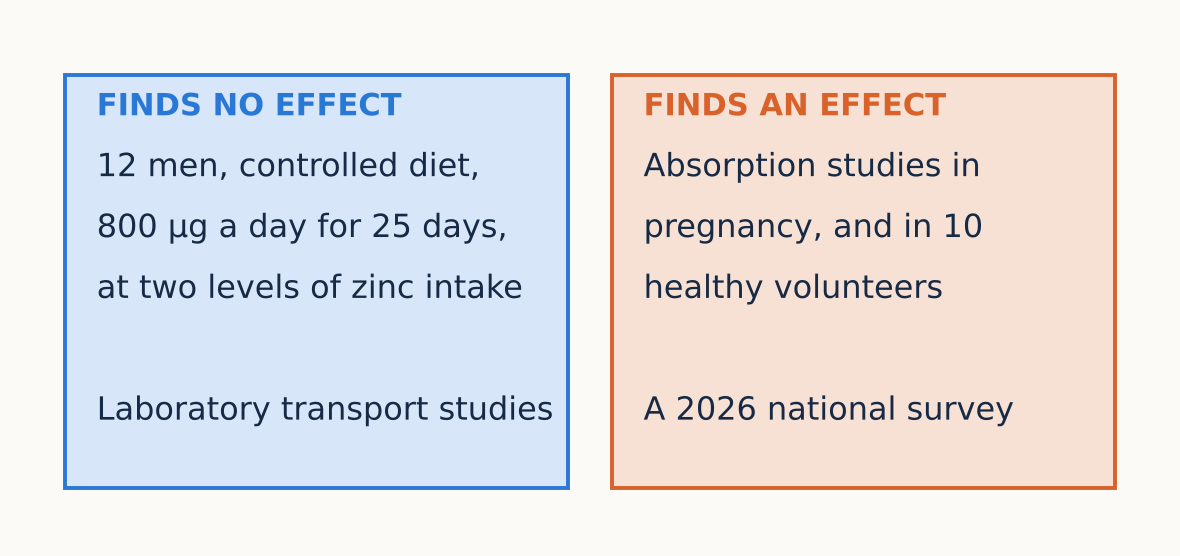
The strongest study on the no-effect side is a controlled metabolic one: twelve men ate a diet containing either 3.5 or 14.5 milligrams of zinc a day for two 25-day periods, taking 800 micrograms of labelled folic acid or a placebo. No difference appeared in plasma zinc, red cell zinc, urinary zinc, metallothionein or alkaline phosphatase, at either level of zinc intake. That is a well-designed study and it found nothing.
Against it: absorption studies in pregnancy found zinc uptake reduced after two weeks of iron-and-folate supplements, and reduced by folate alone in ten healthy volunteers. And a 2026 analysis of national survey data concluded that folic acid supplementation attenuates blood zinc concentration across a whole population.
What to do with that. It is not a reason to separate folate and zinc in a formulation: the controlled study that was designed to detect the effect did not find it. It is also not something to state flatly in either direction, because the next study may well move it. An honest formulation file says: considered, evidence mixed, no action taken, reviewed annually.
What the market worries about, and what actually decides the outcome
There is a reason all three of these feel more important than they are. They are visible. They involve two products, two tablets, a rule a company can follow and advertise.
The thing that actually governs iron status in India is none of them.
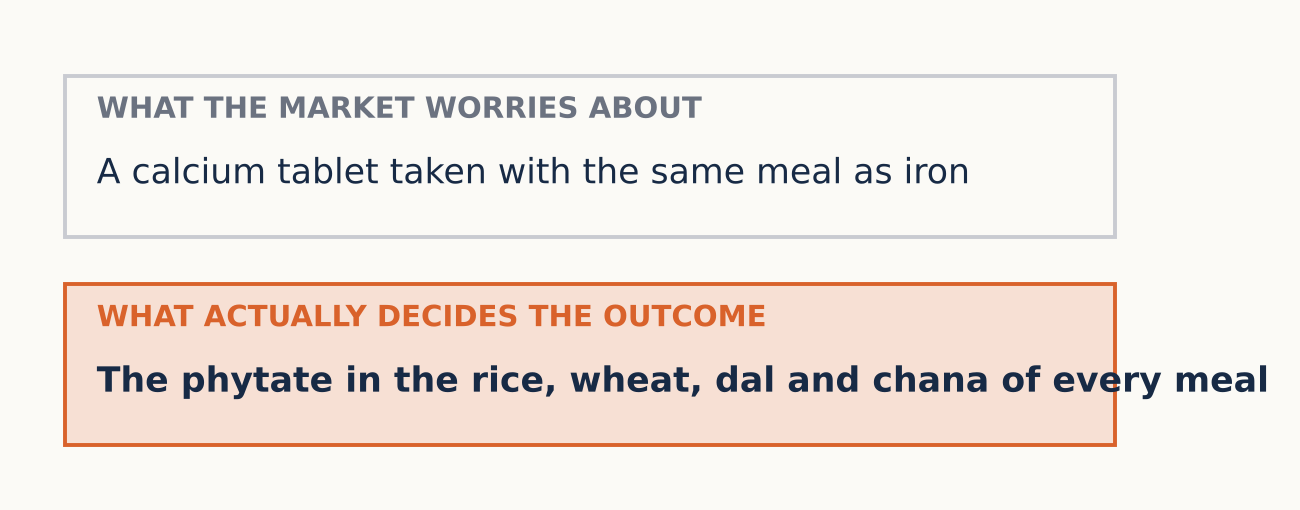
Phytate is present in every cereal and pulse in the Indian diet (rice, wheat, dal, chana) and it binds non-haem iron and zinc substantially. It is not really an interaction so much as the background condition against which every iron product in this country has to work. A calcium tablet at the same meal is a rounding error beside it.
The mitigations are soaking, sprouting and fermenting, and they belong in consumer education rather than in a formulation, because no capsule can change what is in the dal. That makes them unglamorous and, for the same reason, unoccupied: almost nobody in this market is saying it, and it happens to be both true and useful.
There is one more reason to be careful with all three of these, and it is about credibility rather than chemistry. A sales team that warns a pharmacist about calcium and iron, and is then asked what the long-term trials showed, has a bad afternoon. The interactions worth raising are the ones that survive the follow-up question, and the three in this article mostly do not.
Four conclusions
- Keep iron and calcium in separate tablets if it is free to do so. Do not build marketing around the fear, and do not add a dosing instruction whose compliance cost may exceed its benefit.
- Drop the calcium-and-zinc rule. A year of 1,000 milligrams a day did not move plasma zinc.
- Leave folate and zinc together, and describe the evidence as open rather than settled, because it is.
- Spend the attention on phytate instead. It is the larger effect by a wide margin, nobody is talking about it, and it can be explained in a sentence.
The general rule underneath all four: when a single-meal absorption study and a one-year outcome study disagree, the outcome study is the one that describes what happens to a customer.
Sources
- Abioye AI, Okuneye TA, Odesanya AO, Adisa O, Abioye AI, Soipe AI, Ismail KA, Yang JF, Fasehun LK, Omotayo MO. Calcium intake and iron status in human studies: a systematic review and dose-response meta-analysis of randomized trials and crossover studies. Journal of Nutrition 2021;151(5):1084–1101.
- Lönnerdal B. Calcium and iron absorption: mechanisms and public health relevance. International Journal for Vitamin and Nutrition Research 2010;80(4–5):293–299.
- Mølgaard C, Kaestel P, Michaelsen KF. Long-term calcium supplementation does not affect the iron status of 12–14-year-old girls. American Journal of Clinical Nutrition 2005;82(1):98–102.
- Ilich JZ, McKenna AA, Skugor M, et al. Effects of long-term calcium supplementation on iron status in adolescent females. Journal of the American Dietetic Association 1997.
- Yan L, Prentice A, Dibba B, et al. The effect of long-term calcium supplementation on indices of iron, zinc and magnesium status in lactating Gambian women. British Journal of Nutrition 1996;76(6):821–831.
- Kauwell GPA, Bailey LB, Gregory JF, et al. Zinc status is not adversely affected by folic acid supplementation and zinc intake does not impair folate utilization in human subjects. Journal of Nutrition 1995;125(1):66–72.
- Simmer K, Lies C, James C, Thompson RPH. Are iron-folate supplements harmful? American Journal of Clinical Nutrition 1987;45(1):122–125.
- Chen Y, Nichols AR, et al. Folic acid supplementation attenuates serum zinc concentration and its association with dietary zinc intake: NHANES 2011–2016. Current Developments in Nutrition 2026.
- Sandström B. Micronutrient interactions: effects on absorption and bioavailability. British Journal of Nutrition 2001;85(Suppl 2):S181–S185.
Disclaimer
This article is written for formulators, manufacturers and informed readers. It is a summary of published research and is not medical advice, a diagnosis or a treatment recommendation. Anaemia and nutrient deficiencies require medical diagnosis and management, and no one should start, stop or change a prescribed treatment on the basis of this article. Nothing here is a claim for any product, and no brand is named. Product composition and labelling must comply with the Food Safety and Standards Authority of India regulations applicable at the time of manufacture.