
Nutraceuticals · Botanical Safety
Five ceilings that bind, and four ingredients to take off the range
Botanical safety is not a generic caution. It is a short list of specific, dose-related limits that a formulator has to know, and a shorter list of ingredients where the evidence runs against the claim they are sold on.
Most writing about herbal safety is either dismissive or alarmist, and neither is useful at a formulation bench. What a formulator actually needs is a small number of numbers: where the ceiling is, what happens above it, and which ingredients fail badly enough that no dose fixes them.
The five ceilings
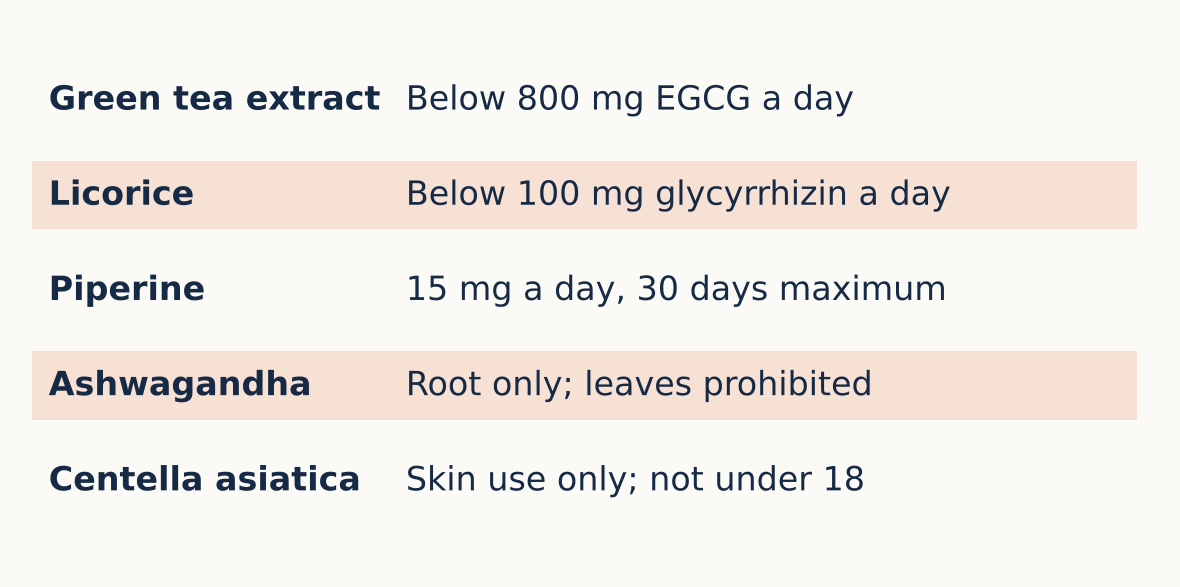
Each of these has a specific consequence, and three of them are easy to breach without noticing.
Green tea extract. The European Food Safety Authority identified a liver signal above 800 milligrams a day of EGCG (epigallocatechin gallate, the main active catechin in green tea) taken as a supplement, based on measurable rises in liver enzymes. The European Union then regulated it: a daily portion must contain less than 800 milligrams, the label must say the figure is not to be exceeded, and there must be warnings for under-18s and for pregnant and breastfeeding women, plus an instruction not to take it on an empty stomach. Green tea as a drink was not implicated, at typical intakes of 90 to 300 milligrams a day.
Licorice. Pooling eighteen studies in 337 people, products containing 100 milligrams or more of glycyrrhizin a day raised systolic blood pressure by 5.45 millimetres of mercury and lowered blood potassium. The effect tracked the dose. Use deglycyrrhizinated licorice, or cap the dose and say so on the pack. One export note: a gummy is legally confectionery, which brings the European liquorice labelling thresholds into play directly.
Piperine. Schedule VI Part A caps it at 15 milligrams a day with a stated maximum duration of use of thirty days, and that duration condition has to appear on the label. A thirty-day ceiling is fundamentally incompatible with a product the consumer is meant to take every day. Piperine also inhibits two of the main routes by which the body clears medicines, which is a real liability in a market where many consumers take several prescriptions at once.
The fourth is Centella asiatica, where the European monograph covers skin use only and states it is not recommended under eighteen. It has no business in a children's oral product. The fifth is ashwagandha, which needs a section of its own.
Ashwagandha: a moving regulatory target
The United States National Institutes of Health rate ashwagandha a likely cause of clinically apparent liver injury, with around twenty-three published cases. The pattern is worth knowing precisely, because it is not the pattern people assume: injury appears two to twelve weeks after starting, it is usually cholestatic or mixed (jaundice and itching rather than a silent enzyme rise), and the jaundice is often prolonged but ultimately resolves completely. The rare deaths and emergency transplants occurred mainly in people who already had liver disease.
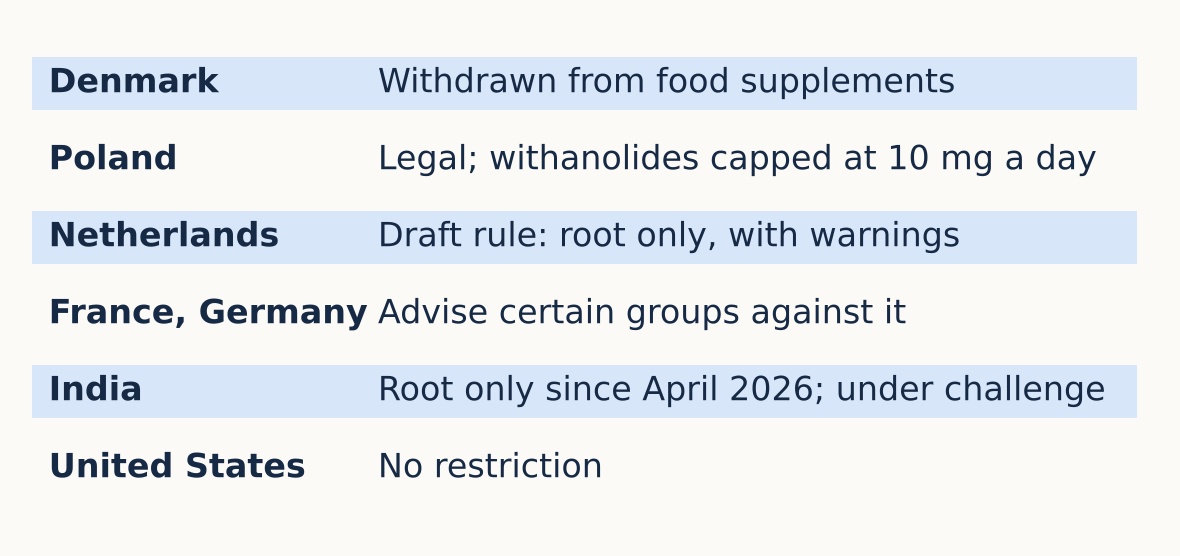
India's own position changed in April 2026, when the Ministry of Ayush directed that only the root may be used and prohibited leaves in any form, with the plant part to be declared on the label. The stated reason was the higher concentration of reactive withanolides, withaferin A in particular, in the leaf.
That position is not settled. In May 2026 the Karnataka High Court granted an interim stay to the eight companies that petitioned against it. Other companies remain bound, and no final ruling had been issued as this was written. Anyone formulating with ashwagandha should check the current position rather than rely on any summary of it, including this one.
Two practical consequences hold regardless of how the litigation ends. Specify root, and test for it. And keep ashwagandha out of children's products: France advises that minors avoid it, and the Netherlands has a draft rule requiring warnings for pregnancy, breastfeeding, liver and thyroid conditions.
There is a separate quality problem underneath the regulatory one. An American university study funded by two federal agencies tested twenty-five ashwagandha supplements bought online in 2025 and found that forty-four per cent failed both the British and the United States pharmacopoeia standards. That is not a regulatory risk. That is a product that cannot work.
Two liver signals, two different mechanisms
It is worth setting ashwagandha beside the other Indian botanical with a documented liver signal, because the two are nothing alike and the difference has a commercial moral.
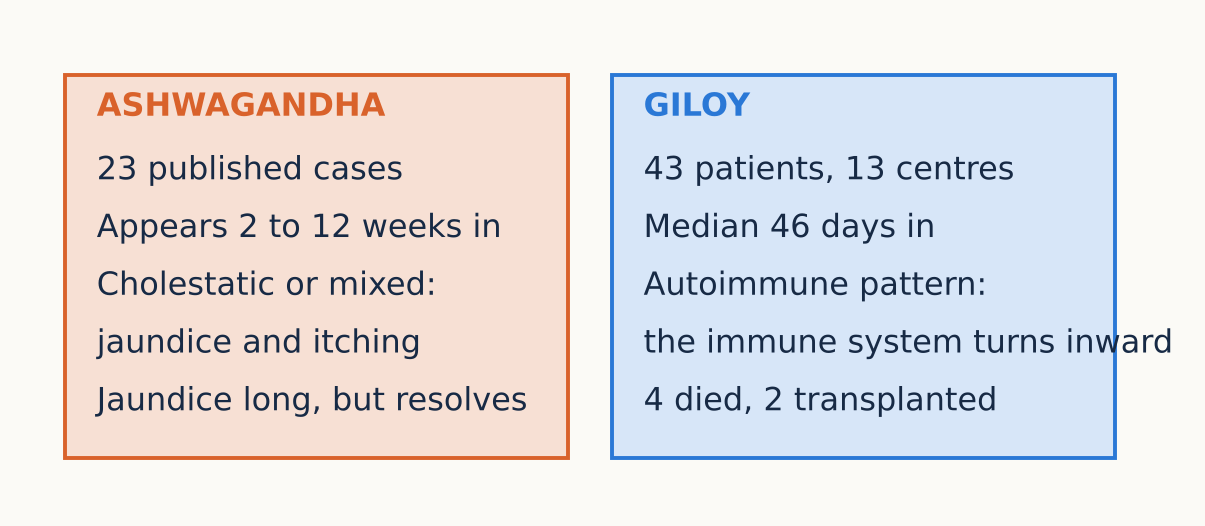
Giloy's mechanism is the uncomfortable part. The herb appears to stimulate the immune system, and in susceptible people that is what causes the harm: an autoimmune-pattern hepatitis, or the unmasking of a quiet autoimmune liver disease the person did not know they had. The property being sold and the property causing the injury are the same property. That is a difficult thing to design around.
Four to take off a range, not merely to dose better
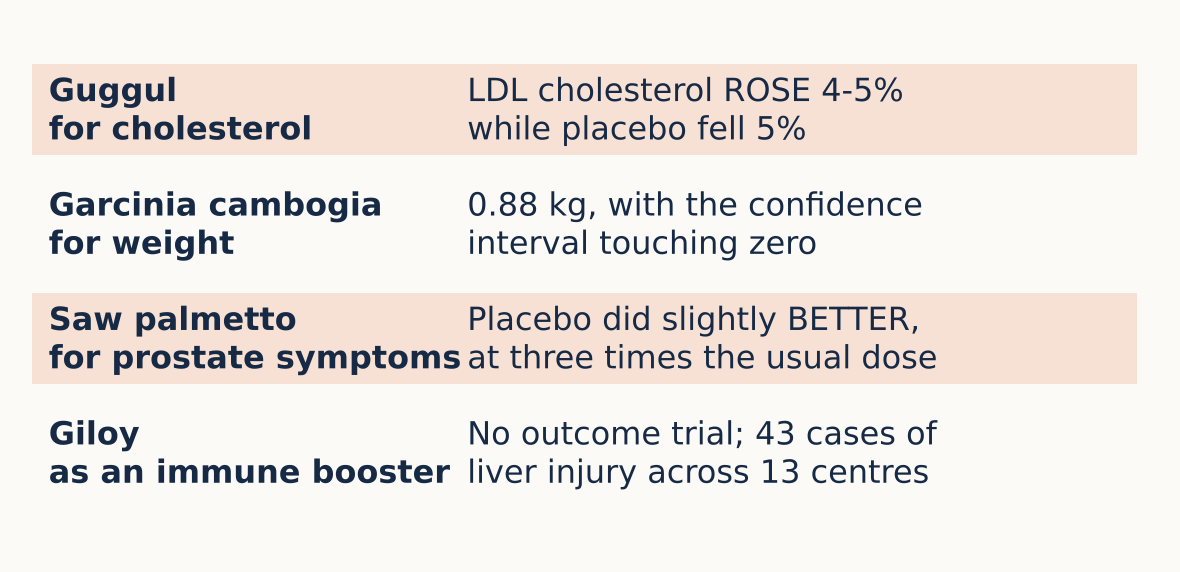
Each of these deserves a sentence, because the detail is what makes the case.
Guggul. In a randomised trial of 103 adults published in JAMA, participants on placebo saw LDL cholesterol (low-density lipoprotein, the kind usually called 'bad' cholesterol) fall by five per cent, while both guggul doses saw it rise by four and five per cent: a net difference of nine to ten points in the wrong direction. Six of the sixty-seven people taking guggul developed a hypersensitivity rash; none on placebo did.
Garcinia cambogia. Pooling nine trials gives a weight difference of 0.88 kilograms, with a confidence interval whose upper bound touches exactly zero. The authors describe the clinical relevance as uncertain. Set against documented cases of drug-induced liver injury, that is not a favourable trade.
Saw palmetto. A trial of 369 men escalated to three times the standard dose over seventy-two weeks. Symptom scores improved by 2.20 points on saw palmetto and 2.99 on placebo, so placebo did slightly better, at a third of the dose. It is also not listed by the Food Authority in any case.
Giloy. No outcome trial exists for the immunity claim it is sold on. Against that, forty-three patients across thirteen Indian centres presented with liver injury after taking it; four died and two received transplants. The Ministry of Ayush has publicly disputed the link, and an Ayurvedic rebuttal argues the plants consumed were probably a related species traded under the same name. That rebuttal is an argument for botanical authentication, not a clean bill of health, and the study's own sample analysis found heavy metals above limits in two of six formulations, including a state-pharmacy powder carrying lead at more than five times the turmeric limit.
Putting a ceiling onto a label without frightening anybody
A duration condition or a warning is often treated as a marketing problem to be minimised. It reads better as a specification the consumer is entitled to, and it can be written that way.
- A duration limit works best stated as a cycle rather than a restriction: a thirty-day course with a stated reason reads as design, where “do not exceed 30 days” reads as a hazard warning.
- A marker content on the pack is the only way a consumer or a customs officer can check a foreign limit. Printing it costs nothing and pre-empts the question.
- Plant part belongs on the label for every botanical, not only the ones where it is now compulsory. It is the cheapest authenticity claim available, and it is verifiable.
- Where a European or American rule requires a warning that India does not, carrying it anyway costs a line of print and makes the same pack exportable.
The underlying point is that these ceilings are mostly not about toxicity at ordinary doses. They are about the small number of people who will take more than intended, or who have a condition nobody knows about. A label that tells those people what to do is doing the job the ceiling exists for.
The pattern across all four
The four ingredients to drop have something in common that is easy to miss. In each case the trial that found nothing was large, independent and well-conducted: 103 people for guggul, 369 for saw palmetto, nine pooled trials for garcinia, forty-three documented liver injuries for giloy. These are not cases where the evidence is thin and might improve. They are cases where somebody looked properly and found the opposite of the claim.
That distinction is worth holding onto, because it separates two very different commercial situations. An ingredient with weak evidence may be worth carrying on a traditional-use positioning, honestly made. An ingredient with good evidence against it cannot be rescued by a careful claim, and carrying it means carrying the day somebody quotes the trial back at you.
The useful way to think about all of this
A ceiling is a design parameter, not a warning label. Knowing that green tea extract has to sit below 800 milligrams of EGCG, or that piperine brings a thirty-day duration condition with it, changes what you formulate before you have spent anything. Finding out afterwards changes what you have to withdraw.
And the four to drop are not marginal calls. In each case there is a well-conducted trial, and in each case it found either nothing or the opposite of the claim. Carrying them is not a risk the evidence is undecided about.
Sources
- LiverTox: Clinical and Research Information on Drug-Induced Liver Injury. Ashwagandha. Bethesda: National Institute of Diabetes and Digestive and Kidney Diseases. (Likelihood score B.)
- Ministry of Ayush letter dated 15 April 2026 and Food Safety and Standards Authority of India advisory dated 16 April 2026, restricting Withania somnifera to root and prohibiting leaf, citing Schedule IV. Interim stay granted by the Karnataka High Court on 12 May 2026 to the petitioning companies.
- Penninkilampi R, Eslick EM, Eslick GD. The association between consistent licorice ingestion, hypertension and hypokalaemia: a systematic review and meta-analysis. Journal of Human Hypertension 2017;31(11):699–707.
- European Food Safety Authority ANS Panel. Scientific opinion on the safety of green tea catechins. EFSA Journal 2018;16(4):5239; and Commission Regulation (EU) 2022/2340.
- European Medicines Agency. Community herbal monograph on Centella asiatica (L.) Urban, herba.
- Szapary PO, Wolfe ML, Bloedon LT, et al. Guggulipid for the treatment of hypercholesterolemia: a randomized controlled trial. JAMA 2003;290(6):765–772.
- Onakpoya I, Hung SK, Perry R, Wider B, Ernst E. The use of Garcinia extract (hydroxycitric acid) as a weight loss supplement: a systematic review and meta-analysis of randomised clinical trials. Journal of Obesity 2011;2011:509038.
- Barry MJ, Meleth S, Lee JY, et al. Effect of increasing doses of saw palmetto extract on lower urinary tract symptoms: a randomized trial. JAMA 2011;306(12):1344–1351.
- Kulkarni AV, Hanchanale P, Prakash V, et al. Tinospora cordifolia (Giloy)-induced liver injury during the COVID-19 pandemic: multicenter nationwide study from India. Hepatology Communications 2022;6(6):1289–1300.
- Andrade RJ, Aithal GP, de Boer YS, et al. Nomenclature, diagnosis and management of drug-induced autoimmune-like hepatitis: an expert opinion meeting report. Journal of Hepatology 2023;79(3):853–866.
- Food Safety and Standards (Health Supplements, Nutraceuticals…) Regulations, 2016, Schedule VI Part A.
Disclaimer
This article is written for formulators, manufacturers and informed readers. It is a summary of published research and regulation and is not legal advice, medical advice, a diagnosis or a treatment recommendation. Liver disease, high blood pressure, prostate symptoms and raised cholesterol all require medical diagnosis and management, and no one should start, stop or change a prescribed treatment, or any supplement, on the basis of this article; anyone with symptoms should seek medical advice. The regulatory positions described here are moving and at least one is before the courts. Nothing here is a claim for any product, and no brand is named. Product composition and labelling must comply with the Food Safety and Standards Authority of India regulations applicable at the time of manufacture, and every schedule entry, directive and foreign limit referred to here should be verified against the current official text before it is relied on.