
Regulatory · Botanical Extracts
The two numbers on a botanical label, and why they are not the same thing
Extract ratio and standardisation percentage get used almost interchangeably. One of them tells you how much herb went in. The other tells you whether the product will do anything. Only the second one is worth buying on.
Herbals are the one category where India has an advantage no imported brand can manufacture: a real tradition, a domestic supply chain, and consumer trust that was not bought. It is also the category where the gap between what is claimed and what is evidenced is widest. Most of that gap opens up before anyone discusses efficacy at all: at the point where somebody reads a specification and misunderstands it.
Two numbers appear on almost every botanical extract specification. They are routinely confused with each other, and the confusion costs money in both directions: products that are reported to regulators as under-dosed when they are not, and products bought at a good price that cannot work.
The first number: the extract ratio
An extract ratio tells you how concentrated the material is, and nothing else. A 10:1 extract means ten kilograms of dried herb produced one kilogram of extract. So 300 milligrams of a 10:1 extract corresponds to three grams of the raw herb.
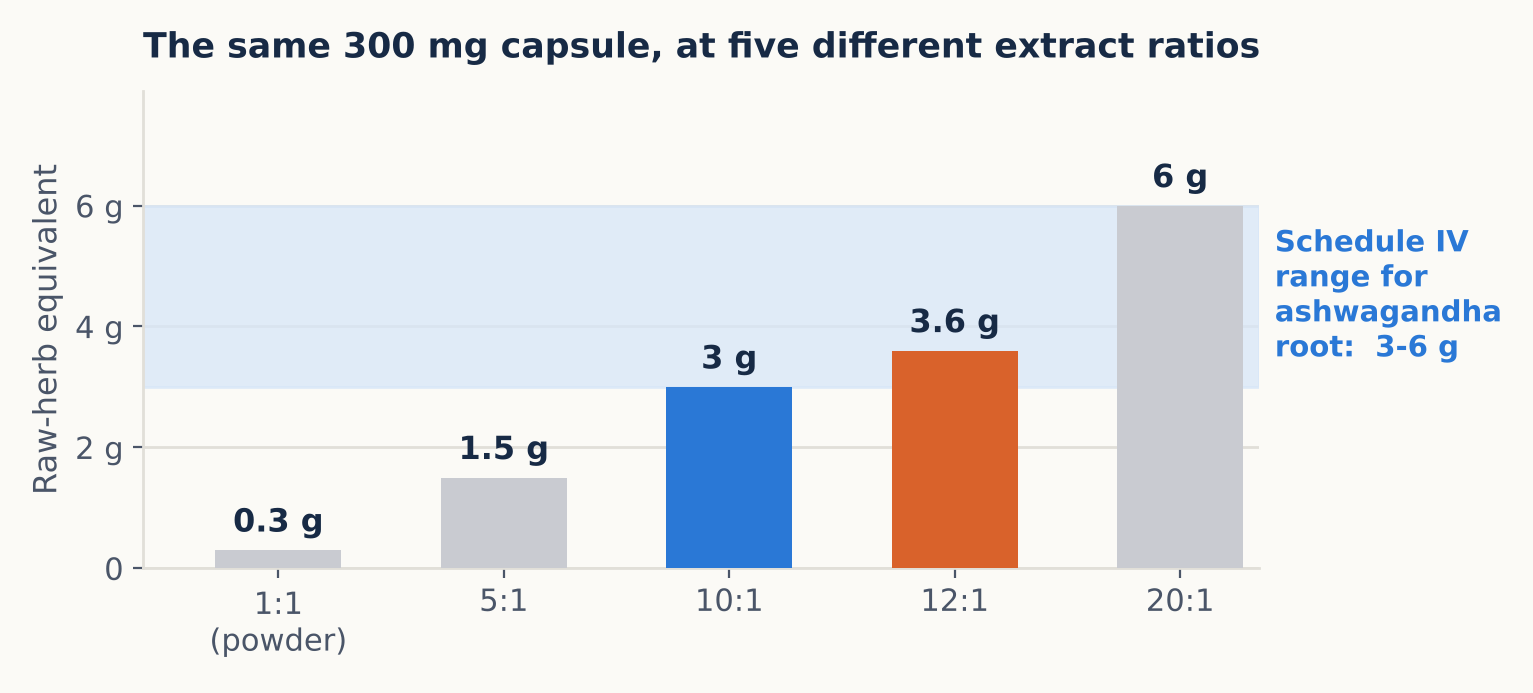
This is why an extract dose and a powder dose are never directly comparable, and it is why comparing a 300 milligram extract against a schedule range written in grams of raw herb produces a false alarm. The product is not under-dosed by a factor of ten. It is concentrated by a factor of ten.
A compliance point that works in your favour
India's Food Safety and Standards Authority has addressed this directly. Its own list of frequently asked questions states that where an extract is used, the quantity of extract shall be adjusted based on the extractive value of the extract obtainable from the minimum and maximum levels of the raw botanical specified in Schedule IV.
In plain terms: an extract is compared against the raw-herb range, not against some separate extract figure. A 300 milligram dose of a 12:1 ashwagandha extract is about 3.6 grams of root-equivalent, which sits comfortably inside the Schedule IV range of three to six grams. Products that look under-dosed against the schedule are often fully compliant once the extractive value is applied, but the specification has to record the calculation, because nobody will do it for you during an inspection.
The second number, and the one that decides whether it works
A standardisation percentage tells you something more useful: how much of the active compound is actually present. This is the number that varies, and it varies a great deal.
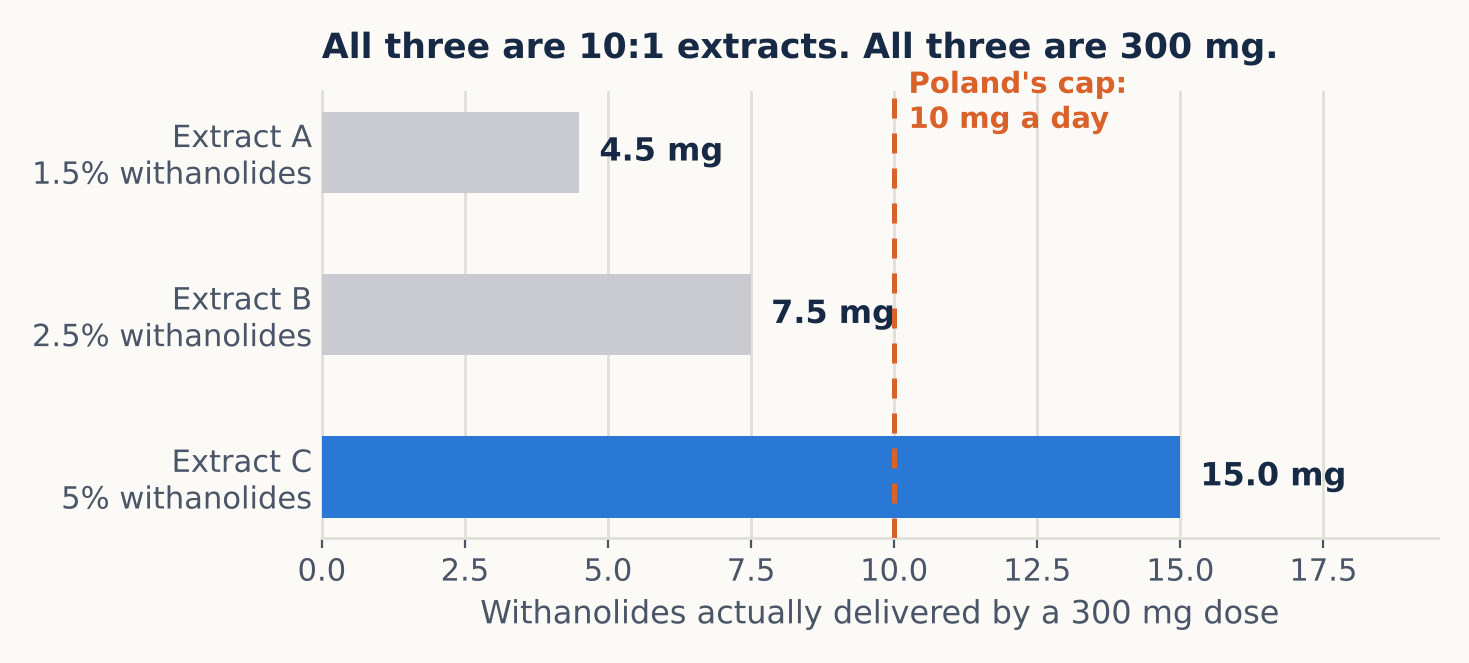
Two ashwagandha extracts can both be honestly described as 10:1 and differ several-fold in withanolide content, depending on the plant material, the season, the solvent and the part of the plant used. The ratio is a statement about process. The percentage is a statement about content. Only one of them is a specification you can test a delivered batch against.
There is a second reason to care, which is that other countries regulate the marker rather than the herb. Poland permits ashwagandha but caps withanolides at ten milligrams a day and requires the content to be declared on the label. A 300 milligram extract standardised to five per cent withanolides delivers fifteen milligrams, so a product that is unremarkable in India is non-compliant there, and you will only know by reading your own certificate of analysis.
What to buy to
For the botanicals worth carrying at all, there is an established marker and an established minimum. These should appear in the purchase specification, on the certificate of analysis, and ideally on the label.
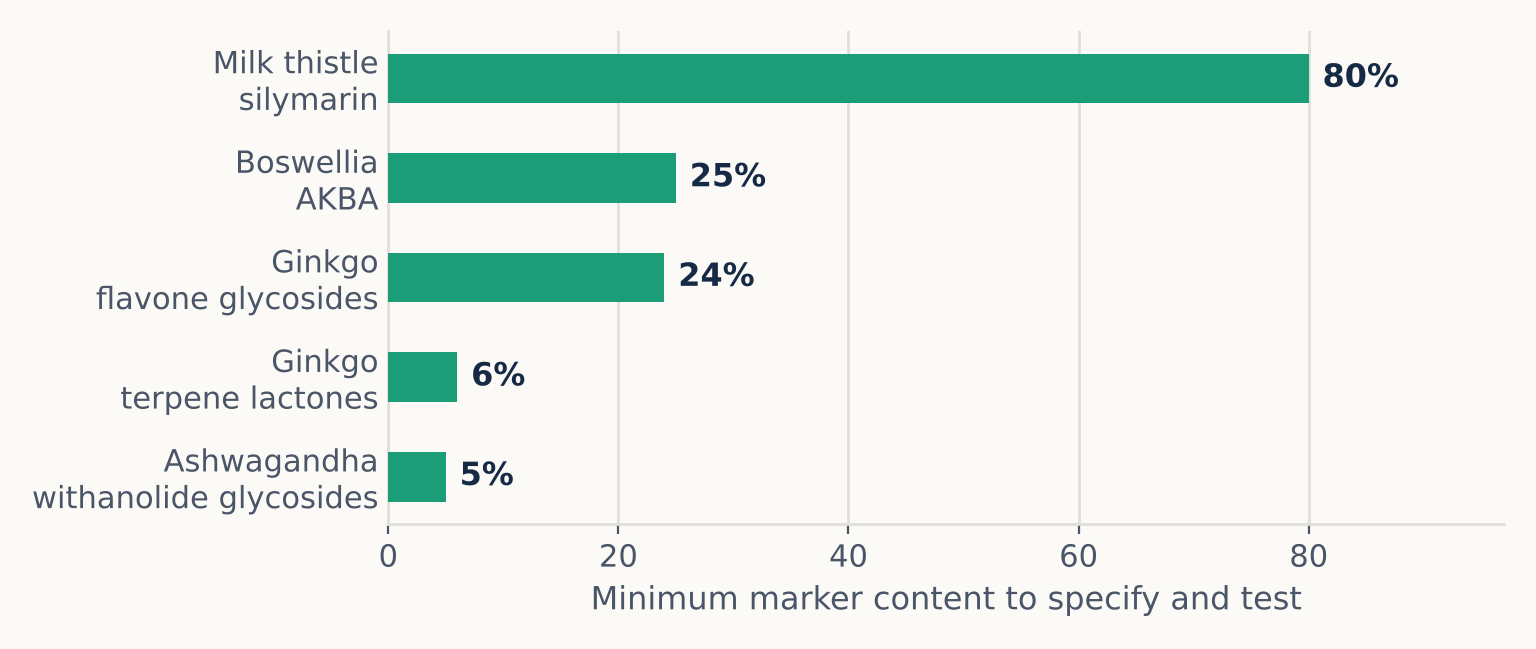
The discipline this imposes is useful beyond compliance. Once a buyer is specifying marker content rather than extract ratio, the price comparison between two offers becomes meaningful for the first time, because the two offers are finally being compared on the same thing.
What the percentage does not tell you
Standardising to a marker is a large improvement on not standardising. It is not the same as standardising to activity, and the difference occasionally matters.
A marker is a compound chosen because it is characteristic of the plant, reliably measurable, and plausibly related to the effect. For some botanicals that relationship is well established. For others the marker is mostly an identity check that happens to be quantitative. Two extracts matching on a marker can still differ in everything else the plant contains, and whole-extract preparations sometimes outperform the isolated marker in trials, which is a hint that the marker is not the whole story.
The practical consequence is narrow and worth stating. Specify the marker, because it is testable and because regulators and customers abroad ask for it. But where a clinical trial used a particular extract made by a particular process, match the process too (solvent, plant part, ratio) rather than assuming that any extract hitting the same percentage is the same material. This is the single most common way a company ends up with a compliant product that does not reproduce the result it was designed around.
What this does to a price comparison
There is a commercial argument for all of this that has nothing to do with compliance, and in most companies it is the argument that actually moves the decision.
Two quotations arrive for a 10:1 ashwagandha extract. One is materially cheaper. Without a marker specification there is no way to tell whether the difference reflects efficiency, scale, or simply less active material per kilogram, and the cheaper offer wins by default, because price is the only number being compared.
Once both are specified to a minimum withanolide content, the comparison becomes a cost per milligram of marker rather than a cost per kilogram of powder. Sometimes the cheaper material is still cheaper on that basis, which is useful to know. Often it is not, and the apparent saving was a dilution that would have been passed on to the consumer as a product that does nothing.
The same logic decides how much extract goes into the capsule. If the trials that support an ingredient used a given quantity of marker compound, that quantity, not the weight of extract, is the thing the formulation has to deliver. A 300 milligram capsule is a package size. It is not a dose.
A ceiling, not a floor
One more point, stated precisely because it is commercially consequential and widely misunderstood.
The operative regulation says only that usage shall not exceed the Schedule IV levels. That is a ceiling. The idea that both ends of the range are mandatory, that a product must deliver at least the minimum, comes from the Food Authority's list of frequently asked questions, which is guidance rather than law.
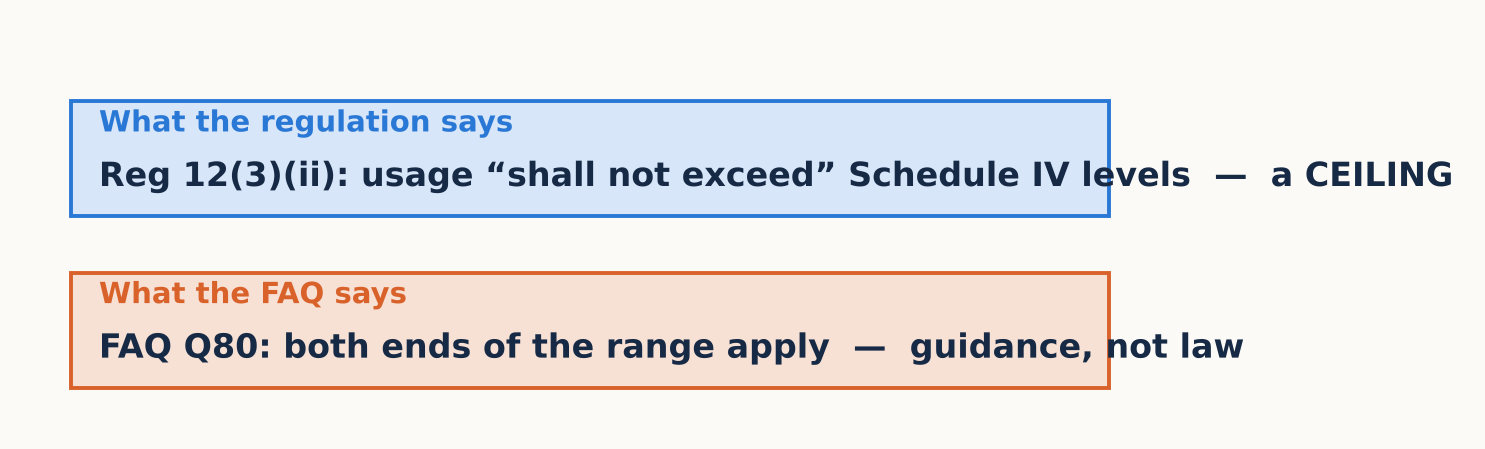
The practical reading is this. Under-dosing a botanical against the schedule is a substantiation risk rather than a demonstrated illegality, but it is the first question an inspector or a retailer's technical team will ask, and the answer should be ready before it is asked. If a product sits below the range, the file should say why, with the extractive-value calculation attached.
There is a harder question underneath it, which no regulation answers. If the dose is below what the trials used, the schedule is no longer the binding constraint: the evidence is. A product can be perfectly lawful and still be too weak to do anything, and that is a worse commercial position than a compliance query, because it does not go away when the paperwork is filed.
One number that is not on the specification at all
Nothing on a certificate of analysis tells you which part of the plant was used, unless somebody asked for it in writing. For most botanicals this is a quality question. For a few it is now a legal one: India restricted ashwagandha to root in 2026 and required the plant part to be declared, and moringa seed and leaf are treated differently from one another in the schedules.
Plant part belongs in the purchase specification next to the marker, and it belongs there before a regulator asks, because retrofitting it means re-qualifying a supplier rather than adding a line to a document.
Four lines for the purchase specification
- State the marker and its minimum percentage, not only the extract ratio. Ratio alone is not a specification; it cannot be tested against.
- State the botanical name and the plant part. Common names are not specifications either, and the schedules distinguish between species that share one.
- Record the extractive-value calculation that places the dose inside the Schedule IV range, in the file, at the time of formulation.
- Test incoming batches against the marker. The whole point of standardising is that seasonal and botanical variation is real, which means a supplier's number is a claim until you have verified it.
None of this is expensive. It is mostly a matter of writing down two numbers instead of one, and knowing which of them to argue about.
Sources
- Food Safety and Standards (Health Supplements, Nutraceuticals, Food for Special Dietary Use, Food for Special Medical Purpose, Functional Food and Novel Food) Regulations, 2016, Schedule IV and regulation 12(3)(ii), as amended.
- Food Safety and Standards Authority of India. Frequently Asked Questions on the Health Supplements and Nutraceuticals Regulations, questions 34 and 80. (Guidance, not law.)
- Rozporządzenie and resolutions of Poland's Chief Sanitary Inspectorate team on food supplements, 2020: ashwagandha permitted below 3 g powdered root a day and not more than 10 mg withanolides per daily portion, with content and a warning declared on the label.
- Commission Regulation (EU) 2022/2340 amending Annex III of Regulation (EC) No 1925/2006 as regards green tea extracts containing (−)-epigallocatechin-3-gallate.
- European Medicines Agency. Community herbal monographs for Ginkgo biloba L., folium and Silybum marianum (L.) Gaertn., fructus, for the standardisation conventions cited.
Disclaimer
This article is written for formulators, manufacturers and informed readers. It is a summary of published regulation and research and is not legal advice, medical advice, a diagnosis or a treatment recommendation. Regulatory positions change and several of those described here are the subject of ongoing proceedings. Nothing here is a claim for any product, and no brand is named. Product composition and labelling must comply with the Food Safety and Standards Authority of India regulations applicable at the time of manufacture, and every schedule entry, FAQ and foreign limit referred to here should be verified against the current official text before it is relied on.