Regulatory · Health Claims
Two ingredients you may legally say lower cholesterol
India, Europe and the United States have each authorised a cholesterol-lowering claim for beta-glucan from oats and barley, and for plant sterols and stanols. Almost nothing else in the supplement cabinet has that, and in India both sit in the schedule of claims about reducing disease risk, which is the strongest class of claim the regulations provide for.
Most supplement marketing consists of saying as much as the law will tolerate about ingredients the evidence barely supports. There is a small category where the opposite is available: ingredients whose effect regulators have examined, accepted and written down, so that the permitted wording is already drafted and waiting. In India there are eight such relationships in all. Two of them are about cholesterol.
What the law already allows you to say
Schedule III of India's advertising and claims regulations lists the permitted reduction-of-disease-risk claims. Entry six covers soluble dietary fibre from sources including oats, barley and millets, and blood cholesterol: the food must contain at least 1 gram per serving, and the label must tell the consumer that the benefit comes from 3 grams a day. Entry seven covers plant sterols and stanols on the same architecture: at least 1 gram per serving, eaten twice a day with meals, for a daily intake of up to 3 grams.
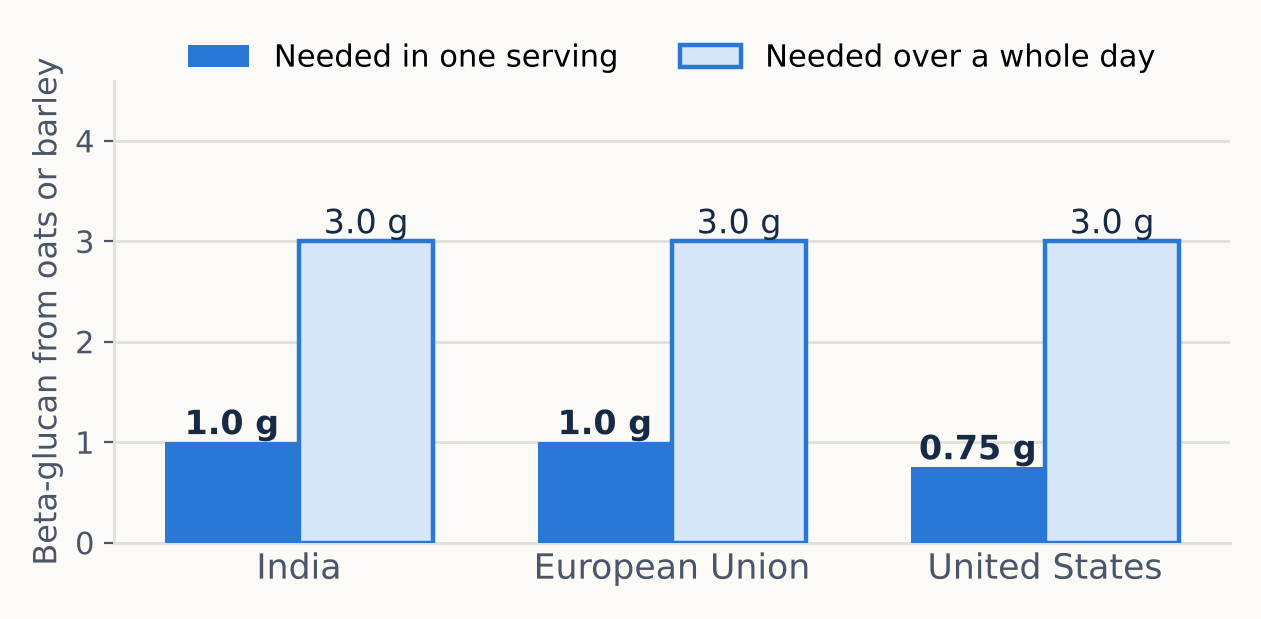
Europe has four separate authorised beta-glucan claims: two general-function claims, one for cholesterol and one for blunting the rise in blood sugar after a meal, and two disease-risk-reduction claims, one for oat and one for barley, reading 'has been shown to lower blood cholesterol' followed by the statement that high cholesterol is a risk factor for coronary heart disease. None of the four is restricted to conventional food, so a supplement meeting the conditions can carry them.
The American claim is older and narrower. It sets 0.75 grams of beta-glucan per standard serving and 3 grams a day, and the food must also be low in saturated fat and cholesterol. One caution worth stating: the American rule is written in conventional-food terms throughout, and we have not found a Food and Drug Administration statement either extending it to supplements or excluding them. Do not assume it travels.
How much they actually move cholesterol
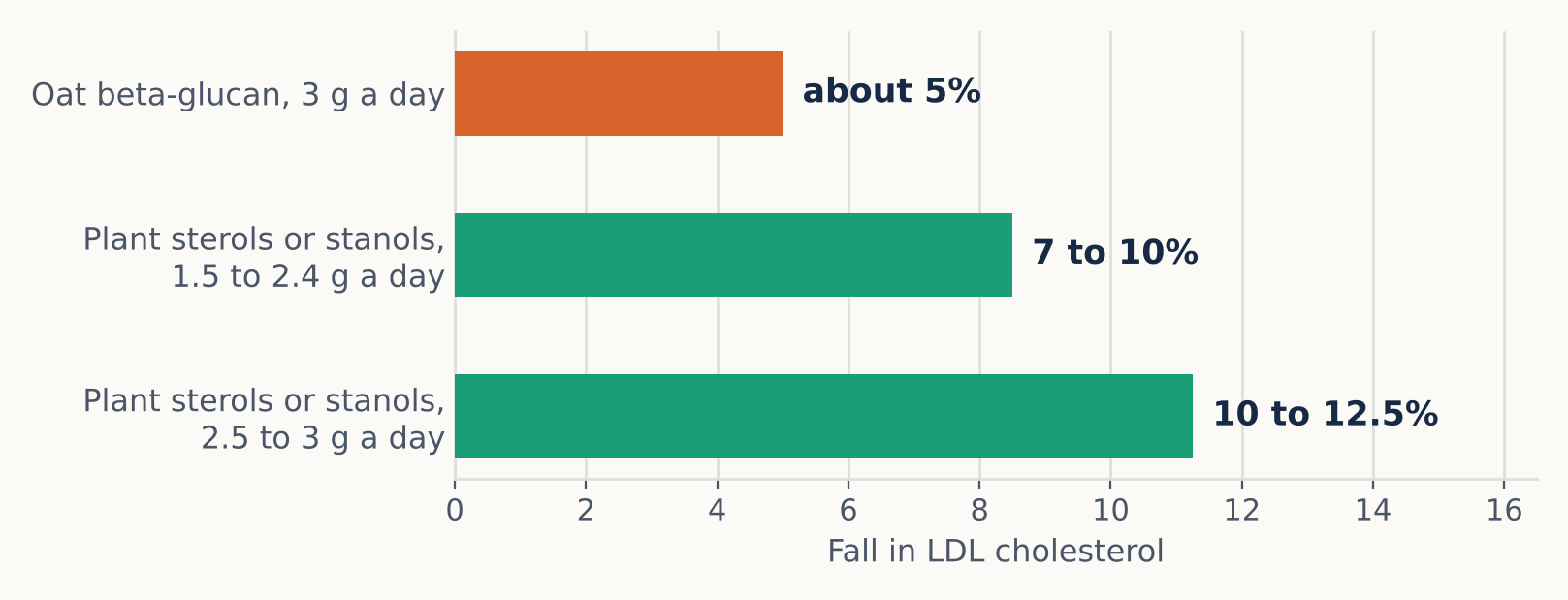
For oat beta-glucan, 28 randomised trials all dosed at 3 grams a day or more give a fall of 0.25 millimoles per litre, which works out at roughly 5 per cent, rising towards 7 in people whose cholesterol started higher. Two findings in that analysis are commercially useful: there was no dose-response between 3 and 12.4 grams a day, and no effect of duration between two and twelve weeks. Three grams is the dose. More does not buy more, and the effect arrives quickly.
Plant sterols and stanols are the stronger of the two. Pooling 84 trials gives an 8.8 per cent fall at an average 2.15 grams a day, and a larger analysis of 124 studies found the effect still rising towards 12 per cent at 3 grams. A 2026 umbrella review of fourteen separate systematic reviews rated the certainty of the LDL effect as high, which is the top grade that system awards and a rating almost nothing in this category holds. Europe permits those magnitudes to be stated on pack, with a time-to-effect of two to three weeks, though only for certain food categories.
The specification that decides whether it works at all
Here is the part that a certificate of analysis will not tell you, and it is the single most important fact in this article for anyone buying raw material. Beta-glucan works by forming a viscous gel in the gut. Viscosity depends on how long the molecules are. Shorten them and the gel thins.
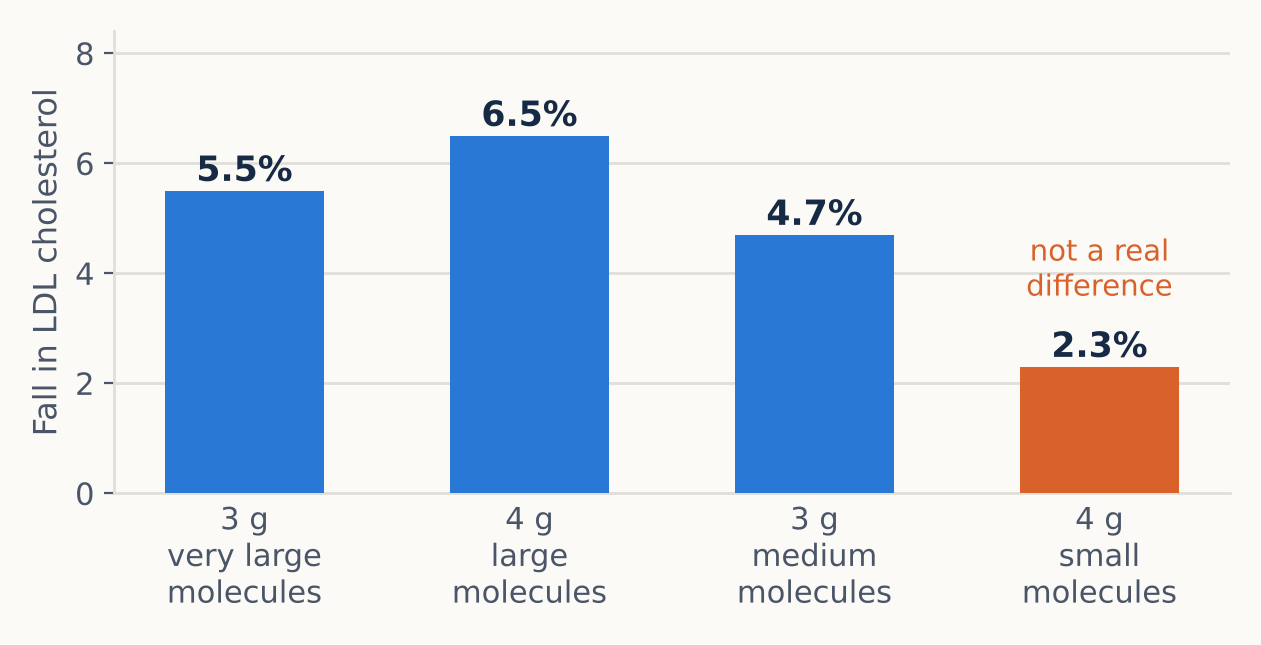
Four grams of short-molecule beta-glucan did less than three grams of long-molecule beta-glucan, and its result was not statistically distinguishable from no effect at all. Separate processing work shows why: reducing molecular weight from about 1.9 million to 250,000 cut the thickness of an extract measured under gut-like conditions more than twentyfold.
And there is a direct tension buried in that. Higher-purity concentrates are produced by processing that tends to break the molecules down. So a buyer who optimises purely for percentage beta-glucan can meet the dose on paper and lose the effect in the body. Specify molecular weight and solubility in the purchase specification, not just assay.
The format problem, stated honestly
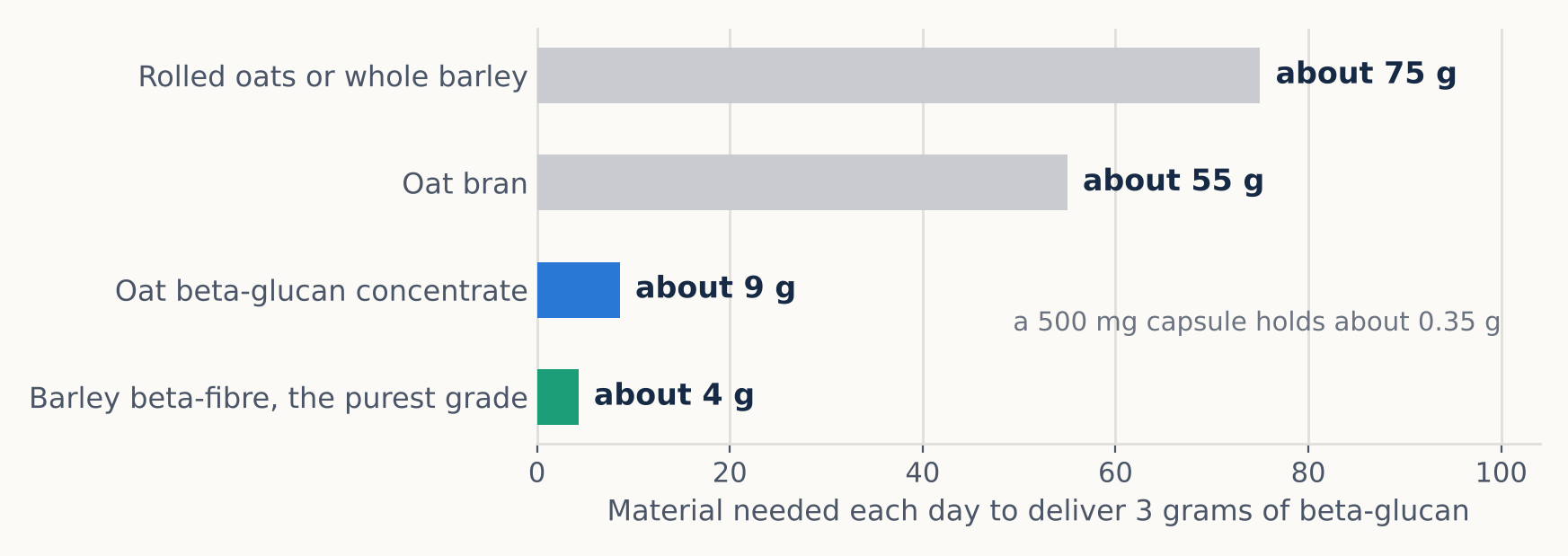
A standard 500 milligram capsule holds about a third of a gram of a fibre powder. Even using the purest regulatory grade, a 3 gram daily dose is eight to ten capsules; at ordinary concentrate purity it is thirty or more. Beta-glucan is not a capsule or tablet ingredient. The viable routes are a powder sachet, a stick pack, a ready-to-mix drink, or fortification of a food, and since both India and Europe permit the claim at 1 gram per portion, the realistic architecture is three portions a day rather than one heroic dose.
Plant sterols are easier: 1 gram per serving twice a day is achievable in a spread, a dairy product, a drink or a tablet, and the Indian rules contemplate exactly that pattern.
What an honest brand should also say
Three caveats, none of which stops the proposition, all of which belong on the record.
First, plant sterols reduce blood carotenoids. Pooling 41 trials and 3,306 people at an average 2.5 grams a day, beta-carotene fell about 16 per cent and lycopene about 12, though all values stayed inside normal ranges and fat-soluble vitamins were essentially unaffected once the figures were corrected for the fall in the cholesterol that carries them through the blood. This is why European labelling law requires the pack to advise regular consumption of fruit and vegetables. India's rules do not require that advice; including it anyway is good practice.
Second, neither ingredient has ever been shown to reduce cardiovascular events. The European Atherosclerosis Society says so in terms: there are no randomised controlled trial data with hard endpoints establishing clinical benefit. Both claims are built on cholesterol as a stand-in for the outcome that matters. That is legitimate regulatory practice (it is how most preventive medicine works), but it is not the same as proven prevention, and a brand that says so will be right when someone eventually asks.
Third, there is a live scientific argument about plant sterols that has moved in the last few years, and it is better to know it than to be surprised by it. Observational studies found no association between blood plant sterol levels and heart disease. But two genetic analyses, in 2022 and 2023, found that people genetically disposed to higher blood sitosterol had higher coronary risk. The counter-argument is technically strong (the genes used also change cholesterol absorption, so the method may be measuring the wrong thing) and regulators in Europe and the United States continue to permit and recommend these ingredients. But the debate is open, not closed, and anyone selling the ingredient should be able to describe it.
There is also a clear contraindication. People with sitosterolaemia, a rare inherited condition in which plant sterols accumulate massively, must not use sterol-enriched products. European labelling additionally requires statements that the food is not intended for people who do not need to control their cholesterol, that those on cholesterol-lowering medication should use it only under medical supervision, and that it may not be appropriate for pregnant or breastfeeding women or children under five.
Why this matters more in India than almost anywhere
The most recent national study of Indian lipid levels, covering 121,078 adults across every state and union territory, put the overall prevalence of dyslipidaemia at 87.3 per cent, and found it in 40 per cent of people who had no diabetes, no high blood pressure and no obesity. An earlier phase of the same study found 11.8 per cent with raised LDL cholesterol specifically and 79 per cent with at least one lipid abnormality.
Set against a population of that size, two ingredients with pre-written permitted claims, a well-characterised dose, an effect in the region of 5 to 12 per cent and decades of safety data are not a marginal opportunity. They are the most defensible cholesterol proposition available to a food business in this country, provided the specification is written properly and the format can actually carry the dose.
A second claim on the same ingredient
Beta-glucan carries a separate authorised claim that is often forgotten: entry eight of the same Indian schedule: taken as part of a meal, it reduces the rise in blood sugar after that meal. India permits it at 4 grams of beta-glucan for every 30 grams of available carbohydrate in the portion; Europe's wording and conditions are the same. That is a different architecture from the cholesterol claim (it is about the ratio of fibre to carbohydrate in the food, not a daily total) and it suits a breakfast cereal, a flour blend or a biscuit far better than it suits a supplement.
Worth noticing what that means commercially. One raw material, bought to one specification, serves two authorised claims in two different formats. Very few ingredients offer that.
What to build, and what to put in the purchase specification
- Specify molecular weight and solubility for beta-glucan, not only percentage assay. A high-purity, low-molecular-weight concentrate can meet the dose and lose the effect.
- Design for 1 gram per portion and three portions a day. Both India and Europe write the claim that way, and it is the only architecture a consumer will actually follow.
- Do not attempt beta-glucan in capsules. The dose does not fit. Sachets, stick packs, drinks and fortified foods are the formats.
- For plant sterols, 1 gram per serving twice a day with meals is both the evidenced pattern and the Indian permitted one.
- Carry the carotenoid advice and the medical-supervision statement even though Indian law does not require them. They cost nothing and they are true.
Neither ingredient is exciting. Both have a permitted claim already written by a regulator, a dose that is known, an effect size that is honest, and decades of safety data. Dull, documented and defensible is a stronger commercial position than it sounds.
Sources
- Food Safety and Standards (Advertising and Claims) Regulations, 2018, Schedule III, entries 6, 7 and 8.
- Commission Regulation (EU) No 1160/2011 of 14 November 2011 (oat beta-glucan disease-risk claim).
- Commission Regulation (EU) No 1048/2012 of 8 November 2012 (barley beta-glucan disease-risk claim).
- Commission Regulation (EU) No 432/2012 of 16 May 2012 (general-function claims for beta-glucans and for plant sterols and stanols).
- Commission Regulation (EC) No 983/2009 of 21 October 2009 and Commission Regulation (EU) No 384/2010 of 5 May 2010 (plant sterol and stanol disease-risk claims), as amended by Commission Regulation (EU) No 686/2014 of 20 June 2014 (conditions of use and permitted magnitudes).
- Regulation (EU) No 1169/2011 on the provision of food information to consumers, Annex III, point 5 (mandatory statements for added plant sterols and stanols).
- United States Code of Federal Regulations, title 21, section 101.81: health claims, soluble fiber from certain foods and risk of coronary heart disease.
- Whitehead A, Beck EJ, Tosh S, Wolever TMS. Cholesterol-lowering effects of oat beta-glucan: a meta-analysis of randomized controlled trials. American Journal of Clinical Nutrition 2014;100(6):1413–21.
- Ho HVT, Sievenpiper JL, Zurbau A, et al. The effect of oat beta-glucan on LDL-cholesterol, non-HDL-cholesterol and apoB for cardiovascular disease risk reduction. British Journal of Nutrition 2016;116(8):1369–82.
- Ho HVT, Sievenpiper JL, Zurbau A, et al. A systematic review and meta-analysis of randomized controlled trials of the effect of barley beta-glucan on LDL-cholesterol. European Journal of Clinical Nutrition 2016;70(11):1239–45.
- Wolever TMS, Tosh SM, Gibbs AL, et al. Physicochemical properties of oat beta-glucan influence its ability to reduce serum LDL cholesterol in humans: a randomized clinical trial. American Journal of Clinical Nutrition 2010;92(4):723–32.
- Tosh SM, Brummer Y, Miller SS, et al. Processing affects the physicochemical properties of beta-glucan in oat bran cereal. Journal of Agricultural and Food Chemistry 2010;58(13):7723–30.
- Demonty I, Ras RT, van der Knaap HCM, et al. Continuous dose-response relationship of the LDL-cholesterol-lowering effect of phytosterol intake. Journal of Nutrition 2009;139(2):271–84.
- Ras RT, Geleijnse JM, Trautwein EA. LDL-cholesterol-lowering effect of plant sterols and stanols across different dose ranges: a meta-analysis of randomised controlled studies. British Journal of Nutrition 2014;112(2):214–19.
- Zurbau A, Haintz L, Chen V, et al. Efficacy of phytosterols for reduction of cardiometabolic risk factors: an umbrella review and updated dose-response meta-analyses of randomized trials. Clinical Nutrition 2026;63:106698.
- Baumgartner S, Ras RT, Trautwein EA, Mensink RP, Plat J. Plasma fat-soluble vitamin and carotenoid concentrations after plant sterol and plant stanol consumption: a meta-analysis of randomized controlled trials. European Journal of Nutrition 2017;56(3):909–23. (Two of the five authors were employed by an ingredient manufacturer.)
- Gylling H, Plat J, Turley S, et al., European Atherosclerosis Society Consensus Panel. Plant sterols and plant stanols in the management of dyslipidaemia and prevention of cardiovascular disease. Atherosclerosis 2014;232(2):346–60.
- Genser B, Silbernagel G, De Backer G, et al. Plant sterols and cardiovascular disease: a systematic review and meta-analysis. European Heart Journal 2012;33(4):444–51.
- Scholz M, Horn K, Pott J, et al. Genome-wide meta-analysis of phytosterols reveals five novel loci and a detrimental effect on coronary atherosclerosis. Nature Communications 2022;13(1):143.
- Zhao Y-M and colleagues. Blood phytosterols in relation to cardiovascular diseases and mediating effects of blood lipids and haematological traits: a Mendelian randomization analysis. Metabolism 2023.
- Windler E and colleagues. Phytosterols and cardiovascular risk evaluated against the background of phytosterolemia cases: a German expert panel statement. Nutrients 2023.
- Fumeron F, Bard J-M, Lecerf J-M. Interindividual variability in the cholesterol-lowering effect of supplementation with plant sterols or stanols. Nutrition Reviews 2017;75(2):134–45.
- Deepa M, Pradeepa R, Anjana RM, et al. Prevalence of dyslipidemia in India: the ICMR-INDIAB national study. Journal of Clinical Lipidology 2026.
- Joshi SR, Anjana RM, Deepa M, et al. Prevalence of dyslipidemia in urban and rural India: the ICMR-INDIAB study. PLoS One 2014;9(5):e96808.
Disclaimer
This article is written for formulators, manufacturers and informed readers. It is a summary of published research and is not medical advice, a diagnosis or a treatment recommendation. Raised cholesterol requires medical assessment; no one should start, stop or change a prescribed cholesterol treatment on the basis of this article, and anyone taking cholesterol-lowering medication should use sterol-enriched products only under medical supervision. Plant sterol products are contraindicated in sitosterolaemia. Nothing here is a claim for any product. Product composition, claims and labelling must comply with the Food Safety and Standards Authority of India regulations applicable at the time of manufacture, and every claim and schedule entry referred to here should be verified against the current gazetted text before it is relied on.