
Probiotics · Regulatory & Labelling
Your Label Names a Bacterium That No Longer Exists
Two of the three main spore probiotics have been renamed since 2020, one of them twice. The clinical evidence is filed under the old names, almost nothing under the new ones, and dossiers are quietly drifting out of date.
A quiet change with loud consequences
In 2020 a genomic reassessment split the genus Bacillus into seventeen clades and proposed new genera for most of them [2]. Two organisms at the centre of the probiotic business moved.
Bacillus coagulans became Weizmannia coagulans in 2020, and then Heyndrickxia coagulans in 2023. Bacillus clausii was proposed as Alkalihalobacillus clausii in 2020 and settled as Shouchella clausii in 2022. Both current names are the ones carried today by the List of Prokaryotic names with Standing in Nomenclature, the reference that regulators and journals use to decide what a name means [3, 4]. Bacillus subtilis did not move.
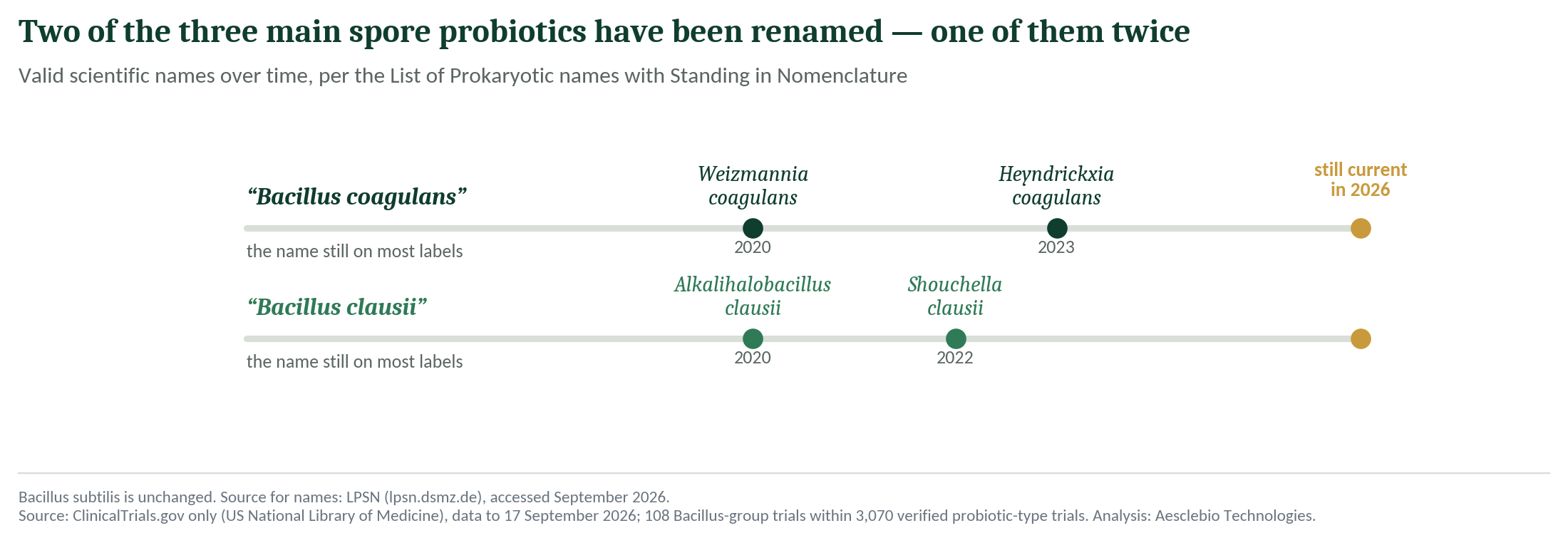
This is not pedantry. A species name is the key to a safety assessment, a positive list, a customs code, a literature search and a claim dossier. When the key changes and the lock does not, things stop opening.
The evidence is filed under a name that is no longer valid
Here is the part that should worry anyone who builds dossiers.
Of the 53 trials of this organism in the registry-verified probiotic set, 34 call it "Bacillus coagulans", 11 call it "Weizmannia coagulans", and exactly one uses the current correct name, "Heyndrickxia coagulans" [1]. Every use of Weizmannia is from 2024 or later: the industry adopted the 2020 name just as it was being superseded.
For B. clausii the split is starker still: 23 trials say "Bacillus clausii", one says "Shouchella", none say "Alkalihalobacillus" [1].
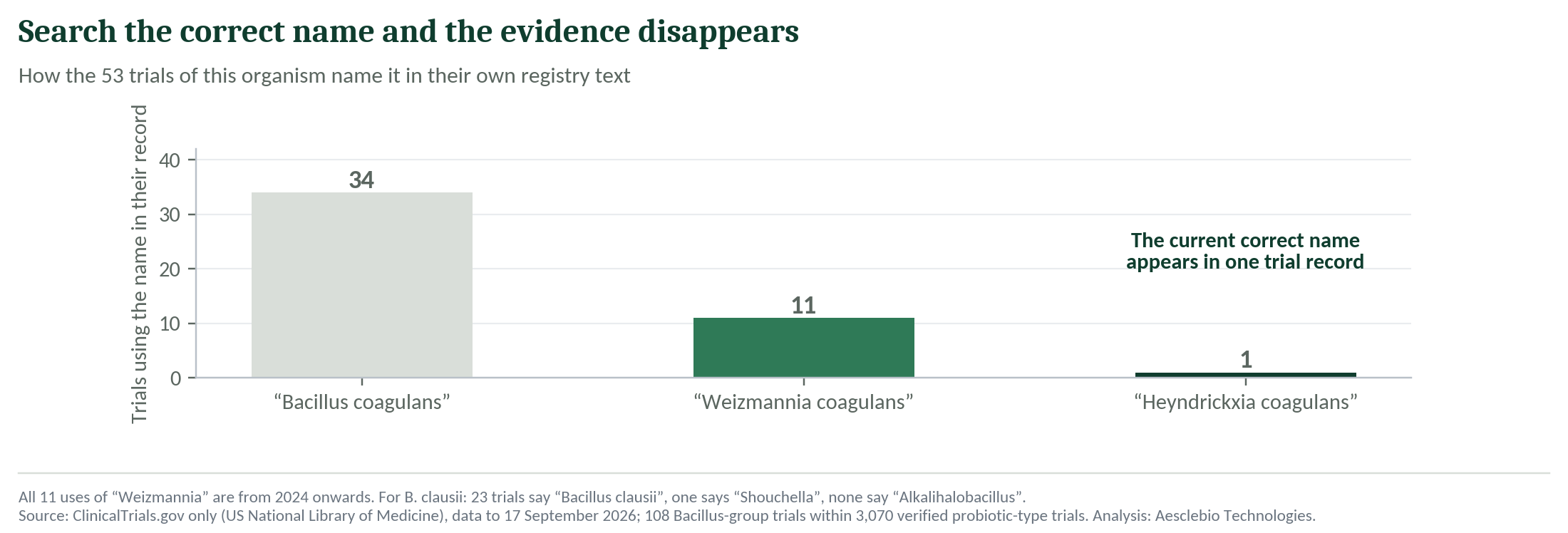
Search the registry on the current scientific name and you find one trial. Search the name on your own label and you find thirty-four. Neither search finds everything. A monitoring alert, a competitor scan or a review built on a single name is missing most of the field, and the same arithmetic applies to the published literature that follows these trials.
The correct name returns one trial. The obsolete name returns thirty-four. Most search strategies in this industry are built on one or the other.
Where this shows up as a real problem
Safety and permitted-list status. EU Qualified Presumption of Safety entries, national positive lists and novel-food determinations are all species-level instruments [5]. Lists updated at different times will carry different names for the same organism, and an entry under the old name does not automatically read across to a filing under the new one, or the reverse. Both names have to be on the table when you argue status.
Dossiers and specifications. A specification that says Bacillus coagulans, a certificate of analysis that says Weizmannia coagulans and a trial report that says Heyndrickxia coagulans can all describe the same strain. To an auditor, three names look like three organisms until someone proves otherwise.
Quality control. Independent checks on commercial Bacillus products have repeatedly found label–content mismatches at species level [6]. Nomenclature drift makes that harder to police, and easier to explain away.
Marketing risk. The temptation to present a rename as a discovery ("now with Heyndrickxia") is real, and it is exactly the kind of claim that invites a regulator's attention while adding nothing. It is the same organism your competitor sells as Bacillus.
What stays stable when names move
One identifier does not drift: the strain deposit. BC99, GBI-30 6086, DE111, MTCC 5856: these survive every reclassification, because a deposit number points at a physical culture in a collection, not at a taxonomic opinion.
That is the practical answer to nomenclature churn, and it is another reason the strain-disclosure habit matters: in the same dataset, only 53% of spore-former trials name a strain at all [1]. A trial that names neither the current species nor a strain code is, for filing purposes, almost untraceable.
Five moves to make this week
- Write both names, once, everywhere. "Heyndrickxia coagulans (formerly Bacillus coagulans)" on specifications, dossiers, certificates and technical literature. One line, permanently solved.
- Rebuild your searches and alerts. Every monitoring query (registry, literature, competitor, adverse events) should carry all three names for coagulans and all three for clausii.
- Check which name each market's list uses. Confirm the exact wording on the permitted or positive list you rely on before you file, and mirror it rather than "correcting" it.
- Anchor everything to the deposit number. Strain code first, species name second. Ask suppliers for the deposit certificate and the sequencing report, and keep them with the specification.
- Brief marketing before someone announces a "new" organism. A rename is not a new ingredient, a new benefit or a point of difference.
The ask worth making
Trade associations and ingredient suppliers could resolve most of this with one page: an agreed cross-reference table of current and superseded names for the organisms this industry actually sells, dated and updated when nomenclature moves, and shared freely with regulators. It costs a morning of work. It would spare an industry that sells microbiology the embarrassment of not knowing what to call its own products.
Until then, assume that any spore probiotic document more than two years old uses a name that is now wrong, and that some regulator, buyer or reviewer is about to notice.
Working on this? If you are updating specifications or dossiers for coagulans or clausii products, we are glad to compare notes on how other companies are handling the dual naming.
A question for our readers: does your product specification carry the current species name, the old one, or both?
Notes and sources
- The Bacillus Surge: clinical-trial trends for spore-forming probiotics. Aesclebio Technologies, 25 September 2026. Analysis of 3,070 verified interventional probiotic-type trials registered on ClinicalTrials.gov, data to 17 September 2026; naming counts from the title, intervention and summary text of the 53 H. coagulans and 29 S. clausii trials.
- Gupta RS, Patel S, Saini N, Chen S. Robust demarcation of 17 distinct Bacillus species clades, proposed as novel Bacillaceae genera, by phylogenomics and comparative genomic analyses. International Journal of Systematic and Evolutionary Microbiology 2020;70(11):5753–98.
- List of Prokaryotic names with Standing in Nomenclature (LPSN). Species page: Heyndrickxia coagulans, correct name (Hammer 1915) Narsing Rao et al. 2023; Weizmannia coagulans (Gupta et al. 2020) listed as a synonym. lpsn.dsmz.de, accessed 26 September 2026.
- List of Prokaryotic names with Standing in Nomenclature (LPSN). Species page: Shouchella clausii, correct name (Nielsen et al. 1995) Joshi et al. 2022. lpsn.dsmz.de, accessed 26 September 2026.
- European Food Safety Authority, Panel on Biological Hazards. Qualified Presumption of Safety: the list of QPS-recommended biological agents is reviewed and updated periodically. efsa.europa.eu, accessed 26 September 2026.
- Kolaček S, Hojsak I, Berni Canani R, et al. Commercial probiotic products: a call for improved quality control. ESPGHAN Working Group position paper. Journal of Pediatric Gastroenterology and Nutrition 2017;65(1):117–24.